When you live in Houston Heights, planning ahead can feel oddly personal. You may be thinking about an aging parent in the neighborhood, a spouse who handles the bills, or a house closing that can't wait if a medical crisis interrupts your routine. A power of attorney often becomes important at exactly the moment your family has the least time and energy to sort it out.
That's why I encourage people to treat this as a practical protection plan, not a last-minute legal form. Clients seeking a Houston Heights power of attorney lawyer likely desire more than just a definition. They want to know what to sign, how to sign it, where Harris County rules matter, and how to make sure the document works when your family needs it.
What Is a Power of Attorney and Why Do You Need One
You are recovering at home in Houston Heights after an unexpected hospital stay. The mortgage is due, your bank will not discuss your account with your daughter, and a title company needs a signature before a real estate deadline passes. Your family is ready to help, but readiness is not legal authority.
A power of attorney, or POA, is the written permission that gives someone you trust the ability to act for you in certain situations. You are the principal. The person you appoint is your agent. In a good estate plan, that document works like a spare key with clear limits. You decide who holds it, what doors it opens, and when they can use it.

What a POA does
A POA gives structure to a hard moment. Instead of leaving your spouse, adult child, or other trusted person to guess what they can do, it gives them recognized authority to handle the tasks you listed in the document.
Depending on the type and wording, an agent may be able to:
- Handle banking and bill payment during a hospitalization or recovery period.
- Sign papers for a limited transaction if you are out of town, physically unable to appear, or tied up with medical care.
- Work with banks, title companies, insurers, and other institutions that require written authority before speaking with anyone else.
- Address property matters involving your home, rental property, or another asset when timing matters.
That matters in Houston Heights for practical reasons, not just legal ones. Families here are often juggling older homes, busy work schedules, caregiving, and real estate deadlines. A POA helps keep those everyday obligations from turning into larger problems while you are unavailable.
Why people need one before a crisis
Many Houston Heights residents assume a husband, wife, or adult child can step in if something goes wrong. In many cases, that is not how institutions operate. If an account is in your name alone, or a document requires your personal authority, your family may hit a wall without signed paperwork.
The alternative is often slower, more expensive, and more stressful. If no valid authority is in place and you become incapacitated, your family may need to ask a court for the power to manage your affairs.
Texas also has formal rules for these documents. For example, a durable financial power of attorney must be signed before a notary and contain the language Texas law requires if you want it to remain effective during incapacity under Texas Estates Code §751.002. For a Houston Heights resident, that means the plan is not just choosing the right person. It is also making sure the document is signed correctly so a bank in the Heights, a title office in Houston, or another third party will accept it when your family presents it.
At The Law Office of Bryan Fagan, we often explain it this way. A power of attorney is less about losing control and more about keeping control through planning. You make the choices now, while you can, so your family has a clear path later.
The Different Types of Texas Powers of Attorney
Not every power of attorney does the same job, leading to common confusion among people in Houston Heights. They hear "POA" and assume one document covers everything. In Texas, different documents handle different categories of decisions.
Financial and medical powers are not the same
A financial power of attorney allows an agent to handle property and money matters. Depending on the language you approve, that may include banking, taxes, contracts, or real estate.
A medical power of attorney is different. That document names someone to make healthcare decisions if you're unable to make or communicate them yourself.
Here is the easiest way to grasp this:
| Situation | Likely document |
|---|---|
| Your mortgage payment is due while you're incapacitated | Financial POA |
| A doctor needs consent for treatment and you can't communicate | Medical POA |
| You want someone to sign a narrow set of closing papers | Limited POA |
| You want authority to continue during incapacity | Durable POA |
What makes a POA durable
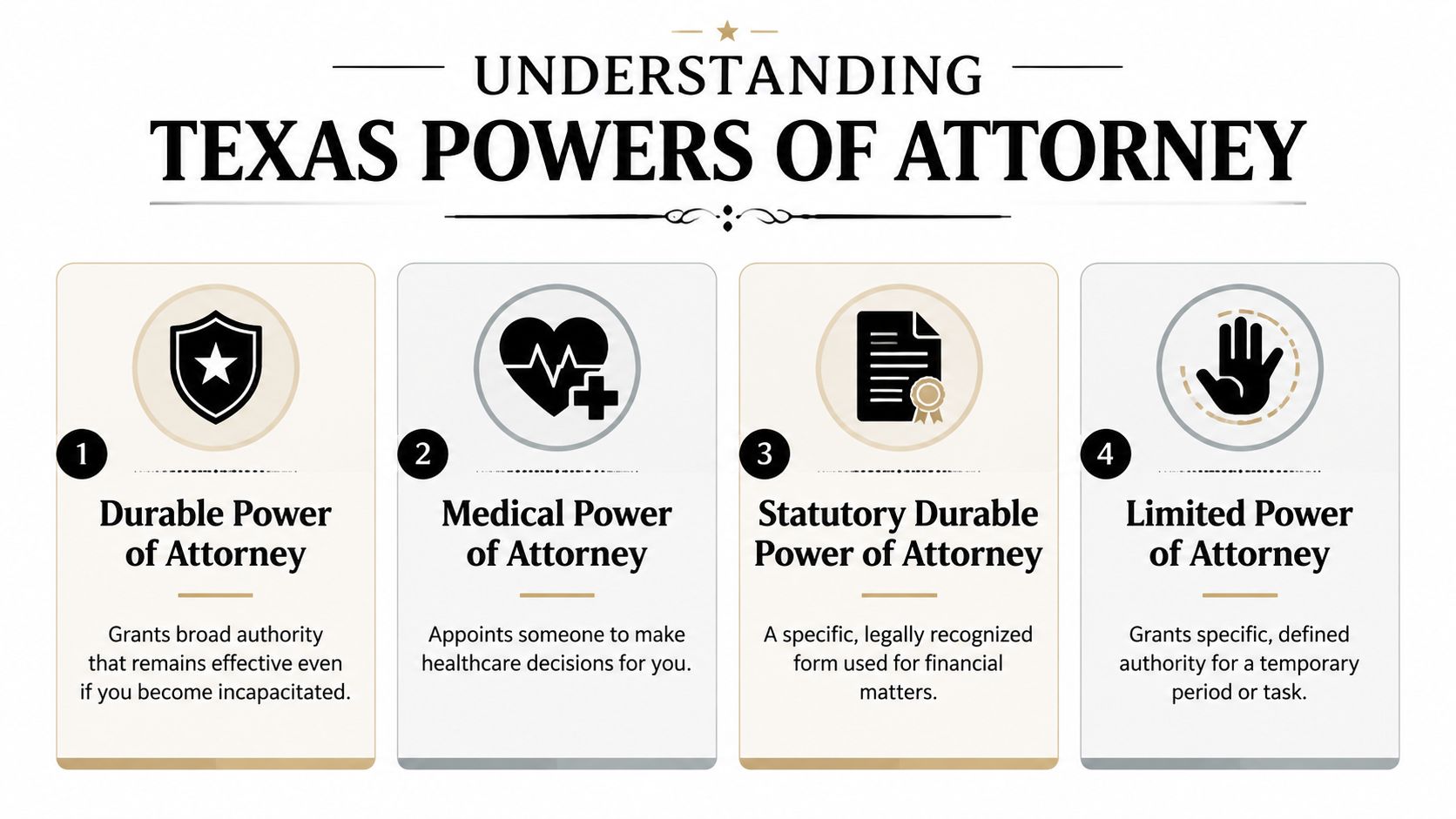
A durable power of attorney remains effective if the principal becomes incapacitated. That durability matters because incapacity is often the very reason families need the document.
Texas doesn't assume durability automatically. Under Texas Estates Code §751.002(1), the document must expressly say that the authority survives incapacity. The required concept is explained in the Texas State Law Library guide on durable powers of attorney, which includes language such as: “This power of attorney shall not be affected by the subsequent disability or incapacity of the principal.”
If that durability language is missing, the document may fail at the exact moment your family expected it to help.
Four types Houston Heights residents often consider
Durable Power of Attorney
This is the workhorse document for long-term financial planning. It's often used by homeowners, retirees, caregivers, and families managing multiple accounts.Medical Power of Attorney
This names the person who can speak with doctors and make treatment decisions when you can't.Statutory Durable Power of Attorney
Texas law recognizes a statutory form for financial matters. Many people use it as a starting point, then tailor it to fit their actual needs.Limited Power of Attorney
This works well when you want someone to handle one specific task, such as signing a document while you're traveling.
Some families also connect POA planning with broader end-of-life and post-death planning, including Probate, which involves probate administration and estate settlement in Texas. The documents serve different purposes, but they often belong in the same conversation.
Texas Legal Requirements for a Valid POA
A power of attorney only helps if Texas law treats it as valid. That's why execution details matter so much. Small mistakes can make a document difficult or impossible to use.
The rules that matter most
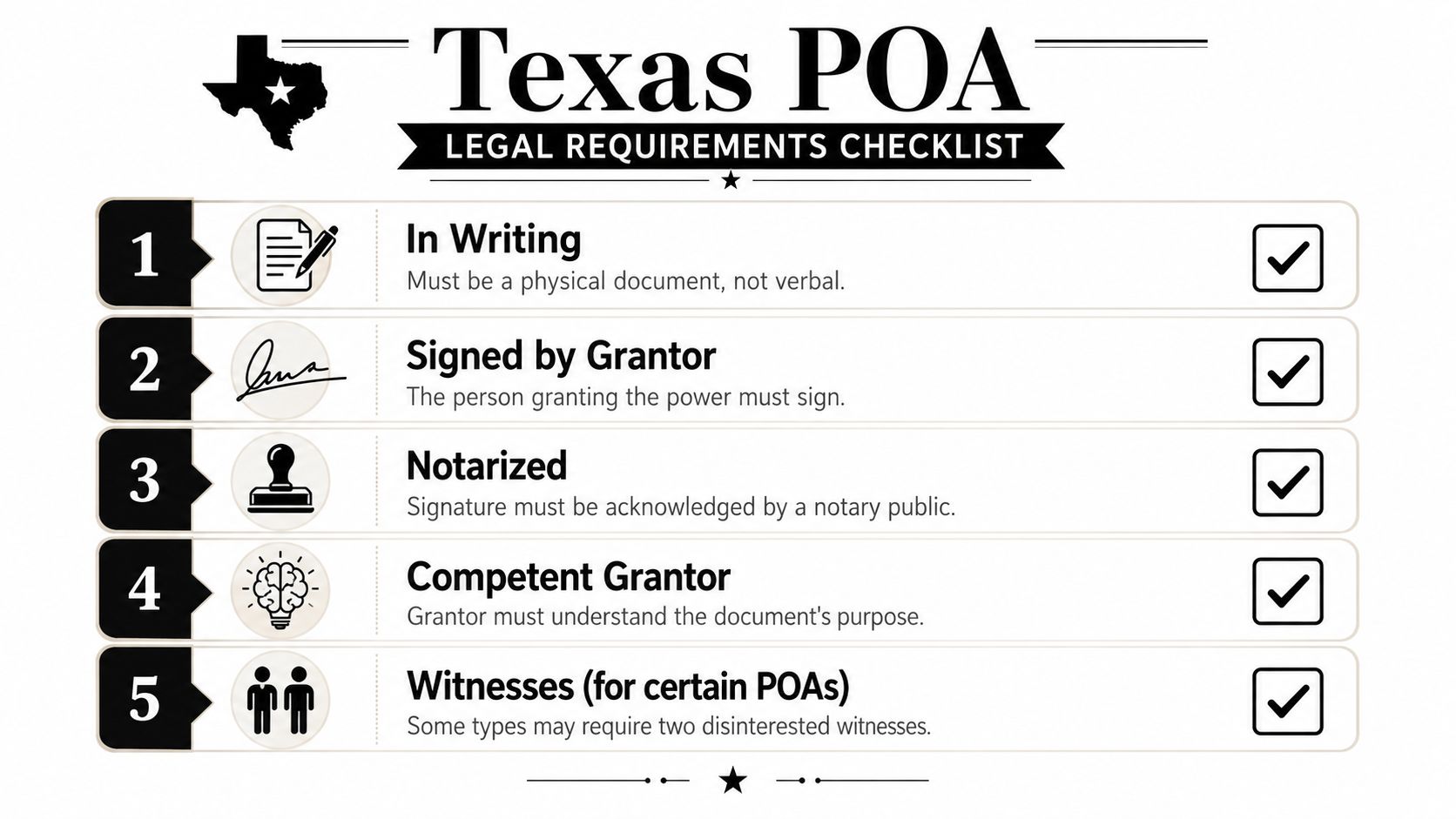
For a Texas financial power of attorney, the principal must sign the document in the physical presence of a notary public. A medical power of attorney works differently. It may be signed before two competent adult witnesses instead of a notary. FreeWill's Texas power of attorney guide explains this distinction clearly, and the two methods are not interchangeable.
That means a family can't safely assume that witness rules for a medical POA also make a financial POA valid. They don't.
A simple checklist before signing
- Capacity matters. You need to understand what you're signing, who your agent is, and what powers you're granting.
- Use the right form for the right purpose. Financial authority and medical authority belong in different documents.
- Follow the signing formalities exactly. If notarization is required, it isn't optional.
- Review the scope of powers carefully. Broad authority may be appropriate, but only if it matches your goals.
- Keep the language current and clear. Vague or incomplete authority can create problems later.
This short video gives a helpful overview before you sign anything.
Where readers often get tripped up
Some people download a form, sign it at the kitchen table, and assume the job is done. Others think any relative can witness any document. Those shortcuts can create serious problems later when a bank, title company, or hospital reviews the paperwork.
A valid POA isn't just about your intent. It's about whether the document was executed in the way Texas law requires.
If you're unsure whether your current documents were signed correctly, that uncertainty is worth addressing now. It's much easier to fix a POA while you're healthy and fully available than during a crisis.
Common Scenarios for Needing a POA in Houston
A Houston Heights resident falls on the porch, ends up in the hospital, and suddenly no one can speak with the mortgage company, access the right bank account, or sign the closing documents that were supposed to close that week. Families often assume a spouse or adult child can automatically step in. In Texas, that assumption can break down fast.
I see that problem in ordinary, local situations, not only in major emergencies. A power of attorney helps create a practical plan for the moments when life interrupts your ability to handle your own affairs.
Everyday situations where a POA helps
One common example is aging at home. A retired homeowner in the Heights may still manage daily life well, but want an adult child to help if memory slips, medications increase, or bills start getting missed. A durable financial POA works like a backup set of keys for legal and financial tasks. It can let the chosen agent handle banking, insurance, utilities, and other routine matters without asking a court for permission.
Travel is another frequent reason. A younger professional who travels for work may own property in Harris County, be refinancing a home, or need someone available to sign time-sensitive documents while they are out of town. In that setting, a limited or broader financial POA can keep a transaction from stalling over logistics.
Families with children often need planning too. If one parent is injured, recovering from surgery, or temporarily unable to manage paperwork, the other parent may need quick authority to deal with accounts, benefits, or property issues. The goal is simple. Reduce delay at the exact moment your household has the least capacity for extra stress.
Long-term care planning also belongs in this conversation. Once a family starts comparing care options, paying bills, and gathering records, legal authority becomes a day-to-day issue instead of an abstract one. If you are already assembling support around an older parent, elder law paralegal support may help you understand the administrative side of the process, while a lawyer makes sure the POA itself fits Texas law and your family's needs.
Why timing matters in Houston
A defective or missing POA usually causes problems at the worst possible time. You may not discover the issue until a bank questions the form, a title company refuses a signature, or a care facility needs someone with clear authority to act.
For Houston Heights residents, the local challenge is often logistical as much as legal. Harris County property, Houston-area medical providers, and large financial institutions each have their own review process. A document can look complete to a family and still draw objections when it is finally presented for use. That is why planning early matters. It gives you time to sign the right document, store it properly, and make sure the right people know where to find it.
The practical lesson is straightforward. A POA is not only for old age or end-of-life planning. It is for travel, illness, recovery, caregiving, and any season of life when someone you trust may need to step in and keep your Houston household running.
The Process for Creating and Revoking a Power of Attorney
Estate planning becomes less daunting once the process is broken into steps. A power of attorney doesn't have to be overwhelming if you move through it methodically.
How to create the document
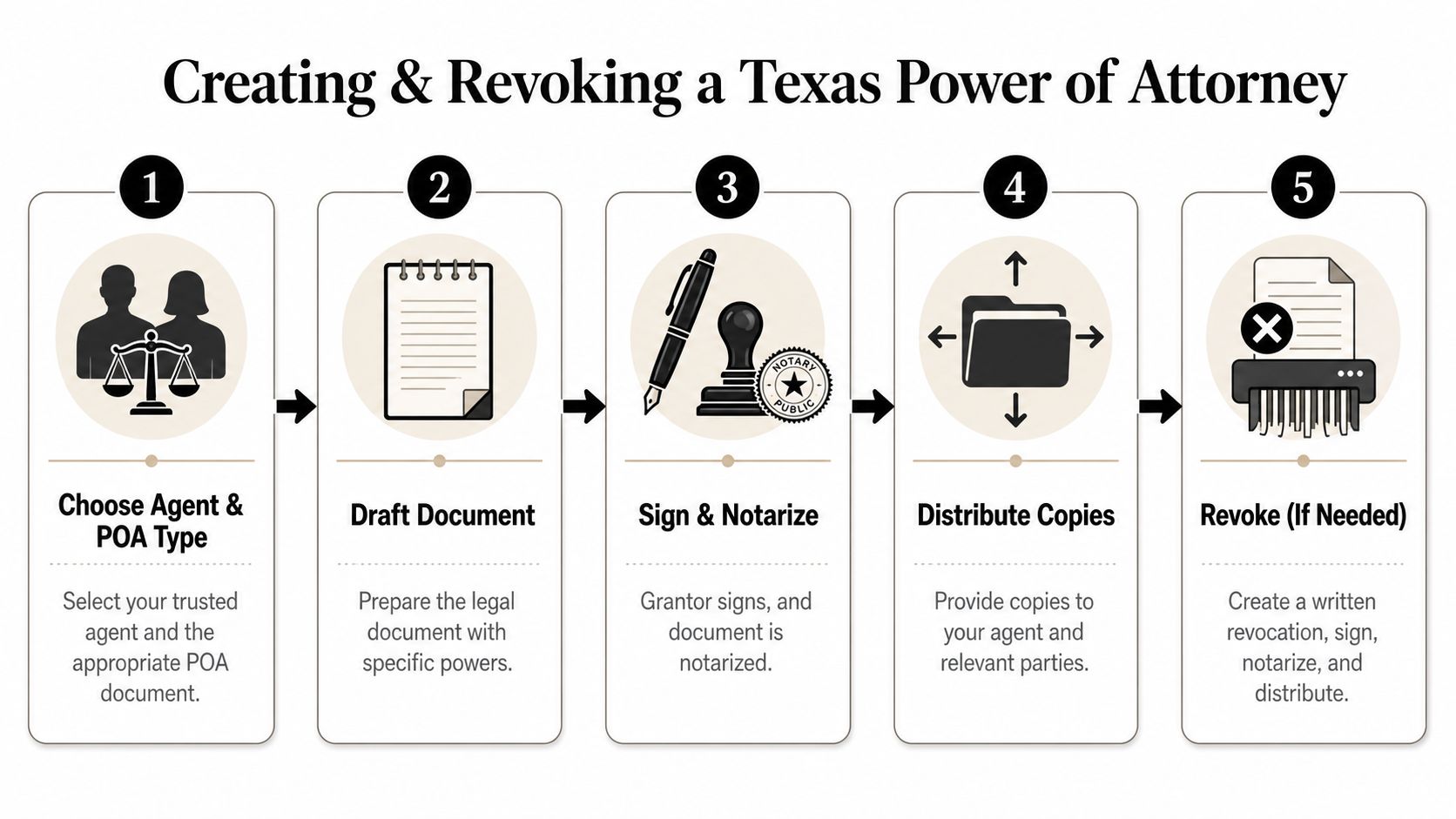
Choose your agent thoughtfully
Pick someone dependable, organized, and calm under pressure. Trust matters, but so does practical ability. The person who loves you most isn't always the person best suited to handle paperwork, deadlines, and financial details.Decide what powers to grant
Some people want broad authority. Others prefer to limit the agent's power to specific accounts, property, or time periods. Your document should reflect your real comfort level.Gather key information
Bring legal names, addresses, and a clear list of any property or account categories involved. If real estate is part of the plan, say so early.Draft the POA carefully
Custom language matters. A lawyer can match the document to your needs and help avoid authority gaps that third parties may question later.Sign the document properly
Use the execution method Texas law requires for that particular kind of POA. This step is where many do-it-yourself documents go wrong.
What to do after signing
A signed POA doesn't help much if no one can find it. Once the document is complete:
- Give copies to your agent so they know where to locate it.
- Keep the original secure in a place that can still be accessed when needed.
- Tell the right people it exists. That may include a spouse, adult child, accountant, or financial institution.
- Review it after major life changes such as marriage, divorce, death, relocation, or a major shift in health.
If you're organizing documents for an older parent or a family member with complex care needs, administrative help can also matter. Some families look into elder law paralegal support to understand the workflow around records, forms, and case preparation before or alongside attorney review.
How revocation works
You are not locked into your choice forever. If your relationship with an agent changes, or if you want a different plan, you can revoke the POA while you still have legal capacity.
A careful revocation usually includes:
- A written revocation document that clearly identifies the prior POA.
- Proper signing and notarization so the revocation is easy to recognize and rely on.
- Notice to the former agent so they know their authority has ended.
- Notice to banks or other third parties that may have relied on the earlier POA.
Review your POA the same way you review beneficiary designations. If your life changes, your documents should change too.
How to Choose Your Houston Heights Power of Attorney Lawyer
A Houston Heights resident often reaches this point after a specific worry surfaces. A parent is slowing down. A closing is coming up on a rental property. A spouse is traveling for work and someone needs authority to sign if an emergency hits. In that moment, you are not really shopping for a form. You are choosing a lawyer who can build a document people will accept and use.
That difference matters in real life. A power of attorney works a lot like a set of instructions and a key handed to someone you trust. If the instructions are too vague, too broad, or missing a step Texas law requires, the person holding that key may still get turned away by a bank, title company, or hospital.
Questions worth asking in a consultation
Start with questions that test how the lawyer handles day-to-day use, not just document drafting.
- How would you tailor the POA to my household and property if I own a Houston Heights home, rental property, business interest, or several financial accounts?
- What signing steps apply to the documents I need under Texas law, including notarization and any witnesses for medical planning documents?
- How do you handle Harris County real estate issues if my agent may need to sign for a sale, refinance, or other property matter?
- What is the process for updates or revocation later if my family situation changes?
- How do you coordinate the POA with a will, medical directive, or other estate planning documents so the plan fits together?
Those answers show whether the lawyer is thinking one step ahead. That is what you want. A good POA lawyer should be able to explain the process in plain English and point out the spots where Houston Heights homeowners and families often get stuck.
Why local knowledge matters
Local knowledge is not about a ZIP code on a business card. It is about knowing how these documents get used around Houston.
For example, a Houston Heights homeowner may need a POA that works for a bank on North Shepherd, a title company handling a Harris County closing, and family members trying to coordinate care from different parts of town. Each institution may review the same document with a different checklist. A lawyer who prepares POAs for Harris County clients regularly can help you reduce those friction points before they become a problem.
That practical side is easy to miss. Many people assume a signed and notarized document is the finish line. It is closer to the start of the race. The better question is whether your lawyer is preparing a POA that stands up when it is handed across a desk and someone says, "Do we have authority to rely on this?"
One more point to keep in mind
Your choice of agent and your choice of lawyer can be affected by family dynamics. Divorce, remarriage, blended families, tension between siblings, or concern about an adult child's judgment can all change who should have authority and how broad that authority should be.
In those situations, the Law Office of Bryan Fagan, PLLC handles both Texas family law and estate planning matters, which can help if a POA decision overlaps with a larger legal transition. If divorce is part of your current situation, Divorce covers Texas divorce representation for contested, uncontested, and high-conflict cases.
A good consultation should leave you calmer, not more confused. You should walk away understanding who will act for you, what powers they will have, how the document will be signed, and what steps may apply here in Houston Heights if property or local logistics are involved.
Your POA Document Checklist and Local Logistics
Before meeting with a lawyer or notary, organize the information that usually slows people down. A little preparation makes the signing process much smoother.
What to gather before your appointment
Bring or prepare:
- Your chosen agent's full legal name and contact details
- At least one backup agent if your first choice can't serve
- A list of the powers you want granted such as banking, real estate, taxes, or limited transaction authority
- Property information for any Houston Heights home or other real estate
- A current list of institutions involved such as banks, lenders, or investment firms
- Questions about limits you want placed on the agent's authority
If medical documents are also part of your planning, think in advance about who can speak calmly with doctors and follow your wishes under pressure.
Harris County filing and neighborhood logistics
If your POA gives authority over real estate in Houston Heights, filing may be essential. Under Texas Property Code §11.001, a POA used for real estate transactions in Harris County must be filed with the county clerk to be recognized by third parties for matters like sales or mortgages, as explained by Texas Law Help's article on powers of attorney in Texas.
That filing issue surprises many homeowners. They assume notarization alone is enough. For real estate authority, it may not be.
Practical local tips
- Find the notary before the signing day so you don't rush the execution step.
- Ask whether the document involves real estate because that affects what happens after notarization.
- Keep a copy set ready for your agent and any institution likely to request it.
- Use the exact final version when signing. Last-minute edits can create confusion if pages don't match.
A well-prepared POA plan is part legal drafting and part logistics. Both matter.
If you need help navigating divorce, custody, or estate planning in Texas, contact Law Office of Bryan Fagan, PLLC today for a free consultation.