
Navigating a divorce or separation can be one of life’s most difficult transitions—especially when children are involved. The uncertainty of what comes next for your family can feel overwhelming, but understanding your rights and options under Texas law is a powerful first step toward finding a clear path forward. Here in Texas, what most people call "custody" is legally known as "conservatorship," and the state has a strong preference for keeping both parents deeply involved in their child's life.
This guide is designed to be a trusted resource, walking you through the process step-by-step. We will translate the legal jargon, explain the court's priorities, and provide practical guidance to help you make informed decisions that protect your child’s well-being and build a stable future. Our goal is to empower you with the knowledge and confidence to navigate joint custody in Texas.
We'll start with the fundamental legal terms and move all the way to creating a practical parenting plan that truly works for your unique family. By the end, you will have a solid understanding of how Texas courts approach parenting after a separation and feel more prepared for the road ahead.
What You Will Learn in This Guide
The Texas Family Code provides the legal framework for all custody matters, and its primary focus is always on the child's emotional and physical well-being. This means the court's central mission is to support a strong, healthy relationship between the child and both parents.
Here’s a look at what we'll cover:
- Legal Definitions: We’ll break down confusing terms like "conservatorship" and "possession order" into plain, understandable English.
- The 'Best Interest' Standard: You will learn the specific factors a judge must consider when making custody decisions, often referred to as the Holley Factors.
- Practical Parenting Plans: We’ll offer actionable advice for crafting a detailed parenting schedule that minimizes conflict and provides your child with essential stability.
By the time you finish this guide, you will have a much clearer picture of how joint custody in Texas really works, helping you feel more in control and less anxious about the future.
If you need help navigating divorce, custody, or estate planning in Texas, contact The Law Office of Bryan Fagan today for a free consultation.
What Joint Managing Conservatorship Really Means
When people discuss "joint custody," they are typically imagining a scenario where both parents remain actively involved in raising their child. In Texas, the legal term for this arrangement is Joint Managing Conservatorship (JMC). Understanding this concept is the first crucial step in understanding your rights and responsibilities.
A common misconception is that JMC automatically means a 50/50 split of the child's time. While a 50/50 schedule is possible, the core of JMC is not about the calendar—it's about sharing the authority to make critical decisions for your child.

Think of it as being co-captains of a team dedicated to raising your child. Under a JMC, you and the other parent are expected to collaborate on the significant, life-shaping decisions.
The Texas Family Code explicitly outlines a set of rights and responsibilities that parents share in a JMC. The purpose is to ensure that even though your relationship has changed, you are both empowered to parent effectively. These shared powers are the foundation of joint custody in Texas.
Key decision-making areas you will typically share include:
- Education: This extends beyond choosing a school. It involves agreeing on tutoring, special education services, and other educational matters.
- Medical Care: Parents must confer on non-emergency medical, dental, and psychological treatments for the child.
- Religious Upbringing: Both parents retain a voice in their child's moral and religious development.
As a practical example, if your child needs braces, one parent cannot make that decision unilaterally. Both parents would need to discuss the orthodontist, the treatment plan, and how the costs will be managed. It is a collaborative effort.
Texas Family Code § 153.002 establishes a legal presumption that naming parents as Joint Managing Conservators is in the child's best interest. A court will only deviate from this standard if there is evidence that this arrangement would harm the child’s physical or emotional well-being.
The Role of the Primary Conservator
Even in a shared decision-making framework, the court must designate one parent as the "primary" managing conservator. This designation is not about granting one parent more power but about creating a stable home base for the child. This role includes a few exclusive rights.
The primary conservator typically has the exclusive right to:
- Determine the child's residence, although this is usually restricted to a specific geographic area (like a county or school district).
- Receive child support payments on behalf of the child.
- Consent to medical treatment during an emergency if the other parent is unavailable.
The other parent is often referred to as the "possessory" conservator. They will have a defined visitation schedule (the possession order) and will typically be ordered to pay child support. It is essential to remember, however, that both of you remain Joint Managing Conservators with an equal say on the major decisions previously discussed.
The legal framework can become complex, especially when difficult circumstances are involved. You can learn more by reading our guide on what conservatorship is and how a CPS removal impacts it.
Understanding the “Best Interest of the Child” Standard
When a Texas judge makes any decision regarding custody, it is filtered through one guiding principle: the best interest of the child. This is not merely a suggestion; it is the supreme legal standard under Texas Family Code § 153.002 that governs every facet of a custody case.
While it sounds simple, this standard is a comprehensive framework designed to protect a child's emotional, mental, and physical well-being above all else. A judge’s personal opinions or what seems "fair" to the parents are not the focus. What matters is the evidence presented in court demonstrating which environment and arrangement will best allow the child to thrive. Your entire case must be built around proving how your involvement directly serves your child’s best interest.
The Holley Factors Explained
So, how does a court determine what is truly in a child's best interest? It isn't a guess. Texas courts rely on a specific set of criteria known as the "Holley Factors," which originated from the 1976 Texas Supreme Court case, Holley v. Adams.
These factors serve as a non-exhaustive checklist, helping the court gain a complete picture of the family’s circumstances. Let's break down what these key factors mean for you.
- The Child's Needs: This focuses on the child’s current emotional, physical, and developmental needs. For a toddler, this may mean a consistent routine and a deeply attuned primary caregiver. For a teenager, it could mean maintaining stability in their school and social life.
- Parental Abilities: The court will carefully assess each parent's capacity to provide a safe, nurturing, and stable home. This is not just about financial resources but also about who can provide emotional support, guidance, and appropriate discipline.
- Stability of the Home: A judge will look closely at the stability of each proposed residence. A parent with consistent employment, stable housing, and a strong support system is often viewed favorably.
- The Child’s Wishes: Once a child is 12 or older, a judge is required to interview them in chambers to hear their preference regarding where they want to live. However—and this is critical—the child's wish is just one factor among many. It is not binding on the court, which will always prioritize the child's overall best interest.
- Acts or Omissions by a Parent: The court will consider any past behavior that might indicate a parent is not a suitable caregiver. This could include actions like abuse or substance use, or a failure to act, such as neglect or exposing the child to dangerous situations.
One of the biggest misconceptions I see is that the "best interest" standard is about what's fair to the parents. The truth is, Texas law is laser-focused on the child. The court's primary goal is to create an arrangement that fosters the child's happiness, security, and well-being, even if that arrangement doesn't feel perfectly equal to Mom and Dad.
Here’s a quick look at how the court weighs these different elements.
The Holley Factors at a Glance
| Factor | What It Means for Parents |
|---|---|
| Child's Needs | Can you meet your child's specific emotional, physical, and educational needs? |
| Parental Abilities | Do you have the skills and stability to be an effective and nurturing parent? |
| Stability of Home | Is your proposed home environment consistent, safe, and supportive? |
| Child's Wishes | If your child is 12+, their preference will be heard, but it's not the deciding factor. |
| Parental Conduct | Have your past actions (or inactions) positively or negatively impacted your child? |
| Emotional/Physical Danger | Is there any immediate or future risk of harm to the child with either parent? |
| Future Plans for Child | What are your concrete plans for raising your child, both now and in the long term? |
| Parenting Skills | How well can you provide guidance, care, and discipline? |
| Explanations for Conduct | Are there valid reasons for any past behaviors that might raise concerns? |
Ultimately, a judge uses these factors to build a comprehensive view of what life will be like for the child in each potential custody scenario.
How the Court Gathers Information
A judge will not simply take a parent's word for it. To properly evaluate the Holley Factors, the court relies on information from many different sources. This is where your preparation and conduct become critically important.
Evidence can come from various sources, including:
- Testimony from you and the other parent under oath
- School records, such as report cards and attendance logs
- Medical and mental health records for the child and parents
- Statements from teachers, counselors, or family members
- Reports from a court-appointed custody evaluator or an amicus attorney assigned to represent the child
For example, if one parent accuses the other of neglect, the court will look for concrete proof, like school records showing frequent tardiness or testimony from a teacher about the child’s poor hygiene. By understanding these factors, you can proactively build a case that clearly demonstrates the positive and stable role you play in your child's life.
If you need help navigating divorce, custody, or estate planning in Texas, contact The Law Office of Bryan Fagan today for a free consultation.
Crafting Your Possession Order and Parenting Plan
Once a Joint Managing Conservatorship is established, the next step is to create the practical roadmap for your co-parenting life. This begins with a possession order, the legal term for the detailed schedule that specifies when your child will be with each parent. Think of it as the official playbook for your family, designed to eliminate confusion and reduce potential conflict by setting clear expectations.
Alongside the schedule, you will develop a parenting plan. This is a broader document that outlines the rules of the road for how you will co-parent. It addresses the specifics of decision-making, communication protocols, and day-to-day logistics, ensuring you are both aligned on important matters.
The Foundation: The Texas Standard Possession Order
Texas courts start with a default schedule known as the Standard Possession Order (SPO). The Texas Family Code presumes this schedule is in the child's best interest because it provides a consistent and predictable routine.
For parents living within 100 miles of each other, the SPO generally grants the non-primary parent possession of the child on the first, third, and fifth weekends of a month. It also divides major holidays and gives the non-primary parent an extended period of possession in the summer, typically 30 days.
To learn more about the specifics, you can read our detailed article on what a Standard Possession Order is and how it works. Understanding this baseline is crucial, as it serves as the starting point for nearly all custody negotiations.
When to Create a Custom Schedule
While the SPO is the standard, it is not a one-size-fits-all solution. The Texas Family Code acknowledges that every family is unique. You and the other parent can agree to almost any schedule you design together, as long as it serves your child's best interest. If you cannot agree, a judge can order a custom schedule if the SPO is proven to be unworkable for your family.
Here are a few common scenarios that often require a custom possession order:
- Children Under Three: Infants and toddlers have distinct developmental needs and often benefit from shorter, more frequent visits with each parent to maintain strong bonds.
- Non-Traditional Work Schedules: For parents who are first responders, nurses, or work nights, weekends, or rotating shifts, the standard weekend schedule is often impractical.
- Parents Living Far Apart: When parents reside more than 100 miles apart, the SPO itself modifies to account for travel. The non-primary parent typically has fewer but longer periods of possession, such as every spring break.
- A Child's Special Needs: A child with significant medical needs or a demanding extracurricular schedule may require a highly tailored schedule that prioritizes their stability and care.
This timeline illustrates the core considerations for a court when determining if a standard or custom plan is the right fit.
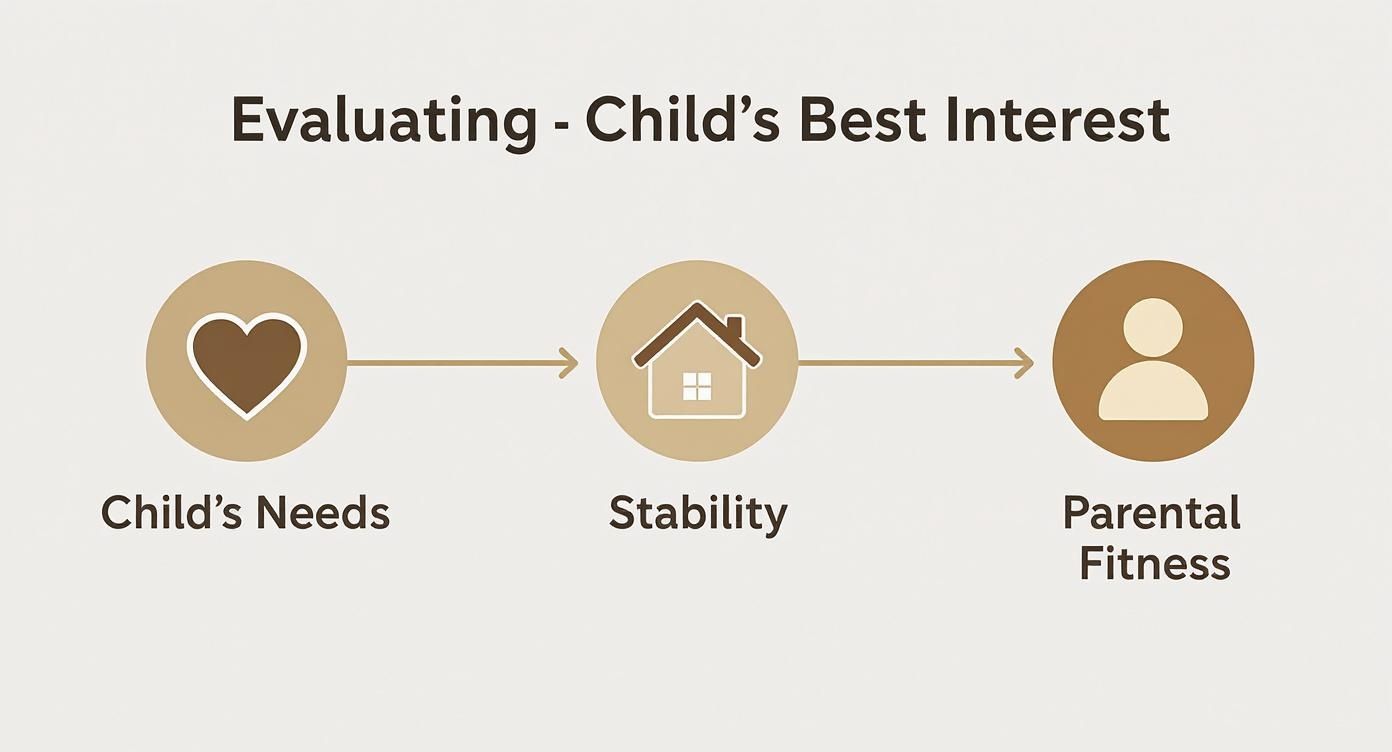
The key takeaway is that a child's specific needs are the driving force behind the custody decision, followed by the stability each parent can provide.
Building a Strong and Clear Parenting Plan
A detailed parenting plan is your single best tool for preventing future conflict. The more specific you are now, the less room there is for disagreement later. It should be a collaborative document that anticipates future challenges and establishes clear rules for handling them.
A well-crafted parenting plan acts like a constitution for your co-parenting relationship. It provides structure and rules that you can both rely on, especially during moments of stress or disagreement.
Your parenting plan should clearly map out several key areas:
- Communication Guidelines: How will you communicate about the children? Will you use text, email, or a dedicated co-parenting app? Setting these boundaries can significantly reduce conflict.
- Transportation Logistics: Who is responsible for pick-ups and drop-offs? Where will exchanges occur? A neutral location, like the child's school, can be a low-stress option.
- Travel Authorizations: The plan should define the rules for any out-of-state or international travel, including notice requirements and the sharing of itineraries.
- Right of First Refusal: This common clause requires that if one parent needs childcare for a specified period (e.g., more than four hours), they must offer that time to the other parent before contacting a babysitter or family member.
Creating these documents can feel daunting, but they are absolutely essential for building a stable and predictable environment where your child can thrive. Investing the time now to build a thoughtful and comprehensive plan is an investment in a more peaceful future for your entire family.
How Child Support Works in a Joint Custody Case
One of the most common areas of confusion regarding joint custody in Texas involves child support. Many people believe that if parents share decision-making and have significant possession time, child support is not required. This is a major misunderstanding that can lead to significant financial surprises.
Even when parents are named Joint Managing Conservators, the court will still designate one as the "primary" conservator who has the right to determine the child’s residence. The other parent, the possessory conservator, is typically ordered to pay child support. The purpose of child support is to ensure the child enjoys a similar standard of living in both homes.
Calculating Guideline Child Support
Texas law provides a clear formula for calculating baseline child support. The calculation begins with the paying parent's (the "obligor's") net monthly resources.
Here is a simplified step-by-step explanation:
- Determine Gross Income: First, all sources of income are added together. This includes wages, salary, commissions, self-employment income, rental income, and nearly all other money received.
- Calculate Net Resources: Next, certain deductions are made from the gross income. These include Social Security taxes, federal income tax (based on a single person with one exemption), union dues, and the amount paid for the child's health insurance. The remaining amount is the "net resources."
- Apply the Percentages: A set percentage is then applied to the net monthly resources, which varies based on the number of children before the court.
The standard guidelines are as follows:
- 20% for one child
- 25% for two children
- 30% for three children
- 35% for four children
- 40% for five or more children
For example, if a paying parent has $6,000 in net monthly resources and one child, the guideline child support would be $1,200 per month (20% of $6,000). For a more detailed breakdown, our child support overview for Texas families provides a comprehensive look at the process.
Important Financial Updates and Considerations
It is crucial to stay informed about changes in the law that can impact your finances. For instance, effective September 1, 2025, Texas is increasing the cap on net monthly resources used in the support calculation from $9,200 to $11,700. This adjustment means the maximum presumptive child support amount will rise, reflecting the increasing cost of living.
A frequent question is whether having more possession time can lower a child support obligation. While the standard formula does not automatically adjust for possession time, a judge has the discretion to deviate from the guidelines if it is proven to be in the child's best interest. This may occur in cases with a near 50/50 schedule where both parents have comparable incomes.
In addition to the monthly payment, the court will order one parent to provide health and dental insurance for the child. The cost of this insurance premium is factored into the overall support calculation. The financial picture can become complex, which is why many parents benefit from working with professional financial planning services to manage their new budget.
Common Questions About Joint Custody in Texas
As you navigate the complexities of child custody, it is completely normal to have many questions. Most parents find themselves grappling with similar concerns. The legal system can feel like a maze, but getting clear, straightforward answers is the best way to feel back in control. Here are some of the most common questions our clients ask about joint custody in Texas.
Can a Child Decide Which Parent to Live With in Texas?
This is one of the most misunderstood aspects of Texas custody law. The short answer is no, but the reality is more nuanced.
Under the Texas Family Code, once a child reaches the age of 12, the judge is required to interview them in private to hear their preference. However—and this is the critical point—the child's stated wish is just one of many factors the court considers. The final decision will always be based on the child's overall best interest, not just their preference.
What Is the Difference Between a Primary and a Possessory Conservator?
Even with a Joint Managing Conservatorship (Texas's term for joint custody), the parents' roles are not identical. While both parents share major decision-making rights, the court will name one the "primary" conservator. This is the parent with the exclusive right to determine the child's residence (usually within a specific geographic area) and the parent who typically receives child support payments.
The other parent is named the "possessory" conservator. This parent has a clear visitation schedule outlined in the possession order and is generally responsible for paying child support.
Do We Have to Use the Standard Possession Order?
Absolutely not. The Standard Possession Order (SPO) is the default schedule because it provides the predictability and routine that children need. However, parents are always encouraged to collaborate on a custom schedule that fits their family's unique life.
The best possession orders are the ones you create yourselves. A custom plan that works around your jobs and your child’s soccer practice is almost always better than a one-size-fits-all court order.
If you and the other parent cannot reach an agreement, a judge is likely to implement the SPO.
How Can I Modify a Joint Custody Order in Texas?
Life is dynamic. Jobs change, children get older, and families evolve—and custody orders can be modified to reflect these changes. To modify an existing order, you must file a petition with the court and prove that there has been a "material and substantial change" in the circumstances of a parent or the child since the last order was made.
A common reason for modification is when one parent wishes to relocate. A move can trigger numerous logistical challenges. For example, this Ultimate Relocation Guide for Moving from Florida to Texas highlights the many details involved in a long-distance move, which would almost certainly be considered a material and substantial change by a court.
If you need help navigating divorce, custody, or estate planning in Texas, contact The Law Office of Bryan Fagan, PLLC today for a free consultation.