
Divorce can be one of life’s most difficult transitions—but understanding your rights under Texas law can make it less overwhelming. When your marriage is ending, the financial unknowns can be terrifying. One of the biggest questions that comes to mind is, "Can you get alimony in Texas?"
The simple answer is yes, but it’s not a given. What most people call "alimony" is known in the Texas Family Code as "spousal maintenance," and our state has some of the toughest eligibility rules in the entire country. It's not awarded in every divorce, and it's certainly not automatic. This guide will walk you through what you need to know, in plain English, to help you feel supported and understood.
Understanding Your Rights to Spousal Support in Texas
Going through a divorce is an incredibly challenging experience, but gaining clarity on your rights under Texas law can bring a sense of control back into your life. Spousal maintenance isn't meant to be a permanent paycheck; think of it more as a temporary bridge. The purpose, according to the Texas Family Code, is to provide a lower-earning spouse with short-term financial help so they have time to gain the skills or education needed to become self-sufficient.

Unlike alimony in some other states that can last for years, Texas law puts firm caps on who can get it, how much they can receive, and for how long. My goal here is to provide a practical, step-by-step explanation of these rules, making them relatable and easy to understand.
The Two Paths to Financial Support
In Texas, there are two distinct ways to receive financial support from an ex-spouse after the divorce is final. Knowing the difference between them is a critical first step in planning for your financial future.
- Court-Ordered Spousal Maintenance: This is the official, judge-ordered support laid out in the Texas Family Code. It comes with a long list of strict legal requirements you must meet to prove you are eligible.
- Contractual Alimony: This is a private financial agreement that you and your spouse negotiate, usually as part of your overall divorce settlement. It is much more flexible and isn't bound by the state's limits on amount or duration.
Who Might Qualify for Court-Ordered Maintenance
To even be considered for court-ordered spousal maintenance, you must first prove to the judge that you will not have enough property—including your share of the marital assets—to cover your "minimum reasonable needs" after the divorce.
If you can clear that first hurdle, you also have to meet at least one of several other specific conditions.
This table gives you a clear snapshot of the situations where a Texas court might order spousal maintenance. It's a practical way to see if your circumstances might qualify.
Quick Guide to Spousal Maintenance Eligibility in Texas
| Eligibility Pathway | Key Requirement | Governing Statute (Texas Family Code) |
|---|---|---|
| Long-Term Marriage | Your marriage lasted 10 years or longer, and you lack the ability to earn sufficient income to provide for your minimum reasonable needs. | Chapter 8, Subchapter B |
| Family Violence Conviction | Your spouse was convicted of (or received deferred adjudication for) an act of family violence against you or your child within two years of filing for divorce. | Chapter 8, Subchapter B |
| Disability of a Spouse | You are unable to earn sufficient income to provide for your minimum reasonable needs due to an incapacitating physical or mental disability. | Chapter 8, Subchapter B |
| Caring for a Child with a Disability | You are the custodian of a child of the marriage who requires substantial care and personal supervision due to a disability, preventing you from earning sufficient income. | Chapter 8, Subchapter B |
Remember, meeting one of these conditions doesn't guarantee an award. It simply opens the door for the judge to consider it. You still have to prove your case based on the specific facts of your marriage and financial situation.
Alimony vs. Spousal Maintenance: What's the Real Deal in Texas?
When you’re facing the financial uncertainty of a divorce, a common question is, "Can I get alimony in Texas?" It's a valid concern, but Texas law has its own specific concept called spousal maintenance. Understanding this key difference is your first step toward figuring out your financial footing post-divorce.
Think of spousal maintenance less like a permanent paycheck and more like a temporary, rehabilitative tool. Its purpose is to act as a financial bridge, designed to help a spouse who earns less transition from financial dependence during the marriage to self-sufficiency after it's over. The law is focused on providing short-term support, giving you a runway to get the training or education needed to stand on your own two feet.
The First Hurdle: Proving You Genuinely Need It
Before a Texas court will even consider awarding spousal maintenance, you have to clear a high legal bar. Under Chapter 8 of the Texas Family Code, you, as the requesting spouse, must first prove that you won’t have enough property to provide for your "minimum reasonable needs" once the divorce decree is final.
What does that mean in plain English? The court will take a hard look at every asset you’re awarded in the divorce—your share of bank accounts, retirement funds, real estate, and everything else. If the judge determines that those assets are sufficient to cover your basic living expenses, your request for maintenance will almost certainly be denied.
So, what exactly are "minimum reasonable needs"? This is where things get subjective, as there’s no magic number or one-size-fits-all answer.
A judge will analyze your specific situation, looking at your monthly budget for essentials like housing, utilities, food, healthcare, and transportation. This isn't about maintaining the lifestyle you were accustomed to during the marriage; it’s about making sure your fundamental needs are met.
Two Paths to Spousal Support
It's also critical to know that Texas law provides two completely different ways to get post-divorce financial support. Each path has its own set of rules, and the one you choose can have a huge impact on your financial future.
- Court-Ordered Spousal Maintenance: This is governed by the rigid statutes in the Texas Family Code. It comes with strict caps on how much a judge can order and for how long. The eligibility requirements are narrow, and the burden of proof is high.
- Contractual Alimony: This is a private agreement that you and your spouse negotiate, usually with the help of your attorneys. Because it's a contract, it isn't bound by the state's tough limitations. This opens the door to far more flexibility, allowing you to agree on amounts, durations, and payment methods that a court simply couldn't order.
Grasping this difference is key. While court-ordered maintenance offers a legal safety net in very specific circumstances, contractual alimony often provides a more creative and collaborative solution. To dive deeper into how these arrangements work, you can explore our detailed guide on spousal maintenance in Texas. This flexibility can be a powerful tool for crafting a fair settlement that works for both of you, without a lengthy court battle.
The Strict Requirements for Spousal Maintenance Eligibility
Getting a judge to order spousal maintenance in Texas is not easy. The law is very particular, setting up a two-part test you must pass. First, you have to prove that you cannot meet your own “minimum reasonable needs” with your current resources. If you clear that hurdle, you then have to qualify under one of several specific situations laid out in the Texas Family Code.
I know this can feel overwhelming, but understanding exactly what the court is looking for is the first step in building a strong case. Let's walk through each potential path with clear, step-by-step explanations.
The 10-Year Marriage Rule
This is the most common path people think of when it comes to alimony. To qualify this way, you have to show the court two things:
- Your marriage lasted for 10 years or longer.
- You have been diligently trying to earn enough money or acquire the necessary skills to support yourself, but you have been unsuccessful.
The law recognizes that a spouse who steps away from their career for a decade or more to run the household and support the family is at a real disadvantage when trying to re-enter the workforce.
For example, imagine a woman who left her career as a nurse 15 years ago to raise her children. Now, as they're divorcing, she's applying for jobs but finds her certifications have lapsed and entry-level positions don't cover her basic living expenses. A court might see that she's actively trying to become self-sufficient but can't yet, making her a candidate for temporary maintenance.
This flowchart helps visualize the different paths to spousal support in Texas, showing both court-ordered maintenance and private agreements.
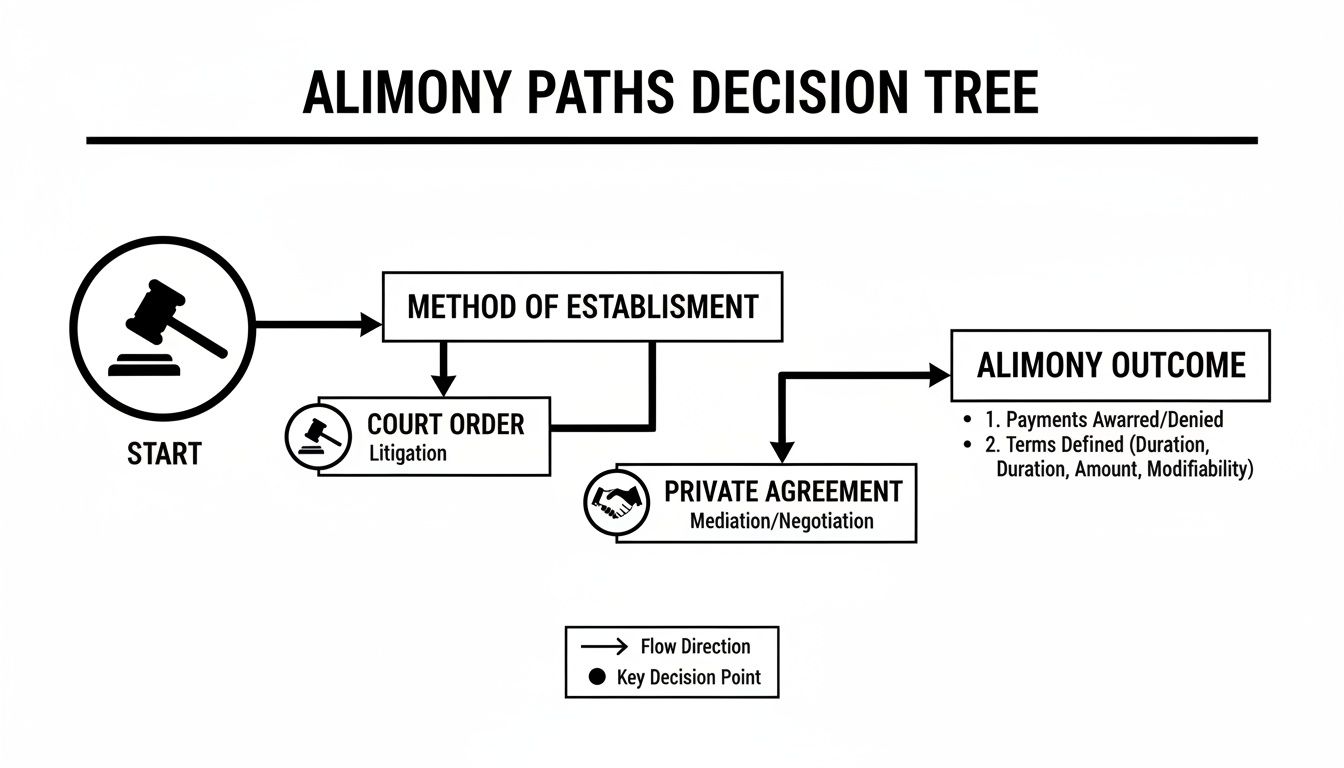
As the chart shows, the path through the court system is governed by strict legal rules, while private agreements offer much more flexibility.
The Family Violence Exception
Your safety is the top priority. Texas law makes a critical exception to the 10-year rule for victims of domestic abuse. The length of the marriage does not matter if:
- Your spouse was convicted of (or received deferred adjudication for) a criminal act that also qualifies as family violence under the Texas Family Code.
- This act was committed against you or your child during the marriage.
- The offense happened within two years of filing for divorce or while the divorce was ongoing.
This rule acknowledges the devastating impact of family violence, which can make it incredibly difficult for a victim to maintain employment or financial stability.
The Disability Exception
The law also provides two separate paths when a disability prevents a spouse from earning enough to get by.
Your Own Incapacitating Disability: You may qualify if you cannot earn enough to provide for your own minimum reasonable needs because of an incapacitating physical or mental disability. The length of your marriage does not matter here.
Caring for a Child with a Disability: You could also be eligible if you are the primary caregiver for a child of the marriage (of any age) who has a physical or mental disability. The key is that the child's condition requires substantial, personal care from you, which prevents you from being able to work and earn enough to cover your own needs.
Key Takeaway: Proving you are eligible is a high bar to clear. Texas alimony laws demand clear proof of necessity, which is why it’s a rare remedy. Courts deny a large percentage of requests because the requesting spouse is found capable of self-sufficiency. You can discover more insights about Texas divorce and custody statistics.
Successfully navigating these strict requirements demands a deep understanding of the law and the ability to present compelling evidence to the court. Having an experienced attorney in your corner can make all the difference in clearly demonstrating why you qualify for the support you need.
How Courts Calculate Maintenance Amount and Duration
If you’ve cleared the tough eligibility hurdles for spousal maintenance, the next question is a practical one: how much money can you actually receive, and for how long?
Texas law doesn’t leave this up to a judge’s whim. There are hard and fast limits on both the amount and the duration of these payments, designed to create a predictable outcome.
A judge cannot just pick a number out of thin air. The law puts a firm cap on what they can order. Maintenance payments cannot exceed the lesser of two amounts: $5,000 per month or 20% of the paying spouse's average monthly gross income.
Let's look at a scenario. Say your ex-spouse earns an average of $8,000 in gross income each month. The absolute highest a judge could order is $1,600 per month (20% of their income). If your ex-spouse earned $30,000 a month, the payment would be capped at $5,000, not the $6,000 that 20% would equal. This structure provides support without creating an unreasonable financial burden.
Duration Limits Tied Directly to Marriage Length
The next question is, how long do the payments last? The answer is tied directly to how long you were married. It’s important to understand that the timeframes set by law are maximums, not automatic guarantees.
A judge will always look at what is reasonable and necessary for you to get the training or education needed to support yourself. That means the final court order could be for a much shorter period than the maximum allowed.
Securing alimony—legally known as spousal maintenance—is far from guaranteed in Texas. Courts impose strict caps that limit both the duration and amount to protect paying spouses from indefinite obligations. Under Texas Family Code Section 8.055, a court cannot order maintenance exceeding the lesser of $5,000 per month or 20% of the paying spouse's average monthly gross income. Duration is equally restricted, and statistics show alimony is awarded in less than 10% of Texas divorces. Discover more insights about how alimony is determined in Texas.
Texas Spousal Maintenance Duration Limits
To make these rules crystal clear, this simple table outlines the maximum time limits for spousal maintenance based on the length of your marriage, as laid out in the Texas Family Code.
| Length of Marriage | Maximum Duration of Maintenance Payments |
|---|---|
| 10 to 20 Years | Up to 5 years |
| 20 to 30 Years | Up to 7 years |
| 30 Years or More | Up to 10 years |
There are a couple of key exceptions. If a spouse is disabled or is the primary caregiver for a disabled child of the marriage, the court has the discretion to order maintenance payments for as long as that condition of eligibility continues.
Ultimately, these strict caps and timelines highlight a core principle in Texas family law: spousal maintenance is meant to be a temporary bridge to help you get back on your feet, not a permanent financial arrangement. Understanding these limits is the first step in setting realistic expectations.
Building Your Case for Spousal Maintenance
Asking a judge for spousal maintenance isn’t as simple as filling out a form. To be successful, you must build a clear, compelling case backed by solid proof. The judge needs to see, without a doubt, that you have a real need for financial support and that you've been doing everything you can to become self-sufficient. At The Law Office of Bryan Fagan, PLLC, we understand how overwhelming this can be, and we are here to provide the practical guidance you need.
Think of it like building a house. You need a solid foundation of hard evidence that supports your request and shows the court exactly what you're facing.

Proving Your Minimum Reasonable Needs
The cornerstone of your case is showing your financial need. You have to prove to the court that once the divorce is final, you will not have enough property or income to cover your “minimum reasonable needs.” This is about covering the basic, necessary costs of living, not maintaining your marital lifestyle.
To do this, you need to create a detailed and realistic monthly budget. This is a formal document, usually part of a Financial Information Statement, that meticulously breaks down your expenses.
Your budget should clearly document costs like:
- Housing: Mortgage or rent payments, property taxes, and insurance.
- Utilities: Electricity, water, gas, internet, and cell phone bills.
- Transportation: Car payments, insurance, gas, and routine maintenance.
- Food and Groceries: A realistic monthly estimate for your family's needs.
- Healthcare: Health insurance premiums, co-pays, and prescription costs.
This budget paints a real-world picture for the judge, turning abstract legal terms into concrete numbers that show exactly what you need to live each month.
Demonstrating Your Efforts Toward Self-Sufficiency
Another critical piece is proving you’ve made a good-faith effort to either earn enough money or develop the job skills needed to support yourself. Texas law presumes that maintenance isn't necessary if you haven't been diligently seeking employment. It's up to you to rebut that presumption with clear evidence.
A job search log is an excellent tool for this. It should detail every application submitted, every interview attended, and any networking events or job fairs you've participated in. This log provides tangible proof that you're actively trying to stand on your own two feet.
A very common argument from the paying spouse is that you are "voluntarily underemployed"—meaning you are either not working on purpose or taking a job beneath your qualifications to get maintenance. A detailed job search log is your single best defense against this claim.
Preparing for Common Defenses
It's also smart to anticipate the arguments your spouse’s attorney is likely to use to fight your request. Being prepared for these defenses is the first step to overcoming them.
Common arguments used to oppose spousal maintenance include:
- Sufficient Property: Your spouse will argue that your share of the community property—like retirement funds, home equity, or savings—is more than enough to meet your needs.
- Voluntary Underemployment: As mentioned above, they'll claim you could earn more money if you tried harder.
- Unreasonable Budget: They will scrutinize your budget, arguing that your listed expenses are inflated or are luxuries, not true "minimum reasonable needs."
Building a persuasive case for spousal maintenance in Texas requires careful preparation and a strategic presentation of evidence. This is where an experienced family law attorney is invaluable. We can help you gather the right documents, craft a compelling narrative, and effectively counter the other side’s arguments. With tailored guidance, you can ensure your request is presented in the strongest possible light.
Contractual Alimony as a Strategic Alternative
What if you don't fit into the narrow box for court-ordered spousal maintenance? Or what if you and your spouse simply want more control over your financial future, without leaving it to a judge? This is where contractual alimony serves as an incredibly powerful and strategic tool in a Texas divorce.
Think of it this way: court-ordered maintenance is dictated by a judge and must follow the rigid rules of the Texas Family Code. Contractual alimony, on the other hand, is a private agreement. You and your spouse negotiate the terms yourselves as part of your overall divorce settlement, giving you the freedom to create a solution that works for your unique situation.
The Key Advantages of a Private Agreement
Opting for contractual alimony opens up a world of possibilities you won't find in a courtroom. Because it's a contract, you are not bound by the state's limits on how much can be paid or for how long. This flexibility can be a game-changer for your financial stability.
Here is some practical guidance on the main benefits:
- No Statutory Caps: You can agree to an amount higher than the $5,000/month or 20% income limit that restricts a judge.
- Flexible Duration: The support payments can last for a shorter or longer period than the law allows—whatever you both decide is fair.
- Creative Payment Structures: You can negotiate a one-time lump-sum payment, transfer property in lieu of cash, or design other financial arrangements that make sense for both of you.
- Certainty and Security: You can agree to make the terms non-modifiable. This is a huge benefit, as it means neither of you can go back to court later to try and change the amount or duration, providing real predictability.
For example, a couple might agree that one spouse receives the family home free and clear in exchange for waiving any claim to monthly support payments. This kind of creative, practical problem-solving is only possible through negotiation.
Securing Your Future Through Negotiation
Contractual alimony is usually negotiated during mediation or a collaborative divorce. These processes are designed to help you resolve issues without the stress, expense, and uncertainty of a court battle. It puts the power back in your hands. To get a better feel for how this works, you can learn more about contractual alimony as a form of spousal support.
At The Law Office of Bryan Fagan, PLLC, our attorneys are skilled negotiators who have helped countless clients secure stable financial futures through these kinds of private agreements. We believe in empowering you with creative, practical solutions that protect your interests.
Common Questions About Spousal Support in Texas
As you navigate the details of spousal maintenance, many questions are bound to arise. It's completely normal to feel concerned. Here, we'll answer some of the most common questions we hear from our clients in a clear, straightforward way.
Think of this as a practical Q&A session to clear up any lingering confusion and help you feel more prepared.
Can I Get Alimony If I Committed Adultery in Texas?
Yes, you still can, but it is a significant factor. Texas is a "fault" state, which means a judge can consider a spouse's behavior—like adultery—when deciding on spousal maintenance. If you were the unfaithful spouse, it could seriously weaken your case for receiving support. Conversely, if your spouse's affair led to the divorce, that fact could strengthen your argument for needing it.
Does Spousal Maintenance Automatically End If I Remarry?
Yes, it does. Under the Texas Family Code, a court-ordered spousal maintenance obligation terminates automatically on the date the receiving spouse remarries. The payments also end if the recipient begins living with a new romantic partner on a continuous basis, although the paying spouse must file a motion with the court to get it officially terminated in that scenario. For a deeper look into this, check out our guide on when an alimony order can be terminated.
It's crucial to remember that privately negotiated contractual alimony can have different rules. The terms you and your ex-spouse agreed to in your settlement will determine what happens if one of you remarries or cohabitates.
Can Spousal Maintenance Payments Be Changed Later?
Court-ordered maintenance can be modified, but only downward. A paying spouse can ask the court for a reduction if they experience a material and substantial change in their circumstances, such as an involuntary job loss. The duration of the payments can never be extended. Contractual alimony, however, can be written to be non-modifiable, providing both parties with more certainty.
How Does Alimony Work for Military Divorces?
Military divorces involve a unique intersection of Texas family law and federal regulations. While state law determines your eligibility for spousal maintenance, federal rules govern how military retirement pay is handled. This retirement pay can be divided as community property and is often a source of funds for making maintenance payments.
These cases have an extra layer of complexity, making it essential to work with an attorney who understands both Texas law and the specific rules that apply to military families. A big part of moving on is getting your finances in order. For some great tips on this, take a look at resources on financial planning after divorce.
If you need help navigating divorce, custody, or estate planning in Texas, contact The Law Office of Bryan Fagan today for a free consultation. You can reach us at https://www.bryanfagan.com.



