
Navigating a divorce or custody dispute can be one of life’s most difficult transitions—but understanding your rights and the legal process under Texas law can make it feel less overwhelming. When a court appoints a Guardian Ad Litem, often called a GAL, it introduces a new person into your family’s most private matters. Their single, focused mission is to represent the best interests of a child during a legal case. Instead of seeing them as just another lawyer taking sides, it’s helpful to view them as an independent investigator whose only client is your child.
Understanding the Role of a Guardian Ad Litem in Texas

Going through a child custody dispute is one of the most stressful experiences any parent can face. When a judge decides to appoint a Guardian Ad Litem (GAL), it can feel overwhelming, as if you’re losing control. We understand this uncertainty, and our goal is to bring clarity and reassurance to what can be a very challenging time.
A GAL is a neutral professional brought in by the court, not to pick a parent’s side, but to act as an independent voice for your child’s well-being. Understanding their purpose is the first practical step toward navigating this process effectively and advocating for a positive outcome for your family.
The GAL’s Core Mission: A Step-by-Step Breakdown
The Texas Family Code § 107.001 gives a court the authority to appoint a GAL in any suit affecting the parent-child relationship when it is in the child’s best interest. This role is critical because it ensures the child’s perspective is heard, especially when they are too young or the conflict is too intense for them to express their needs clearly. It’s an essential safeguard in high-conflict family disputes. You can discover more insights about the role of a GAL in family law on floridabar.org.
A Guardian Ad Litem’s work typically breaks down into a few key steps:
- Investigation: The GAL conducts a thorough, unbiased investigation into the child’s life and circumstances.
- Interviews: They will speak with everyone involved—the child, parents, teachers, counselors, and anyone else who plays a significant role in the child’s life.
- Observation: It’s common for a GAL to visit each parent’s home to observe the living environment and parent-child interactions firsthand.
- Recommendation: Finally, they deliver a report to the judge with recommendations about what they believe is truly in the child’s best interest regarding custody and visitation.
Clarifying the Guardian Ad Litem’s Core Responsibilities

To understand how a Guardian Ad Litem (GAL) can shape your case, it’s important to know what they actually do. Think of the GAL as the court’s trusted investigator, tasked with one profound and singular mission under Texas Family Code § 107.002: to determine and advocate for the “best interest of the child.” This isn’t just a vague goal; it’s a legal standard that dictates every action they take.
A GAL steps into your family’s life to offer an objective, impartial view that a judge, confined to the courtroom, simply cannot get. Their job is to gather information from all sides, see the full picture, and then report their findings and recommendations back to the court. This process helps ensure the judge’s final orders are based on a thorough investigation, not just the conflicting stories presented by the parents.
The Investigation: The Heart of the GAL’s Work
The core of a Guardian Ad Litem’s job is to conduct a thorough, independent investigation. They are not limited to the evidence you or the other parent presents in court. Instead, they have the authority to dig deeper to build a complete picture of your child’s world.
This is a multi-faceted process that usually involves several key steps. The GAL will:
- Talk to the Child: This is a crucial and non-negotiable step. The GAL speaks with your child in a private, age-appropriate manner to understand their feelings, preferences, and daily life without parental pressure.
- Interview Both Parents: They will meet with each parent separately to hear their perspective, concerns, and their proposed parenting plan.
- Contact Collateral Sources: A GAL’s investigation extends beyond the immediate family. They often speak with teachers, counselors, therapists, doctors, and even family friends or neighbors—anyone who can offer objective insight into the child’s life.
- Review Important Documents: The GAL has the authority to access and review records that provide context about the child’s well-being, such as report cards, school attendance records, medical charts, and therapy notes.
By piecing all this information together, the GAL creates an unbiased narrative focused on one thing: what environment will best support the child’s physical health and emotional stability.
A Real-World Scenario: The Schooling Disagreement
Let’s make this concept more relatable. Imagine a difficult divorce where parents, Maria and David, are at an impasse over where their 8-year-old son, Leo, should attend school. Maria insists Leo should remain in his current school district to maintain stability with his friends and teachers. David, however, believes a specialized private school in another city would better serve Leo’s specific learning needs. The conflict becomes so intense that the judge appoints a GAL.
Here’s how the GAL would provide practical guidance:
- Meet with Leo: The GAL talks to Leo, who expresses nervousness about leaving his friends but also excitement about the programs at the new school.
- Interview Parents and Review Records: The GAL interviews Maria and David, reviews Leo’s academic records, and speaks with his current teacher and a child psychologist.
- Formulate a Recommendation: After this deep dive, the GAL might conclude that while David’s intentions are good, the emotional stress of moving schools and a long daily commute would outweigh the potential academic benefits for Leo at this time. The GAL would then write a report recommending that Leo stay in his current school for the next year, with a suggestion to revisit the issue later. This recommendation isn’t about choosing a winner; it’s about prioritizing Leo’s immediate emotional well-being.
The GAL’s Final Report and Recommendations
Once the investigation is complete, the Guardian Ad Litem compiles their findings into a detailed report for the judge. This report summarizes everything—interviews, home visits, and document reviews—and concludes with specific recommendations on custody, visitation, and any other contested issues.
While the GAL’s recommendation isn’t legally binding, judges give it significant weight. They rely on the GAL’s impartial assessment because that individual has invested the time to understand the family dynamics in a way the court cannot. It’s a vital tool that helps ensure the final ruling truly is in the child’s best interest. It is easy to confuse this role with others, so for a deeper look at a similar but distinct appointment, you can learn more about what an Attorney Ad Litem does in a Texas family law case in our detailed article.
When a GAL is Appointed in a Texas Custody Case
When a judge brings a Guardian Ad Litem (GAL) into your custody case, your mind might jump to the worst-case scenario. It’s a completely natural reaction. Parents often ask us, “What did I do wrong?” or “Is the court saying I’m a bad parent?”
Let’s be clear: a GAL appointment is not a punishment. It’s a safeguard. A Texas judge does not take this step lightly. It typically happens when the conflict between parents becomes so intense that the court questions whether they can still see what’s best for their child through the fog of their own disputes. The GAL steps in as a neutral party to ensure the child’s voice is heard and their well-being remains the central focus.
High-Conflict Custody Battles
One of the most common reasons for a GAL appointment is a high-conflict custody battle. This isn’t a simple disagreement over a pickup time. This is when communication has completely broken down, and parents are stuck in a hostile cycle, unable to make basic co-parenting decisions without returning to court.
When parental anger clouds judgment, a judge must ensure the child’s best interests are not overlooked. A GAL is appointed to cut through that noise, investigate the reality of the situation without bias, and provide the court with a clear recommendation.
“A Guardian Ad Litem is appointed not because the parents are ‘bad,’ but because the conflict is so significant that the court needs a neutral third party to investigate what is truly best for the child.” – The Law Office of Bryan Fagan, PLLC
In these situations, the GAL’s primary job is to understand the child’s daily life and suggest a plan that shields them from parental conflict as much as possible.
Allegations of Abuse or Neglect
A judge will almost certainly appoint a Guardian Ad Litem if serious allegations of abuse or neglect arise. This includes any claim of physical, emotional, or sexual abuse, or situations where one parent alleges the other is failing to provide a safe and stable home.
These are incredibly serious accusations, and the court has a duty to investigate them thoroughly. A GAL is tasked with:
- Interviewing the child in a safe, neutral setting where they feel comfortable talking.
- Speaking with other adults in the child’s life, such as teachers, doctors, or counselors, who may have important observations.
- Reviewing any reports from Child Protective Services (CPS).
- Evaluating the credibility of the claims and, most importantly, their impact on the child.
The GAL then compiles their findings into a detailed report for the court, giving the judge a clearer picture to make critical decisions about the child’s safety and future.
Concerns About Parental Fitness
Sometimes, a GAL is appointed because a specific issue has raised red flags about a parent’s ability to provide proper care. This doesn’t mean the parent doesn’t love their child; it means something may be hindering their ability to parent effectively and safely.
Common concerns that might lead to a GAL appointment include:
- Substance Abuse: If there is evidence that a parent is struggling with drug or alcohol abuse, a GAL will investigate how that behavior impacts their ability to care for the child.
- Mental Health Issues: An untreated or unstable mental health condition can also trigger a GAL appointment to assess the stability of the home environment.
- New Partners or Living Situations: A judge might want an investigation if a parent’s new partner has a troubling criminal history or if the new living arrangement is potentially unsafe.
The GAL isn’t there to pass moral judgment. Their focus is narrow and specific: to determine how these behaviors or circumstances directly affect the child’s best interests, as defined by the Texas Family Code.
The role of a guardian ad litem is crucial in the U.S. judicial system, where they are appointed in over 1 million cases each year. In Texas, courts often rely on GALs under Rule 173 to protect children in a significant portion of contested custody cases, which are unfortunately common. Learn more about the scope and impact of GAL appointments in family law from this research. This underscores the importance of their role in ensuring child welfare.
What to Expect During the GAL Investigation Process
Knowing a Guardian Ad Litem (GAL) has been appointed to your case can be nerve-wracking. What will they do? What will they ask? Understanding the road ahead can alleviate much of that anxiety. The GAL’s investigation is a step-by-step process designed to give the court a clear, unbiased look into your child’s world. By knowing what to expect, you can work with the GAL constructively and ensure your perspective is heard.
The process begins once the judge signs the order appointing the GAL. They will likely start by reviewing the court file to understand the main points of contention in your case. After that, expect them to contact you and your attorney to schedule an initial meeting. This is your first opportunity to set a cooperative, child-focused tone.
The Initial Meetings and Interviews
Your first meeting with the GAL is a critical first impression. You should be prepared, organized, and, above all, honest. The GAL’s goal is to understand the parenting arrangement you believe is best for your child and your reasons for it. They are there to gather facts, not to mediate disputes between you and the other parent.
A significant part of their investigation involves speaking with your child. This interview will always happen in a private, neutral, and comfortable setting where your child feels safe to open up. GALs are trained to ask age-appropriate questions to understand the child’s routines, relationships, and wishes without putting them in the middle of the conflict.
Home Visits and Collateral Interviews
To get a true sense of your child’s daily life, the GAL will schedule home visits. They are not inspecting for dust; they are observing whether the environment is safe, stable, and nurturing. They will pay attention to your interactions with your child and look at where your child sleeps, plays, and does schoolwork.
The investigation extends beyond just the parents and child. The GAL has the authority to contact collateral sources—neutral, third-party individuals who can offer an objective perspective. These sources often include:
- Educators: Teachers, school counselors, or principals who interact with your child daily and can speak to their academic performance, behavior, and social interactions.
- Healthcare Providers: Your child’s pediatrician, therapist, or any other medical professional with insight into their physical and emotional health.
- Family and Friends: In some cases, a GAL may speak with grandparents, aunts, uncles, or close family friends who see the child regularly.
This flowchart illustrates the typical reasons a court appoints a GAL and initiates an investigation.
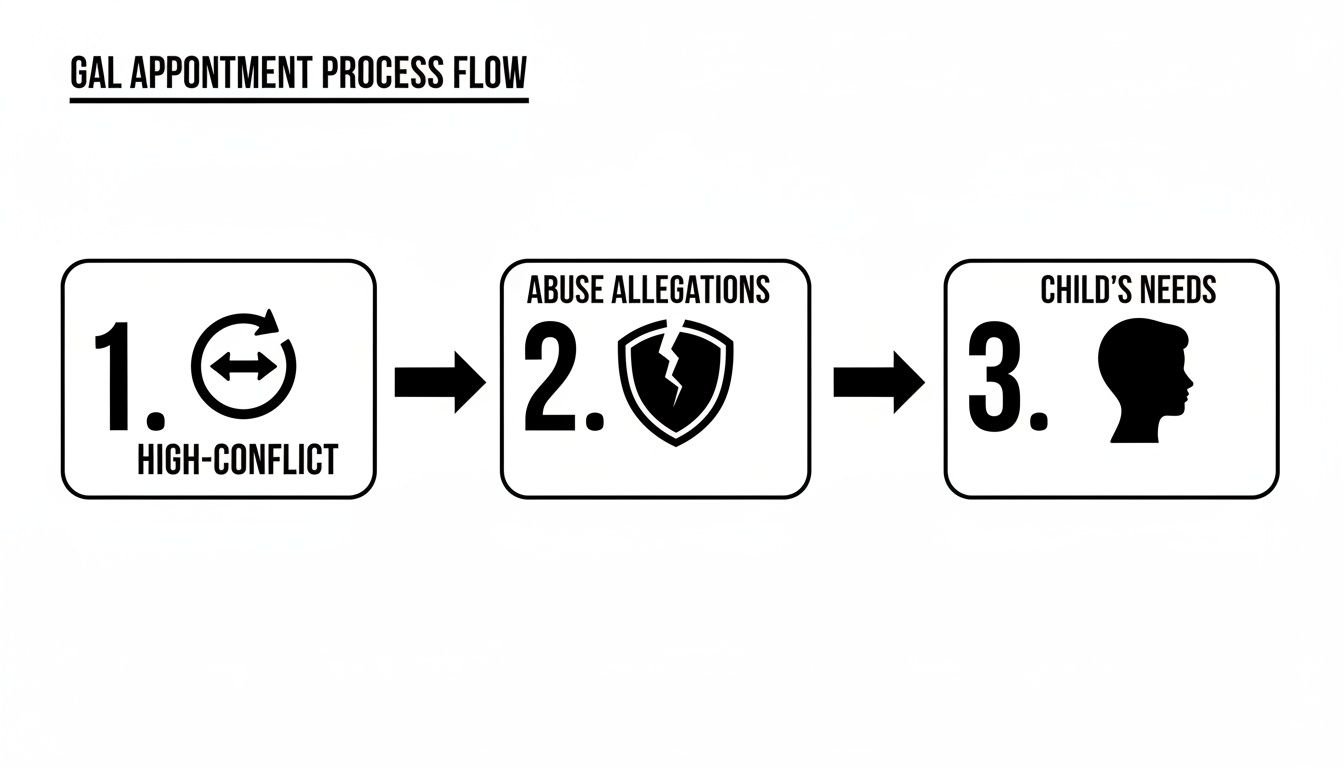
As you can see, situations ranging from high-conflict custody battles to serious safety concerns all lead to the court appointing a GAL to be the eyes and ears for the child’s best interests.
Practical Guidance for Parents
Your conduct during this process is very telling. The GAL observes everything to form their recommendation to the judge. To demonstrate you are a capable and focused parent, we offer this actionable guidance:
- Be Organized: Prepare your documents. Have report cards, medical records, and a list of your collateral contacts with their phone numbers and emails ready.
- Communicate Honestly: Never exaggerate or make false accusations about the other parent. Your credibility is paramount. If you have made mistakes, acknowledge them and explain what you have learned.
- Stay Child-Focused: Keep every conversation centered on your child’s needs, not your frustrations with the other parent. Show that you can prioritize your child’s well-being over the conflict.
- Be Prompt and Cooperative: When the GAL requests information or schedules a meeting, respond quickly. Being difficult or unresponsive can be viewed negatively.
A GAL’s investigation has much in common with a full custody evaluation, where a neutral expert provides the court with a professional opinion. You can find more practical tips in our guide on preparing for a child custody evaluation.
By following this advice, you can navigate the investigation confidently, ensuring the GAL gets an accurate picture of your parenting and dedication to your child.
How to Work Effectively with the Guardian Ad Litem
When a Guardian Ad Litem (GAL) is appointed to your case, it is not a time to panic. Instead, see it as an opportunity to demonstrate to the court your commitment to your child’s well-being. How you interact with the GAL will significantly influence their final recommendation, so building a professional and cooperative relationship is essential.
Think of this process less as trying to “win over” the GAL and more like providing them with a clear, honest, and organized view of your life as a parent. Preparation and a child-focused attitude can make all the difference.
Set a Cooperative Tone from the Start
Your first meeting with the Guardian Ad Litem sets the stage for your entire interaction. It is your opportunity to be respectful, transparent, and prepared. It’s a common mistake to view the GAL as an adversary. A more effective approach is to see them as a neutral fact-finder whose sole purpose is to help the judge make the best possible decision for your child.
Maintain a calm and respectful tone in all communications, whether in person, on the phone, or via email. Emotional outbursts or hostility can be misinterpreted as you being more focused on your conflict with the other parent than on your child’s needs.
Be Prepared and Organized
A prepared parent is a parent who is taken seriously. Before you meet with the GAL, take time to organize your important documents. This simple step shows the GAL that you respect their time and are taking this process seriously.
Consider putting together a simple binder or folder with the following:
- A brief summary: A one-page overview of your primary concerns and what you believe is in your child’s best interest. Stick to the facts and avoid overly emotional language.
- Key documents: Copies of your child’s recent report cards, relevant medical records, and important communications with the other parent.
- Contact list: A clear list of important people in your child’s life, such as teachers, doctors, and therapists, with their contact information. For a more detailed checklist, review our guide on what to bring to a child custody pre-trial.
This upfront effort helps the GAL get up to speed quickly and paints a picture of you as a responsible and proactive parent.
Common Mistakes to Avoid
Knowing what to do is only half the battle; knowing what not to do is just as critical. Certain behaviors can quickly undermine your credibility and leave the GAL with a negative impression.
A Guardian Ad Litem’s opinion is shaped by more than a single meeting. They will notice patterns in your behavior, how you manage your child’s routine, and how you handle conflict. Steady, child-focused behavior builds credibility.
Here are a few major mistakes to avoid at all costs:
- Badmouthing the Other Parent: It can be tempting to vent, but resist the urge. The GAL is not your therapist. Focusing on conflict can make you seem uncooperative and less focused on what truly matters—your child.
- Making Unsubstantiated Claims: If you raise a serious concern, be prepared to back it up with a document, photo, witness, or other proof. Baseless accusations will damage your credibility.
- Coaching Your Child: Never tell your child what to say to the GAL. These professionals are trained to recognize when a child’s words are not their own. This is not only harmful to your child but will be seen as an attempt to manipulate the investigation.
- Being Dishonest or Evasive: Tell the truth. If you’ve made mistakes, own them and discuss what you’ve learned. Lying to a GAL is one of the fastest ways to lose their trust and receive an unfavorable recommendation.
The Guardian Ad Litem’s Role Beyond Family Court
When people hear “Guardian ad Litem” (GAL), their minds usually go to high-conflict child custody battles. However, their role as a protector extends beyond family court. A GAL’s mission is always the same: to be the court’s eyes and ears and advocate for the best interests of someone who cannot speak for themselves. This duty is equally critical in guardianship and probate cases, which are governed by the Texas Estates Code.
In these moments, the GAL’s compassionate, investigative skills become invaluable when a judge must make life-altering decisions for vulnerable individuals, such as an aging parent or a minor child who stands to inherit property.
Guardianship Proceedings for Incapacitated Adults
What happens when a person can no longer make safe decisions about their own health or finances due to age or illness? A court may be asked to appoint a guardian. Taking away someone’s fundamental rights is a serious step, and the court must be certain it is necessary.
This is where a Guardian Ad Litem is essential. Under the Texas Estates Code, § 1054.051, a judge appoints a GAL to independently investigate the situation. In a guardianship case, their responsibilities include:
- Meeting the Proposed Ward: The GAL personally meets with the individual alleged to be incapacitated to understand their wishes and assess their condition.
- Investigating the Need for Guardianship: The GAL reviews medical records and interviews doctors, family, and caregivers to determine if a less restrictive alternative, like a power of attorney, would be more appropriate.
- Evaluating the Proposed Guardian: The GAL also assesses the person seeking to become guardian to ensure they are suitable and have no conflicts of interest.
After a thorough investigation, the GAL provides a detailed report to the judge with a clear recommendation on whether guardianship is truly in the person’s best interest. With an aging population, this function is more important than ever. In fact, for Texas seniors and their families, guardianship cases have been climbing by an estimated 15% each year. Learn more about the crucial role GALs play in protecting vulnerable populations in these detailed findings.
Protecting Minors in Probate and Estate Cases
A Guardian Ad Litem also plays a crucial part in probate court when a minor is set to inherit property. A child cannot legally manage their own inheritance, so the court must protect their financial future.
If a minor is named as a beneficiary in a will or stands to inherit property, the court will appoint a GAL. Their job is to ensure the child’s financial interests are protected throughout the probate process.
The GAL will review the estate’s assets, monitor how the inheritance is being managed, and approve any settlements or distributions made on the child’s behalf. This ensures the child’s inheritance is not mismanaged before they are old enough to receive it. While often seen in family court, the role of a guardian can extend to other areas, such as when making critical decisions for an incapacitated adult. For details on the legal process, you can find valuable information on how to obtain guardianship of a parent in Ohio.
Answering Your Questions About Guardians Ad Litem
Going through a legal process involving a Guardian Ad Litem (GAL) naturally brings up questions. This uncertainty can be stressful, but getting clear answers is the first step toward feeling more prepared and in control. Here are some of the most common questions our clients ask.
Who Pays for the Guardian Ad Litem in Texas?
Under the Texas Family Code, the judge decides how the Guardian Ad Litem’s fees are paid. In most cases, the judge will order the parents to split the costs. The division depends on each parent’s financial situation and ability to pay. The court can order one parent to cover the entire cost or divide it in a manner it deems fair and just. It is wise to discuss these potential expenses with your attorney early in your case.
Can I Disagree with the GAL’s Recommendation?
Yes, you can. The GAL’s report carries significant weight with the court, but it is not a final order. If you and your attorney believe the GAL’s findings are inaccurate or not in your child’s best interests, you have the right to challenge them in court. Your attorney can cross-examine the GAL during a hearing, question their investigation methods, and present evidence to counter their conclusions. This is a critical moment where having an experienced family law attorney is essential to protect your rights.
Is What I Tell the Guardian Ad Litem Confidential?
No, and this is a crucial point to understand. Your conversations with a Guardian Ad Litem are not confidential. The relationship is different from the one you have with your own lawyer; there is no attorney-client privilege.
A Guardian Ad Litem’s job is to investigate everything and report all relevant findings back to the court. Anything you say, your child says, or anyone else says to the GAL can end up in their official report and become part of their testimony.
It is important to be honest and cooperative, but also mindful that your words will likely become part of the official court record. This is a standard part of their role as the court’s impartial investigator.
If you need help navigating divorce, custody, or estate planning in Texas, contact The Law Office of Bryan Fagan today for a free consultation. Our experienced attorneys are here to provide the compassionate support and tailored guidance your family deserves.