
If you're searching late at night for what is full custody, there's a good chance you're not doing it out of curiosity. You're worried. Maybe the other parent has become unpredictable. Maybe your child isn't safe. Or maybe you're trying to understand whether the arrangement you want is even something Texas courts can grant.
Texas custody law can feel confusing because the words people use in everyday life aren't always the words the court uses. The phrase "full custody" is common. In a Texas courtroom, though, the more precise term is usually sole managing conservatorship. That difference matters, because it affects what you ask for, what you must prove, and what a judge can order.
A lot of parents also assume that if they get "full custody," the other parent disappears from the picture. That's usually not how Texas law works. In many cases, one parent gets broader decision-making authority while the other still keeps some rights, some duties, and some form of possession or access.
What follows is a Texas-specific guide built around the actual legal framework, not generic internet advice. If you're trying to protect your child and make sense of your options, this will help you understand the language, the standards, and the process.
What Full Custody Really Means in Texas Law
When the term full custody is used, it usually means one parent has the main authority over the child and the child lives primarily with that parent. In Texas, the legal system doesn't usually use that phrase. Instead, Texas courts talk about conservatorship, and the closest legal match is sole managing conservatorship.
Under Texas law, a parent appointed as Sole Managing Conservator can receive exclusive rights over major decisions affecting the child. Those rights often include the authority to determine the child's primary residence and make important choices about health care, education, and other major issues without needing the other parent's agreement. Texas courts treat that arrangement as the exception rather than the default, and Texas Family Code § 153.131 starts from the presumption that appointing parents as joint managing conservators is in the child's best interest unless joint conservatorship would impair the child's physical health or emotional development, as summarized in this Texas custody overview on sole managing conservatorship.

What sole managing conservatorship usually includes
A Texas order may give one parent the exclusive right to:
- Choose the child's home so the child primarily resides with that parent
- Make educational decisions such as school enrollment and related academic choices
- Consent to medical care for the child
- Handle major day-to-day direction when quick decisions are needed
That doesn't always mean the other parent loses all involvement.
In many families, the other parent is named a possessory conservator. That parent may still have visitation, access to records, and the ability to stay informed about the child's welfare. So if you're wondering what is full custody in a practical Texas sense, the answer is often narrower and more structured than people expect.
Why Texas uses different language
Texas uses the word conservatorship because custody has more than one part. There are decision-making rights, time with the child, and financial responsibilities. Courts separate those ideas instead of treating them as one all-or-nothing label.
Practical rule: In Texas, asking for "full custody" is really asking the court to define specific rights, duties, and possession terms in a way that protects your child.
A simple example
Suppose a mother is caring for a child, and the father has ongoing substance abuse issues that make his judgment unreliable. A Texas court might appoint the mother as sole managing conservator so she can make school and medical decisions on her own, while still allowing the father limited or supervised visitation if the court believes that contact can happen safely.
That example shows why the wording matters. You're not asking for a slogan. You're asking for a specific legal structure under the Texas Family Code.
The Building Blocks of a Texas Custody Order
Many parents get lost because they think "custody" is a single decision. In Texas, it isn't. A custody order usually has three separate parts, and once you see them side by side, the whole system makes much more sense.
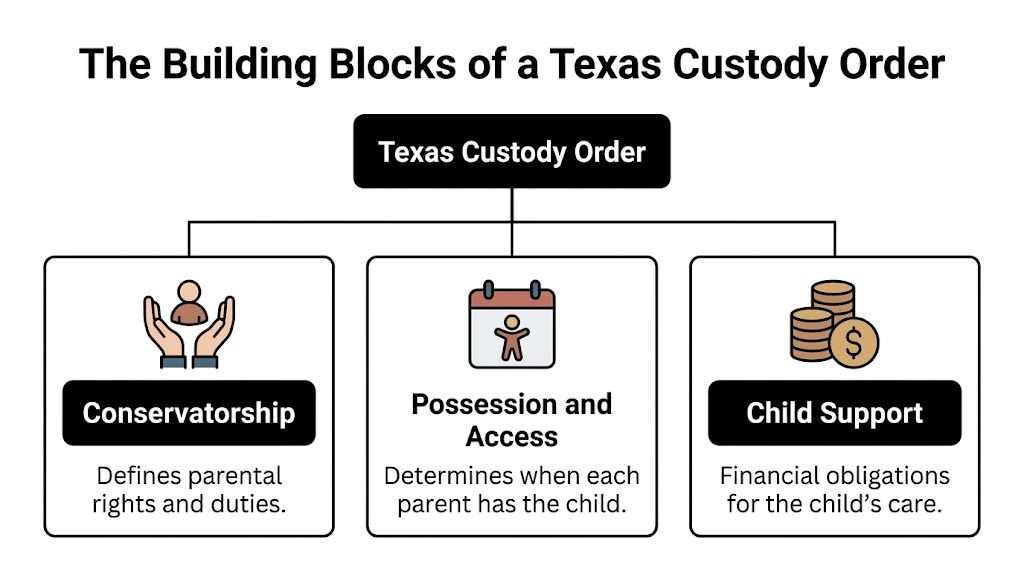
The three parts you need to separate
| Part of the order | What it covers | What parents often call it |
|---|---|---|
| Conservatorship | Decision-making rights and duties | Legal custody |
| Possession and access | When the child is with each parent | Physical custody or visitation |
| Child support | Financial support for the child | Support payments |
A parent can have strong decision-making rights and still not have the child every day. A parent can also have regular possession time without controlling major decisions. That's why broad phrases often create confusion.
Conservatorship means decision-making
Conservatorship is about legal authority. It answers questions like:
- Who decides where the child lives
- Who can consent to medical treatment
- Who makes educational choices
- Whether certain rights are shared, independent, or exclusive
Texas courts may divide these rights carefully. Some are exercised jointly. Some are exercised independently. Some may belong only to one parent.
Possession and access means time with the child
This is the parenting schedule. It sets out when each parent has the child, how exchanges happen, holiday schedules, and summer possession. If you've heard the phrase Standard Possession Order, you're already in this part of the law. For a clearer breakdown of how schedules work, this guide on possession orders in Texas family law is a useful companion.
A parent can be the sole managing conservator and still have to follow a possession schedule for the other parent if the court finds contact is appropriate.
Child support is separate from custody
Parents often assume support and custody rise and fall together. They usually don't. Child support exists to help meet the child's needs. A parent's income may affect support, but it doesn't decide conservatorship by itself.
The court doesn't award decision-making rights as a reward for earning more money. The court assigns rights and duties based on the child's best interest.
A relatable example
Take a father who lives close to the child's school and has been extensively involved in homework, appointments, and daily routines. The mother may still have substantial parenting time. In one order, the father might have the exclusive right to designate the child's primary residence, both parents might share some educational decisions, and one parent might still pay child support.
That isn't contradictory. It's how Texas courts tailor orders to fit real families.
Joint vs Sole Conservatorship The Strong Presumption in Texas
Texas judges don't begin with the assumption that one parent should control everything. They begin with the opposite idea. The law generally presumes that joint managing conservatorship is in a child's best interest.
That doesn't mean equal time in every case. It also doesn't mean parents must agree on every detail. It means the court usually wants both parents to remain legally involved unless there is a strong reason not to do that.
What joint managing conservatorship looks like in practice
In a joint arrangement, parents may share some rights and duties, while one parent still gets certain exclusive rights. For example, one parent may have the exclusive right to designate the child's primary residence, but both parents may retain access to school records, medical information, and other important aspects of the child's life.
This catches many parents off guard. They hear "joint" and think "50/50 everything." Texas law is more flexible than that.
Why sole conservatorship is harder to get
Nationally, full custody is granted in under 20% of U.S. cases, according to the summary provided in this discussion of full custody and sole legal custody. That same source notes that sole custody is typically pursued when joint decision-making fails because of serious non-cooperation.
The point for Texas parents is simple. Sole conservatorship is possible, but it isn't the court's starting position.
What a judge is looking for
A judge will usually ask:
- Can these parents safely and responsibly share decision-making in some form?
- Is one parent trying to cut the other parent out for personal reasons, or because the child needs protection?
- Would shared authority expose the child to instability, fear, or ongoing harm?
If your case involves abuse, neglect, untreated addiction, or extreme conflict, the legal presumption in favor of joint conservatorship can be overcome. But the evidence has to be strong, specific, and tied to the child's well-being.
When Do Texas Courts Award Sole Managing Conservatorship
Texas courts reserve sole managing conservatorship for cases where a joint arrangement would put the child at risk or seriously undermine the child's well-being. The question isn't whether one parent is more frustrated, more organized, or more vocal. The question is whether the facts show that giving one parent broader authority is necessary to protect the child's best interest.

Circumstances that often lead to sole conservatorship
Courts look closely at situations such as:
- Family violence that affects the child directly or creates an unsafe home
- Abuse or neglect involving the child
- Substance abuse that interferes with parenting ability or judgment
- Serious mental health concerns when they impair safe parenting
- Chronic absence or abandonment by a parent
- Extreme conflict or repeated refusal to follow court orders when cooperation has broken down
Texas courts don't need a parent to be perfect. They do need a parent to be safe, stable, and able to act in the child's best interest.
The best-interest analysis is broader than one incident
A judge won't usually make a major custody decision based on one argument, one late pickup, or one offensive text message. The court looks for patterns. It considers the child's present needs, future needs, home stability, and whether a parent's conduct shows an unhealthy parent-child relationship.
You may hear lawyers refer to the Holley factors. Those are well-known best-interest considerations used in Texas family cases. They include the child's emotional and physical needs, the stability of each proposed home, and acts or omissions that suggest one parent may not be acting appropriately.
A strong sole conservatorship case doesn't just say the other parent is difficult. It shows why the child's safety, stability, or emotional development is at stake.
State laws differ more than most parents expect
Parents often compare stories with friends in other states and assume the same rules apply in Texas. They don't. Nationally, fathers receive about 35% of child custody time on average, but that varies sharply by state. The same summary reports that 40% of states now have laws designed to provide equal custody time, with examples ranging from about 50% parenting time in Florida to about 21.8% in Tennessee, as discussed in these national child custody statistics.
That comparison matters because Texas courts aren't deciding your case based on what happened in Florida, Tennessee, or what someone's cousin says happened elsewhere.
For a more focused discussion of strategy, this article on how to get sole custody in Texas can help you think through the evidence and arguments that matter most.
A short explainer may also help if you're trying to understand how Texas courts talk about sole managing conservatorship in plain language:
A realistic example
Suppose one parent repeatedly drives with the child after drinking, misses school meetings, and refuses to tell the other parent where the child is staying. That doesn't just show tension between adults. It may show a pattern of unsafe judgment and instability. In that kind of case, the court may decide that one parent needs exclusive authority over major decisions and residence.
Proving Your Case Evidence and Documentation Needed
Parents often believe that if they tell the judge what happened, that should be enough. In family court, detail matters. Documentation matters more. If you're asking for sole managing conservatorship, you need proof that is organized, credible, and tied to the child's best interest.

What evidence tends to help most
Some of the most useful forms of evidence include:
- Police reports if there has been family violence, threats, or disturbances
- Medical records showing injuries, neglect concerns, or treatment needs
- School records that reflect attendance problems, behavioral changes, or repeated disruption
- Text messages, emails, and voicemails that show threats, admissions, refusal to cooperate, or unsafe behavior
- Photos or videos when they clearly document relevant conditions or events
- Witness testimony from teachers, counselors, relatives, neighbors, or others with direct knowledge
- Drug test results or psychological evaluations when substance use or mental health is an issue
The key is relevance. The court wants evidence that helps answer a legal question, not evidence that serves only to show the other parent is irritating.
Keep your records in a form your lawyer can use
Try organizing documents by date and issue. For example, keep one folder for school concerns, another for medical issues, and another for communication problems. Save screenshots with visible dates. Keep copies of incident reports. If an exchange goes badly, note who was present and what happened as soon as you can while your memory is fresh.
A personal journal can still help your lawyer spot patterns, but it usually works best as a guide rather than your main evidence.
Important distinction: "I know what happened" and "I can prove what happened" are not the same thing in a custody case.
What parents sometimes do wrong
These mistakes can weaken a case:
- Collecting too much irrelevant material such as every rude message from the past several years.
- Editing or annotating screenshots in ways that raise authenticity concerns.
- Recording selectively so the evidence appears misleading or incomplete.
- Ignoring their own conduct when the court will be evaluating both parents.
If you need a practical primer on organizing proof, this guide on proving a child custody case is a helpful place to start.
A better way to think about evidence
Good evidence tells a clear story. It shows what happened, when it happened, how often it happened, and why it affects the child. If your materials do that, your lawyer has something concrete to work with.
The Legal Process to Request or Modify Custody in Texas
A parent often reaches this stage after a hard moment. Maybe the current schedule has stopped working. Maybe school calls keep going unanswered, or a safety problem has gotten too serious to ignore. At that point, it helps to know what Texas courts do with a request for what many parents call full custody. In Texas, the question is usually whether the court should create or change a conservatorship order, and in some cases whether one parent should be named sole managing conservator.
The process is legal, but it is also practical. A custody case is the court's way of answering a few basic questions in an orderly sequence: What is the current arrangement? What needs to change? What proof supports that request? What order would protect the child's best interest under the Texas Family Code?
How a Texas custody case usually moves
Texas cases do not all look identical, but the path is usually familiar.
A petition is filed
This is the document that starts the case. It tells the court whether you are asking for an original order, raising custody issues in a divorce, or requesting a modification of an existing order.The other parent is served and given a chance to respond
Courts do not make lasting custody decisions based on one side's story alone. The other parent must receive legal notice and have an opportunity to file an answer.Temporary orders may be needed
Temporary orders are short-term rules while the case is pending. They can cover where the child stays, who makes certain decisions, how exchanges happen, and whether any contact needs limits for safety reasons. These orders matter because they often shape daily life for months.Each side gathers and exchanges information
Lawyers may request records, send written questions, take depositions, or subpoena school, medical, or police records when those records are relevant. This stage is where broad accusations start getting tested against documents, timelines, and witnesses.Mediation is often required
Many Texas courts want parents to try mediation before trial. Mediation is not surrender. It is a structured settlement meeting where you can resolve some issues, all issues, or none at all.The judge decides what remains disputed
If no full agreement is reached, the court holds a final hearing or trial. The judge reviews the evidence, applies Texas law, and signs final orders.
A helpful way to picture this is a funnel. At the top, there may be years of conflict, dozens of complaints, and a lot of emotion. As the case moves forward, the court narrows that mass of information into specific legal questions it can answer.
Requesting a modification instead of a brand-new order
Many parents are not starting from scratch. They already have orders, but those orders no longer fit the child's reality.
In a modification case, the court usually looks first at whether there has been a material and substantial change in circumstances since the last order. Then the court considers whether the requested change is in the child's best interest. A move to another city, a major change in work hours, repeated violations of the order, or a new safety concern can all matter. The key is not that life changed in some general way. The key is that the change is meaningful enough to justify a new court order.
That standard can confuse parents. Here is a simple way to understand it. Texas courts do not rewrite custody orders just because one parent is frustrated. Courts change orders when the facts have shifted enough that the old plan no longer serves the child well.
What parents should expect during the case
Custody cases often move slower than parents want. Hearings may be weeks or months apart. Paperwork matters. Deadlines matter. So does conduct outside the courtroom.
Judges notice patterns. A parent who follows temporary orders, shows up on time, communicates clearly, and stays focused on the child usually presents a stronger case than a parent who treats the case like a running argument with an ex. That is true even when the facts are painful.
Emotions are part of this process too. If divorce grief is affecting your concentration or decision-making, these expert tips on navigating divorce grief may help you stay steady while your case moves forward.
Practical steps you can take now
- Follow the current court order unless your lawyer advises you to request emergency relief or a modification
- Write down new problems promptly with dates, names, and supporting records
- Keep communication brief and child-focused
- Bring your lawyer specific examples, not just conclusions such as "the other parent is irresponsible"
- Ask early about temporary orders if the child needs immediate structure or protection
For parents who want representation, Law Office of Bryan Fagan, PLLC handles Texas family law matters involving conservatorship, possession, support, and modification proceedings.
Common Misconceptions About Getting Full Custody
Many custody disputes get worse because parents start from bad assumptions. Clearing those up can save time, money, and heartache.
Mothers always get custody
This belief is common, but Texas law doesn't award conservatorship based on gender. Courts look at the child's best interest.
Nationally, in approximately 51% of custody cases, both parents mutually agreed that the mother should receive primary custody, and about one-third of those decisions were reached voluntarily without mediation or court intervention, according to these child custody statistics on parental agreement. That tells you many arrangements result from agreement, not automatic favoritism.
If I get full custody, the other parent will never see the child
Usually, no. Sole managing conservatorship often affects decision-making authority more than it eliminates the other parent's relationship with the child. If contact can happen safely, Texas courts often preserve some form of possession and access.
In high-risk cases, that access may be supervised or limited. But "sole" doesn't automatically mean "no visitation."
The parent with more money wins
Income can matter for child support. It doesn't control conservatorship.
A parent with a larger paycheck doesn't automatically get stronger custody rights. Judges focus on safety, stability, caregiving history, and the child's needs.
Full custody means I never have to deal with the other parent again
That's rarely true. Even when one parent has broader authority, the other parent may still have rights to information, scheduled possession, and notice about important issues. You may still need to exchange the child, share updates, and follow detailed court orders.
Parents often come to court asking for peace. What the court can usually give is structure.
Frequently Asked Questions About Texas Custody Orders
At what age can a child choose which parent to live with in Texas
A child doesn't get to make the final legal decision. In Texas, a child who is at least 12 years old may be interviewed by the judge about their wishes in some cases, but the judge still decides based on the child's best interest. The child's preference is a factor, not the whole case.
What if the other parent refuses to follow the possession order
You shouldn't respond by violating the order yourself unless there is a true emergency and you need immediate legal help. Texas courts can enforce possession orders through enforcement actions, makeup time, and other remedies. Keep detailed records of missed exchanges, denied visits, and related communications.
Can I get sole managing conservatorship if we were never married
Yes. Unmarried parents can still ask Texas courts to establish conservatorship, possession, and child support. The court will still apply the same best-interest analysis. If paternity hasn't been legally established, that issue may need to be resolved first.
Does sole managing conservatorship mean the other parent loses all rights
Not necessarily. A possessory conservator may still keep certain rights, such as receiving information about the child or attending school activities, depending on the order. The exact wording matters.
What is a geographic restriction
A geographic restriction limits where the child can live, usually to keep the child within a certain county or region. Courts often use it to preserve the child's relationship with both parents and make possession schedules workable. If one parent wants to move, that may become a modification issue.
Can a sole managing conservatorship order be changed later
Yes, sometimes. If circumstances change significantly and the child's best interest supports a new arrangement, a parent can ask the court to modify the order. Courts don't change orders lightly, but they do recognize that family situations evolve.
What should I do first if I think my child isn't safe
Get legal advice quickly. If there is immediate danger, contact law enforcement or emergency services as appropriate. Then preserve records, keep communications focused and factual, and speak with a Texas family lawyer about temporary orders or emergency relief.
What if the other parent keeps making co-parenting impossible
Frustration alone usually isn't enough for sole conservatorship. But if the conflict becomes so severe that it harms the child or makes joint decision-making unworkable, the court may consider stronger restrictions. The difference is proof. Judges need evidence showing impact on the child, not just adult disagreement.
If you need help navigating divorce, custody, or estate planning in Texas, contact Law Office of Bryan Fagan, PLLC today for a free consultation. A Texas family law attorney can help you understand whether "full custody" in your situation means seeking sole managing conservatorship, modifying an existing order, or taking immediate steps to protect your child.


