
If you're reading this after missing payments, seeing notices from the Attorney General, or watching your balance climb faster than you expected, you're not alone. Many Texas parents reach this point after a job loss, illness, disability issue, incarceration, or a long stretch of unstable income. The panic is real, but so is the path forward.
In Texas, child support arrears means unpaid court-ordered support that is still owed. It doesn't disappear because your child turned 18, because you meant to catch up later, or because life got hard. But that doesn't mean you're out of options. The right move is to stop guessing, get clear on the numbers, and act before enforcement gets more aggressive.
The Weight of Unpaid Child Support in Texas
A parent often realizes the problem in stages. First comes one missed payment. Then a partial payment. Then an unexpected expense pushes everything else behind. Months later, the balance no longer looks temporary. It looks permanent.
That feeling is common in Texas because the child support system here operates at a massive scale. The Texas Child Support Division administers about 1.5 million cases, serves 1.7 million children, and collected a record $4.8 billion in child support during state fiscal year 2020, according to Texas child support statistics compiled here. The same source notes that a 2025 Texas Senate bill analysis cited approximately $19 billion in unpaid child support owed by Texas parents.
Why this matters to you
Those numbers don't excuse nonpayment. They do show that arrears are not rare, unusual, or something Texas courts haven't seen before.
Parents usually come into this problem in one of two positions:
- You owe arrears and want to prevent things from getting worse. You need to know what can still be fixed, what can't be undone, and what steps reduce risk.
- You're owed arrears and need to collect. You need to understand what tools the system uses and when a private enforcement strategy may move faster.
Practical rule: Shame delays action. Documentation and timely filings solve more problems than explanations after the fact.
Arrears are serious, but they are manageable
The worst response is silence. Ignoring notices, skipping hearings, or hoping the balance will work itself out usually gives the other side and the state more room to enforce.
The better approach is calmer and more disciplined:
| Immediate concern | Productive response |
|---|---|
| You don't know your exact balance | Request a current arrears accounting |
| Your income dropped | Review whether a modification should be filed |
| You made direct payments | Gather proof and organize it |
| You're receiving SSI or have very low income | Review whether your support should be set at $0 prospectively |
| A hearing is coming up | Prepare records and get legal advice quickly |
Information about Child Support Arrears Texas often focuses solely on penalties. Those penalties matter. But the more useful question is this: what can you still do today to limit damage and regain control?
How Child Support Arrears Are Calculated in Texas
Arrears usually feel mysterious because people see a large number without understanding how the balance grew. In Texas, the math is more straightforward than many parents expect. The problem is that the consequences are bigger than many parents realize.
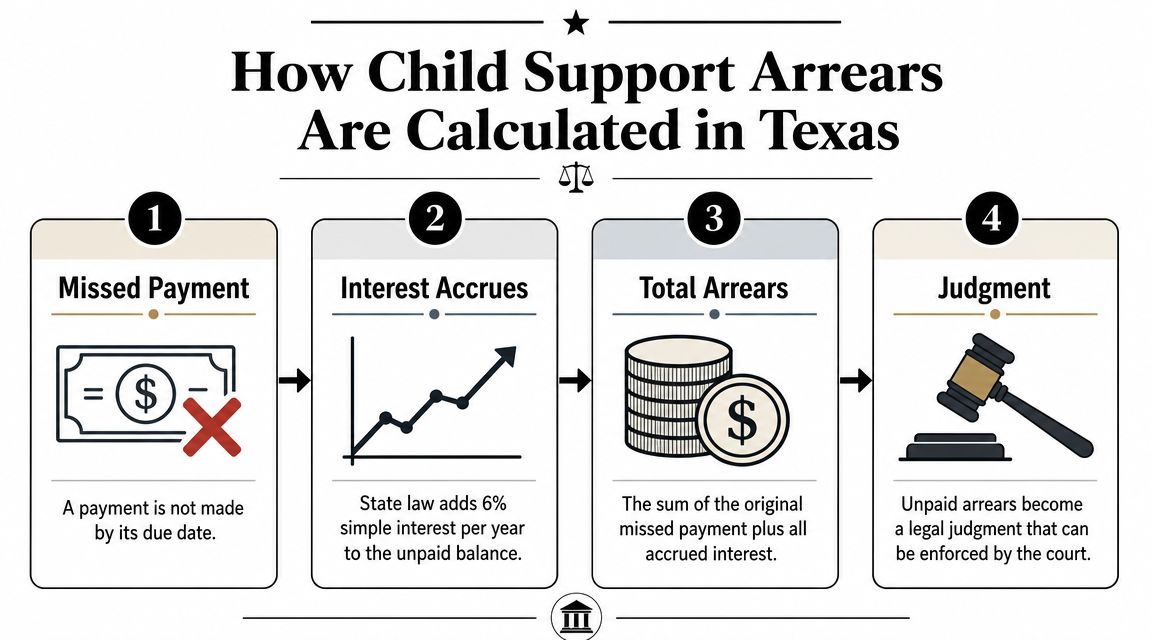
Texas law treats unpaid support as a debt that keeps earning interest. Under Texas law, unpaid child support accrues 6% interest, and arrears remain collectible until the debt and interest are paid in full, as explained by Texas Law Help's child support guidance.
The basic calculation
Each month, compare what the order required with what was paid.
- Start with the ordered amount. Use the amount in the signed court order, not what you believed was fair.
- Subtract what was paid. If the payment was short, the unpaid portion becomes arrears.
- Add interest. Texas applies statutory interest to the unpaid balance.
- Repeat for each missed or partial payment.
A simple example
Assume your order required a monthly payment. If you missed one payment entirely, that unpaid amount becomes part of your arrears. If you missed another payment later, that unpaid amount is added too. Interest applies to what remains unpaid.
The key point is not the exact hypothetical total. The key point is that every unpaid amount keeps following you. Even if current support has ended, old arrears don't vanish.
For readers trying to understand the underlying support amount in the first place, this guide on how to calculate child support in Texas helps explain the starting number that later turns into arrears if it isn't paid.
What people often misunderstand
A few misconceptions show up again and again:
- “I paid something, so I shouldn't be in arrears.” Partial payments reduce the balance, but they don't erase the unpaid portion.
- “The child is grown, so the case should be over.” Current support may end, but arrears stay due.
- “Terminated parental rights wiped out what I owed.” Existing arrears still survive until the debt and interest are paid.
If your balance looks inflated, don't assume the system is right or wrong. Verify it line by line against your own payment history.
Where disputes usually happen
Disputes over arrears often come from record problems, not bad faith. Common issues include:
- Direct payments not credited because they weren't processed through the usual payment channel
- Old withholding gaps when an employer failed to deduct correctly
- Informal agreements between parents that were never approved by the court
- Medical, dental, or retroactive support amounts being added to withholding
This is why the first smart move isn't arguing. It's getting the accounting, matching it to your records, and identifying exactly where the disagreement starts.
Texas Child Support Enforcement and Collections
Once arrears build up, Texas doesn't rely on one collection method. The system uses several at once. That matters because many parents think they can avoid trouble if they change jobs, work irregularly, or stop responding. In practice, enforcement often reaches far beyond a paycheck.
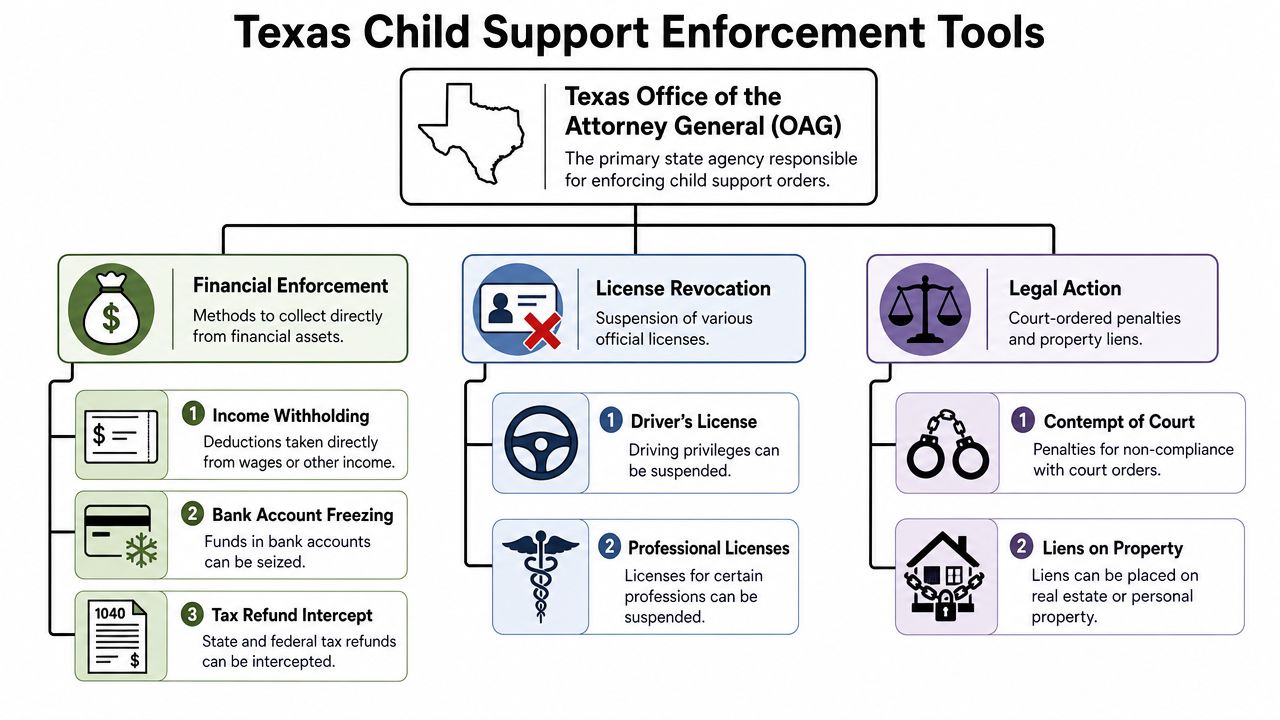
Texas-focused legal analysis explains that enforcement tools can include liens on bank accounts or property, interception of federal income tax refunds, garnishment of Social Security retirement benefits, interception of civil settlements, insurance payouts, and lottery winnings, as described in this overview of Texas child support arrears enforcement tools.
What enforcement looks like in real life
For some parents, enforcement begins unannounced. A tax refund never arrives. A bank account is frozen. A settlement check is intercepted before they even touch it.
For others, the pressure is more visible:
- Income withholding takes money directly from earnings
- Liens attach to property or accounts
- Refund interception diverts federal tax refunds
- Asset interception can reach certain payouts and windfalls
- Court enforcement can lead to contempt proceedings
If you're trying to understand the broader process from the collection side or enforcement side, this resource on how to enforce child support in Texas provides a useful overview.
Why avoidance usually fails
Parents sometimes believe they can wait things out. That's usually a mistake.
A parent with irregular income may think wage withholding won't matter, but other assets can still be targeted. A parent who no longer has current child support due may assume enforcement is over, but arrears collection can continue after the child support period itself ends. A parent expecting a civil settlement or insurance payment may not realize those funds can be intercepted.
The state doesn't need your case to fit one pattern. It has multiple collection paths, and it can use more than one of them.
A practical enforcement map
| Enforcement tool | What it can affect | Why it matters |
|---|---|---|
| Wage withholding | Earnings and some income streams | Ongoing collection without waiting for voluntary payment |
| Liens | Bank accounts, real property, personal property | Limits access to assets and sale proceeds |
| Tax refund intercept | Federal tax refunds | Captures lump sums many parents count on |
| Intercepted payouts | Civil settlements, insurance, lottery winnings | Reaches money outside routine wages |
| Court action | Compliance through court orders | Raises the risk of contempt findings |
What works better than waiting
The parents who usually put themselves in the strongest position do three things early:
- They confirm the amount being claimed.
- They stop new arrears from accumulating if circumstances changed.
- They show the court or the Attorney General a realistic plan instead of excuses.
That doesn't erase debt. It often changes how the case moves.
Defenses and Relief from Child Support Arrears
A parent often comes in after an enforcement notice arrives, convinced the case is only about punishment now. That is usually the worst point to wait. Texas courts do not like to erase valid arrears, but parents still have real options to reduce damage, correct the record, and stop a bad situation from getting worse.
The first question is not always, "How do I deal with the old balance?" In many cases, the better question is, "How do I stop new arrears from piling up next month?" That is especially true if the parent is on SSI, became disabled, lost earning capacity, or has income so low that the current order no longer reflects reality.
Texas Law Help explains that SSI is not counted as income for child support in the usual way, and that issue can support a request to reduce support, including to zero in the right case, as discussed in this Texas child support overview. The mistake I see is delay. Parents wait until arrears are large, then try to argue about fairness at an enforcement hearing. By then, the court is often looking backward at missed payments that already accrued.

File the right motion early if your circumstances changed
If your support amount no longer matches your ability to pay, the usual procedural step is a Petition to Modify the Parent-Child Relationship. That filing asks the court to change future child support. It does not wipe out arrears that already vested, but it can stop a broken order from creating new debt.
Parents with SSI-only income, serious disability, or a sharp long-term income drop should usually gather more than one document before filing. Bring the Social Security award letter or benefit verification letter, recent bank statements, medical records or disability paperwork if available, proof of current housing and living expenses, and any financial information sheet required by the court or requested by the Office of the Attorney General. If you were incarcerated or recently released, include release records, proof of job search efforts, and evidence of current income.
The hearing matters. Judges want specifics. They will usually focus on whether the change is material and substantial, whether the parent has earning capacity beyond the claimed disability or low income, and whether the proof is current and organized. A parent who walks in with only a verbal explanation is in a weaker position than a parent who files the modification, serves the other side, brings updated records, and asks for relief before more payments come due.
If your immediate problem is that you cannot keep up with the current order, this guide on steps to take when you can't afford child support anymore gives a useful starting point.
SSI, disability, and low income can change the path
These cases need careful handling because the legal answer is not the same for everyone.
- SSI-only income may support setting future support at $0, but you still need a signed court order. The SSA letter by itself does not change your obligation.
- SSDI or other disability income does not automatically mean support goes to zero. The court may still calculate support differently depending on the income source and any derivative benefits paid to the child.
- Low-income status can justify a lower amount, but the court may still expect some support if there is countable income.
- Incarceration can support modification in some cases, but it is not a blanket defense to arrears that accrued before a modified order was signed.
That last point causes a lot of trouble. Texas support orders keep running until they are changed by the court. A parent may have a strong reason for nonpayment and still lose ground by waiting.
Credits and arrears review can matter as much as a defense
Some parents do not need forgiveness. They need the ledger fixed.
Arrears balances are sometimes inflated by missing credits, direct payments that never hit the state record, or duplicate entries. If you paid the other parent directly, covered agreed expenses in place of support, or have proof that the balance claimed is off, ask for an arrears review and be ready to prove every dollar. Useful documents include payment histories from the state disbursement unit, cancelled checks, money order receipts, bank records, text messages confirming receipt, and emails discussing how payments were handled.
Judges do grant credits in the right case. They do not grant them based on general memory or a stack of unlabeled screenshots.
Relief is often procedural, not dramatic
Parents tend to look for one big solution. Most cases are resolved through smaller, targeted steps.
| Option | What it does | Trade-off |
|---|---|---|
| Petition to Modify the Parent-Child Relationship | Changes future support if circumstances materially changed | Does not erase vested arrears |
| Motion or request for arrears review | Tests whether the balance is accurate and fully credited | Requires organized records |
| Negotiated payment plan | Reduces immediate enforcement pressure through a structured proposal | The debt remains owed unless part of it is formally compromised |
| Agreed order with the other parent | Resolves disputes about credits or payment terms with court approval | Informal side agreements alone are risky |
A law office such as Law Office of Bryan Fagan, PLLC can help sort out which filing fits the problem. That matters because a modification, a credit claim, and a response to enforcement are different jobs. Filing the wrong thing wastes time you may not have.
Some parents need a defense. Some need a corrected balance. Some need a court-approved payment plan. The right answer depends on what created the arrears in the first place.
What usually fails
The fastest way to make an arrears case harder is to rely on informal fixes.
What tends to go badly:
- Verbal agreements that support would be paused or reduced
- Cash payments with no paper trail
- Waiting to file after disability, job loss, or release from jail
- Assuming SSI status alone changed the order without a judge signing one
- Showing up to enforcement court without records, payment history, or a pending modification
Parents also ask whether debt relief in another court can solve this problem. It usually cannot. Child support is treated differently, and bankruptcy and child support obligations are handled under a different set of rules than ordinary unsecured debt.
The practical goal here is simple. Stop future arrears if the order no longer fits. Check whether the balance is accurate. Put a documented plan in front of the court before enforcement pressure gets worse.
The Role of Bankruptcy in Child Support Arrears
A common question is whether bankruptcy can wipe out child support debt. The short answer is no. Child support is treated very differently from ordinary consumer debt.
That means a bankruptcy filing doesn't erase arrears the way it might affect credit cards, medical bills, or other unsecured obligations. If you're researching the overlap between family law and debt relief, this explanation of bankruptcy and child support obligations is a helpful starting point.
What bankruptcy can and cannot do
What it usually cannot do
- Discharge child support arrears
- Eliminate ongoing support obligations
- Cancel enforcement exposure just because a case was filed
What it may still help with
- Create structure around other debts so cash flow improves
- Provide a framework for dealing with total financial pressure
- In some situations, support an organized repayment approach rather than chaotic collection pressure
Why this distinction matters
Parents sometimes delay taking family-court action because they assume bankruptcy will solve the problem later. That delay can be costly.
If the issue is that your support order no longer matches your income, bankruptcy is not the substitute for a modification. If the issue is a disputed arrears balance, bankruptcy is not the substitute for an arrears review. If the issue is an upcoming enforcement hearing, bankruptcy is not the substitute for court preparation.
Bankruptcy may help with the broader financial picture. It is not a reset button for child support arrears.
The practical value of discussing bankruptcy with the right lawyer is coordination. You may need one plan for family court and another for your overall debt load. Confusing the two often leads to missed opportunities in both.
Practical Steps to Address Your Child Support Arrears
When parents feel overwhelmed, they often try to solve everything at once. That usually leads to delay. A better approach is to work in sequence.
Start with the paperwork. Then move to correction. Then move to negotiation or court action.
A working checklist
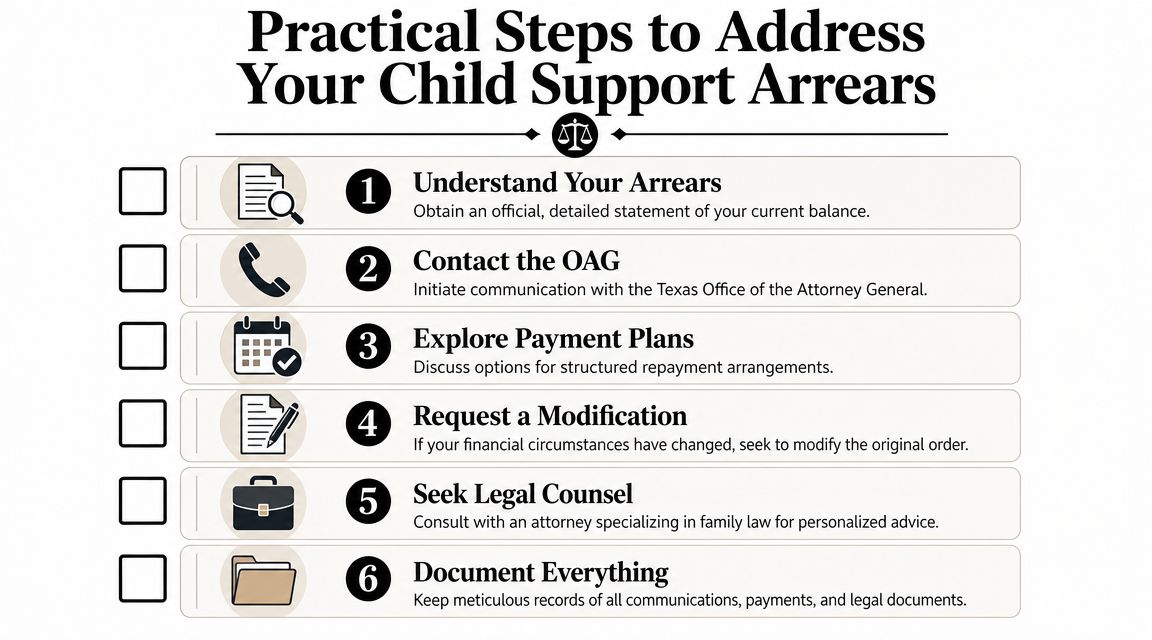
Request the official arrears balance.
Get a current accounting through the proper child support channels so you're working from the same baseline the state is using.Build your own payment file.
Gather bank statements, receipts, cancelled checks, money order stubs, wage withholding records, texts, and emails. Put them in date order.Compare line by line.
Don't just look at the total. Check which months are marked unpaid or underpaid. That's where errors usually surface.Identify the core issue.
Ask whether your problem is one of these:- a wrong balance,
- an inability to pay under the current order,
- an enforcement threat,
- or some combination of all three.
Before moving to the next steps, it may help to hear a practical overview of how these cases unfold:
What to do after you know the numbers
Once the records are organized, the next steps become clearer.
- Contact the enforcement side with documentation. If the amount appears correct but you need time, a payment arrangement may reduce immediate friction.
- File for modification if your circumstances changed. This matters most when you're still accruing new support you can't pay.
- Prepare for court if a hearing is pending. Bring organized records, proof of income, proof of disability if applicable, and proof of any payments not reflected.
Keep one rule in mind
Every communication, payment, and filing should be documented.
| Task | Why it matters |
|---|---|
| Save proof of every payment | Prevents future credit disputes |
| Keep copies of notices | Helps you track deadlines and hearing dates |
| Organize income records | Supports modification or payment-plan requests |
| Preserve SSI or disability documents | Critical if ability to pay is a legal issue |
Parents often lose strong arguments because the papers are scattered, incomplete, or missing. The facts may be on your side. You still have to prove them.
When to Hire a Texas Family Law Attorney
A parent usually calls a lawyer at the point where the problem stops feeling manageable. The notice says enforcement. A hearing date is set. The arrears balance looks wrong. Income dropped because of disability, job loss, or a shift to contract work, and the case is now bigger than a few phone calls and payment receipts.
That is the right time to get legal help.
Hire a Texas family law attorney if any of these apply:
- You have been served with an enforcement motion, contempt action, or court setting
- You may be facing jail time for alleged nonpayment
- You believe the arrears amount is inflated or missing payment credits
- You need to file a modification because your income changed
- Your case involves SSI, disability benefits, or a serious question about ability to pay
- You paid support directly and need the court to recognize those payments
- You are self-employed, paid in cash, or have irregular income that is hard to document
- Another state is involved, or you are unsure which court has authority
- You are close to missing a deadline or already missed one
These cases turn on details. A small recordkeeping problem can become a finding that you owe more than you actually owe. A missed hearing can lead to orders that are hard to undo. If disability or low income is part of the story, the court still needs the right motion, the right exhibits, and a clear explanation of what happened and when it changed.
I tell parents this often. The lawyer's job is not only to argue in court. It is to get ahead of the problem before an avoidable mistake becomes a contempt risk, a license suspension, or a judgment that follows you for years.
Good legal help matters most when there is still something to preserve. That may mean contesting the arrears calculation, presenting proof of direct payments, asking for a payment plan, filing a modification for current support, or raising defenses tied to inability to pay. It may also mean giving straight advice when a weak argument will only make the judge less receptive to the strong ones.
If you need help with a Texas child support arrears case, including enforcement, modification, SSI or disability issues, or a disputed balance, contact Law Office of Bryan Fagan, PLLC for a free consultation.