
A missed child support payment in Texas rarely feels like a simple bookkeeping problem. For one parent, it may mean rent, groceries, school supplies, or child care suddenly become harder to cover. For the other, it may mean panic after a job loss, illness, or another setback, followed by fear about court, jail, or losing a license.
Both sides usually want the same thing at the start. They want to know what happens next, what Texas law allows, and what can still be fixed.
Under Texas law, child support is a court-ordered obligation. What happens when child support is not paid in Texas depends on why the payment was missed, how long the problem has continued, and whether the parent who owes support takes action quickly. Texas has a clear enforcement system, and there are also clear steps available for a parent who can't pay.
That Sinking Feeling When a Child Support Payment Is Missed
You check your bank account in the morning because support usually posts by now. It isn't there. If you're the parent receiving support, your mind often jumps straight to the practical problem. How do I cover the electric bill, after-school care, or this week's groceries? If you're the parent who was supposed to pay, the feeling can be just as immediate. You may already know you can't make the payment, and now you're wondering how fast Texas can come after you.
That moment creates a lot of confusion because people often mix up three different issues. First, there is the court order itself. Second, there is the unpaid amount that starts building. Third, there are the enforcement tools the state or a court can use if the problem continues.
Two parents can be in very different situations
A parent who refuses to pay despite having the ability to do so faces one kind of legal problem. A parent who lost a job, became disabled, or was incarcerated faces another. Texas law treats those situations differently, but only if the facts are raised properly and at the right time.
Practical rule: A missed payment should never be ignored, whether you're the parent owed support or the parent who fell behind.
Many families are surprised by how formal this area of law is. Child support isn't an informal promise between parents. It is a court order, usually enforced through the Texas family court system and the Office of the Attorney General. That means missed payments can turn into collection actions, court hearings, and in some cases contempt or criminal exposure.
The first question to ask
Start here: Was the payment missed because someone won't pay, or because someone can't pay right now?
That question shapes almost everything that follows. If you're owed support, the answer helps you decide whether to work through the Attorney General or hire private counsel. If you're behind, the answer determines whether you should be preparing to pay, negotiating a plan, or filing a modification as fast as possible.
Understanding Child Support Orders Arrears and Interest
A Texas child support order is a legally binding court order. It is not a suggestion, and it does not pause automatically because someone's income changed. Once a payment is missed, the unpaid amount becomes arrears, which means past-due child support that is still legally owed.
Texas treats arrears as serious debt. Under Texas Family Code § 157.265, child support arrears accrue 6% simple interest per year. That means the balance can grow while the parent who owes support is already struggling to catch up.

What arrears really mean
People often assume a missed payment can be fixed later with an informal agreement. That is where trouble starts. Unless the court changes the order, the original amount remains due. The unpaid portion becomes a legal debt tied to the existing order.
That matters because Texas enforces arrears aggressively. A Houston Chronicle-based report on Texas child support arrears noted that nearly half a million parents in Texas were behind on child support, with an unpaid balance close to $11 billion. That tells you two things. First, this problem is widespread. Second, the state has a strong reason to devote major enforcement resources to it.
Why parents get caught off guard
The most common misunderstanding is this: people think support changes when life changes.
It doesn't. Not by itself.
If a parent loses a job on Monday, the court order still controls on Tuesday. If a parent is out of work for months, the order still controls unless a judge signs a modification. That is why arrears can grow so fast.
A child support order keeps operating until the court changes it. The real danger often isn't immediate jail. It's a debt that keeps growing while you wait.
A simple example
Suppose a parent had every intention of paying but was laid off and stopped sending support while looking for work. If no modification was filed, each missed month still becomes arrears. Interest still applies. Enforcement can still begin. The court may later consider whether the parent had the ability to pay, but the missed support does not vanish.
The practical takeaway is straightforward:
- Order first: The signed court order controls.
- Arrears next: Any unpaid amount becomes past-due support.
- Interest follows: Texas adds interest under Family Code § 157.265.
- Enforcement comes after that: The state or the other parent can act to collect.
The State's Enforcement Toolkit Common Civil Penalties
Texas does not start every unpaid child support case with a jail hearing. In many situations, enforcement begins with administrative and civil collection tools. These are the practical methods the state uses to collect money and pressure compliance before a judge imposes contempt sanctions.
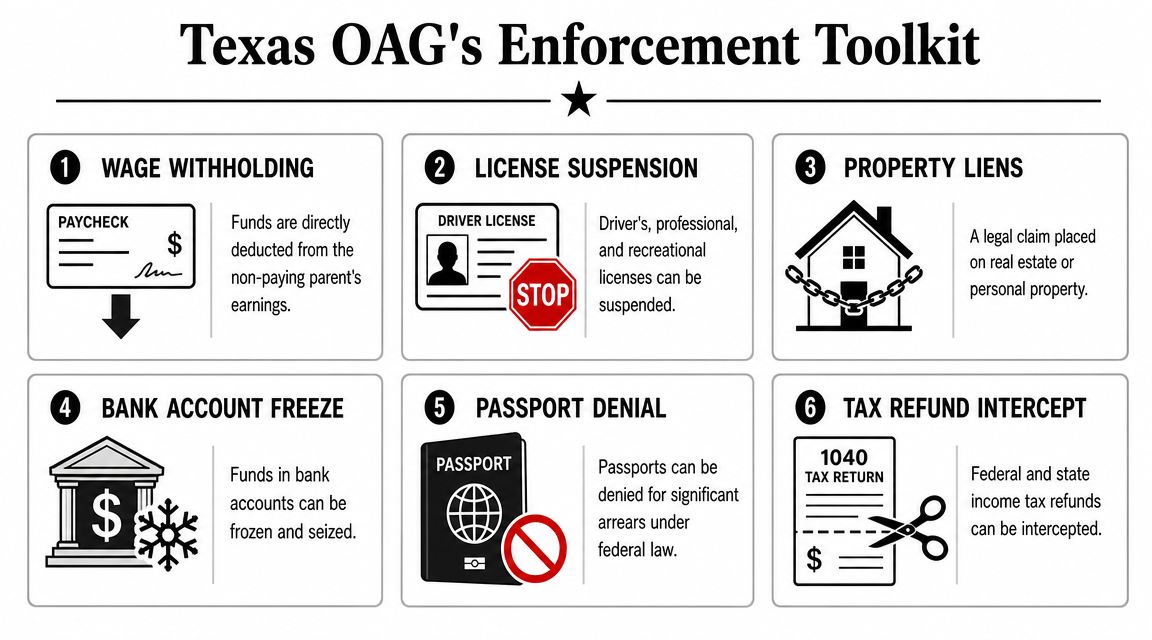
Wage withholding is often the first major step
One of the most common enforcement tools is an income withholding order. Texas can direct an employer to deduct child support from the obligor's paycheck and send it through the proper payment system. For many families, this is the most efficient way to stabilize payments because it takes the transfer out of the parents' direct conflict.
If you're the parent owed support, wage withholding often feels like the first sign that the system is finally doing something concrete. If you're the parent paying support, it can feel abrupt, but it is a standard enforcement mechanism.
Other civil collection tools can hit daily life hard
When wage withholding is not enough, or when it is not available, Texas can use other collection methods. These can affect property, accounts, and routine activities.
- Property liens: The state can place liens on certain property, including real estate or personal property. A lien can complicate a sale or refinance until the debt issue is resolved.
- Bank account seizure: Funds in bank accounts may be frozen or taken through enforcement procedures.
- Tax refund intercepts: Child support arrears can lead to intercepted tax refunds and other government payments.
- License suspension: A parent can face suspension of a driver's license, professional license, and even recreational licenses.
- Passport problems: Significant arrears can also affect passport issuance under federal enforcement mechanisms.
Why license suspension matters so much
License suspension often causes more disruption than people expect. Losing the ability to drive can affect work, child exchanges, and basic errands. Losing a professional license can threaten income at the exact time a parent most needs to earn money and get current.
That is why a parent who has fallen behind should not assume silence is safer than communication. In many cases, the earlier you address the issue, the more options you have for a payment arrangement or modification request before the consequences expand.
A public reminder that Texas takes enforcement seriously
Texas also maintains a public evader program through the Attorney General. The Texas Child Support Evaders list has featured people owing $57,997 for support of one child and $126,274 for support of one child. Public posting shows how unpaid support can move beyond routine collection into a much more visible enforcement process.
Civil enforcement is designed to collect support, not just punish nonpayment. But the practical effect can still be severe if a parent waits too long.
For many parents, the most important point is this: unpaid child support in Texas can affect your paycheck, bank account, tax refund, licenses, property, and travel. Even before a contempt hearing, the pressure can become intense.
Going to Court Contempt and the Threat of Jail Time
A common turning point looks like this. A parent misses support, then misses again, and then a court notice arrives with a hearing date. At that point, the case is no longer sitting in a file somewhere. A judge is about to ask what happened, what was possible, and what needs to happen now.
When collection tools have not solved the problem, the case can come back before the family court through a Motion for Enforcement. That request asks the judge to match the order against the payment record, calculate what was missed, and decide whether the failure to pay should be treated as contempt.

For the parent owed support, this hearing can be the first moment the court directly addresses repeated nonpayment. For the parent who is behind, it is also a chance to show the judge the full story with documents, work history, medical records, or proof that a modification should have been requested sooner.
What contempt means in a child support case
Contempt is the court's way of enforcing obedience to its orders. In plain terms, the judge is asking whether the parent was ordered to pay, knew about the order, had the ability to comply, and failed to do so anyway.
If the judge finds willful nonpayment, the consequences can include jail time, community supervision, a repayment schedule, attorney's fees, and court costs. Texas courts can use confinement as a contempt remedy in child support enforcement cases. That is one reason these hearings need to be taken seriously from the start.
For a closer look at the enforcement process, this discussion of how to file contempt of divorce decree is useful because the same court-enforcement principles often apply in family law orders.
The hearing usually turns on one issue
The central question is willfulness.
Many parents hear that word and get stuck. A missed payment alone does not answer it. The court looks at whether the parent could have paid and chose not to, or whether a real barrier made payment impossible.
That difference matters a great deal. A parent who kept working, had available funds, and ignored the order is in a very different position from a parent who lost a job, became disabled, or faced another serious setback and can prove it with records.
A useful comparison is rent after a storm damages a home. If someone has the money and refuses to pay, the court sees a choice. If income stopped and the person can show why, the court sees a problem that needs proof and a plan.
What both parents should bring to court
Judges usually focus on practical evidence, not broad claims.
- The payment record: what the order required and what was paid
- Ability to pay: income, bank records, assets, employment status, and recent changes
- Reason for nonpayment: job loss, illness, incarceration, or deliberate refusal
- Efforts to fix the problem: partial payments, communication, job search records, or a filed modification request
This short video gives more context on how these hearings can unfold:
For the parent owed support, organized records help the judge see a clear pattern. For the parent who cannot pay, the goal is different but just as concrete. Show the court that the problem is real, documented, and being addressed.
Walking into an enforcement hearing with no paperwork is a mistake. Walking in with pay stubs, medical proof, job applications, tax returns, and a realistic payment proposal gives the judge something useful to work with.
If a parent skips the hearing or ignores court orders, the judge may issue a bench warrant. If that has already happened, this guide on how to resolve a bench warrant fast explains the basic process.
When Non-Payment Becomes Criminal Nonsupport
A missed payment can start as a family court problem and, in some cases, turn into a criminal case. That shift matters. Once the state treats the conduct as criminal nonsupport under Texas Penal Code § 25.05, the case is no longer only about collecting overdue support. It is also about whether a parent intentionally or knowingly failed to support a child.
That difference can confuse people, especially parents who assume all child support cases stay in family court. Civil enforcement focuses on getting the order followed. Criminal nonsupport asks whether the parent's conduct crossed a line the state can prosecute.
The consequences are heavier. A conviction can bring jail time in a state jail facility, along with a criminal record that can follow a parent into job applications, housing searches, and professional licensing questions. If you want a practical overview of how unpaid support can be enforced before a case reaches that point, this guide on how to enforce child support in Texas is a helpful starting place.
For the parent owed support, this is the key takeaway. Long-term nonpayment is not always treated as simple delay or disorganization. If the facts suggest deliberate refusal, the state may become involved in a more serious way.
For the parent who is behind, the lesson is different but just as important. Silence can look like avoidance. Ignoring notices, skipping court dates, and making no effort to pay or modify the order can make a bad situation look worse. A judge or prosecutor will often look for signs that a parent tried to address the problem, even if full payment was impossible.
Missed hearings can also trigger warrants. If that has happened, learn how to resolve a bench warrant fast and take action quickly.
Criminal nonsupport is serious, but it is not a dead end. The parent owed support should keep records and report ongoing nonpayment through the proper channels. The parent who cannot pay should get legal advice, gather proof of income and hardship, and ask for a modification before the arrears problem starts looking like intentional refusal.
For the Parent Owed Support A Plan to Enforce Your Order
A missed payment can feel like the floor drops out from under your month. Rent is due, school costs do not pause, and your child still needs the same routine, meals, and care. If support has stopped, the goal is not only to prove that money is owed. The goal is to choose the enforcement path that fits your facts and gets results.
Texas gives you more than one way to act. Some parents do best through the state system. Others need a private attorney because the case is more urgent, more contested, or harder to trace.
Option one is working through the Attorney General
The Texas Office of the Attorney General Child Support Division can help enforce an existing order. In practical terms, that usually means opening or updating your case, submitting a copy of the order, and sharing current information you have about the other parent, such as an employer, address, or possible assets.
This route often works well if the case is straightforward and you want a lower-cost enforcement option. It can also be a good fit when wage withholding is likely to work because the paying parent has regular employment.
Option two is hiring private counsel
A private family law attorney can file a Motion for Enforcement and ask the court to address the missed support directly. That can matter when the other parent is self-employed, paid in cash, changes jobs often, moves frequently, or ignores earlier collection efforts.
If you want a practical overview of what that process looks like, this guide on how to enforce child support in Texas explains the main steps.
One possible option in Texas is speaking with Law Office of Bryan Fagan, PLLC or another private family law firm to decide whether court enforcement, contempt allegations, or an arrears judgment makes more sense than waiting on agency action alone.
OAG enforcement vs private attorney enforcement
The difference is often similar to using a standard claims process versus hiring someone to press your specific case. Both can work. The better choice depends on how simple or difficult collection is likely to be.
| Feature | OAG Child Support Division | Private Family Law Attorney |
|---|---|---|
| Cost structure | Usually available without private attorney fees | Involves legal fees |
| Who handles the case | State child support enforcement system | Attorney focused on your specific case |
| Best fit | Straightforward collection matters | Contested, urgent, or complex enforcement |
| Speed and personalization | Process-driven and high-volume | More individualized strategy |
| Court advocacy | Enforcement services through the agency process | Direct representation in hearings and filings |
What to gather before you act
Good records make enforcement easier. A judge, attorney, or agency worker needs a clean paper trail, not a general sense that payments have been late.
Start with these items:
- Court order: Keep the signed child support order and any later modifications.
- Payment history: Save bank records, OAG payment logs, or your own written records showing what was missed and when.
- Contact details: Gather employer names, job information, addresses, social media clues, and any recent updates you have.
- Written communications: Preserve texts, emails, and messages that show promises to pay, excuses, admissions, or refusals.
A simple folder can help more than people expect. Child support enforcement often works like building a timeline brick by brick. Each document helps show the court what was ordered, what was paid, and what remains unpaid.
If support has stopped, treat documentation like evidence, not clutter. What you save now may matter later in court.
For the Parent Who Cannot Pay Your Options and Next Steps
If you've fallen behind because life changed suddenly, the worst move is doing nothing. Child support does not stop on its own. It keeps coming due until a judge signs a new order.
Texas guidance also makes an important point many parents miss. A court can impute income to an unemployed or underemployed parent, often at minimum wage, even if the parent isn't earning that amount, as explained in this Texas Law Help child support resource. That is one reason arrears can keep building after a layoff or reduction in hours.
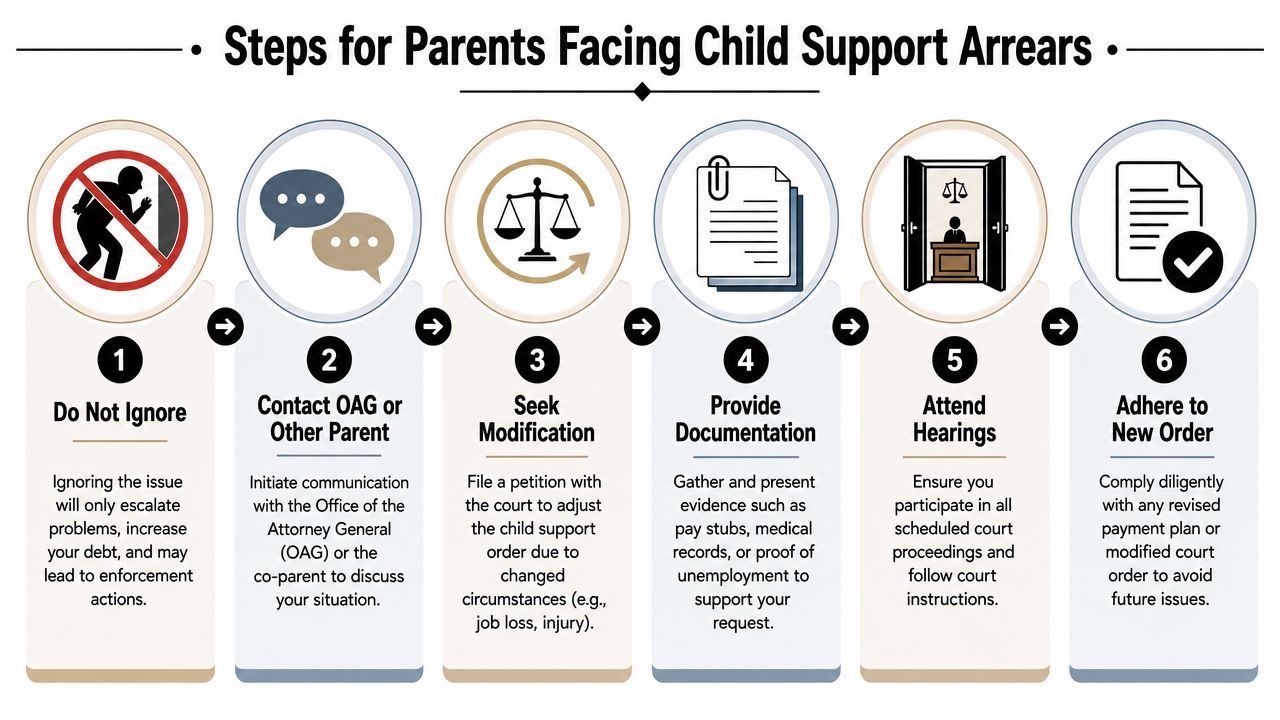
The first move should be proactive, not defensive
If you cannot pay the ordered amount, file for a modification as soon as possible. A modification can ask the court to lower support going forward based on a material and substantial change in circumstances such as job loss, disability, or another major shift.
It usually will not erase what is already owed. But it can stop the future balance from growing at the old level.
What you should do right away
Different facts call for different strategies, but these steps help in most situations:
- Keep paying what you reasonably can: Partial payments may show good-faith effort, even if they do not satisfy the full order.
- Document the reason: Save termination letters, medical records, benefit information, and job search materials.
- Seek modification quickly: This is often the most important legal step after income drops.
- Show up to hearings: Missing court dates makes a bad situation much worse.
- Communicate carefully: If possible, communicate in writing and stay factual.
If you're dealing with this problem now, these steps to take when you can't afford child support anymore can help you think through the next move.
A realistic example
Suppose a parent loses a job, assumes the order will adjust later, and waits several months before filing anything. During that delay, the support order stays in force. Arrears continue. The court may still expect proof of job-search efforts and other facts showing inability to pay. By the time the parent acts, the debt may be far harder to manage than it would have been with an immediate filing.
What helps most is speed, documentation, and a willingness to deal with the problem directly.
If you need help navigating divorce, custody, or estate planning in Texas, contact Law Office of Bryan Fagan, PLLC today for a free consultation. Whether you're trying to enforce a child support order or you're struggling to pay and need to seek modification, specific legal advice can help you protect your rights, understand your options under the Texas Family Code, and take the next step with clarity.



