 Skip to content
Your parent has had a hospital stay, the bills are starting to pile up, and suddenly the old will on file doesn't feel like enough. That's the moment many Texas families realize elder law isn't about paperwork in a drawer, it's about whether someone can still pay the mortgage, sign a transfer, or make medical decisions without losing control of everything they've built.
A good elder law attorney Texas families can rely on doesn't just draft documents. The lawyer helps you protect a parent's dignity, preserve assets, and keep one crisis from turning into a court fight. In Texas, that usually means thinking about estate planning, Medicaid timing, guardianship alternatives, and what to do when a trusted person has already crossed the line.
When Your Family Needs More Than Just a Will
A daughter calls after her father's memory starts slipping, and the first question she asks is whether his old will is still valid. That's not the primary problem. The primary problem is that the bills still need to be paid, the bank wants authority, and nobody in the family is sure whether Dad can safely sign anything now.
That's where elder law starts to matter. A basic will decides where property goes after death, but elder law deals with the much harder question of what happens while a person is still alive, but losing capacity. Texas families need a plan for decision-making, care, and asset protection before a crisis forces bad choices.
If you're trying to keep track of medical paperwork, bank information, insurance cards, and legal documents for an older parent, a care organizer can save time and stress. A practical place to start is a Family Folder senior care system so the family has one place to find the documents that matter most.
Practical rule: If a parent can't safely manage bills, treatment decisions, or property on their own, the issue is no longer just estate planning. It's elder law.
Texas families often wait too long because they assume a will, a power of attorney, and a few named decision-makers will solve everything. Sometimes they do. Sometimes they don't, especially when health declines fast, a caregiver becomes overinvolved, or a Medicaid deadline is already close.
Core Services a Texas Elder Law Attorney Provides
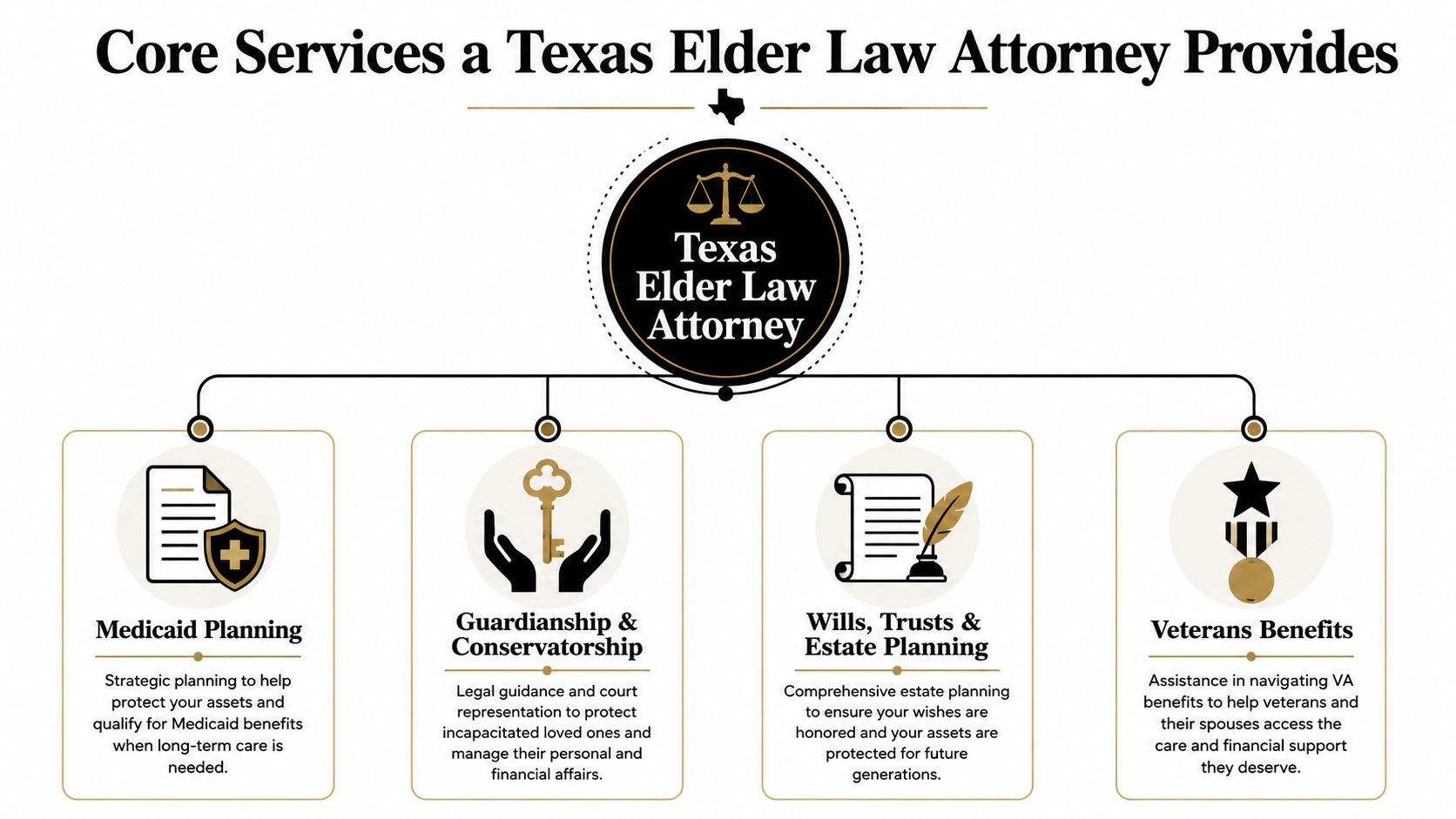
A Texas elder law practice is not just about drafting papers. It is about building a plan that works when a caregiver is overwhelmed, a bank is demanding proof of authority, or a parent can no longer make safe decisions on their own.
Families usually run into the crisis-response side of elder law first. A lawyer has to know how to stop bad planning from spreading, fix documents that no longer fit the situation, and keep one mistake from turning into a court fight or a benefits denial.
Medicaid planning and long-term care
This is often the first real pressure point for families, even before they understand why. Medicaid planning helps prepare for nursing-home or other long-term care costs while avoiding mistakes that can block eligibility later. A lawyer should review whether the family needs Estate Planning tools such as trusts, wills, and powers of attorney as part of a broader protection strategy.
The timing matters because rushed transfers can create problems that are hard to fix later. A lawyer who understands Texas long-term care rules should look at what can be protected now, what has already been moved, and what should be left alone.
Guardianship and alternatives
When an adult cannot make safe decisions, Texas law requires the court application to address whether alternatives to guardianship were considered and whether they are feasible, under Texas Estates Code § 1101.001. A lawyer should start with the least restrictive option that can still protect the person, including supported decision-making, a durable power of attorney, or practical family assistance.
That approach matters because guardianship is a court process, and court control should not be the first answer if a legal tool already solves the problem.
Wills, trusts, and estate planning
A well-drafted estate plan still matters, but elder law uses those documents for a different purpose. A trust may help preserve control, a will may direct probate property, and powers of attorney may keep a family from needing a guardianship petition later. For a family facing dementia or a sudden stroke, those documents can make the difference between orderly administration and a court-supervised mess. They can also help unlock your time, because fewer legal breakdowns mean less scrambling for the adult child who is already handling care.
A strong plan also needs the right medical authority in place. The medical power of attorney in Texas lets someone make health care decisions when the parent cannot, and that authority has to work alongside the financial documents, not replace them.
Probate and benefits coordination
After death, probate may be required to transfer property and settle the estate. Before death, public benefits can become the central issue. Texas families often need both tracks handled together, because a problem in one can affect the other.
A lawyer also has to watch for the hidden crisis points that generic planning misses. If a caregiver has taken control of accounts, if a transfer was made at the wrong time, or if someone is draining funds under the cover of “helping,” the legal response has to be immediate and specific.
A strong elder law plan is less about having more documents, and more about having documents that work when a hospital, bank, or court asks for them.
Texas families get hurt most often when they wait until the nursing home admission packet is on the table. Medicaid long-term care planning turns on timing, and the federal 60-month look-back period sits at the center of it. If assets move inside that window, eligibility can be delayed, and the family ends up paying privately when it expected Medicaid to help.
The hard truth is simple. Waiting shrinks your options. Earlier planning gives the lawyer more room to use lawful tools such as irrevocable trusts, spousal resource planning, or other exempt transfers. That does not mean every family needs the same strategy. It means the family that starts early usually has more legal paths to choose from.
A Texas report cited in a major local media segment said 70% of people age 65 and older will need some type of long-term care, and about 20% will need care for 5 years or longer. Those figures explain why middle-income families feel trapped. They are often too “rich” for emergency aid and too dependent on fixed income to self-fund care for very long. The Fox 26 Houston segment on elder law also noted the state's aging trend, which is one reason these cases keep growing.
What the timing changes
If your parent has already made transfers, the lawyer has to work with the transfer rules rather than around them. If your parent has not transferred anything yet, the lawyer may still be able to build a cleaner path. That is why the same family can end up with very different options depending on when they call.
Bottom line: Medicaid planning is a timing strategy, and the clock matters.
You can also see the same issue from a care-coordination angle. Families that organize appointments, documents, and communications early often buy themselves breathing room, which is why some people use care services to unlock your time while they focus on the legal decisions that cannot wait.
For a deeper look at the property side of this problem, the article on how to protect assets from nursing home explains the logic families should understand before they sign anything or move money.
Protecting Seniors From Financial Exploitation and Abuse
A lot of families assume elder law is about planning ahead. It isn't only that. It's also about stepping in when an older adult's money, authority, or trust has already been abused. Texas resources for older adults frequently mention guardianship problems, revocation of powers of attorney, identity theft, debt issues, and exploitation, which tells you how common these cases really are.

If a caregiver is pressuring your parent, draining accounts, or controlling access to documents, the first legal question is simple, who still has lawful authority, and who shouldn't. A misused power of attorney may need to be challenged or revoked. A representative payee may need to be removed. In some cases, asset recovery or a guardianship challenge becomes necessary.
What families should document first
Start with dates, bank statements, text messages, care records, and any signed documents. Don't wait for the situation to “prove itself.” The faster the family builds a timeline, the faster a lawyer can determine whether the problem is bad judgment, confusion, or actual abuse.
The Texas advocacy resource from Lone Star Legal Aid's older-adult project is useful because it highlights the exact kinds of matters families run into, including exploitation, guardianship challenges, and revocation of powers of attorney. That makes it a good practical reference point for people who need to understand what can be done, not just what went wrong. Lone Star Legal Aid's Justice for Older Adults project reflects that broader pattern.
If the concern is financial misuse rather than a full incapacity issue, families can also use consumer-focused tools to build a safer response. A practical resource on financial safety with Koru can help families think about how to organize protection steps while legal work is underway.
Later in the process, the question becomes whether the family can undo the damage quickly enough to protect the remaining assets. That may mean court action, but it may also mean a precise demand to stop access, a new decision-maker, or a benefits review before more harm is done.
A lawyer handling these cases should be comfortable moving between planning and crisis response. That is the standard, not the exception.
How to Choose the Right Elder Law Attorney in Texas
A general lawyer can draft a will. That is not enough for an older parent facing Medicaid problems, guardianship risk, or a disputed power of attorney. You need a lawyer who can handle the whole picture, because elder law cases usually involve incapacity, benefits, property control, and the need to stop a problem before it spreads.
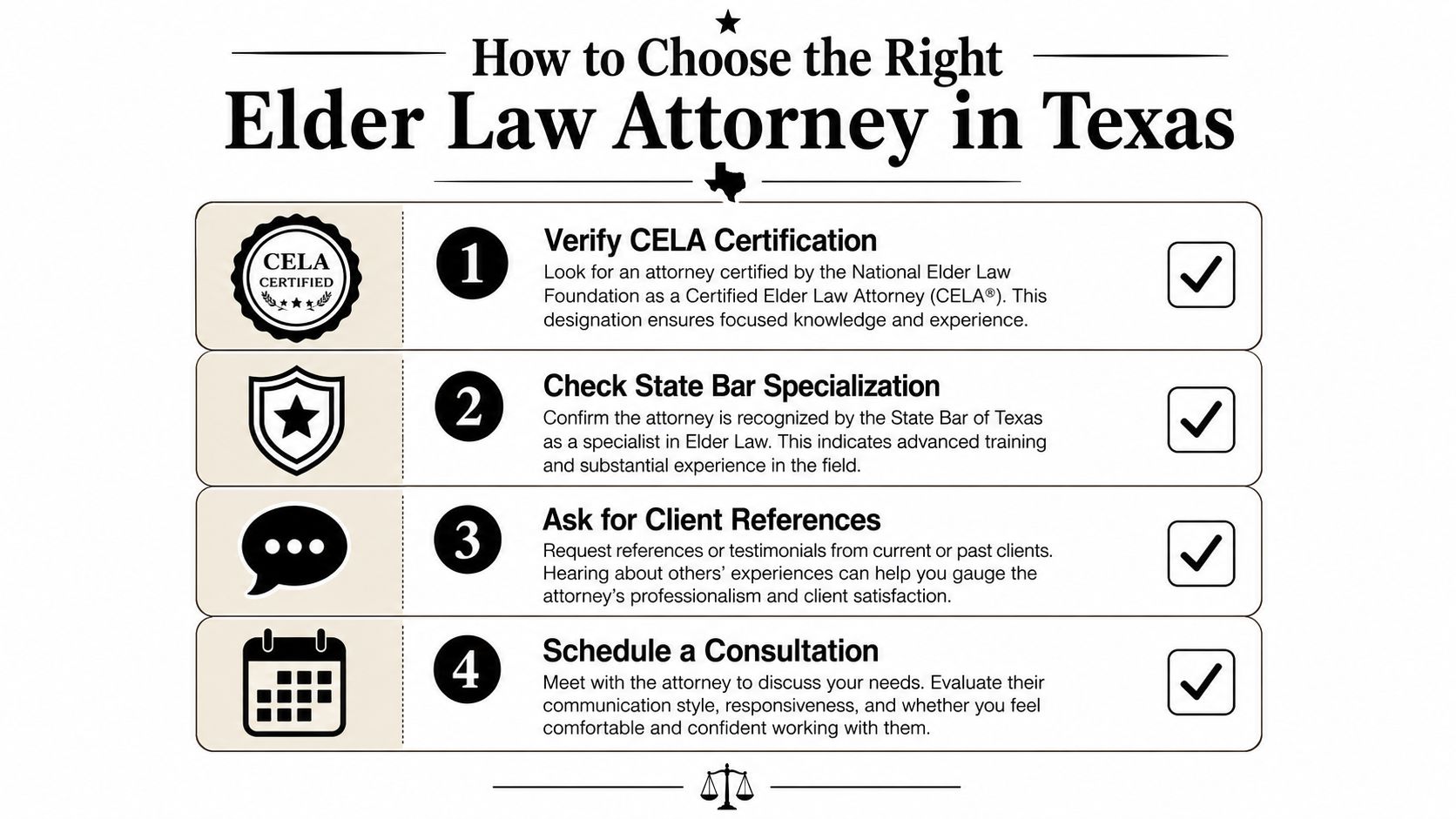
Compare credentials, not just titles
The strongest credential to look for is the Certified Elder Law Attorney (CELA) designation. NELF's rules require substantial involvement in elder law for the three years before applying, including at least 60 elder law matters and at least 45 hours of elder-law continuing legal education, plus five attorney references and a certification exam, according to the NELF certification rules. That gives you a real standard to measure against instead of relying on a broad practice description.
A good Texas elder lawyer should also know the state's power of attorney rules cold. Texas Law Help says a power of attorney must be in writing, name the agent, be signed and notarized, and the principal must be 18 or older and of sound mind when signing. If the agent will handle real estate, the document must be filed with the clerk in each county where the property is located. Those details are not trivia. They decide whether the document holds up when a bank, title company, or family member challenges it.
Ask direct questions in the consultation
Bring a list and get answers that sound specific. Ask whether the lawyer handles Medicaid planning, guardianship defense, probate, and exploitation cases. Ask how they review powers of attorney, whether they work with tax issues when needed, and how they address the 60-month look-back problem.
Use the consultation to compare the lawyer's estate-planning and probate support with any other attorney you are interviewing, including the Law Office of Bryan Fagan, PLLC. A firm's friendliness matters less than its ability to solve your family's exact problem right now.
Practical rule: If the lawyer cannot explain the difference between avoiding guardianship and winning a guardianship case, keep looking.
Understanding Elder Law Costs and Fee Structures in Texas
Texas elder law has a real market, and families should expect real pricing. One independent cost survey estimates about 1,707 active elder law attorneys statewide, with an average hourly rate of $261 and an average total case cost of $8,040 Texas elder law cost survey. The same source says Texas elder-law rates are about 3% below the national average of $270/hour.
| Texas Elder Law Cost Overview | ||
|---|---|---|
| Metric | Texas Value | National Context |
| Active elder law attorneys | About 1,707 | Statewide availability in a major legal market |
| Average hourly rate | $261 | About 3% below the national average of $270/hour |
| Average total case cost | $8,040 | Reflects the specialized nature of the work |
The fee structure usually depends on what you need. Hourly billing makes sense for contested matters or complicated planning. Flat fees may work for document packages. Retainers are common when a lawyer expects ongoing advice, revisions, or coordination across benefits and probate issues.
Costs rise when the matter is urgent, when assets are complex, or when family members disagree. That's why a late call often costs more than an early one. A simple consult today can prevent a larger Medicaid or guardianship mess later.
The best way to budget is to ask three things up front. What work is included, what triggers extra fees, and what the likely next step will cost if the situation changes. The more specific the answer, the easier it is to compare lawyers fairly.
For a fuller breakdown of billing questions, see the firm's guide on elder law attorney cost. That kind of cost transparency is useful before you commit to a representation agreement.
Taking the Next Step to Protect Your Family's Future
Elder law is not a one-time document run. It's an ongoing legal relationship that changes when health changes, assets shift, or a caregiver starts making decisions that don't look right. Texas families usually need a blend of planning, crisis response, and careful follow-through.
If you only remember three things, make them these. First, don't wait for a hospitalization to think about Medicaid timing. Second, don't assume a power of attorney is valid just because someone says it is. Third, don't ignore signs of exploitation while you're trying to be polite.
The Legal Hotline for Texans can be a smart first call for older Texans age 60 or older, and it also offers advice on Medicaid, Medicare, and long-term care Legal Hotline for Texans. That's a good triage step when you're not sure what issue comes first. After that, a private elder law lawyer can help you build the actual plan and handle the documents or court steps that follow.
If your family needs guidance on Medicaid planning, guardianship alternatives, exploitation concerns, probate, or powers of attorney, don't wait for the next crisis to force the issue. Get the documents reviewed, the risks mapped out, and the right strategy in place while you still have options.
If you need help navigating divorce, custody, or estate planning in Texas, contact The Law Office of Bryan Fagan today for a free consultation. Our team helps families protect assets, prepare for incapacity, and respond to elder law crises with practical Texas-focused guidance. Visit Law Office of Bryan Fagan, PLLC to schedule your free consultation and get clear next steps for your family.


