
Divorce can be one of life’s most difficult transitions—but understanding your rights under Texas law can make it less overwhelming. When you’ve spent years building a significant estate, the process can feel even more complex. The fear of losing what you’ve worked so hard for is real, but a clear understanding of the legal landscape can empower you to protect your future.
In Texas, a high net worth divorce generally describes a case where a couple’s marital estate is valued at at least $1 million. This isn't just a standard divorce with more zeros; it's about untangling a complex financial life that demands a much higher level of legal and financial skill.
What a High Net Worth Divorce Means for You

What truly defines a high-net-worth divorce isn't just the dollar amount, but the sheer complexity of the assets. This complexity is why these cases require a far deeper financial dive than a typical divorce.
Key Characteristics of These Cases
The assets involved usually go well beyond a family home and a 401(k). We’re often looking at a sophisticated portfolio that needs to be handled with precision and expertise.
Common elements we see in these cases include:
- Business Ownership: Putting a fair value on a family business or professional practice is a critical—and often contentious—part of the process.
- Complex Investments: This can involve everything from stock options and private equity holdings to hedge funds and other non-traditional financial instruments.
- Real Estate Holdings: Multiple properties, like vacation homes, rental portfolios, or commercial real estate, all need to be professionally appraised before they can be divided.
- Trusts and Inheritances: Figuring out how trusts and inherited assets are treated under Texas law is a specialized field in itself.
The Importance of Financial Transparency
Unfortunately, financial disputes are a major driver of divorce. In fact, economic pressures are the second-leading cause of divorce across all income levels. For affluent families with complex portfolios, these issues are magnified. Financial dishonesty can take sophisticated forms, like hiding assets in offshore accounts, creating complex trust arrangements, or making undisclosed business deals. You can learn more about how financial issues contribute to divorce statistics to better understand these challenges.
Under the Texas Family Code, there is a presumption that all property acquired during the marriage is community property. This means it belongs to both spouses and must be divided in a "just and right" manner.
This bedrock principle is where every divorce case starts. In a high-net-worth divorce, however, proving which assets are separate property (anything owned before the marriage or received as a gift or inheritance) becomes a much more detailed and crucial fight.
With the right legal team, you can protect your separate property and ensure the community estate is divided fairly and equitably.
How Texas Community Property Law Applies to Complex Estates
At the heart of every Texas divorce lies a powerful legal rule known as community property. The law starts with the assumption that everything you and your spouse acquired from your wedding day until the divorce is filed belongs to the marital estate, to be divided between you.
In a high-net-worth divorce, however, that starting point is often just the beginning of a more complicated financial puzzle. The lines between "mine," "yours," and "ours" can become incredibly blurred, especially when you're dealing with complex assets built up over decades.
The Texas Family Code is very clear about what isn't community property. This is called separate property, and it typically includes:
- Assets you owned free and clear before the marriage.
- Property you received as a gift meant only for you during the marriage.
- An inheritance you received during the marriage.
Protecting what you can prove is your separate property is a cornerstone of preparing for a high-net-worth divorce. But this is where the real fight often begins.
The Problem of Commingled Assets
What happens when separate property gets mixed in with community funds? We see this all the time. It’s a process called commingling, and it’s one of the biggest financial hurdles in a complex divorce.
Here's a common scenario: imagine you inherited $200,000 from a relative (your separate property). You deposit that money into a joint savings account that you and your spouse use for everyday expenses. Over the years, you both deposit your paychecks (community property) into that same account. You use the funds to pay the mortgage, invest in stocks, and take family vacations.
Years later, when the divorce is filed, that original $200,000 is no longer clearly identifiable. It's been completely mixed—or commingled—with community funds. The law now presumes the entire account is community property. Without pristine records, proving which slice of that account is still legally yours is an uphill battle.
Tracing and Reimbursement Claims
To pull your separate property back out of a commingled account, Texas law demands a process called tracing. This isn't a simple task. It requires creating a perfect financial paper trail—think bank statements, deeds, and receipts—that follows the separate asset from its origin all the way to its current form. It's a meticulous, detail-heavy process that almost always requires a forensic accountant.
Texas Family Code § 3.001 sets the stage for this entire process. It legally defines separate and community property and establishes the powerful presumption that everything you own at the time of divorce is community property. To overcome this, a spouse must prove an asset is separate with "clear and convincing evidence."
What if you used your separate money to benefit the community? For instance, maybe you used $100,000 from your pre-marital savings as the down payment on the family home. In that case, you may have a reimbursement claim. This is a legal tool that allows you to be repaid from the community estate for the separate funds you contributed.
Getting the classification of your estate right isn't just a box-checking exercise; it is the absolute foundation of a fair property division. To go deeper on these rules, you can learn more about the community property essentials for Texas divorces in our detailed guide. Protecting what you brought into the marriage requires a smart strategy, rock-solid documentation, and an experienced attorney who lives and breathes the nuances of complex Texas estates.
The Critical Process of Business and Asset Valuation
In a high-net-worth divorce, what you see on a balance sheet is rarely the whole story. The real challenge—and where fortunes are protected or lost—lies in accurately valuing the complex assets that define your wealth, such as privately-held businesses, professional practices, real estate portfolios, and sophisticated investments.
Getting this step right is the foundation of a fair property division. It’s not just about crunching numbers; it demands a deep understanding of financial modeling and Texas law. Without a precise and defensible valuation, you risk leaving a staggering amount of money on the table or agreeing to a split that simply isn't just and right.
Why Professional Valuation Experts Are Essential
For many couples, the most valuable asset they own is a business they poured their lives into. But how do you put a fair price on a company that isn't traded on the stock market? This is where professional valuation experts become your most critical allies.
Bringing in forensic accountants and certified valuation analysts isn’t just a good idea—it’s a necessity. These experts act as neutral financial detectives, using established, court-accepted methods to uncover the true fair market value of your assets.
Their work isn't a quick glance at the books. They will:
- Analyze Financial Statements: They dig deep into years of profit and loss statements, balance sheets, and cash flow records to see what the numbers really say.
- Evaluate Market Conditions: They analyze industry trends, economic conditions, and what comparable businesses are selling for.
- Forecast Future Earnings: Using sophisticated financial models, they project the business's capacity to generate income down the road.
Understanding how these experts operate is key. For instance, many use advanced techniques like discounted cash flow analysis. Learning what a DCF model entails for business valuation can give you a better grasp of the sophisticated tools used to arrive at a value. Their unbiased analysis gives the court a credible, defensible number that serves as the bedrock for negotiations or a judge's final ruling.
To better understand how these complex assets are typically assessed, the table below summarizes common valuation methods used in Texas high-net-worth divorces.
Key Assets in High Net Worth Divorce and Their Valuation Methods
| Asset Type | Common Valuation Method | Key Consideration |
|---|---|---|
| Privately-Held Business | Income Approach (DCF), Market Approach | Distinguishing between personal and enterprise goodwill, which is critical in Texas. |
| Professional Practice | Income Approach, Asset Approach | Valuing intangible assets like client lists and reputation (goodwill). |
| Commercial Real Estate | Income Approach (Cap Rate), Sales Comparison | Market rental rates, vacancy rates, and recent comparable sales. |
| Stock Options/RSUs | Black-Scholes Model, Intrinsic Value | Vesting schedules and determining the portion that is community property. |
| Trusts | Review of Trust Documents, Asset Appraisal | Identifying whether trust assets are separate or community property. |
| Retirement Plans (401k/Pensions) | Actuarial Valuation, Account Statements | Calculating the community property portion earned during the marriage. |
This table illustrates that there's no one-size-fits-all approach. Each asset requires a specific methodology to ensure its value is accurately represented for a fair division.
Understanding the Three Main Valuation Approaches
Valuation experts generally lean on one or a combination of three standard methods to pin down a business's worth. Each looks at value from a different angle, and the right approach often depends on the type of business we're talking about.
The Asset Approach: This is the most direct method. It’s essentially a balance sheet calculation: take the total value of all business assets and subtract the total liabilities. This works best for asset-heavy businesses, like real estate holding companies, where the value is tied up in tangible things.
The Market Approach: Think of this like pricing a house. An expert looks at what similar, privately-owned companies have recently sold for. It provides a real-world sanity check on the value, but it can be tricky if there aren’t many comparable sales to draw from.
The Income Approach: For a profitable, service-based, or growing business, this is often the go-to method. It focuses entirely on the company’s ability to make money in the future. The expert calculates the present value of all anticipated future earnings, giving a clear picture of its true economic engine.
And of course, figuring out what needs to be valued in the first place is paramount. Assets that start as separate property can easily get mixed with community funds, changing their legal character entirely.
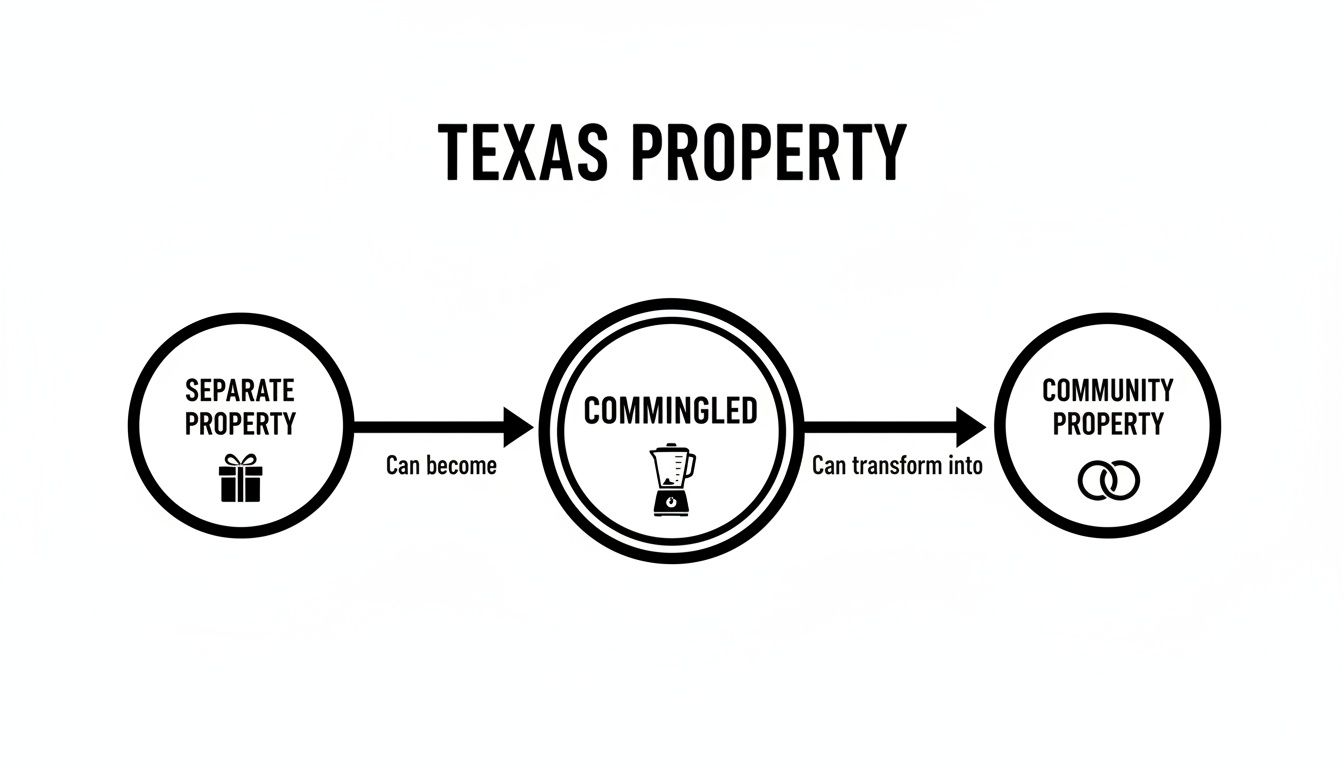
This chart shows just how easily that line can blur, which is why it's so important to have an expert trace and value every significant asset that might be on the table.
The Texas Distinction: Personal vs. Enterprise Goodwill
When it comes to professional practices—like a surgeon's clinic, a successful law firm, or an accounting practice—Texas law draws a bright and incredibly important line around the concept of goodwill. Goodwill is that intangible value tied to a business's reputation, brand, and loyal customer base.
In Texas, goodwill is split into two distinct types: personal goodwill, which is tied to the unique skill, reputation, and talent of one spouse, and enterprise goodwill, which is the value that exists within the business itself, no matter who is running it.
This isn't just legal hair-splitting; the financial implications are massive. Personal goodwill is considered the separate property of the professional spouse and is not divided in the divorce. Enterprise goodwill, on the other hand, is a community asset that must be valued and split.
Drawing the line between these two can dramatically alter the final property award by hundreds of thousands, or even millions, of dollars. If a family business is part of your marital estate, it’s worth reading our deeper dive into startup company valuations in a Texas divorce.
Uncovering Hidden Assets and Ensuring Full Financial Transparency

One of the biggest anxieties in any divorce is the nagging fear that your spouse isn't being honest about money. When significant assets are involved, that concern gets dialed way up. Complex financial structures can make it much easier to hide or undervalue property.
The good news? You don't have to take their word for it. Texas law provides powerful tools to demand total financial transparency, ensuring the final property division is based on a complete and accurate picture.
You aren’t expected to just trust the other side to do the right thing. The legal system is built to compel full disclosure through a formal process called discovery. This is a structured, court-supervised exchange of information where both spouses are legally required to answer questions and provide documents—truthfully and completely.
This isn't just a friendly request; it's a legal demand backed by the full authority of the court. Failing to comply comes with serious penalties, which creates a powerful incentive for everyone to lay their financial cards on the table.
The Tools of Formal Discovery
During the discovery phase, your attorney will deploy several legal instruments to gather the evidence needed to build a comprehensive map of your marital estate. Each tool is designed to uncover a specific piece of the financial truth.
- Requests for Production: These are formal, written demands for your spouse to produce specific documents. We’re talking about everything from bank and credit card statements to business records, loan applications, tax returns, and real estate deeds.
- Interrogatories: Think of these as written questions your spouse must answer under oath. They're perfect for getting specific information that might not show up in a document, like a list of all bank accounts opened during the marriage or an explanation for a series of large cash withdrawals.
- Depositions: This is sworn testimony given outside of court but under oath. Your attorney gets to question your spouse directly about their finances, asking follow-up questions in real-time and locking in their answers on the official record.
These tools work together to create a detailed financial picture, leaving very little room for assets to stay hidden in the shadows. If you're worried about what your spouse might be doing, our attorneys can explain in detail what happens if your spouse hides assets in Texas and how the law protects you.
The Role of the Forensic Accountant
While legal tools force the information out, a forensic accountant is the financial detective who can actually make sense of it all and find what's missing. In a high-net-worth divorce, their role is often indispensable. They are trained to spot the red flags that most people—even attorneys—would miss, and they know how to trace money through the most complex financial webs.
A forensic accountant does more than just check the math; they look for patterns and anomalies. They might conduct a lifestyle analysis to see if a spouse's spending matches their reported income, or trace funds that were quietly moved to offshore accounts or unfamiliar shell companies.
For example, a forensic accountant might notice a family business is suddenly paying huge "consulting fees" to a new company owned by a distant relative—a classic tactic to siphon cash out of the marital estate. By uncovering these moves, they provide the hard evidence needed to prove that hidden assets exist and ensure they get included in the property division.
The sad reality is that financial disputes are a primary driver in high-asset separations. Statistics show that around 42-45% of U.S. marriages end in divorce. While money stress affects all couples, the unique challenges facing affluent families—from valuing a business to untangling complex investments—often pour fuel on the fire. You can explore more insights on divorce rate data to understand these trends.
By demanding full transparency from the start, you protect your rights under Texas community property law and pave the way for a property division that is truly just and right.
Strategic Paths to Resolving Your Divorce
When you're facing a high-net-worth divorce, the thought of a public, drawn-out court battle can be daunting. The good news is, you're not automatically destined for that fight. While traditional litigation certainly has its place, many couples discover that alternative, more private methods are far better for protecting their wealth, their privacy, and their business interests.
These strategic paths give you something invaluable: more control over the final outcome. That’s a critical advantage when every single decision carries significant financial weight. For many, the idea of a judge making the final call on a business you built from the ground up or assets you've managed for decades is just unsettling. Methods like Mediation and Collaborative Divorce shift that power right back into your hands, letting you and your spouse build a custom agreement with the guidance of trained professionals.
Mediation: A Confidential Negotiation
Mediation is a structured, private process where a neutral third-party mediator sits down with you and your spouse to help you negotiate a settlement. The mediator’s job isn't to make decisions for you. Instead, they facilitate communication, help you find common ground, and guide you through the sticking points.
This entire process is completely confidential, which is a massive benefit for high-profile individuals or business owners who need to keep sensitive financial details out of the public record.
The key benefits of mediation are straightforward:
- Complete Privacy: Every discussion, document, and offer made during mediation is confidential and can't be used against you in court if negotiations break down.
- Greater Control: You and your spouse—not a judge—have the final say on how your property is divided and how you’ll handle co-parenting.
- Cost-Effectiveness: Mediation is almost always significantly less expensive and faster than taking your case all the way to a trial.
Collaborative Divorce: A Team-Based Approach
Collaborative Divorce takes the cooperative spirit of mediation a step further. In this process, you, your spouse, and your respective attorneys all sign a binding agreement to resolve every issue without going to court. This commitment instantly creates a team-oriented environment focused on one thing: finding mutually beneficial solutions.
The core principle of Collaborative Divorce is transparency and problem-solving. It often involves a team of neutral experts, such as a financial professional and a child specialist, who work together to provide comprehensive guidance and support.
This approach is incredibly powerful in a high-net-worth divorce where complex financial matters demand specialized knowledge. The team works together to structure a settlement that is not just fair, but also financially intelligent, taking tax consequences and long-term wealth preservation into account.
The Power of Prenuptial and Postnuptial Agreements
A well-drafted marital agreement is one of the most effective tools available for protecting assets and streamlining a potential divorce. A prenuptial agreement, signed before the marriage, can clearly define separate property, shield business interests from division, and set clear expectations for how assets would be divided if the marriage ends.
Similarly, a postnuptial agreement, created during the marriage, can accomplish the same goals. Couples often use these to clarify their financial arrangements after a major life event, like starting a new business or receiving a large inheritance. When a divorce happens, a valid marital agreement can eliminate a huge amount of conflict by providing a clear, predetermined roadmap for dividing the estate.
When a marriage with significant wealth ends, the rules for financial support—both for a spouse and for children—get more complicated. The standard formulas that work for average-income cases just don't fit. You have to understand the specific rules in the Texas Family Code to know what to realistically expect.
Many people assume a high-income marriage automatically means a huge, long-term alimony check. That’s a myth in Texas. Here, what most people call alimony is legally known as spousal maintenance, and getting it is far from guaranteed.
Judges must follow a very strict set of eligibility rules. Spousal maintenance is usually only on the table if the spouse asking for it won't have enough property after the divorce to meet their basic needs and they meet other tough requirements, like being married for at least 10 years and being unable to earn a sufficient income.
Spousal Maintenance Caps and Limitations
Even if a spouse qualifies for maintenance, Texas law puts firm caps on how much they can receive and for how long. This is probably one of the biggest surprises for people going through a high-net-worth divorce.
Under Texas Family Code § 8.055, a court-ordered maintenance award can't be more than the lesser of these two amounts:
- $5,000 per month
- 20% of the paying spouse’s average monthly gross income
These legal limits mean that no matter how high one spouse's income is, Texas law prevents the kind of astronomical, open-ended support awards you might see in other states. The goal here is to provide temporary support to help a spouse get back on their feet, not to permanently equalize two different lifestyles.
Child Support Beyond the Guidelines
Child support calculations for high earners in Texas also have their own unique set of rules. The law uses a percentage-based formula on the paying parent's net monthly resources, but that formula only applies up to a certain income level. This "cap" is adjusted for inflation, and as of 2023, it was set at $9,200 in net monthly resources.
So, what happens when a parent earns far more than that? The court doesn't just apply the same percentage to their entire income. First, the judge applies the standard guidelines up to the $9,200 cap. After that, additional support can be ordered, but only if the receiving parent can show that the proven needs of the children justify it.
This is a crucial distinction. The focus shifts from a simple income percentage to a detailed analysis of the child's specific, demonstrable needs.
This means you have to build a case based on the expenses required to maintain the child’s standard of living. In high-income families, that might include things like:
- Private school tuition and all associated fees
- Specialized tutoring or high-level extracurriculars
- Travel expenses for family vacations and experiences
- Health insurance premiums and any uncovered medical or dental costs
- Regular contributions to a 529 college fund or a child's trust
A court won’t just take your word for it; you need to provide concrete evidence for these expenses. Simply proving one parent has a massive income isn't enough to get a massive child support award—you have to prove the children’s needs first.
Frequently Asked Questions About High Net Worth Divorce
When you're facing a high-net-worth divorce, the questions that keep you up at night are often complex and heavy. The future can feel incredibly uncertain when significant assets are on the line, but getting straight answers is the first step toward regaining a sense of control.
We've put together some of the most common questions we hear from clients to give you the clarity you need. Our goal is to explain how Texas law actually applies to your situation so you can start building a solid plan.
Is My Inheritance Considered Community Property in Texas?
In Texas, the short answer is no. Anything you receive as a gift or inheritance is legally considered your separate property, even if you received it during the marriage.
But here’s the critical part: you have to keep it separate. If you take that inherited money and drop it into a joint checking account or use it to buy a family vacation home, you risk commingling it. Once that happens, it can be nearly impossible to trace, and a court may treat it as community property, putting your inheritance on the table for division.
How Will My Professional Practice Be Valued in the Divorce?
Valuing a professional practice—like a medical clinic, dental office, or law firm—is a specialized process. It’s not as simple as just looking at the equipment and bank accounts. Experts will analyze everything from cash flow and tangible assets to something called "goodwill."
In Texas, the law makes a crucial distinction between personal goodwill (value tied to your specific reputation and skills) and enterprise goodwill (value tied to the business itself, independent of you). As a general rule, only the enterprise goodwill is considered a community asset that can be divided. Getting this right requires a forensic accountant who truly understands this specific Texas rule.
Can a Prenuptial Agreement Be Challenged in a Texas Court?
Yes, a prenup can be challenged, but it's a tough battle to win. For a challenge to succeed, the person fighting the agreement typically has to prove one of two things: either they didn't sign it voluntarily, or the agreement was "unconscionable" when it was signed because they weren't given a fair and reasonable disclosure of the other person's finances.
A well-drafted and properly executed prenup is one of the strongest asset protection tools available. When all the legal boxes are checked, Texas courts are very likely to uphold the agreement, providing a clear and predictable path for dividing property.
How Can I Protect My Business From Being Divided in the Divorce?
Protecting your business starts with figuring out its legal status. If you owned it before the marriage, it's your separate property. The main job then becomes proving its separate character and dealing with any community claims for reimbursement (for example, if community funds were used to grow the business).
If the business was started during the marriage, it’s community property. But that doesn’t mean you have to sell it and split the cash. Common strategies include:
- Negotiating a buyout of your spouse’s share.
- Giving your spouse other community assets of equal value.
- Creating a structured, long-term payment plan.
You can also use a postnuptial agreement to formally clarify ownership and shield the business from future disputes.
If you need help navigating divorce, custody, or estate planning in Texas, contact The Law Office of Bryan Fagan today for a free consultation. Our experienced attorneys are here to provide the tailored guidance you need to protect your future. Call us at (281) 810-9760 or visit us at https://www.bryanfagan.com.


