
Losing a loved one is one of life’s most profound challenges, made even more difficult by the complex legal system that follows. When someone passes away, their family is left to manage not just grief, but also final wishes and financial affairs. The probate process in Texas is the court-supervised path for handling these responsibilities, providing a clear, empathetic, and legal way forward for your family. As a firm deeply rooted in Texas family law, The Law Office of Bryan Fagan, PLLC understands the emotional and financial weight of this journey. Our expertise ensures your family is guided with both compassion and authority every step of the way.
Understanding the Texas Probate Process

It’s easy to think of probate as just another bureaucratic hurdle to jump through during an already difficult time. But it’s better to view it as the official framework for honoring a person’s final legacy. It’s the system our state has in place to make sure a will is legally recognized, an executor is formally appointed, and the estate’s assets are handled correctly.
The entire process is laid out in the Texas Estates Code, which provides the rulebook for everything from the initial court filing all the way to closing the estate. This legal code is the foundation of our work, ensuring every action we take is authoritative and trustworthy.
The Purpose of Probate
At its heart, probate serves several critical functions. It’s designed to protect the deceased’s wishes, the rights of their heirs, and the interests of any creditors. Understanding these goals helps make sense of why this legal journey is so important.
The probate process in Texas is designed to accomplish a few key things:
- Validating the Will: The court officially confirms that the will presented is the real, final testament of the person who passed away and that it meets all of Texas’s legal requirements.
- Appointing an Executor: The person named in the will (or appointed by the court if there’s no will) is given the legal power to manage the estate.
- Managing Estate Assets: This executor is responsible for finding, inventorying, and protecting all of the deceased’s property.
- Settling Debts and Taxes: Before anyone inherits anything, all legitimate debts and final taxes must be paid from the estate’s funds.
- Distributing Property: Once all debts are settled, the remaining assets are legally transferred to the beneficiaries named in the will or, if there’s no will, to the heirs determined by state law.
To give you a clearer picture, here’s a high-level look at how these goals fit into the overall probate timeline.
Key Stages of the Texas Probate Process
| Stage | Primary Goal | Typical Timeframe |
|---|---|---|
| 1. Initial Filing | File the will and application with the probate court to officially start the process. | 1-4 weeks after death |
| 2. Court Hearing & Executor Appointment | The court validates the will and formally appoints the executor. | 2-6 weeks after filing |
| 3. Notice to Creditors & Inventory | The executor notifies potential creditors and creates a detailed inventory of all estate assets. | Within 30-90 days of appointment |
| 4. Paying Debts & Taxes | The executor uses estate funds to pay all valid debts, funeral expenses, and final taxes. | 6 months to 1 year+ |
| 5. Final Distribution & Closing | Remaining assets are distributed to beneficiaries, and the estate is formally closed. | 9 months to 2 years+ from start |
This table provides a bird’s-eye view, but remember that every estate is unique. The actual timeline can shift based on the estate’s complexity and whether any disputes pop up along the way.
The Impact on Families and Children
For families, especially those with minor children, probate can be a source of major stress. Any delays or arguments can create financial uncertainty, which is the last thing a child needs. When an estate is tied up in court, assets needed for a child’s education, healthcare, or even just daily living expenses can be frozen, causing a huge disruption to their academic and emotional well-being.
Imagine a single parent passes away, leaving behind a teenager getting ready for college. If the probate process gets bogged down by a will contest or disorganized paperwork, the money set aside for tuition could be locked up for months, or even years. This kind of financial instability can have a profound, negative impact on a young person’s future, adding immense stress during a time of grief and affecting their ability to focus on school.
A smooth, well-managed probate process ensures that a child’s inheritance is protected and available when it’s needed most. It provides stability during a time of painful transition. At the Law Office of Bryan Fagan, PLLC, we are committed to guiding families through this journey with both empathy and expertise. If you’re facing the probate process in Texas, schedule a consultation with our team to discuss how we can help protect your family’s future.
Determining if Probate Is Necessary in Texas

One of the first questions we hear from grieving families is, “Does every single estate in Texas have to go through probate?” The answer, which usually brings a sigh of relief, is a definite no. The probate process in Texas isn’t a one-size-fits-all mandate.
In fact, Texas law offers several different paths for settling an estate, and formal probate is only required under certain conditions. Many assets can pass directly to loved ones without any court involvement whatsoever. Our experience at The Law Office of Bryan Fagan, PLLC allows us to quickly assess your situation and provide authoritative advice on the most efficient path forward.
Understanding Non-Probate Assets
These are what we call non-probate assets. You can think of them as having a built-in “express lane” for transfers after death. They are legally structured with a designated beneficiary who automatically inherits the asset, completely bypassing the will and the entire court system.
Ownership is determined by a contract or how the asset is titled, not by what’s written in the will.
Common examples of these non-probate assets include:
- Life Insurance Policies: The money is paid directly to the beneficiary named in the policy.
- Retirement Accounts (401(k)s, IRAs): Funds go straight to the designated beneficiary listed on the account.
- Payable-on-Death (POD) Bank Accounts: The balance is paid out to the person named as the POD beneficiary.
- Joint Tenancy with Right of Survivorship: If one owner of a jointly held property (like a house or bank account) passes away, the surviving owner automatically takes full ownership.
These tools are incredibly powerful because they give families immediate access to funds and assets, which can be absolutely crucial for financial stability after a loss. Good estate planning ensures these assets avoid the delays and costs of the Texas probate courts. For more on this, a comprehensive end-of-life planning guide can provide some valuable insights.
When Is Formal Probate Required?
So, when is formal probate truly unavoidable? It really boils down to the value of the assets left over—the ones that don’t have a named beneficiary.
Texas law generally requires probate for estates with a value over $75,000, not including those non-probate assets we just talked about. If the estate is under that threshold, it often qualifies for simpler, faster alternatives. This financial line in the sand is what determines if an estate needs formal court administration.
Probate becomes necessary when a court’s authority is needed to legally transfer title of property, settle disputes among heirs, or validate a will to appoint an executor with the legal power to act.
Streamlined Alternatives to Formal Probate
For smaller estates that fall below that $75,000 mark and meet a few other criteria, the Texas Estates Code provides much simpler, faster, and cheaper alternatives. These options can be a lifeline for families, cutting down on both the emotional and financial strain.
- Small Estate Affidavit: As authorized by Texas Estates Code Chapter 205, this is a sworn statement filed with the court that lets heirs collect the decedent’s property without a formal probate proceeding. It can only be used if there’s no will and the estate’s value (excluding the homestead and exempt property) is $75,000 or less.
- Muniment of Title: This is a unique Texas procedure used when there’s a valid will and no unpaid debts (other than those secured by real estate). The court essentially recognizes the will as a legal document that transfers ownership, almost like a deed.
Choosing the right path is vital. For families with children, avoiding formal probate means getting faster access to an inheritance that might be needed for school tuition or other living expenses, helping preserve a sense of normalcy during a tough time.
Understanding whether probate is truly necessary is the first step toward a more manageable and less stressful estate settlement. At The Law Office of Bryan Fagan, PLLC, we help families evaluate their options and choose the most efficient path forward. If you have questions about your loved one’s estate, schedule a consultation with our experienced team today.
Independent vs. Dependent Administration in Texas
When you find yourself navigating the Texas probate process, one of the biggest forks in the road you’ll encounter is the type of administration the estate will go through. This single factor can dramatically change the timeline, the cost, and frankly, the stress level for everyone involved. The Texas Estates Code lays out two main paths: independent administration and dependent administration.
Think of independent administration as the express lane for settling an estate. It’s faster, far less expensive, and doesn’t require the court to micromanage every single step.
On the other hand, dependent administration is like taking a long, scenic route with a tour guide—the court—who has to approve every single turn you make. Under this path, the executor has to get a judge’s permission for nearly everything, from paying a simple utility bill to selling a piece of property. While this constant oversight is meant to protect everyone, it can bog the process down and rack up legal fees.
For families, the difference is night and day. Imagine children waiting on an inheritance to pay for college tuition. A dependent administration could tie up those critical funds for months, adding a layer of financial and emotional strain to an already difficult time and potentially disrupting a child’s academic future.
Why Independent Administration Is the Go-To in Texas
There’s a very good reason why the vast majority of estates in Texas—around 80% of probate cases—are handled through independent administration. It’s all about efficiency. This streamlined approach gives the executor the freedom to manage the estate’s business without constantly running back to the courthouse.
Once the court appoints an independent executor, they can get to work collecting assets, paying off debts, selling property if needed, and distributing what’s left to the heirs. They can do all of this without needing a judge’s green light for each action. You can get more details on Texas probate laws and the different types of administration here.
This autonomy is a massive advantage. It means lower attorney’s fees, fewer court costs, and a much quicker path to closure for the family.
At its core, independent administration is built on trust. The court, acting on the wishes in the will or the agreement of the heirs, trusts the executor to do the right thing without needing constant supervision.
How to Qualify for Independent Administration
So, how does an estate get on this faster, more efficient track? It usually happens in one of two ways:
- It’s in the Will: The easiest way is when the person who passed away specifically requested an independent administration in their will. This is a hallmark of good, forward-thinking estate planning.
- All the Heirs Agree: If the will doesn’t mention it, or if there’s no will at all, all the beneficiaries can sign a written agreement asking the court for an independent administration. As long as the judge finds it’s in the estate’s best interest, they will almost always grant the request.
A Tale of Two Families: A Hypothetical Scenario
Let’s look at a hypothetical example. The Smith family’s father had a will that clearly requested independent administration. After one short court hearing, the executor he named was able to pay the final medical bills, put the family home on the market, and get the inheritance into the hands of the heirs—all within about eight months. The process was straightforward and let the family focus on grieving instead of legal hurdles.
Now, consider the Jones family. Their father died without a will, and old family tensions prevented the siblings from agreeing on an independent administration. The court had no choice but to order a dependent administration. Every single move—from paying the light bill on the empty house to hiring a real estate agent—required filing a formal motion and waiting for a court hearing. The process dragged on for nearly two years, slowly draining the estate with mounting legal fees and creating lasting bitterness. Worse, a teenage child’s college fund was tied up, putting their academic future in jeopardy and causing immense emotional distress.
This stark contrast shows just how much impact a single clause in a will can have. It can save a family from months of frustration and protect the financial well-being of the next generation. At The Law Office of Bryan Fagan, PLLC, we help families understand these critical distinctions every day. Schedule a consultation with our team to see how we can guide you through the probate process in Texas with clarity and confidence.
A Step-by-Step Guide to the Probate Timeline
Navigating the probate process in Texas can feel like trying to find your way through a new city without a map. It’s an overwhelming time, and the legal jargon doesn’t help. To bring some clarity, we’ve laid out a clear, step-by-step guide to the typical probate timeline. Think of this as your roadmap—understanding it can help your family feel more in control and prepared for the journey ahead.
This timeline breaks down the key milestones, from the moment a petition is filed with the court all the way to the final distribution of assets.
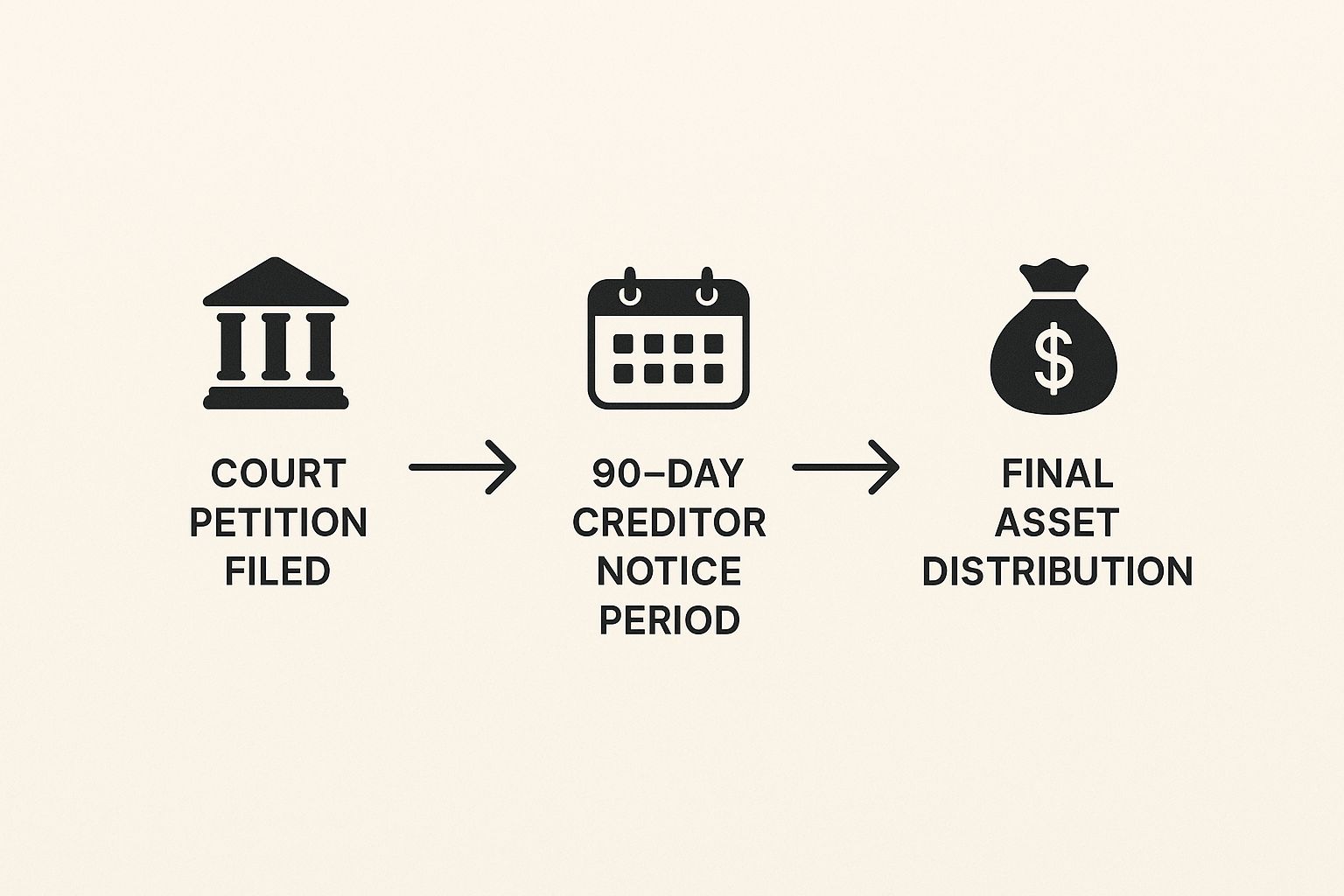
As you can see, the probate journey has distinct phases. Each one has its own purpose and required actions, ensuring the estate is settled in an orderly, fair way.
Step 1: Filing the Application with the Court
The probate journey officially kicks off when an application is filed with the right Texas probate court. This usually happens within a few weeks of a loved one’s passing and absolutely must be done within four years, according to the Texas Estates Code, Section 256.003. This initial filing involves submitting the original will (if there is one) and a formal request to open the estate.
Once that application is filed, a mandatory waiting period begins. The county clerk is required to post a public notice at the courthouse for at least ten days before any hearing can take place. It’s a formal step that ensures any interested parties know that a probate proceeding has started.
Step 2: The First Court Hearing and Executor Appointment
After the waiting period is over, the court holds a hearing. The main goals here are simple: formally recognize the will as valid and officially appoint the executor named in it. The judge will listen to some brief testimony to confirm basic facts, like the date of death and that the will is legitimate.
If everything is in order, the judge signs an order admitting the will to probate. This is a huge milestone. The court then issues “Letters Testamentary,” which is the official legal document giving the executor the authority to act on behalf of the estate.
Step 3: Notifying Creditors and Marshalling Assets
With the Letters Testamentary in hand, the executor’s real work begins. One of their first and most critical duties is to notify creditors. In Texas, this means publishing a notice in a local newspaper within one month of being appointed. Any known creditors also have to be notified directly.
At the same time, the executor has to create a complete list of everything the estate owns. This is known as the “Inventory, Appraisement, and List of Claims.” This detailed document, which must be filed with the court within 90 days of appointment, includes everything from real estate and bank accounts to personal belongings.
Think of the inventory as a complete financial snapshot of the estate. Its accuracy is vital for ensuring all assets are accounted for and properly managed, protecting the inheritance intended for the beneficiaries.
A Real-Life Example: The Martinez Family
Let’s imagine a scenario with the Martinez family. Mr. Martinez passed away, leaving a will that named his oldest daughter, Sofia, as the executor. The will stated his estate would be split between Sofia and her younger brother, Leo, who is still in high school. Feeling the weight of her new responsibilities, Sofia hired an attorney to guide her through the probate process in Texas.
Together, they filed the application, and after the hearing, Sofia received her Letters Testamentary. She immediately published the creditor notice and got to work on the inventory. In doing so, she discovered a savings account her father had specifically set aside for Leo’s college education.
A delay in filing the inventory could have frozen access to these funds. This might have disrupted Leo’s academic plans and added serious financial stress on top of his grief. By following the timeline correctly, Sofia made sure the funds would be available when needed, providing crucial stability for her brother during a vulnerable time and protecting his emotional and academic future.
Step 4: Paying Debts and Final Distribution
Once the creditor notification period ends, the executor’s next job is to pay all valid debts and final taxes using the estate’s funds. This has to be done before any assets can be handed over to the heirs.
After all obligations are settled, the executor can finally prepare to distribute the remaining property according to the will’s instructions. They will often draft a final accounting that shows all the money that came in and went out of the estate. Once the assets are distributed, they can file the last bit of paperwork to officially close the estate, concluding the formal probate process.
Understanding these steps can make the journey feel more manageable. At The Law Office of Bryan Fagan, PLLC, we are dedicated to helping families navigate this timeline with empathy and skill. Schedule a consultation with us to discuss how we can support your family and protect your loved one’s legacy.

Starting the probate process in Texas means dealing with more than just legal paperwork; it’s a journey through financial and emotional realities. It’s crucial for any family to have an honest conversation about the potential costs and the common hurdles they might face.
Knowing what to expect upfront helps manage expectations, allows for smarter decisions, and ultimately protects both the estate’s assets and your family’s well-being. The money side of probate is usually a top concern, and the total cost can swing wildly depending on how complex the estate is and whether any disputes pop up.
Even for a smooth, uncontested estate, there are several key costs to anticipate. These are the predictable expenses. The real wildcards, the ones that can send costs soaring, are the unexpected challenges that often surface along the way. Our experience at The Law Office of Bryan Fagan, PLLC has prepared us to handle these challenges with authority and care, ensuring your family’s trustworthiness in our firm.
A Transparent Look at Probate Expenses
The probate process in Texas isn’t free, but the costs don’t have to be overwhelming. For a simple, uncontested estate, most families can expect to pay somewhere between $3,000 and $7,000. This ballpark figure covers the essentials: court filing fees, attorney fees, and other administrative costs.
However, if the estate gets complicated or family disagreements flare up, those costs can easily jump past $10,000.
Here are the key expenses you should plan for:
- Court Filing Fees: This is the initial cost to get the probate case officially started with the court.
- Attorney’s Fees: Legal guidance is essential to get through probate correctly, and this is typically the biggest chunk of the total cost.
- Executor Compensation: The person managing the estate is entitled to be paid for their time and effort.
- Appraisal Fees: If the estate has unique assets like real estate or valuable art, you’ll likely need professional appraisals.
- Bond Premiums: For dependent administrations, the court might require the administrator to post a bond to protect the estate’s assets.
Beyond these fees, you’ll also have to manage ongoing financial responsibilities like property taxes. For anyone dealing with real estate in North Texas, a guide to property taxes in Dallas Texas can be a very useful resource.
Common Challenges That Escalate Costs and Timelines
While the administrative costs are fairly predictable, a few common problems can turn a straightforward probate into a long, expensive nightmare. These issues usually boil down to family dynamics or financial loose ends left by the deceased.
The biggest probate delays are rarely about legal procedure; they’re almost always personal. Unresolved family conflicts can grind the whole process to a halt, hitting not just the estate’s finances but the emotional health of everyone involved.
One of the most common roadblocks is a will contest, where an heir challenges the will’s validity. This immediately throws the case into litigation, a process that is both emotionally draining and financially costly. Another frequent problem is when beneficiaries fight over personal property, where items with little monetary value can spark intense arguments because of sentimental attachment.
Real-Life Scenario: Sibling Disagreement Over the Family Home
Let’s imagine a situation with two adult siblings, Anna and Ben, who inherit their mother’s house. The will says to split everything equally. Anna wants to sell the home immediately to help pay for her daughter’s college tuition. Ben, on the other hand, has lived in the home for years and wants to keep it, but he can’t afford to buy out Anna’s half.
This single disagreement stops the probate process in its tracks.
The siblings hire their own lawyers, and what should have been a simple division of an asset becomes a bitter legal fight. As the legal bills mount, they start eating away at the home’s equity, shrinking the inheritance for both of them.
This conflict doesn’t just hurt Anna and Ben. Anna’s daughter feels the stress, her college future now uncertain because of the family turmoil. This added layer of anxiety can directly impact her academic performance and emotional well-being. The damage strains family bonds for years to come, creating a painful legacy from one unresolved issue. Understanding these potential traps allows families to look for solutions like mediation before things escalate.
Getting through these challenges takes more than just legal know-how; it requires compassion. At The Law Office of Bryan Fagan, PLLC, we help families see these issues coming and resolve them efficiently. Schedule a consultation with our team to learn how we can protect your family’s assets and relationships through the probate process.
How an Experienced Attorney Can Guide Your Family
Navigating the probate process in Texas while grieving the loss of a loved one can feel like an impossible weight to carry. The emotional toll is heavy enough without the added pressure of confusing legal deadlines, stacks of court filings, and sudden financial responsibilities.
This is exactly where having an experienced probate attorney in your corner can make all the difference. Think of them as a dedicated guide for your family during a difficult journey. Instead of you having to decipher the complexities alone, they manage the intricate details so you can focus on what truly matters. They make sure every step—from filing the initial application to notifying creditors and finally distributing assets—is handled correctly and efficiently, building on our firm’s established expertise and authoritativeness.
Protecting Your Family’s Future and Well-Being
An attorney’s role goes far beyond just pushing paper. Their main goal is to protect your loved one’s legacy and, just as importantly, safeguard your family’s future.
A skilled lawyer helps by:
- Preventing Costly Mistakes: One wrong move or a misinterpreted legal requirement can lead to significant delays and financial penalties. An attorney ensures everything is done by the book, in full compliance with the Texas Estates Code.
- Minimizing Family Conflict: Money and grief can be a volatile mix. When disagreements pop up, a legal professional provides objective counsel and helps facilitate resolutions, which can be critical for preserving family relationships.
- Shielding Children’s Inheritance: Making sure any assets meant for minor children are properly managed and protected is a huge priority. Delays in probate can put funds needed for a child’s education and stability at risk.
An experienced attorney transforms a confusing legal process into a manageable path forward, providing the peace of mind that comes from knowing your loved one’s final wishes are being honored correctly.
By taking on the complexities of the probate court, a lawyer helps keep the process from becoming another source of stress that could negatively impact a child’s emotional well-being and even their performance in school. The stability an attorney provides can be a cornerstone for a child’s resilience during a period of loss.
At The Law Office of Bryan Fagan, PLLC, we get it. We understand how delicate these situations are, and we’re here to provide the compassionate, expert guidance your family deserves. Schedule a consultation with our team to talk about your specific circumstances and find out how we can bring you clarity and peace of mind.
Common Questions About the Texas Probate Process
Losing a family member is hard enough without having to figure out the legal maze that comes next. The probate process in Texas can feel overwhelming, but getting clear, straight-talk answers can make all the difference for your family. Here, we’ll tackle some of the most frequent questions we hear from families trying to find their footing.
Our goal is simple: to cut through the legal jargon and give you the straightforward information you need to move forward with confidence during a difficult time. As a trusted authority in Texas family and probate law, we believe in empowering our clients with knowledge.
How Long Do I Have to File for Probate in Texas After Someone Dies?
This is one deadline you absolutely can’t miss. According to the Texas Estates Code, Section 256.003, you generally have four years from the date of your loved one’s death to file an application for probate. It’s always best to start the process as soon as your family feels up to it.
If you wait longer than four years, you’re creating a serious legal headache for yourself. While there are a few very narrow exceptions—like proving you weren’t at fault for the delay—courts are extremely reluctant to accept a will for probate after that window has slammed shut. Acting quickly saves a world of trouble down the road.
What Happens if Someone Dies Without a Will in Texas?
When a person passes away without a will, the law calls it dying “intestate.” The probate process in Texas still has to happen, but instead of following the deceased’s wishes, the court is forced to use a rigid legal formula set by the state to decide who gets what. This is governed by the laws of intestate succession found in Chapter 201 of the Texas Estates Code.
There’s no executor named in a will, so the court will appoint an administrator to take charge of the estate. The assets are then handed out to legal heirs, which usually means the surviving spouse and children according to a specific distribution plan outlined in the code. This route almost always involves more court supervision, takes longer, and ends up being more expensive than probating an estate with a clear, valid will.
Without a will, you give up your voice in deciding who inherits your property. The state steps in and makes those decisions for you, and its choices might not be what you would have wanted for your family.
Can I Sell Estate Property During the Probate Process?
Yes, it’s possible to sell property during probate, but whether you can—and how you do it—boils down to the type of administration and the authority granted by the will or the court.
With an Independent Administration, which is the most common and efficient path in Texas, the executor usually has the power to sell property without asking for the court’s permission first. This is especially true if the will specifically grants that power or if the sale is needed to pay off the estate’s debts.
On the other hand, in a Dependent Administration, the executor’s hands are tied. They must file a formal application and get a court order before selling any real estate or other major assets. This extra layer of red tape adds significant time and cost to the process, which is why good estate planning is so important.
At The Law Office of Bryan Fagan, PLLC, we’ve walked alongside countless families through these challenges. If you have more questions about the probate process in Texas, we’re here to provide the answers and compassionate guidance you deserve. Schedule a consultation with our experienced legal team today.