
Divorce can be one of life’s most difficult transitions—but understanding your rights under Texas law can make it less overwhelming. When you're facing a divorce, it’s completely normal to feel a knot in your stomach about your financial future. One of the biggest questions we hear from clients is, "What's going to happen to my 401(k)?" After all, you’ve worked hard for years to build that nest egg. The short answer is that in Texas, retirement funds earned during the marriage are typically considered community property, meaning they are subject to a "just and right" division.
This means your 401(k) will almost certainly be a major topic of discussion. However, any portion you contributed before you got married usually remains your separate property, as long as you can clearly prove it.
Your 401k and a Texas Divorce: The First Steps
Going through a divorce is an emotional and financial challenge, and worrying about your retirement only adds to the stress. The good news is that Texas law provides a clear framework for handling these complex assets. Understanding your rights is the first and most critical step toward protecting what you've built and moving forward with confidence.
This guide is designed to walk you through the process, step-by-step. We'll cut through the legal jargon to explain how Texas views your 401(k) under the Texas Family Code, demystify the essential legal tool known as a QDRO, and outline practical, actionable guidance you can use to secure a fair outcome.
Understanding the Basics
Under the Texas Family Code § 3.002, any property that either spouse acquires during the marriage is presumed to be community property. This umbrella covers everything from the money you contributed to your 401(k) to your employer's matching funds and any investment gains that piled up between your wedding day and the day you divorced.
The core idea here is that marriage is a partnership. The assets you build together during that partnership belong to both of you. Since a 401(k) is often one of the largest assets a couple accumulates, it naturally becomes a central point in divorce negotiations.
Think of this guide as your roadmap. By understanding the rules of the road, you can walk into negotiations with confidence instead of confusion. When you start to protect your money in a divorce, knowledge of the law is your single greatest advantage.
Getting ready for this part of the process involves a few key actions:
- Gather Your Paperwork: Start collecting every 401(k) statement you can find, from both before and during the marriage.
- Know Your Numbers: You'll need to figure out the account's value on the date you got married and its current value.
- Get an Advocate: An experienced family law attorney can be invaluable in tracing your separate property claims and fighting for a division that is truly fair.
To make sense of the legal language you'll encounter, it helps to have a quick reference.
Key Terms for Dividing Your 401k
This table breaks down some of the essential concepts you'll need to know as you navigate the division of your retirement assets in a Texas divorce.
| Legal Term | What It Means for Your Retirement |
|---|---|
| Community Property | This is everything you and your spouse earned or acquired during the marriage. For your 401(k), it includes all contributions, matches, and gains from your wedding day forward. This is the portion that gets divided. |
| Separate Property | This is what you owned before the marriage. If your 401(k) had a balance when you got married, that original amount (plus provable growth) is yours alone and not subject to division. |
| QDRO (Qualified Domestic Relations Order) | Think of this as a special court order that tells your 401(k) plan administrator how to split the account without triggering early withdrawal penalties or taxes. It's a non-negotiable legal tool required by federal law. |
| Just and Right Division | In Texas, "just and right" is the standard for dividing community property, as outlined in Texas Family Code § 7.001. It doesn't always mean a perfect 50/50 split. The court can consider factors like fault in the divorce or earning potential to order a different percentage. |
| ERISA (Employee Retirement Income Security Act) | This is the federal law that governs most private-sector retirement plans like 401(k)s. It sets the rules that QDROs must follow to be valid, ensuring the process is done correctly and legally. |
Getting familiar with these terms will give you a solid foundation for the conversations ahead, whether you're in mediation or heading to court.
Figuring Out What Part of Your 401(k) Is Community Property
When you're facing a divorce, getting a handle on what portion of your 401(k) is up for grabs is one of the most critical steps you can take to protect your financial future. In Texas, the law draws a firm line between separate property (what’s yours and yours alone) and community property (what belongs to the marriage). Only the community property part of your 401(k) gets thrown into the pot for division.
Here’s the rule of thumb under the Texas Family Code: any asset you gained from the day you said "I do" to the day you file for divorce is presumed to be community property. For your 401(k), that means every single dollar you contributed, every employer match you got, and all the investment growth that happened during the marriage. The money you had in the account before the wedding? That’s your separate property—but only if you can prove it.
This timeline breaks down the key moments in a divorce that shape how your 401(k) is handled.
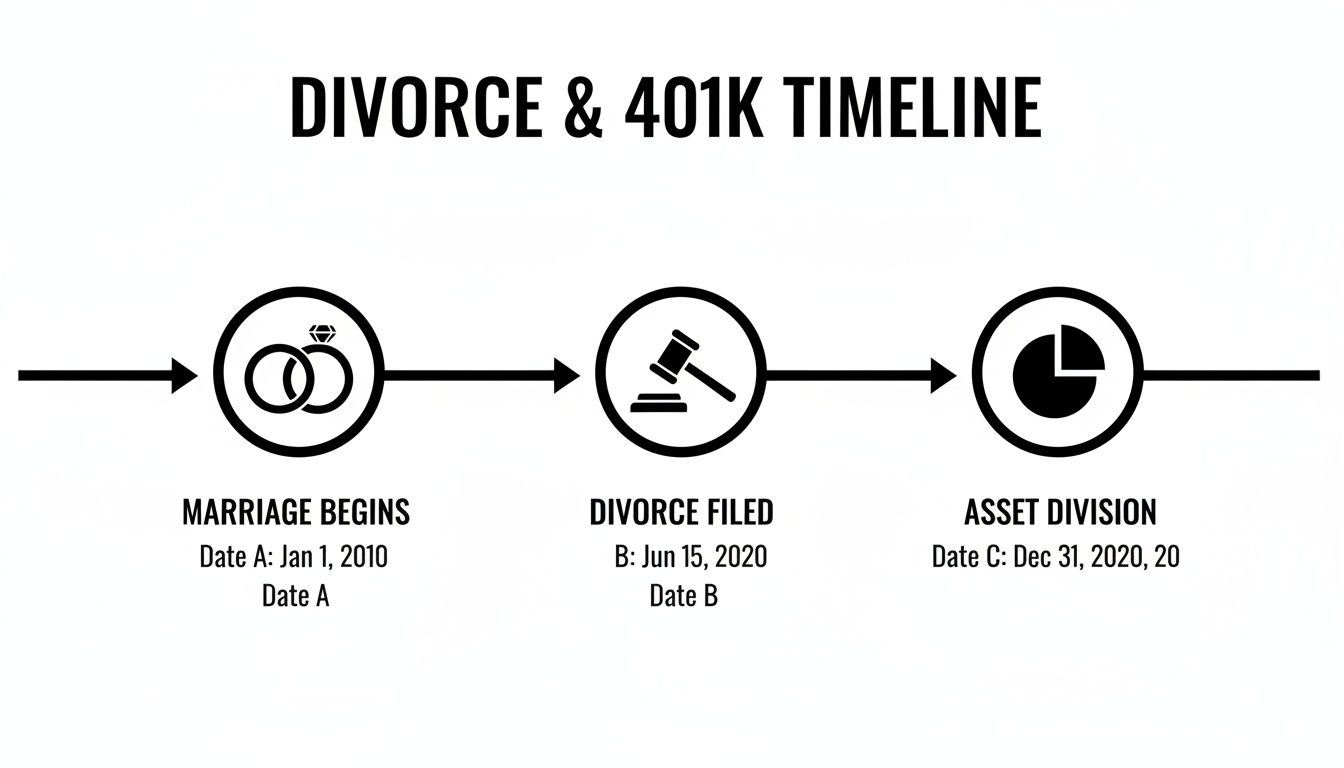
As you can see, that entire stretch between the wedding and the divorce filing is when community property builds up, making the asset division stage absolutely crucial for a fair outcome.
A Real-World Example of Tracing Property
Let's walk through a common scenario to see how this works in practice. Say you were at your job for five years before you got married, diligently contributing to your 401(k). On your wedding day, your balance was a solid $50,000.
You stay married for ten years, and all the while, you keep contributing to that same 401(k). By the time you file for divorce, the account has grown to $250,000.
So, how does the court split this?
- Separate Property: That initial $50,000 you started with is yours, no questions asked. On top of that, any growth that can be directly traced back to that original $50,000 is also considered separate.
- Community Property: The other $200,000—which is a mix of your contributions, your employer's matches, and all the investment gains during those ten years of marriage—is community property. This is the amount the court will divide in a "just and right" manner.
This "tracing" is where things get serious. It demands detailed paperwork to prove exactly which part of your 401(k) is separate. A huge piece of this puzzle is understanding your broker statements and having a clear financial picture.
Why Your Paperwork Is Everything
In Texas, the burden of proof is on the person claiming something is separate property. If you can't provide clear, convincing evidence, the court will assume the entire account is community property and divide it accordingly.
A core principle of the Texas Family Code is that if you can't cleanly trace your separate property, it gets tangled up with community assets and is subject to division. This is why organized records are your best friend in a divorce.
Dividing 401(k)s has become a massive issue, especially with the rise of "gray divorces." With 36% of U.S. adults divorcing after the age of 50, retirement funds are often the biggest asset on the table. In community property states like Texas, everything earned during the marriage is on the line.
This is exactly why having a firm grasp of what property goes to which spouse in a Texas divorce is so important. Your attorney can help you pull together the necessary statements and, if the numbers get complicated, bring in a financial expert to conduct a forensic tracing analysis to protect what’s rightfully yours.
Using a QDRO to Legally Divide Your 401k
When you’re untangling finances in a divorce, the 401(k) is often one of the biggest assets on the table. But you can't just write a check for half or transfer the funds like you would with a regular savings account. Retirement accounts are wrapped in layers of strict federal protection, and one wrong move can trigger a financial catastrophe—think massive tax bills and steep early withdrawal penalties.
So, how do you divide it the right way? Texas courts use a very specific legal instrument: the Qualified Domestic Relations Order, better known as a QDRO.
Think of a QDRO as a special set of instructions sent directly to the person managing the 401(k) plan. It's a separate, standalone court order—not just a line item in your divorce decree. This document is the only way to tell the plan administrator how to legally split the retirement benefits between you and your soon-to-be ex-spouse without setting off a tax bomb.

Without a properly executed QDRO, the plan administrator’s hands are tied. They have zero legal authority to give your ex-spouse their share of the account. This document is the key that unlocks those funds, and it has to be drafted with surgical precision to meet the requirements of both the Texas Family Code and federal law, namely the Employee Retirement Income Security Act (ERISA).
The QDRO Process Step by Step
Getting a QDRO finalized isn’t a quick signature-and-done deal. It’s a meticulous process where every detail matters. Even a tiny mistake can cause major delays or get the order flat-out rejected by the plan administrator, forcing you to go back to square one.
Here’s a clear, step-by-step explanation of how it typically works:
- Drafting the Order: Once you and your spouse have an agreement on the split (or a judge has made a ruling), an attorney drafts the QDRO. This isn’t a generic form; it must include very specific information like the full legal names of both parties, the official name of the retirement plan, and the exact dollar amount or percentage being awarded.
- Pre-Approval from the Plan Administrator: This is a smart, highly recommended step. The draft QDRO is sent to the 401(k) plan administrator before it goes to the judge. They'll review it to make sure it complies with their plan's unique rules and federal regulations, catching any red flags early on.
- Signature by the Judge: After the language is vetted and approved, the QDRO is submitted to the family court judge. Once the judge signs it, it becomes an official, legally binding court order.
- Final Submission to the Plan: The signed, court-stamped QDRO is then sent back to the plan administrator. At this point, they will follow the order’s instructions and execute the division of the funds.
This careful, multi-step process is designed to protect both spouses from disastrous and unintended financial consequences.
Why a Perfectly Drafted QDRO Is Non-Negotiable
The language in a QDRO has to be exact. Period. Any vague terms, missing data, or incorrect information will almost certainly get it kicked back by the plan administrator, who is legally obligated to follow their plan documents to the letter. A poorly drafted QDRO can quickly turn into a legal and financial nightmare.
A QDRO is more than just paperwork; it is a critical safeguard for your financial future. Errors can lead to the receiving spouse being hit with a 10% early withdrawal penalty and immediate income taxes, potentially erasing tens of thousands of dollars from their settlement.
Some of the most common mistakes that can get a QDRO rejected include:
- Incorrect Plan Name: Using "My Company 401(k)" instead of the official, legal name of the plan.
- Ambiguous Division Method: Not clearly stating if the split is a flat dollar amount or a percentage calculated on a specific date.
- Missing Information: Forgetting to include full names, current addresses, or Social Security numbers for both parties.
- Contradicting Plan Rules: Trying to order a type of payment or a distribution option that the specific retirement plan simply doesn't allow.
The stakes are far too high to leave this to chance. It is absolutely essential to have an experienced family law attorney handle this part of your divorce. Understanding how qualified plans like 401k plans are divided is a specialized skill. We make sure every QDRO is drafted with the precision needed to protect your hard-earned assets and finalize your divorce without a hitch.
How Do You Actually Split a 401(k) in a Divorce?
Once you’ve done the hard work of figuring out what part of a 401(k) is community property, the next step is the nuts and bolts: how do you divide it fairly? We’re moving from legal theory to practical math. This isn't just about cutting a number down the middle; it's about making sure the final distribution is truly “just and right” as Texas law requires.
The process has a few key milestones. You'll need to lock down a valuation date, pick a division method, and deal with any curveballs like outstanding 401(k) loans. Every one of these decisions can dramatically change how much each spouse walks away with.
Setting the Valuation Date
Before you can split a single dollar, you both have to agree on a specific date to value the 401(k) account. This is a massive deal because 401(k)s are tied to the market, and their value can swing wildly from one month to the next. An account worth $200,000 in May could easily be $215,000 in June or dip to $190,000.
So, what date do you pick? Common options include:
- The date of separation: This is the day the couple officially stopped living together as a married unit.
- The date of filing for divorce: This marks the day the original petition for divorce was formally filed with the court.
- A date close to the final trial or settlement: This gives you the most up-to-the-minute market value.
Choosing this date often becomes a point of negotiation. If the stock market has been on a bull run, the non-employee spouse will likely argue for a later date to get a piece of those gains. On the flip side, if the market is tanking, the employee spouse might push for a later date to minimize the amount they have to share.
Choosing a Division Method
With a value locked in, the next big question is how to split the money. Typically, you'll choose between a percentage split or a specific dollar amount. The right choice really hinges on your personal circumstances and what you plan to do with the money.
Let's walk through an example.
Imagine the community portion of a 401(k) is valued at $300,000 on your agreed-upon date. Here’s how the two methods could play out:
- Percentage Split: The QDRO might award the non-employee spouse 50% of the community portion. This means they are entitled to $150,000, plus or minus any market gains or losses that happen between the valuation date and the day the funds are actually paid out. With this method, both of you are in the same boat, sharing the market's ups and downs.
- Specific Dollar Amount: The QDRO could state that the non-employee spouse receives a flat $150,000, period. They get exactly that amount, no matter what the market does. The employee spouse takes on all the risk if the market drops but also gets to keep all the upside if it soars.
Key Takeaway: A percentage split is often considered more equitable because both spouses share the market risk together. A specific dollar amount offers certainty but shifts all the risk—and potential reward—onto the account holder.
Comparing 401k Division Methods
To make sense of these options, it helps to see them side-by-side. Understand the two main options for dividing your 401k and which might be better for your situation.
| Division Method | How It Works | Best Suited For… |
|---|---|---|
| Percentage Split | The receiving spouse gets a specified percentage of the account value, adjusted for market gains or losses up to the distribution date. | Situations where fairness in sharing market risk is a priority, or when the distribution may take some time to process. |
| Specific Dollar Amount | The receiving spouse gets a fixed sum, and the account holder absorbs all subsequent market gains or losses. | Cases where the receiving spouse needs a predictable, guaranteed amount for a specific purpose, like a down payment on a new home. |
Choosing the right method depends on your risk tolerance and financial needs. A fixed amount is predictable, but a percentage split ensures that neither party feels cheated by a sudden market swing.
What About Outstanding 401k Loans?
Here's a common wrench in the works: an outstanding 401(k) loan. Under Texas law, any debt taken on during the marriage is usually a community debt. That means a 401(k) loan is generally treated as an advance against the community's retirement funds.
So, how does that work in practice? The loan balance is typically added back to the account's value before it's divided.
For instance, if an account has a balance of $180,000 but there’s a $20,000 outstanding loan, the court will likely value the community asset at $200,000 for division purposes. After splitting that $200,000, the employee spouse is still on the hook for repaying the $20,000 loan themselves. Getting these details right is crucial for a division that is truly fair.
Avoiding Taxes and Penalties with Smart Rollover Options
When you're dividing a 401(k) in a divorce, it's not just about splitting the account down the middle. It's about protecting every single dollar you've worked so hard to save from getting eaten up by unnecessary taxes and penalties. Making the right move here is absolutely critical for your future financial security. Thankfully, federal law gives you a clear path to access these funds without the financial sting you might expect.
The magic key is something called a Qualified Domestic Relations Order (QDRO). When it's drafted correctly, a QDRO acts like a shield, letting the spouse who is receiving the funds access their share of the 401(k) without getting hit with the usual 10% early withdrawal penalty. This is true even if they're under age 59½—a crucial exception carved out specifically for divorce situations.

Cash Distribution vs. a Tax-Free Rollover
Once the judge signs the QDRO and the plan administrator approves it, the spouse receiving the money (often called the "alternate payee") has a big decision to make. Do you take the money as a lump sum of cash, or do you roll it over into another retirement account? The choice you make here has serious financial consequences.
Option 1: Taking a Cash Distribution
You can, of course, choose to have your portion of the 401(k) paid out directly to you in cash. While this gives you immediate access to the money, it comes at a very high price.
Even though the QDRO saves you from the 10% penalty, the distribution is still considered taxable income. The plan administrator is legally required to withhold a mandatory 20% for federal income taxes right off the top. Let's say your share is $100,000. They will automatically send $20,000 to the IRS, and you'll get a check for just $80,000. And depending on your total income for the year, you could owe even more when you file your taxes.
Option 2: Executing a Direct Rollover
For most people, the smartest financial move is a direct, tax-free rollover. This is a simple process where you instruct the 401(k) plan administrator to transfer your awarded funds straight into another qualified retirement account that you set up in your own name, like an Individual Retirement Account (IRA).
By choosing a direct rollover, you defer all income taxes and preserve the full, pre-tax value of your retirement funds. That entire $100,000 continues to grow tax-deferred for your future, which can make a difference of thousands of dollars over time.
This strategy keeps your retirement savings working for you, helping to secure the financial stability you need and deserve after a divorce.
Making the Right Choice for Your Future
The decision between cashing out and rolling over really boils down to your immediate financial needs versus your long-term goals. A cash distribution might seem tempting if you need money right away to cover post-divorce expenses, but the tax hit is severe. A rollover protects your nest egg and allows it to keep growing for the future you envision. It's also worth knowing about the other early withdrawal penalty exceptions that can apply to retirement funds, especially after a major life event.
This decision carries a lot of weight, and it's one you shouldn't make alone. We always recommend talking it through with your family law attorney and a qualified financial advisor. Your attorney will make sure the QDRO is airtight to prevent any accidental penalties. Your financial advisor can walk you through the long-term impact of each choice and help you build a solid plan for a secure retirement.
Rebuilding Your Retirement After Your Divorce
Watching a huge chunk of your 401(k) get handed over to your ex-spouse can feel like a punch to the gut. It’s a massive financial setback, and it's perfectly normal to feel discouraged. But it's absolutely critical to see this moment for what it is: not an end, but a new beginning. With a clear head and a solid game plan, you can grab the reins of your financial future and start rebuilding with real purpose.
You're not alone in feeling this way. Far from it. Research shows that 56% of people are worried sick that divorce will blow up their retirement strategy, and that number jumps to 63% for Millennials. For those who've been through it, the numbers are even starker: 40% said divorce completely derailed their retirement, and another 34% said it set them back in a big way. You can learn more about these findings on retirement security here.
The key now is to zero in on what you can control. With some smart planning, you can get right back on track and start working toward the secure retirement you've earned.
Reassessing Your Financial Landscape
Life after divorce is different, and that includes your finances. That's okay. Your first move is to build a new, brutally honest budget based on your new income and expenses. This step isn't glamorous, but getting that clarity is the bedrock for every single financial decision you'll make from here on out.
Once you have a firm grip on your monthly cash flow, it's time to take a hard look at your retirement goals.
- Review Your Timeline: Let's be realistic. You might need to push back your target retirement age a bit or get more aggressive with your savings rate to make up for the assets that were divided.
- Maximize Contributions: If you aren't already, now is the time to start putting the maximum amount allowed into your 401(k) or other workplace plan. You can't afford to leave any employer match money on the table.
- Explore Other Options: Think about opening a Roth or Traditional IRA to put away even more. This gives you another powerful tool for tax-advantaged growth to supplement your 401(k).
This is also a great time to get creative with how you settle things. For instance, instead of splitting the 401(k) down the middle, you could offer to trade your share of it for full equity in the family home. This could give you much-needed housing stability and let your spouse keep their retirement account whole—a potential win-win that avoids the hassle of a QDRO.
The Critical Task of Updating Beneficiaries
In the whirlwind of emotions and paperwork that comes with divorce, one of the easiest—and most dangerous—things to forget is updating your beneficiaries. Your 401(k), IRAs, and life insurance policies all have a person named who will inherit those funds if you pass away.
In Texas, failing to remove an ex-spouse as a beneficiary after a divorce can create a legal nightmare for your loved ones, potentially sending your hard-earned assets to the very person you no longer intend to receive them.
Sure, the Texas Family Code automatically voids most beneficiary designations naming an ex-spouse once the divorce is final, but relying on that is just asking for trouble. Be proactive. The moment the ink is dry on your divorce decree, get on the phone with every financial institution and your employer to update those forms.
It’s a simple step, but it ensures your assets go exactly where you want them to—to your kids, a new partner, or other family members. Taking care of this small task delivers a huge amount of peace of mind.
Common Questions About Dividing a 401k in Texas
When you're staring down the process of divorce, the big-picture concepts are one thing, but the day-to-day worries and "what if" questions are what really keep you up at night. Let's tackle some of the most frequent and practical questions we hear from clients in Texas to give you some clarity.
Can My Spouse Empty Our 401k Before the Divorce Is Final?
This is a huge fear for many, and it's completely understandable. The good news is that Texas law has protections in place. As soon as a divorce is filed, most counties issue a Standing Order, which works like a temporary restraining order.
This order freezes the financial accounts, preventing either spouse from making unusual moves—like draining a 401k—without getting permission from the court or agreeing to it together. If you have any reason to believe your spouse might try something like this, you need to talk to an attorney immediately. We can make sure your assets are locked down right from the start.
Do We Have to Split the 401k Exactly 50/50?
Not always. It’s true that Texas is a community property state, but the legal standard for dividing assets is what is “just and right,” not necessarily a rigid 50/50 split. A judge can look at the whole picture and decide that an unequal division is fairer.
What might cause a judge to lean away from a 50/50 split?
- Fault in the breakup (like adultery or cruelty).
- A big difference in earning power between you and your spouse.
- The overall size of the community estate and whether one person needs more to be financially stable.
More often than not, couples find a creative solution themselves. It’s very common to see one spouse keep their entire 401k, but in exchange, the other spouse gets the house or a larger slice of another asset. It's all about finding a balance that works for both of you.
Patience is key here, because this part of the process can really drag. Getting the money from your ex-spouse’s 401k requires a special court order called a Qualified Domestic Relations Order (QDRO), and it's not a quick signature-and-done deal.
The QDRO has to be drafted, reviewed by the 401k plan administrator (who can be very picky), signed by the judge, and then sent back to the administrator for final processing.
On average, you can expect the QDRO process to take anywhere from a few months to over a year after your divorce is officially final. Getting a head start on the drafting and making sure it's done right the first time is the best way to avoid frustrating delays.
What Happens if We Can’t Agree on How to Split the 401k?
If you and your spouse are at a stalemate and can't reach an agreement through negotiation or mediation, the decision ultimately falls to the judge. Both of your attorneys will present arguments and financial evidence, and the court will make a ruling on how to divide the community portion of the retirement accounts in a way it believes is just and right.
Going to trial is always an option, but it's an expensive and time-consuming one. This is why working toward a fair settlement is almost always the better path. A good attorney can help you understand your rights and negotiate from a position of strength to protect your financial future.
If you need help navigating divorce, custody, or estate planning in Texas, contact The Law Office of Bryan Fagan today for a free consultation.