
A lot of parents land here the same way. You're sitting at a kitchen table after separation papers were filed, or after months of trying to work things out informally, and the questions start piling up. Who pays what. How is support calculated. What if the other parent is self-employed. What if you're the one who lost hours at work. What if you live in Texas and the other parent doesn't.
When money and parenting collide, fear shows up fast. Most parents aren't trying to win a legal contest. They're trying to make sure the rent gets paid, the child stays insured, and school, food, and daily life stay steady.
One of the most stressful moments in family law is realizing that good intentions aren't the same thing as a court order. A parent may promise to help. Another parent may say they can only pay when work improves. Meanwhile, the child still needs groceries, medical care, school clothes, and stability.

That pressure is not unusual. The national child support system served 12.2 million children and collected $29.5 billion in 2024, yet only 38% of custodial parents received some of the support they were owed, according to Clio's family law statistics summary. Those numbers show two things at once. The system is large, and many families still struggle to get consistent results.
Parents often start by searching calculators and comparison tools because they want a rough sense of what life may look like after a separation. If spousal maintenance is also part of the conversation, a tool like this spousal support calculator can help frame related financial questions, but child support in Texas still depends on case-specific facts and a legally enforceable order.
Practical rule: Verbal agreements may feel easier in the moment, but they rarely solve the problem when payments stop or circumstances change.
The first step toward control is understanding that child support legal advice isn't just about a number. It's about process, proof, and enforceability. Once you know how Texas courts look at support, the path gets clearer and your next move becomes easier to evaluate.
What Texas Law Says About Child Support
Texas treats child support as a legal duty owed to the child. In most cases, one parent pays support and the other parent receives it for the child's benefit, but the core idea is broader than a monthly transfer. Texas courts also address medical support and dental support as part of the overall obligation.
The governing framework appears in Texas Family Code Chapter 154. The central theme is the best interest of the child. Courts don't approach support as a punishment for one parent or a reward for the other. They use it to protect the child's day-to-day welfare after parents separate.
What child support is meant to cover
Child support is supposed to help maintain a child's basic standard of living. That includes ordinary expenses such as housing, food, utilities, clothing, and routine care. It can also interact with school costs, activity costs, and health-related needs, depending on the order and the family's circumstances.
Medical and dental support matter more than many parents realize. I've seen parents focus only on the monthly support figure and overlook who must carry insurance, who reimburses premiums, and how uninsured expenses will be handled. Those issues often become major sources of conflict later if they aren't written clearly.
For a broader introduction to the subject, Bryan Fagan's article on child support overview for Texas families is a useful companion read.
Who pays and who receives
In many Texas cases, the parent with primary possession receives support and the other parent pays it. But that isn't a moral label. It's how the law allocates financial responsibility in light of the parenting schedule, the child's primary residence, and each parent's resources.
A parent can be involved, loving, and committed, and still owe support. A receiving parent is not getting a windfall. The law assumes both parents should contribute to the child's upbringing, and support is one way the court enforces that duty.
The strongest child support orders are specific. They identify the monthly amount, the payment method, health and dental obligations, and how extra expenses will be addressed.
When parents understand this early, negotiations improve. They stop arguing over abstract fairness and start focusing on what a Texas judge will sign.
How Texas Calculates Child Support Payments
A parent often walks into my office with a number already in mind. Usually it came from a quick online calculator, a friend, or what feels fair after a breakup. Texas courts start somewhere else. The calculation begins with the paying parent's net monthly resources, then applies guideline percentages under Texas Family Code Chapter 154.
That distinction matters because child support cases are often won or lost on the income figure, not the percentage. If the income number is wrong, everything built on it is wrong too.
Start with net monthly resources
Net resources usually begin with gross income, then allowed deductions are applied. In practice, the hard part is proving what should be included and what should be subtracted.
Common issues include:
- Wages and salary: Base pay is only part of the picture. Overtime, bonuses, commissions, and other recurring compensation may count if they show up consistently.
- Self-employment income: These cases require closer review. Courts look past a simple claim that the business had a bad month and often focus on tax returns, bank records, profit and loss statements, and whether personal expenses are being run through the business.
- Allowed deductions: Texas law permits certain deductions, which can include Social Security taxes, federal income tax based on the tax rate for a single person claiming one exemption, union dues, and the cost of the child's health insurance or cash medical support.
- Missing or weak records: If a parent cannot produce reliable documents, the court may make reasonable inferences from the evidence it does have. In some cases, the judge may assign income based on earning ability, work history, or available job opportunities.
Parents should collect records early. Waiting until the hearing creates preventable problems, especially for parents with variable pay, cash income, side work, military allowances, or a small business.
Texas Standard Child Support Guideline Percentages
Once net resources are established, the guideline percentages are usually straightforward for a parent supporting children before the court:
| Number of Children | Percentage of Net Resources |
|---|---|
| 1 child | 20% |
| 2 children | 25% |
| 3 children | 30% |
| 4 children | 35% |
| 5 children | 40% |
| 6 or more children | Not less than 40% |
These percentages can change in more complex situations, such as when the paying parent also has a duty to support children in another household. That is one reason parents should be careful about relying on a basic calculator without looking at the full family picture.
A practical example
Assume one parent has $6,000 in net monthly resources, there is one child before the court, and no other children affect the calculation. The guideline amount is generally 20 percent. That would place monthly child support at $1,200, before adding medical support or addressing any reason to depart from the guideline.
That is the Texas model most parents will see in court. It does not work as an income-sharing formula based on both parents' combined net resources. Texas usually applies the percentage to the obligor's net resources, then the court considers whether any adjustment is justified.
The guideline formula also applies only up to a statutory cap on net resources, and that cap can change over time. If resources exceed the cap, the court may apply the guideline to the capped amount first, then examine whether the child's proven needs support additional amounts above it. High-income cases often turn into evidence cases. Judges want specifics, not general claims that a child is used to a certain lifestyle.
When the guideline number may change
The guideline amount is presumed to be in the child's best interest, but that presumption can be challenged. A judge may order more or less than the standard figure if the evidence supports it.
Examples that often matter include:
- Special needs or unusual expenses: Therapy, tutoring, recurring medical treatment, or other documented needs can justify a different result.
- Irregular or hard-to-verify income: Commission pay, oilfield work, contract work, and business ownership often require a closer review of earning patterns.
- Low-income cases: If the paying parent has limited resources, the court may use the low-income adjustment rules rather than the standard percentage.
- Other children to support: A parent supporting children from another relationship may not be paying the standard table percentage.
- Agreed orders that do not fit the guideline: Parents can reach agreements, but the court still has to decide whether the result serves the child's best interest.
Military families see this issue often. Base pay is only part of the analysis, and parents need to evaluate items such as BAH, BAS, special pay, deployment changes, and what happens if a parent is transferred. Interstate families face a different problem. The math may be done under Texas law while enforcement or income withholding touches another state's system. Those details should be addressed early because fixing a vague order later costs more.
For a more detailed discussion of the calculation process, see how to properly calculate child support in Texas.
Courts respond to proof. Parents who bring organized pay records, tax documents, insurance information, and a clear explanation of unusual circumstances usually have a much stronger position than parents who rely on estimates.
The Legal Process for Establishing a Support Order
Many parents know they need child support but don't know how the order is created. In Texas, support is commonly established in a divorce or a Suit Affecting the Parent-Child Relationship (SAPCR). The path is procedural, and each step matters because a missed requirement can slow the case or create avoidable expense.
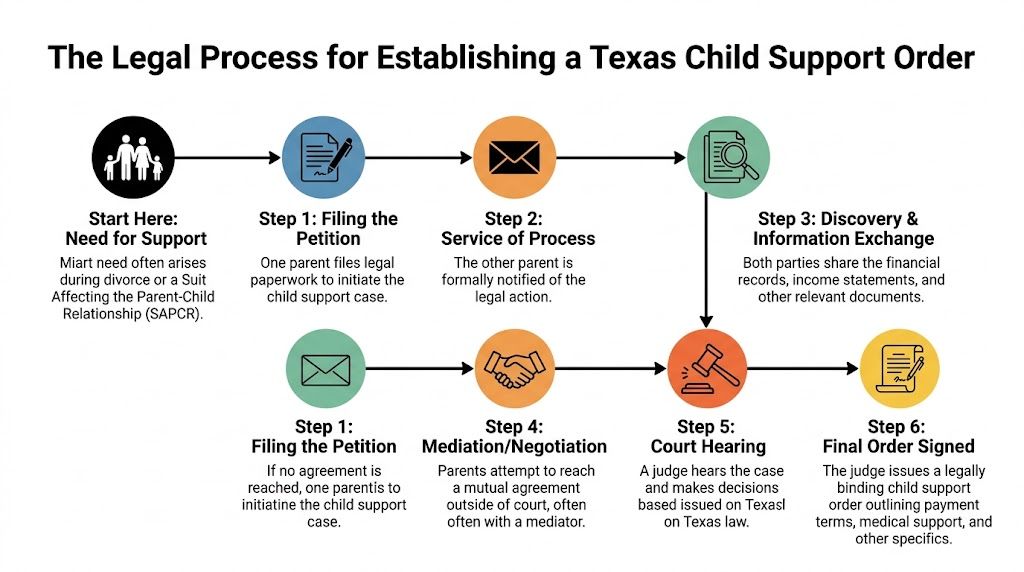
How a support case usually moves
A support case often unfolds in this order:
A petition is filed
One parent starts the legal case by filing the appropriate petition. In a divorce, child support may be part of the broader suit. If the parents weren't married or support wasn't addressed before, a SAPCR may be the right vehicle.
The other parent is formally served
Texas requires legal notice unless service is properly waived. This step matters because a court can't issue enforceable relief against a parent who wasn't brought into the case correctly.
Financial information is exchanged
Parents usually need to provide income records, insurance information, and other financial documents. In some cases this is straightforward. In others, especially with cash income or business ownership, this becomes the primary battleground.
Negotiation or mediation may occur
Many families resolve support terms before a final hearing. A negotiated outcome can save time and reduce conflict, but the agreement still needs to become a signed court order.
The court signs a final order
If the parents agree, the court reviews the paperwork and signs the order. If they don't, the judge decides the unresolved issues after hearing evidence.
What to gather before you file or respond
Parents do better when they prepare like a fact witness, not like someone hoping the judge will sort it out for them. A strong file often includes:
- Tax returns: Bring recent federal returns if available.
- Pay records: Gather current pay stubs or other proof of income.
- Insurance documents: Include proof of health and dental premium costs for the child.
- Child expense records: Keep receipts and statements for recurring expenses that may matter in negotiations or support-related disputes.
- Work history materials: If income is disputed, resumes, prior earnings records, and job search documentation can become important.
A judge can't build your case from a vague story. The paperwork gives your position shape.
A practical example
Take a common situation. One parent has the child most of the time and has been covering insurance, school supplies, and after-school costs. The other parent has helped off and on, but there is no formal order. Once a petition is filed, both parents must put real numbers and real records on the table. That changes the conversation from "I help when I can" to a court-enforceable obligation with defined terms.
That shift often lowers conflict over time because expectations become clear. Parents may not like every part of the order, but clarity usually beats uncertainty.
Enforcing and Modifying Child Support Orders
A mother calls after three missed payments. She has the order, the other parent has a steady job, and the child still needs groceries, school clothes, and a copay for an asthma visit. Another parent sits in my office with a different problem. He wants to pay support, but his hours were cut and the current amount no longer matches what he brings home. Both situations are common in Texas, and both require action through the court, not private promises.

A signed order gives you rules. It does not guarantee compliance. Some parents need enforcement because support is late, partial, or unpaid for months. Others need modification because the numbers stopped matching real life after a job change, a medical issue, a new insurance cost, or a major shift in parenting time.
When the other parent is not paying
Start with records. Bring the payment history, bank statements, screenshots from the state disbursement unit if payments were supposed to run through it, and a copy of the current order. Judges want dates, amounts due, amounts paid, and the running total of arrears. A clear timeline often matters more than a long explanation.
Texas courts have several enforcement tools, and the right one depends on the facts.
- Income withholding: Often the fastest option when the paying parent has regular wages.
- Contempt: Used when a parent had the ability to comply and failed to do so.
- Money judgment for arrears: Helps reduce disputed balances to a specific amount the court can enforce.
- Liens and other collection remedies: Sometimes appropriate if wages are not the full picture.
- License suspension: Pressure can increase when nonpayment continues.
Delay usually makes the case harder. Arrears grow. Records get harder to gather. The paying parent may change jobs, move, or start working as an independent contractor, which can complicate collection. If support has stopped, act while the paper trail is still easy to prove.
One practical warning matters here. Cash payments, direct payments for shoes or camp, and verbal agreements about "skipping this month" often create expensive fights later. Unless the order or the official payment record reflects the credit, the court may not treat those side arrangements the way either parent expected.
When the order no longer fits
Modification is a separate request from enforcement. One asks the court to make the existing order stick. The other asks the court to replace it with a new amount.
Texas courts generally look for a material and substantial change in circumstances. That usually means a real shift, not a temporary inconvenience. Common examples include job loss, lower earnings, a significant increase in income, new health insurance costs, major medical needs for the child, or changes in who has the child most of the time.
Parents often wait too long to file. That is a costly mistake. If your income dropped three months ago but you do not seek a modification, the old amount usually keeps accruing under the current order. In other words, the court may change support going forward, but missed amounts under the old order can still become arrears.
A private agreement is rarely enough. If both parents agree to a lower amount for a while, but no judge signs a new order, the original obligation usually remains enforceable.
Here's a short video that helps illustrate how support disputes and post-order issues often develop in Texas cases:
A practical issue in lower-income cases
Support has to be fair to the child and realistic enough to be paid. If an order is set above what a parent can maintain, arrears tend to build fast. That pattern hurts everyone, especially the child who needs steady support instead of a number that looks good on paper and goes unpaid in practice.
That is one reason lower-income cases need careful proof. The court may need detailed income records, evidence of work history, and clear information about fixed expenses like health insurance for the child. In contested cases, the difference between a manageable order and an unworkable one often comes down to documentation, not just testimony.
For parents dealing with an outdated order, Texas child support order modification part 2 explains more about how the modification process works in practice.
The best support order is one that can be enforced and paid consistently.
Complex Scenarios for Military and Interstate Families
Military and interstate cases are where generic child support legal advice often breaks down. The usual online explanation assumes both parents live in Texas, have ordinary payroll income, and can appear in court without special timing issues. That's not how many families live.
A critical gap in child support guidance involves military allowances, interstate enforcement, and the interaction between Texas law and the Servicemembers Civil Relief Act (SCRA). Recent Texas law changes can affect how some military allowances are treated as net resources, while interstate enforcement remains difficult enough that specialized guidance often makes a real difference, as discussed in Bryan Fagan's article on affordable Texas child support legal services and complex cases.
Military families face a different income picture
Military compensation is not always as simple as base pay. Housing-related allowances and other components may affect the support calculation depending on how the court classifies them. That can create disputes in two directions. One parent may argue income is being understated. The other may argue the calculation is sweeping in items that need careful treatment under Texas law.
SCRA issues can complicate timing too. If a service member is deployed or their duties materially affect their ability to appear, procedural protections may apply. Those protections are important, but they don't erase support obligations. They affect how and when the court proceeds.
Interstate cases depend on procedure
When parents live in different states, support disputes often turn on UIFSA, the Uniform Interstate Family Support Act. UIFSA helps determine which state has authority to establish, enforce, or modify a support order.
That sounds technical, but the practical questions are simple:
- Which state issued the current order
- Where each parent now lives
- Whether Texas can modify the order or only enforce it
- How notice, registration, and hearing requirements must be handled
A common mistake is filing in the wrong place or asking a Texas court to do something it doesn't currently have authority to do. That wastes time and can increase conflict.
What tends to work and what usually doesn't
Parents in these cases are usually better served by a strategy that is document-heavy and procedure-focused.
What tends to work:
- Clear pay records and military compensation documents
- A careful review of the existing order and issuing state
- A UIFSA analysis before filing
- Early review of appearance issues if SCRA may apply
What usually doesn't work:
- Assuming a Texas court can automatically rewrite another state's order
- Relying on informal payment arrangements during relocation
- Self-representation in a case with multiple jurisdictions and military pay issues
When a case involves military service, relocation, and an existing support order from another state, small filing errors can create large delays. These are the cases where precision matters most.
How Our Firm Provides Clarity and Support
By the time parents seek legal help, they're often carrying more than one problem at once. The support amount may be disputed. Insurance may be unclear. Payments may be late. One parent may be moving, changing jobs, or trying to sort out military-related complications. The legal issue is child support, but the underlying concern is stability.
Good representation brings order to that chaos. It starts by identifying the immediate need. Is the priority establishing an enforceable order, correcting a bad calculation, collecting unpaid support, or seeking a modification because the current order no longer fits reality?
The next step is matching the legal tool to the problem. Some cases need aggressive documentation and a focused hearing presentation. Others need negotiation backed by accurate financial analysis. Cases involving self-employment, interstate questions, or military benefits usually require tighter preparation because missing details create expensive detours.
The Law Office of Bryan Fagan, PLLC handles Texas family law matters involving child support calculation, enforcement, modification, and complex family circumstances, including military and interstate issues. For many parents, the greatest relief comes from having a process. Once there is a plan, the fear usually starts to ease.
You don't have to solve every part of this at once. You do need to take the next legally sound step.
Parents deserve child support legal advice that is calm, specific, and grounded in how Texas courts operate. That kind of guidance protects more than a claim. It protects your ability to move forward.
Frequently Asked Questions About Texas Child Support
A lot of parents reach this section with the same concern. They are not looking for a formula anymore. They want to know what happens in real life when the other parent misses visits, changes states, loses a job, or works for cash. These are the questions that affect groceries, school routines, and peace at home.
Can I stop paying child support if the other parent blocks visitation
No. Texas treats child support and possession as separate parts of the case. If the other parent is denying court-ordered visitation, the fix is usually to enforce the possession order. It is not to stop paying support.
I regularly warn parents about this because self-help usually backfires. Missed support can lead to arrears, interest, license problems, and enforcement exposure, even if your complaint about visitation is legitimate.
That concern comes up often, and sometimes it is justified. Self-employment income is not always obvious from a paycheck stub. A parent may deduct personal expenses through a business, delay deposits, or receive money through apps, cash, or contract work.
The answer is evidence, not suspicion alone. Start gathering tax returns, bank records, profit and loss statements, invoices, Venmo or Cash App history, business social media, and any proof of spending that does not match the income being claimed. A judge is more likely to respond to a clean financial timeline than to broad accusations.
Can we just agree on a new amount without going back to court
You can make a private agreement, but the signed court order still controls until a judge signs a new one. That is the part parents miss.
For example, if one parent agrees by text to accept a lower amount for six months after a job loss, the unpaid difference may still count as arrears unless the order was formally modified. Informal side deals create expensive problems later.
What if I lost my job and can't afford the current amount
Act quickly. File for modification as soon as the income change becomes serious, and keep proof of what happened. That usually includes termination paperwork, recent pay records, job search efforts, and any information about severance or unemployment benefits.
Courts want to see two things. The change is real, and you responded responsibly.
Does child support cover medical and dental issues too
Usually, yes. Texas orders often include monthly child support, medical support, and dental support. The order may require one parent to carry insurance and may split uninsured expenses between both parents.
Read that part closely. Many disputes start because parents focus on the monthly support number and ignore who pays deductibles, co-pays, braces, prescriptions, or reimbursement deadlines.
What if the other parent moved to another state
A move does not erase the order, but it can change where you need to file and which court has authority to act. Interstate cases often turn on registration of the Texas order and the rules under UIFSA.
That matters more than many parents expect. If you seek enforcement in the wrong state, or ask Texas for a modification when another state now has control, you can lose time and money before the court ever reaches the core issue.
Are there special child support issues for military families
Yes. Military cases often involve questions civilian parents do not face, such as BAH, BAS, special pay, deployment-related schedule changes, and where the service member is stationed when enforcement or modification becomes necessary.
Jurisdiction can get complicated quickly if one parent is in Texas, the child lives elsewhere, and the service member has moved under orders. Payment records are usually clearer in military cases than in cash-based self-employment cases, but service, timing, and interstate enforcement can be harder. Those cases benefit from careful planning at the start.
Do judges always follow the guideline amount
Not always. The guideline amount is the starting point, and courts usually begin there. A parent asking the court to order more or less than guideline support needs evidence showing why the standard amount does not fit the child's needs or the proven financial facts.
Good records matter here too. If you want a judge to depart from guidelines, you need more than a general sense that the number feels unfair.
What's the biggest mistake parents make in child support cases
They wait, and they keep important issues informal.
They wait to establish an order because payments have been happening off and on. They wait to enforce because they hope the problem will correct itself. They wait to modify because the other parent made a verbal promise. In Texas child support cases, delay usually helps the paperwork problem grow.
If you need help with divorce, custody, or estate planning in Texas, contact Law Office of Bryan Fagan, PLLC today for a free consultation. If you are trying to establish child support, enforce an order, modify support after a job change, or address a military or interstate issue, specific legal advice can help you protect your child and reduce uncertainty.


