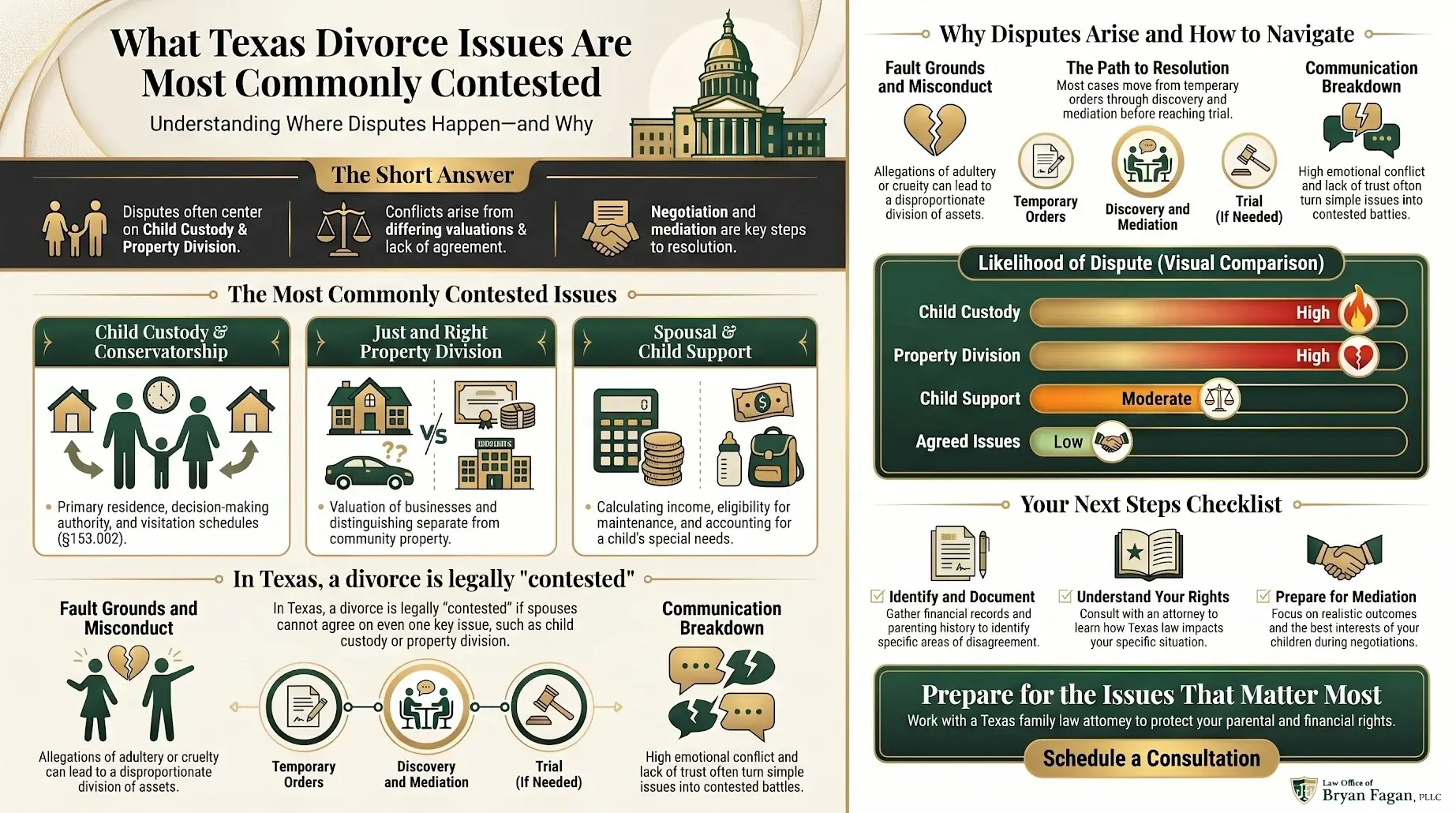

It usually doesn’t start with a courtroom—it starts at the kitchen table. Two people sitting across from each other, trying to divide a life they built together, realizing that agreement isn’t going to come easily. What Texas Divorce issues are most commonly contested becomes a very real question in that moment, when conversations about the house, the kids, or finances shift from “we’ll figure it out” to “we can’t agree.”
For many families, that turning point is where uncertainty sets in. Who will the kids live with? What happens to the home? How will finances work moving forward? These aren’t just legal questions—they’re deeply personal decisions that affect your daily life, your sense of stability, and your future. And when those issues become contested, the process can quickly feel overwhelming.
At the Law Office of Bryan Fagan, PLLC, we’ve guided thousands of Texas families through these exact moments. Led by Bryan Joseph Fagan, a South Texas College of Law graduate and a recognized authority in Texas divorce and custody law, our team understands both the legal complexity and the emotional weight behind every decision. Texas courts operate under the principle that the best interest of the child comes first, as outlined in Texas Family Code §153.002, but applying that standard in real life often requires careful strategy, clarity, and experienced guidance.
The good news is that contested divorce doesn’t have to mean chaos. With the right approach, you can make informed decisions, protect what matters most, and begin to rebuild with confidence. In the sections ahead, we’ll break down where conflict most commonly arises in Texas divorce and how those disputes can shape not only your outcome—but your family’s path forward.
Key Takeaways
- The most commonly contested issues in Texas divorce involve child custody, property division, and financial support—areas where emotions and financial stakes run highest.
- If spouses disagree on any major issues—such as property division, child custody, or support—the divorce becomes contested; agreement on all major issues results in an uncontested divorce, which is typically simpler, faster, and less costly.
- Texas Family Code provides specific guidelines for resolving custody, property, and support disputes, though courts retain significant discretion.
- Most contested issues can still be resolved through negotiation or mediation without trial, saving time and legal fees.
- Early legal guidance helps identify potential disputes and develop resolution strategies before positions harden.

Your Family’s Future Starts Here
Don’t navigate your legal journey alone. Schedule a consultation now and get the clarity and support you deserve.
What Texas Divorce Issues Are Most Commonly Contested? The Short Answer
Understanding What Texas Divorce issues are most commonly contested begins with three primary areas: child custody, property division, and financial support. These are the issues that most often prevent spouses from reaching a full agreement and turn a divorce into a contested process. When even one of these areas remains unresolved, the case typically becomes more complex—often requiring negotiation, mediation, and sometimes trial to reach a final outcome. If you’re trying to understand how that process unfolds, it’s helpful to review this complete guide to contested divorce in Texas.
In straightforward situations, couples may be able to resolve these issues with clear communication and limited legal intervention, especially when both parties are aligned on key decisions. In more complex cases—where disputes are contested over parenting time, finances, or asset division—Texas courts apply specific legal standards that require preparation and strategic thinking. Under Texas Family Code §153.002, judges focus on the best interest of the child, often emphasizing stability and consistency. For financial matters, property is divided in a “just and right” manner under §7.001, which does not always mean equal, but rather fair based on the circumstances.
These conflicts are not just legal—they are deeply personal. Custody disputes affect a child’s daily life and sense of security. Property division determines each spouse’s financial foundation moving forward. Support obligations shape long-term financial stability. Courts evaluate more than positions—they look at credibility, cooperation, financial transparency, and each parent’s ability to create a stable environment. If your situation involves parenting disputes, understanding how courts approach child custody in Texas can provide important clarity.
Where disagreements intensify or communication breaks down, the risk of prolonged litigation increases. That’s often when legal guidance becomes essential. Some cases can move forward efficiently with structured negotiation, while others—especially those involving custody or financial complexity—require a more deliberate, strategy-driven approach. Recognizing where your situation falls is the first step toward protecting your future and making informed decisions for your family.

Child Custody Disputes
When analyzing What Texas Divorce issues are most commonly contested, child custody—referred to as conservatorship under Texas law—consistently stands out as the most emotionally charged and difficult to resolve. When children are involved, disagreements are rarely just legal—they reflect deeply personal concerns about time, influence, and a child’s future. In straightforward situations, parents may be able to agree on schedules and decision-making roles with minimal conflict. But in more complex cases—especially where communication is strained or priorities differ—custody disputes can quickly become the central issue driving the entire divorce.
Texas courts approach these cases with a clear legal framework. Under Texas Family Code §153.002, the “best interest of the child” is always the primary consideration. Judges look closely at stability, consistency, and each parent’s ability to provide a supportive environment. This includes maintaining the child’s current routines whenever possible, such as their home, school, and community connections. For a deeper look at how these disputes unfold in practice, you can review this overview of a contested divorce in Texas.
In many cases, disputes center on whether parents should share decision-making authority as Joint Managing Conservators under Texas Family Code §153.134, or whether one parent should be granted primary rights. While Texas courts generally favor shared responsibility, that presumption can shift if there are concerns about safety, cooperation, or the ability to provide a stable environment. Judges evaluate not just what each parent is asking for, but how they communicate, how involved they are in the child’s life, and whether they can work together in the child’s best interest. Understanding how courts evaluate these factors can provide valuable insight into how child custody in Texas decisions are made.
Where disputes are contested, conflicts often arise over where the child will primarily live, how parenting time is structured, and who has final authority over important decisions like education and medical care. Differences in work schedules, geographic distance, and parenting styles can all contribute to these disagreements. Even when parents agree in principle, details such as holiday schedules or school enrollment can become sticking points that delay resolution.
In more complex cases—particularly those involving high-conflict communication or competing visions for the child’s future—these issues require a more structured, strategic approach. Judges pay close attention to credibility, cooperation, and each parent’s willingness to prioritize stability over conflict. When disagreements escalate or compromise becomes difficult, having a clear legal strategy can help protect your position while keeping the focus where it belongs—on your child’s long-term wellbeing.
Recognizing whether your situation falls into a manageable or more contested category is an important first step. Some custody matters can be resolved with focused guidance and cooperative planning. Others—especially those involving ongoing disputes or major decisions about a child’s daily life—require more deliberate preparation to avoid unnecessary delays and protect your family’s future.
Property Division Conflicts
Asset division is the second most common source of contested issues in Texas divorce, as spouses often disagree over how assets and debts should be allocated when they cannot reach an agreement. In Texas, ‘marital assets’—which are assets acquired during the marriage—and ‘marital property’—which includes all property subject to division in divorce—are central to these disputes. The distinction between marital assets (community property) and separate property is significant, especially in high-asset divorces or when assets have been commingled.
Texas operates as a community property state, meaning property acquired during the marriage is generally presumed to be marital property belonging to both spouses equally. However, the Texas Family Code §7.001 requires courts to divide the marital estate in a manner that is “just and right,” considering the rights of each party and any children. This standard does not require a strict 50/50 split; instead, courts may consider factors such as earning capacity, fault in the marriage breakdown (including adultery or cruelty), and each spouse’s contributions to the marriage when determining a fair division. Fault-based claims can be argued to seek a disproportionate share of the community estate.
A frequent source of conflict is the classification of property as community property or separate property. Under Texas law, property owned before marriage, inherited, or received as a gift is considered separate property and remains the property of the original owner. However, the spouse claiming an asset as separate property bears the burden of proof and must provide clear and convincing evidence to establish its separate character. Commingling funds or using separate property for community purposes can further complicate these determinations.
Disagreements over asset valuation often require expert appraisers and can lead to significant legal fees. Real estate, business ownership interests, stock options, and professional practices require specialized valuation that spouses frequently contest.
Hidden or undervalued assets generate some of the most contentious property division conflicts. When one spouse suspects the other has offshore accounts, unreported income, or transferred assets, the discovery process intensifies and trust deteriorates further.
Retirement accounts and pension division require careful attention. Under Texas law, a qualified domestic relations order (QDRO) is required to divide these marital assets, such as retirement accounts and pensions, during divorce. Disputes may arise over vesting, valuation dates, and what portion of these accounts represents community property versus separate contributions, further complicating resolution.
Child Support Disputes
Child support calculation disagreements occur frequently because the numbers directly impact both parents’ monthly finances for years. Under Texas law, child support follows percentage guidelines based on the paying parent’s net monthly resources.
Texas Family Code Chapter 154 establishes the framework for child support calculations. Effective September 1, 2025, the cap on net monthly resources for guideline support increased from $9,200 to $11,700—meaning higher-income parents may owe more support than under previous guidelines.
Income disputes arise when one parent believes the other underreports income or is voluntarily underemployed. Self-employed parents present particular challenges, as business expenses, deductions, and cash income create disagreement about actual net resources.
Medical insurance and childcare cost disagreements add complexity. Parents may dispute who pays the health insurance premium, how uninsured medical expenses are allocated, and how daycare or afterschool care costs are divided.
Modification requests generate ongoing conflict when circumstances change. A parent losing their job, receiving a significant raise, or experiencing changed parenting time may seek modification—and the other parent frequently opposes the change.
Spousal Support (Alimony) Disputes
When looking at What Texas Divorce issues are most commonly contested, spousal support—also known as spousal maintenance—is not the most frequent dispute, but it often becomes one of the most contentious when it arises. Unlike child support, which follows clearer statutory guidelines, spousal maintenance in Texas is limited and highly fact-specific. That makes eligibility itself a battleground in many cases.
Under Texas Family Code Chapter 8, a spouse must first prove they lack sufficient property to meet their minimum reasonable needs. From there, they must meet additional criteria—such as a marriage lasting at least ten years with limited earning ability, a history of family violence, or the responsibility of caring for a child with a disability. In straightforward situations, where both parties have stable incomes and similar earning potential, spousal maintenance may not be a central issue. But in more complex cases—particularly where one spouse has been financially dependent for years—disputes over eligibility, need, and fairness can quickly escalate.
Judges don’t simply look at who is asking for support—they evaluate credibility, financial transparency, and whether each party has made a good-faith effort to become self-supporting. Disagreements often center on income reporting, lifestyle expectations, and whether one spouse is capable of earning more than they claim. Where disputes are contested, courts also consider the broader financial picture, including how property is divided under the “just and right” standard in Texas Family Code §7.001. For a deeper understanding of how financial disputes can unfold in legal proceedings, you can review this related discussion on contesting financial information in Texas cases.
Even when eligibility is established, conflict doesn’t end there. Texas law caps spousal maintenance at the lesser of $5,000 per month or 20% of the paying spouse’s gross income, and limits duration based on the length of the marriage. Still, disagreements over how long support should last—and how much is appropriate—are common. In higher-conflict situations or where financial records are disputed, these issues can delay resolution and increase the risk of litigation.
Post-divorce, these disputes can continue. Changes in employment, remarriage, or cohabitation may trigger modification or termination requests, which the other party may challenge. In simpler situations, these changes are resolved with minimal conflict. But when communication breaks down or financial circumstances are unclear, legal guidance becomes increasingly important to avoid costly missteps.
Spousal support disputes highlight an important reality: not every case requires the same level of legal involvement. Some situations can be addressed through structured negotiation and clear documentation. Others—especially those involving long-term financial dependency or contested financial disclosures—benefit from a more strategic, litigation-aware approach. Understanding where your case falls can help you protect your financial future while making informed decisions that support long-term stability.

Other Commonly Contested Issues
Beyond the major categories, several additional areas frequently generate disputes in Texas divorce cases.
Temporary orders are often issued by Texas district courts under the Texas Family Code to address urgent issues while a divorce is pending. These orders can cover matters such as who remains in the family home, who is responsible for paying bills, temporary child custody, support, and visitation arrangements. Disagreements over temporary orders themselves are common, especially when both spouses want to stay in the home or dispute who should handle ongoing financial obligations until the final decree.
Hidden assets and financial disclosure problems occur when one spouse believes the other has not fully revealed their finances. Forensic accounting, subpoenas, and extended discovery become necessary, increasing both conflict and legal fees.
Debt responsibility allocation disputes mirror property division conflicts. Credit card debt, loans incurred during marriage, and business liabilities must be assigned—and each spouse typically believes the other should bear more responsibility.
Post-divorce relocation disagreements arise when one parent wants to move out of the county or state after divorce. Such moves disrupt visitation schedules and may require court approval, particularly when the move significantly affects the child’s relationship with the other parent.
Insurance and benefits continuation issues involve health insurance during and after divorce, life insurance to secure support obligations, and other coverage questions that affect both spouses’ security.
Table 1 – Most Common Contested Issues
| Issue | Why It’s Contested | What Courts Consider |
|---|---|---|
| Child Custody | Both parents want primary time; emotional attachment | Best interest of child; stability; parental conduct; child’s preference |
| Property Division | High financial stakes; disagreement over classification | Just and right division; separate vs community; contributions to marriage |
| Child Support | Direct monthly financial impact; income disputes | Net resources; guideline percentages; special needs; medical costs |
| Spousal Support | Eligibility disagreements; duration and amount | Marriage length; earning capacity; financial need; ability to pay |
| Hidden Assets | Mistrust; suspicion of financial deception | Discovery responses; financial records; expert testimony |
| Debt Allocation | Neither spouse wants responsibility | When debt incurred; purpose; ability to pay |
Why These Issues Become Contested
Contested issues emerge from a combination of emotional and practical factors that make compromise difficult during the divorce process. In Texas, most divorces occur without fault, meaning neither spouse is legally blamed for the marriage ending. The most common ground for a no-fault divorce is “irreconcilable differences,” which the Texas Family Code refers to as “insupportability” (Texas Family Code § 6.001)—a straightforward way to end a marriage without proving wrongdoing.
However, Texas law also allows for a fault-based divorce, where one spouse alleges the other’s misconduct—such as adultery or cruelty—as grounds for divorce (Texas Family Code §§ 6.002–6.007). While Texas generally permits no-fault divorce, fault-based claims can be argued to seek a disproportionate share of the community estate, making these cases more likely to become contested.
Emotional attachment drives much of the conflict. Parents feel their identity tied to their children’s daily lives. Spouses feel the family home represents security and stability. These emotional connections make “giving up” feel like losing something essential.
Financial impact and future security concerns create high-stakes negotiations. Property division determines the foundation for each spouse’s post-divorce life. Support obligations affect monthly budgets for years. When the numbers matter this much, both spouses tend to stand firm.
Communication breakdown between spouses often predates the divorce and intensifies during it. Mistrust, anger, and hurt feelings make productive negotiation difficult even when both parties would benefit from compromise.
Lack of understanding about Texas law creates unrealistic expectations. A recent study found approximately 70% of Texas couples were unaware of how community property laws operate before filing. Misconceptions about automatic 50/50 division or guaranteed spousal support lead to contested positions that courts ultimately reject.
How Contested Issues Are Resolved
Understanding What Texas Divorce issues are most commonly contested is only part of the picture—knowing how those disputes are actually resolved is what helps families move forward with clarity. When spouses cannot reach agreement on custody, property, or financial support, Texas law provides several structured pathways to resolution. Trial is always an option, but in most cases, it is the final step after other efforts have been exhausted.
In straightforward situations, many contested issues can be resolved through attorney-led negotiation. This process involves exchanging proposals, clarifying positions, and narrowing disagreements over time. When both parties are reasonably aligned and willing to cooperate, negotiation can resolve disputes efficiently without prolonged court involvement. However, when communication breaks down or financial and custody concerns become more complex, additional steps are often necessary.
Mediation is one of the most common and effective tools used in Texas family law cases. Courts frequently require mediation before allowing a case to proceed to trial. During mediation, a neutral third party helps both sides work toward compromise, particularly in sensitive areas like parenting plans and financial arrangements. Judges strongly favor resolutions that reflect cooperation between parents, especially under Texas Family Code §153.002, which prioritizes the best interest of the child. Agreements reached in mediation often provide more stability and predictability than decisions imposed by a court. For a deeper understanding of how these disputes progress, you can explore this overview of a contested divorce in Texas.
In more complex cases—where disputes are contested over custody, significant assets, or financial transparency—collaborative divorce may be considered. This approach involves both parties committing to resolve issues outside of court with the support of legal and financial professionals. While this can reduce conflict, it requires a high level of trust and cooperation, which is not always present in high-conflict situations.
Where disputes are contested and cannot be resolved through negotiation or mediation, trial becomes necessary. At trial, each side presents evidence, and the judge makes binding decisions based on Texas law. Courts evaluate credibility, consistency, and each party’s willingness to support stability—particularly when children are involved. Property division is determined under the “just and right” standard in Texas Family Code §7.001, while custody decisions are guided by factors outlined in §153.134. Trial can provide resolution, but it also introduces uncertainty, higher costs, and longer timelines.
The path your case follows often depends on the level of conflict and complexity involved. Some families benefit from early resolution strategies that preserve time and resources. Others—especially those facing contested custody or financial disputes—require a more structured, litigation-aware approach to protect long-term outcomes. Recognizing when disagreements are escalating and when legal guidance becomes essential can help you avoid delays, reduce risk, and make informed decisions about your next steps.

Table 2 – Ways to Resolve Contested Issues
| Resolution Method | Best For | Typical Timeline |
|---|---|---|
| Direct Negotiation | Parties with few disputes or strong attorneys | 2-4 months |
| Mediation | Couples willing to compromise with neutral guidance | 4-8 months |
| Collaborative Divorce | Cooperative couples committed to avoiding litigation | 4-9 months |
| Trial | Cases where one or both spouses refuse compromise | 9-18+ months |
How to Reduce Conflict in Divorce
Proactive strategies help minimize disputes and keep the divorce process manageable.
Stay organized with financial documents and records from the beginning. Tax returns, bank statements, pay stubs, and property records provide the factual foundation for fair resolution.
Focus on facts rather than emotions during discussions. What does the evidence show? What does Texas law actually provide? These questions lead to resolution more effectively than grievances about the marriage.
Prioritize children’s best interests in custody matters. Texas courts will apply the best interest standard regardless of parental preferences—aligning your position with that standard strengthens your case.
Consider mediation early in the process before positions harden. Couples who mediate before extensive litigation often reach better outcomes at lower cost.
Communicate through attorneys when emotions run high. This prevents statements made in anger from damaging negotiations or appearing in court records.
Be realistic about court outcomes and legal standards. Understanding what Texas courts actually do helps distinguish battles worth fighting from positions that will not succeed.
How a Texas Divorce Attorney Can Help
When evaluating What Texas Divorce issues are most commonly contested, one of the most important decisions you’ll make is how to approach those disputes from the beginning. A thoughtful legal strategy is not about fighting every issue—it’s about knowing which matters truly impact your future and how to resolve them effectively. In straightforward situations, where both parties are cooperative and transparent, legal guidance may focus on structuring agreements and avoiding unnecessary conflict. But in more complex cases—especially those involving custody disputes, financial disagreements, or high-conflict communication—a more strategic, litigation-aware approach becomes essential.
In Texas family law cases, preparation matters. Courts look closely at credibility, consistency, and each party’s willingness to support stability—particularly when children are involved. Under Texas Family Code §153.002, the best interest of the child remains the guiding standard, and judges expect parents to demonstrate cooperation and a focus on long-term wellbeing. When disputes involve parenting arrangements, understanding how courts evaluate factors in child custody in Texas can help you build a stronger, more effective position. For financial matters, courts also assess transparency and fairness under the “just and right” division standard in §7.001, making accurate documentation and clear financial records critical.
Where disputes are contested, evidence preparation becomes a key part of the process. This includes documenting parenting involvement, organizing financial records, and presenting information in a way that aligns with how Texas courts evaluate cases. In some situations, structured negotiation or mediation may lead to resolution without the need for trial. In others—particularly where disagreements escalate or trust breaks down—having a clear strategy becomes increasingly important to avoid delays, protect your rights, and maintain control over the outcome. If your situation is moving in that direction, it may be helpful to review what to expect in a contested divorce in Texas.
Ultimately, not every case requires the same level of legal involvement. Some families benefit from focused guidance that keeps the process efficient and cost-effective. Others—especially those involving contested custody or financial complexity—require a more deliberate, structured approach to achieve a stable outcome. Recognizing where your situation falls is the first step toward making informed decisions, reducing unnecessary risk, and moving forward with clarity and confidence.

Checklist: What Texas Divorce Issues Are Most Commonly Contested
- [ ] Identify potential disputed issues early in your case
- [ ] Gather complete financial documentation including tax returns, statements, and retirement account records
- [ ] Document your parenting involvement and your children’s needs and routines
- [ ] Organize property and debt information with documentation of ownership and balances
- [ ] Avoid emotional communication with your spouse about divorce matters
- [ ] Consider mediation before committing to litigation
- [ ] Consult an experienced family law attorney before making major decisions
- [ ] Understand Texas law requirements for custody, property, and support
- [ ] Prepare realistic expectations about court outcomes based on legal standards
- [ ] Focus on long-term family stability rather than short-term victories
Moving Forward with Confidence
Understanding What Texas Divorce issues are most commonly contested gives you more than legal insight—it gives you perspective. In straightforward situations, disagreements can often be resolved through clear communication and structured agreements that keep things moving forward. But in more complex cases—especially those involving custody disputes, financial uncertainty, or high-conflict dynamics—the stakes are higher, and the path forward requires careful strategy. If your case involves difficult decisions about your children, your home, or your financial future, having the right level of guidance can make all the difference in how those outcomes unfold.
At the Law Office of Bryan Fagan, PLLC, the focus is not just on resolving disputes—it’s on helping you move forward with clarity and confidence. Some families need targeted legal support to finalize agreements efficiently, while others benefit from experienced advocacy designed to protect long-term stability. Wherever you fall, the goal remains the same: to help you make informed decisions that protect what matters most and position your family for a stronger future.
If you’re facing a divorce where key issues remain unresolved, the next step is understanding your options and building a strategy that fits your situation. With the right approach, even the most contested cases can lead to outcomes that restore peace of mind and give you a clear path forward.
Frequently Asked Questions
The most commonly contested issues in Texas divorce involve child custody, property division, and financial support (child support and spousal maintenance). These disputes arise when spouses cannot agree on key matters, and court intervention in Texas occurs to resolve them.
A divorce in Texas begins when one spouse files an original petition or divorce petition with the Texas district court. This legal document starts the divorce process and outlines the relief sought by the filing spouse.
After filing the divorce petition, divorce papers must be formally served to the other spouse. Service is typically completed by a process server or through certified mail, ensuring the respondent receives official notice of the proceedings.
Once the respondent is served, the legal process continues with opportunities for negotiation, mediation, or court hearings. If the spouses reach an agreement, the case may proceed more quickly; if not, the court will resolve contested issues.
After all legal requirements are met, the judge signs the Final Decree of Divorce, making the divorce official. This step occurs after a prove-up hearing or trial, depending on whether the divorce is contested or uncontested.
For uncontested divorces, after the mandatory waiting period, the case may be finalized on the uncontested docket. Here, both spouses present their agreement, and if all requirements are met, the judge signs the final decree without the need for a traditional trial date.
No, an uncontested divorce in Texas requires agreement from both spouses. If only one party submits a decree without the other’s review or consent, the divorce cannot proceed as uncontested.
Custody disputes occur because both parents typically want meaningful time with their children and authority over major decisions. The emotional stakes are high, and parents often disagree about what arrangement truly serves their children’s best interest.
When spouses cannot agree, Texas courts divide community property in a manner they deem “just and right” under Texas Family Code §7.001. This does not mean automatic 50/50 division—courts consider each spouse’s earning capacity, contributions, and other factors.
Yes, most contested issues are resolved through negotiation or mediation without trial. Texas courts often require mediation before trial dates, and the majority of divorce cases settle before requiring a judge’s decision.
Contested divorces in Texas typically take nine to eighteen months or longer, depending on the complexity of issues and whether trial becomes necessary. The mandatory waiting period is 60 days from filing, but contested cases extend well beyond that minimum.
While you can represent yourself, contested divorce involves complex legal standards, procedural requirements, and strategic decisions that benefit significantly from professional representation. Legal fees in contested divorces average $15,600 without children and $23,500 with children.
Custody disputes benefit from evidence showing your involvement in your children’s lives, stable housing and living environment, records of the other parent’s concerning behavior (if any), and testimony from witnesses who can speak to parenting and children’s needs.
Texas courts first determine eligibility under Chapter 8 of the Texas Family Code, then consider factors including each spouse’s financial resources, education, employment history, and contributions to the marriage. Maintenance is limited in both amount and duration.