
Going through a separation or divorce with children is one of life’s most difficult transitions. When you’re overwhelmed by uncertainty, one of the first and most stressful questions is almost always, “How will we share our time with the children?” It’s a question loaded with emotion, but understanding your rights under Texas law can make the path forward much less overwhelming.
Thankfully, Texas law doesn’t leave parents to figure this out from scratch. The state provides a default framework called the Standard Possession Order (SPO). This schedule, detailed in the Texas Family Code, is what the law presumes is in the best interest of a child. Think of it as a starting point designed to create consistency, give you clarity, and ensure both parents stay deeply involved in their children's lives.
What Are Texas Standard Visitation Rights?
Navigating a custody case can feel daunting, but understanding how the law works can provide a sense of control and stability. The Standard Possession Order isn't a rigid, one-size-fits-all mandate that can't be changed. Instead, it’s a predictable and stable foundation for co-parenting, providing a default schedule for weekends, holidays, and summer breaks that brings much-needed clarity during a time that feels anything but clear.
The primary goal of the SPO is to ensure the child has frequent, meaningful contact with both parents in a stable environment. For this reason, Texas courts operate under the presumption that the Standard Possession Order serves the best interests of children who are three years of age or older, as codified in the Texas Family Code § 153.252. It has become the go-to default for custody arrangements across the state, shaping how millions of Texas families structure their lives post-divorce.
You can learn more about how these schedules are created and enforced in our detailed article about possession orders in Texas family law.
Core Components Of The Standard Order
At its heart, the SPO is a clear and reliable roadmap. While the exact details can change based on how far apart the parents live and other special circumstances, the core of the schedule is straightforward.
To give you a clearer picture, here is a quick summary of what the possession schedule typically looks like for a non-primary parent who lives within 100 miles of the child.
Quick Guide to the Texas Standard Possession Order (Parents Within 100 Miles)
| Possession Type | Schedule Details |
|---|---|
| Weekend Possession | The 1st, 3rd, and 5th weekends of a month. |
| Holiday Possession | Alternating major holidays, such as Thanksgiving and Christmas, in even and odd-numbered years. |
| Summer Possession | An extended 30-day period of possession during the summer break. |
This structure isn’t meant to be complicated. It’s designed to take the guesswork out of co-parenting, helping you know exactly what to expect. When you and the other parent know the standard schedule, you can both plan your lives and, most importantly, give your child the consistent and supportive routine they need to thrive.
If you are facing a custody issue and need help understanding how the Texas Standard Possession Order applies to your family, the experienced attorneys at The Law Office of Bryan Fagan are here to provide clear, actionable guidance. We can help you protect your rights and your child's best interests.
The Standard Possession Order Schedule Explained
The legal language in a court order can feel dense and impersonal. Our goal here is to cut through the jargon and show you what the Texas Standard Possession Order (SPO) actually looks like in your real life, especially for parents living within 100 miles of each other.
When you're trying to co-parent, predictability is everything. Having a clear, reliable framework helps you plan your life and, more importantly, gives your child the consistency they need to thrive. Let's break down the schedule piece by piece.
This timeline gives you a bird's-eye view of how possession periods work throughout a typical year under the Texas SPO, covering everything from weekends to holidays and summer break.
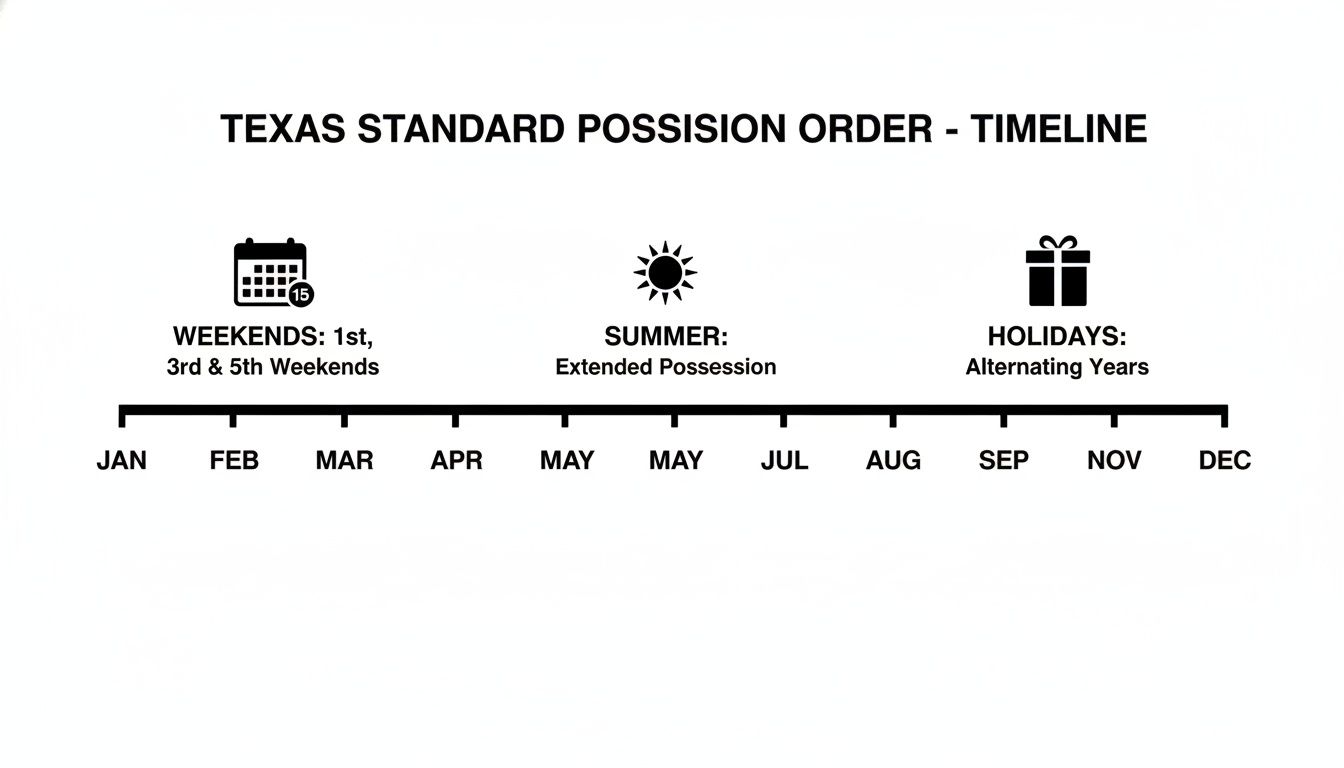
As you can see, the schedule is built to create a consistent rhythm, giving both parents and the child a routine they can count on.
Weekend Possession: The First, Third, and Fifth Weekends
The core of the SPO is the weekend schedule. The non-primary parent (legally known as the possessory conservator) gets possession of the child on the first, third, and fifth weekends of each month.
But what counts as a "weekend"? The SPO is very specific to prevent arguments.
- Step 1: Determine the Start and End. Possession usually starts when school lets out on Friday and ends when the child goes back to school on Monday morning.
- Step 2: Check for an Expanded Order. Your order can specify an earlier pickup (e.g., Thursday after school) and a later drop-off (e.g., Monday morning at school), creating a longer weekend. This "Expanded" version is common and must be written into the order.
- Step 3: Count the Weekends Correctly. It’s crucial to get a calendar and count correctly. A month’s "first weekend" is the one that starts on the first Friday of that month.
A Month in the Life: An SPO Scenario
Let’s walk through a practical scenario to see this in action. Imagine a parent named Sarah is the non-primary parent to her son, Leo. She lives about 20 miles from Leo's school. Let's say October starts on a Tuesday.
- First Weekend: The first Friday of October is the 4th. Sarah will pick Leo up from school on Friday, October 4th, and bring him back to school on Monday, October 7th.
- Third Weekend: The third Friday lands on October 18th. Sarah gets Leo again, from Friday the 18th until Monday the 21st.
- Fifth Weekend: Not every month has a fifth Friday, but when it does—like in May or August of some years—it’s a bonus weekend for the non-primary parent.
This simple, repeating pattern is the foundation of Texas standard visitation rights. It creates the predictability that helps families adjust after a divorce or separation.
Thursday Visits During the School Year
The SPO also includes a mid-week visit to keep the non-primary parent connected between weekends. During the school year, this parent has the right to see the child every Thursday.
Typically, this visit starts when school is dismissed and ends when the child is returned to the primary parent’s home later that evening, often around 8:00 PM. However, if the parents have an Expanded Standard Possession Order, this Thursday visit becomes an overnight, with the parent returning the child to school the next morning. This regular touchpoint is incredibly valuable for maintaining a strong parent-child bond.
Trying to juggle all these dates can feel like a lot at first. A detailed guide to coparenting calendars can provide some great tools to help you and your co-parent stay organized. And while the SPO is the default, it's not the only option. To learn more about other schedules, you may want to read our guide on Texas parental visitation.
How Geographic Distance Changes Your Schedule
A move can change a lot more than your address—it can completely reshape your possession schedule under Texas law. When you’re co-parenting, the distance between your homes isn't just about convenience; it’s a legal yardstick that dictates how and when you see your children. We understand how stressful a potential move can be, and our job is to make it clear what this change means for your family.

The Texas Family Code draws a clear line in the sand using a simple mileage number: 100 miles. Once parents live more than 100 miles apart, the law recognizes that the typical weekend and mid-week visit just isn't practical anymore. Instead, it lays out an alternative schedule built for longer, less frequent visits.
When You Live Over 100 Miles Apart
If the non-primary parent lives more than 100 miles from the child, they get to make some choices about their possession time. This built-in flexibility is the law's way of acknowledging the real-world headaches of long-distance travel.
The non-primary parent can formally elect, in writing, one of these options for their weekend time:
- Option 1: Keep the Standard Weekends. They can stick with the 1st, 3rd, and 5th weekends of the month, just like parents who live closer.
- Option 2: Choose One Weekend a Month. They can pick one specific weekend of their choice each month to have possession. This choice comes with a rule: you must give the other parent at least 14 days' written or electronic notice telling them which weekend you've picked. If you forget to send notice, you automatically get the first weekend of that month.
The trade-off for long-distance parenting is significant. You lose the frequency of seeing your child every other weekend and on Thursdays, but you gain longer, more meaningful blocks of time—especially for summer and holidays.
Living farther apart also automatically changes the holiday and summer schedules. The non-primary parent who lives over 100 miles away gets an extended summer possession of 42 days (up from 30) and gets the child for spring break every single year. You can get a much deeper look at these schedules in our in-depth guide on divorce and child visitation in Texas.
The Expanded Schedule for Parents Living 50 Miles Apart or Less
The Texas Legislature also knows that families in sprawling metro areas like Houston or Dallas-Fort Worth can live 45 miles apart and still face a logistical nightmare. That's why they created what’s known as the "Expanded Standard Possession Order" to help parents who live relatively close.
Under Texas Family Code § 153.317, if parents live 50 miles apart or less, the court is actually required to order an expanded schedule unless it’s proven not to be in the child’s best interest.
This "expanded" schedule typically includes:
- Earlier Weekend Pickups: Your weekend time starts when school lets out on the Thursday before your 1st, 3rd, and 5th weekends.
- Later Weekend Drop-Offs: Your time ends when school starts back up on the Monday morning after your weekend.
This effectively turns your regular weekend into a long weekend. It also gives you an overnight visit every single Thursday during the school year, maximizing your time without pulling the child out of school or disrupting their routine. It’s a modern solution for modern co-parenting.
Holidays and summer vacations are some of the most precious times you'll have with your children. When you're co-parenting, the fear of missing out on those big moments can be a huge source of anxiety.
The good news is that the Texas Standard Possession Order (SPO) was designed with exactly this in mind. It creates a predictable roadmap that protects this time for both parents and gives your children consistent traditions they can count on.
Let's walk through exactly how the holiday and summer schedules work. Knowing what to expect lets you plan ahead and focus on what really matters—making lasting memories with your child.
How The Holiday Schedule Works
To keep things fair and predictable, the SPO splits the biggest school holidays—Thanksgiving and Christmas—on an alternating even-and-odd-year schedule. This simple system ensures both parents get to share these holidays, removing the need for stressful yearly negotiations.
Here’s a simple breakdown of how it works:
- Thanksgiving Break: The non-primary parent gets the kids for the entire Thanksgiving holiday in odd-numbered years (like 2027 and 2029). The primary parent has possession for Thanksgiving during even-numbered years (like 2026 and 2028).
- Christmas/Winter Break: This longer break is split right down the middle. The non-primary parent gets the first half of the break in even-numbered years and the second half in odd-numbered years. The holiday period typically begins the moment school lets out and ends the morning before school starts again.
This alternating schedule is a core part of your Texas standard visitation rights, providing a stable and reliable routine for everyone involved.
Understanding Summer Possession Rights
Summer break is the perfect chance for longer, more relaxed visits. The SPO recognizes this and gives the non-primary parent a significant block of uninterrupted time with the child.
If you live within 100 miles of the other parent, you're entitled to 30 days of summer possession. You can choose to take this time all in one go or break it up into two separate periods. Here is the practical guidance you need to follow:
- Step 1: Provide Notice. You must give the primary parent written notice of your chosen summer dates by April 1st of each year. This notice is a critical step, so mark your calendar!
- Step 2: Know the Default. What happens if you miss the April 1st deadline? The SPO has a fallback plan. If you don't provide notice, your possession time automatically defaults to July 1st through July 31st.
Planning ahead is the key to getting the summer schedule that works best for your family.
Special Days That Are Always Yours
While most major holidays alternate, some days are so important that the Texas Family Code reserves them for one parent every single year. These days override the regular schedule, so you never have to worry about missing them.
- Mother's Day: The child is always with their mother for the entire Mother's Day weekend. Possession starts when school lets out on Friday and ends the following Monday morning when school resumes.
- Father's Day: Likewise, the child is always with their father for the entire Father's Day weekend on the exact same schedule.
These special weekends take priority over everything else. Even if it’s supposed to be the other parent's "first" weekend of the month, possession flips to the designated parent for that holiday. The law protects these irreplaceable moments for you and your child.
Custody Schedules For Children Under Three
When your child is an infant or a toddler, Texas law recognizes that their needs are completely different from those of older kids. The rigid framework of the Standard Possession Order (SPO) simply doesn't work for children under three. Thinking about being separated from a very young child is hard, but the law tries to address this by moving away from a one-size-fits-all calendar.
Instead, the focus shifts entirely to creating a custom-fit schedule that puts the child's needs first.

For children over three, the SPO is the presumed "right" answer. But for infants and toddlers, there is no "standard" schedule at all. A judge's primary job is to build a possession order from the ground up, tailored to that specific child's physical and emotional well-being. This means looking at factors that go far beyond a simple calendar.
Key Factors a Judge Considers
When creating a schedule for a child under the age of three, a judge gets a lot more flexibility to look at the family’s real-life circumstances. Instead of just applying a standard formula, the court will dig into the details. They'll consider things like each parent's work schedule, their health, and, importantly, how the child handles being away from either parent.
A court will carefully evaluate several key areas:
- The Child's Developmental Stage: The needs of a six-month-old are worlds apart from those of a two-and-a-half-year-old. The schedule has to reflect where the child is right now.
- Each Parent’s Ability to Provide Care: The judge will look at who has historically been the main caregiver and each parent's practical ability to handle the day-to-day needs of a very young child.
- The Child’s Emotional Well-Being: How does the child react to separations? The court’s goal is to create a schedule that minimizes distress and supports a secure, healthy attachment to both parents.
- The Stability of the Home Environment: A safe, consistent, and predictable home is absolutely critical for a young child’s development.
Often, these custom schedules begin with shorter, more frequent visits for the non-primary parent. As the child gets older and more comfortable, the duration of these visits gradually increases. For a deeper dive into this, check out our detailed article on child custody for children under three in Texas.
The Overriding Importance of Child Safety
In any custody case, the child’s safety is the court’s number one priority. This is never truer than when dealing with very young children who can't speak for themselves.
Under Texas Family Code § 153.004, if credible evidence of family violence, child abuse, or neglect by a parent is presented, a judge is no longer bound by any standard presumptions. The law flat-out prohibits the court from appointing those parents as joint managing conservators and demands an order that protects the child above everything else.
What this means is that a judge can, and absolutely will, severely limit or even deny a parent's possession if it’s necessary to keep the child physically and emotionally safe. It's a powerful legal safeguard that ensures your child's well-being is never put at risk. Nothing else matters more.
How To Modify Or Enforce Your Visitation Order
Life doesn’t stand still, and what worked for your family right after the divorce might not make sense a year later. While your final custody order is a legally binding document, it’s not set in stone forever. Texas law recognizes that circumstances change and provides clear paths for parents to either update (modify) a possession order or hold a co-parent accountable (enforce) when they aren’t following the rules.
It's a common and frustrating spot to be in—feeling trapped by an outdated schedule or dealing with a co-parent who consistently ignores the court's decree. The good news is, you aren't stuck. You have legal options. Let’s break down how you can take action.
How to Modify Your Possession Order: A Step-by-Step Guide
You can’t just go to a judge and ask for a new schedule because the old one has become inconvenient. To get a court to consider a change, you must follow a clear legal process.
- Step 1: Show a "Material and Substantial Change." You first have to prove there has been a significant change in the lives of the child or one of the parents since the last order was signed. This is a high legal bar, but it’s there to protect the child’s need for stability. Common examples include a parent's relocation, a child’s evolving needs as they get older, or a serious change in a parent's lifestyle that affects the child.
- Step 2: Prove the Change is in the Child’s Best Interest. Once you prove a material and substantial change has occurred, the court then moves to the second question: would changing the order be in the child’s best interest?
Navigating this process requires careful legal strategy and strong evidence, making the guidance of an experienced attorney invaluable.
How to Enforce Your Possession Order
So, what do you do when the other parent just won't follow the possession order? Maybe they’re always late for exchanges, decide last-minute that the kids aren't coming for your weekend, or refuse to let you have your holiday time. This is more than just frustrating—it’s a direct violation of a court order, and you have the power to do something about it.
Here’s the practical guidance on how to proceed:
- File a Petition for Enforcement. You can file this formal legal action with the same court that issued your original custody order. Your petition must be a sworn document detailing every single violation with specific dates, times, and descriptions of what happened. Meticulous documentation is your best friend.
- Serve the Other Parent. Your co-parent must be officially served with the lawsuit so they are legally notified to appear in court.
- Attend a Hearing. Both parents will go before the judge. You will present your evidence of the violations, and the other parent will get a chance to explain their side.
If the judge finds the other parent knowingly violated the order, the consequences can be significant. The court can order them to pay fines, cover your attorney's fees, and even face jail time for contempt of court. A judge can also order "make-up" visitation to compensate you for the time you lost.
Common Questions About Texas Visitation Rights
As family law attorneys, we’ve sat across the table from countless parents trying to make sense of their new co-parenting reality. The same questions, anxieties, and frustrations come up again and again. You're not alone in feeling uncertain, and you deserve clear, practical answers.
This section tackles some of the most common issues we see parents face when navigating a Texas possession order.
Can My Child Refuse to Go on a Visit?
This is one of the toughest situations a parent can face. It's heartbreaking and confusing when your child doesn't want to go with their other parent. But while it's crucial to listen to your child's feelings, the simple legal answer is no, a child cannot refuse to follow a court-ordered possession schedule.
A possession order is a binding legal document that applies to the parents, not the child. It is your legal duty to make sure your child is available for the other parent's time. Failing to do so can land you back in court for violating the order. The best course of action is to figure out why they are reluctant and then work with your co-parent to solve the underlying problem.
What Do I Do If the Other Parent Is Always Late?
Chronic lateness isn't just a minor annoyance—it’s a disruption to your child's routine and a sign of disrespect for your time. The single most important piece of practical guidance is to document everything.
Keep a simple log or journal. For every late pickup or drop-off, write down the date, the scheduled time, and the actual time the exchange happened. This written record isn't just for your own sanity; it becomes powerful evidence if you ever need to ask a court to enforce the order.
Can I Deny Visitation If Child Support Isn't Paid?
This is one of the most critical rules to understand in Texas family law. Child support and visitation are two completely separate legal obligations. You absolutely cannot deny the other parent their court-ordered possession time, even if they are months or years behind on child support.
Withholding the child as a way to force payment will put you in direct violation of the court order, which can bring serious legal trouble your way. The correct and only legal way to address unpaid child support is to file a separate enforcement action through the court.
Practical Tip: The Right of First Refusal
Do you worry about your child being left with a babysitter during the other parent’s time when you’re free and available? The "Right of First Refusal" is a specific provision you can add to your custody order to solve this. It legally requires one parent to offer the other parent the chance to care for the child before calling a babysitter or other third-party caregiver. This simple clause can maximize your time with your child and provide incredible peace of mind.
Understanding these details is fundamental to protecting your rights and giving your child the stability they need.
If you need help navigating divorce, custody, or estate planning in Texas, contact The Law Office of Bryan Fagan, PLLC today for a free consultation.