
Divorce can be one of life’s most difficult transitions—but understanding your rights and options under Texas law can make the journey less overwhelming. In Texas, divorce mediation is a process designed to give you a roadmap. It’s a structured, confidential meeting where you and your spouse sit down with a neutral third-party mediator to find common ground.
Instead of a judge making decisions for you in a courtroom, the mediator helps you both talk through the issues and negotiate an agreement that you can both live with, putting you in control of your family's future.
What Is Divorce Mediation And How Does It Work?
Facing a divorce can feel like you're being asked to navigate a storm without a map, but knowing your options under Texas law can make the journey feel a lot less overwhelming. While many people picture divorce as a dramatic courtroom battle, the reality is that the vast majority of Texas couples resolve their differences outside of court through a process called mediation.
Think of mediation as a guided conversation, not a legal fight. It is a collaborative process where a neutral third-party mediator facilitates discussion between you and your spouse to help you reach a mutually acceptable agreement. The entire process is confidential, which means your family’s private business stays out of the public record.
The Goal of Mediation
The main goal of mediation is to empower you and your spouse to create your own solutions for the future. A neutral mediator, who doesn't represent either of you, keeps the discussion on track and helps you find common ground on the big issues, including:
- Division of property and debts: Deciding how to separate your shared assets and financial responsibilities according to Texas community property laws.
- Child custody and visitation: Creating a parenting plan that truly serves your children’s best interests.
- Child support and spousal support: Figuring out any financial support arrangements that may be necessary.
This approach gives you direct control over the final outcome. Rather than having a judge who doesn't know your family impose a one-size-fits-all order, you get to design an agreement that fits your family's unique needs. It’s a practical, dignified way to close one chapter and begin the next.
The Texas Family Code strongly encourages couples to settle their cases out of court. Mediation aligns perfectly with this principle, fostering amicable resolutions that can build a healthier foundation for co-parenting and life after divorce.
A Proven Path to Resolution
Many people ask if mediation really works. The research consistently shows that it does. Divorce mediation has remarkably high success rates, making it a far more effective path than traditional litigation for many couples.
Studies have shown that mediation leads to a full or partial agreement in 50% to 80% of cases. For Texas families weighing their options, these numbers offer solid proof that mediation is a practical and achievable way to resolve a divorce.
By putting you in the driver's seat, mediation lets you end your marriage with dignity and mutual respect. To get a deeper understanding of how this process works, you might be interested in our detailed look at the benefits of mediation in a Texas family law case.
The thought of divorce often brings a wave of anxiety, much of it from not knowing what lies ahead. When you understand how divorce mediation works in Texas, you can replace that fear with a sense of control. Think of it as a clear, structured roadmap designed to help you and your spouse find common ground and reach your own agreements.
This step-by-step guide will demystify the journey, helping you feel prepared for what’s to come.
The process is designed to guide families from a place of conflict toward a cooperative resolution, steering clear of the stormy and expensive seas of a courtroom battle.
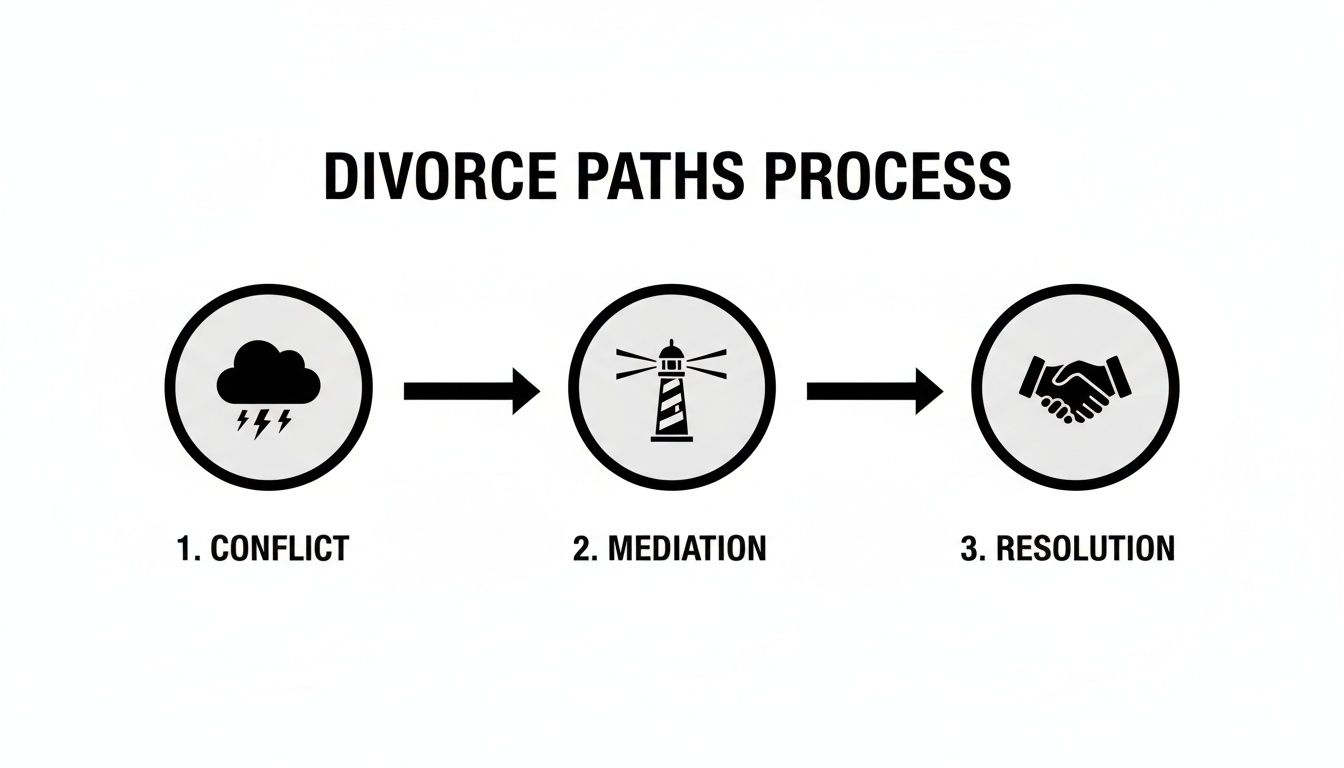
Mediation is a structured path forward, transforming a tense situation into a peaceful handshake that represents a successful agreement. Your attorney from The Law Office of Bryan Fagan, PLLC, will be right there with you, guiding you at every turn.
The Role You Play vs. The Mediator's Role
Understanding who does what in mediation is crucial. It's not a free-for-all; everyone has a distinct and important job to do. This table breaks down the responsibilities so you know exactly what to expect from yourself, your attorney, and the neutral third-party mediator.
| Responsibility | Your Role (And Your Attorney's) | The Mediator's Role |
|---|---|---|
| Decision-Making | Make the final decisions on all issues. Your attorney provides legal advice to inform those decisions. | Facilitates discussion but makes no decisions. The mediator does not have the authority to impose a settlement. |
| Advocacy | Advocate for your own needs and interests. Your attorney advocates for your legal rights. | Remains 100% neutral and impartial. Does not take sides or advocate for either party. |
| Information Sharing | Provide honest and complete information about finances, property, and goals. | Manages the flow of information and ensures both sides are heard. Keeps private conversations confidential. |
| Generating Solutions | Brainstorm creative solutions and propose settlement offers. Your attorney helps you evaluate the pros and cons of each offer. | Helps the parties explore options they may not have considered and reality-tests proposals. |
| Legal Advice | Rely on your attorney for legal counsel. You are the expert on your family's needs. | Provides no legal advice. Cannot act as an attorney for either party. |
Knowing these roles helps you participate effectively. Your job is to be an active, informed participant, while the mediator's job is to keep the process fair, productive, and moving forward.
Step 1: Choosing A Mediator And Scheduling The Session
The first real step is selecting a qualified, neutral mediator. In most cases, the attorneys for both sides will confer and agree on a professional they both trust for their experience and fairness. It’s a collaborative choice.
Once a mediator is chosen, their office steps in to coordinate a date and time that works for you, your spouse, and both attorneys. In Texas, this isn’t just a suggestion. Most courts require you to attempt mediation before they will even consider letting you go to a final trial, making this a critical part of nearly every divorce.
Step 2: The Opening Session
Mediation day usually starts with everyone in the same room (or virtual room) for an opening session. The mediator will introduce themselves, lay out the ground rules—especially confidentiality—and set a cooperative tone for the day.
After the mediator's introduction, you and your spouse (or more often, your attorneys) will have a chance to make a brief opening statement. This isn't the time for arguments or rehashing old wounds. It's for calmly stating your view on the key issues and what you hope to accomplish by the end of the day.
Step 3: Identifying Key Issues And Moving To Private Caucuses
Once the opening statements are done, the group breaks up. You and your attorney will go to a private room, and your spouse and their attorney will go to another. This is where the real work begins.
The mediator will then move back and forth between the two rooms. This process is often called "shuttle diplomacy" or a "private caucus." The mediator acts as the go-between, carrying information, questions, and offers from one room to the other.
In these private sessions, you can speak completely freely and confidentially with the mediator. Anything you say in a caucus is private. The mediator will not share it with the other side unless you give them specific permission to do so.
This confidentiality is the secret sauce of mediation. It creates a safe space to have honest conversations about what you really want, what you're worried about, and where you might be willing to compromise, all without fear of your words being twisted or used against you.
Step 4: Exploring Solutions And Negotiation
With the shuttle diplomacy in full swing, the mediator’s job is to carry offers, counteroffers, and new ideas between the two rooms. They aren't just a messenger, though. A good mediator helps each side explore different solutions, reality-tests proposals, and offers a neutral perspective on the strengths and weaknesses of your legal position.
This phase requires a lot of patience and a genuine willingness to find common ground. For instance, a mediator might help you and your spouse design a creative possession schedule for your children that fits a non-traditional work life—a custom solution a busy judge might not have the time or flexibility to craft in a courtroom.
Your attorney’s role here is vital. They will advise you on the legal and financial impact of every proposal and help you draft counteroffers that protect your interests. To learn more about the specific mechanics of this stage, you can read our in-depth article on mediation in a Texas family law case.
Step 5: Finalizing The Mediated Settlement Agreement
If you and your spouse manage to reach an agreement on all your issues, the mediator’s final task is to draft a Mediated Settlement Agreement (MSA). This is the official, written document that spells out every single term you've agreed upon, from property division to the parenting plan.
In Texas, this isn't just a piece of paper—it’s an incredibly powerful legal document. You, your spouse, and your respective attorneys will all carefully review and sign it. Once signed, a properly executed MSA is binding and irrevocable under the Texas Family Code. This means neither person can simply change their mind later.
This final step transforms your day of hard-fought negotiations into a solid, legally enforceable agreement. It gives you certainty and finality, allowing you to move on to the last steps of your divorce knowing the biggest decisions were made by you, for your family.
Comparing Mediation Against Traditional Court Litigation
When you’re facing a divorce, one of the biggest choices you'll make is how you'll get there. Most people immediately think of a dramatic courtroom battle, but that’s rarely the only path. Understanding the real-world differences between mediation and traditional litigation is key to choosing the strategy that best protects your family, your money, and your future.
At the Law Office of Bryan Fagan, PLLC, our job is to give you the honest truth about your options. We want to lay out a clear comparison to help you decide whether the collaborative approach of mediation or the structured authority of the courtroom is the right fit for your specific situation.

Why Mediation Puts You in the Driver's Seat
Mediation offers some powerful advantages over a court fight, and they all come down to three things: control, privacy, and cost. Once you see how divorce mediation works, it becomes obvious why Texas courts so often require it.
- You Keep the Control: In mediation, you and your spouse make the final decisions. A judge, who only knows the limited facts presented in a formal hearing, won't be the one imposing life-altering orders on your family. The power stays in your hands.
- It’s Completely Confidential: Court hearings and filings are public record. Mediation, on the other hand, is entirely private. This keeps your family’s personal and financial business out of the public eye.
- You Can Get Creative: Judges have to follow rigid legal formulas. Mediation opens the door for creative, customized solutions that actually fit your family’s unique needs—something a courtroom setting can rarely accommodate.
Consider a common scenario we see: a nurse and a firefighter trying to create a custody schedule. Their work shifts are anything but a standard 9-to-5. In court, a judge would likely impose a standard possession order that simply doesn't work for their rotating schedules, creating constant conflict and logistical headaches.
In mediation, they can build a custom schedule from the ground up that works around their rotations. This flexibility allows them to co-parent effectively, cut down on conflict, and put their children’s needs first. It’s a win-win that litigation often makes impossible.
The Real Savings in Time and Money
Beyond the emotional benefits, the financial and time savings are what make mediation so attractive. It's not just a theory; we see it every day. Successful mediation almost always reduces attorney fees and court costs. It can also eliminate the need for expensive expert witnesses, multiple property appraisals, and forensic accountants.
For Texas families, these financial realities matter. Mediation allows you to resolve your disputes more quickly and affordably, preserving your resources for your post-divorce life. You can explore more about the superb benefits of mediation and see how it streamlines the process.
This efficiency is a huge draw. While a straightforward case might be resolved in just a few sessions, even complex divorces that take several weeks to mediate are almost always faster and less expensive than a drawn-out court battle.
By keeping you out of the courtroom, mediation saves you not only money but also the immense emotional toll that litigation takes on a family.
When Litigation Is the Necessary Path
As effective as mediation is, it’s not a cure-all. It isn't the right choice for every single case. Our commitment is to find the best strategy for you, and sometimes, that means gearing up for a fight in court. Litigation is sometimes the only way forward.
These situations often include:
- Cases Involving Family Violence: If there is a history of domestic abuse, the power imbalance can make fair and safe negotiation impossible. The protections of a courtroom are necessary.
- A Spouse Is Hiding Assets: If you suspect your spouse is actively hiding money or property, the formal discovery tools of litigation—like subpoenas and depositions—are essential to uncover the truth.
- An Uncooperative Partner: Mediation requires good-faith participation from both sides. If one spouse simply refuses to negotiate or is completely unreasonable, a judge's intervention may be the only way to get things done.
Choosing between mediation and litigation isn’t about which one is "better." It's about which one is better for your family. By weighing these factors with an experienced attorney, you can make an informed choice that leads to the best possible outcome.
The Legal Power Of Your Mediated Agreement In Texas
You’ve spent hours at the mediation table, hashing out every last detail with your spouse. You finally have an agreement. So, what’s next? This is the moment where all that effort pays off and becomes a real, legally binding result, giving you the certainty you need to start moving forward.
In Texas, the document you sign after a successful mediation is called a Mediated Settlement Agreement (MSA). This is much more than just a handshake deal or an informal understanding. The MSA is a powerful contract that carries serious weight in the eyes of the court.
The Irrevocable Nature of an MSA
Under the Texas Family Code §6.602, a correctly drafted and signed MSA has immense authority. The law is very specific about what makes a mediated agreement binding.
A mediated settlement agreement is binding on the parties if the agreement:
(1) provides, in a prominently displayed statement that is in boldfaced type or capital letters or underlined, that the agreement is not subject to revocation;
(2) is signed by each party to the agreement; and
(3) is signed by the party's attorney, if any, who is present at the time the agreement is signed.
This part of the law is incredibly important. When these requirements are met, the MSA becomes irrevocable. What does that mean in plain English? It means that once you sign, you can't just wake up the next day with "buyer's remorse" and back out of the deal. The purpose of this rule is to provide finality and prevent the divorce process from dragging on endlessly with second-guessing.
From Agreement to Final Court Order
Think of your signed MSA as the detailed blueprint for your divorce. It lays out every single term you and your spouse agreed upon, from how your property and debts will be divided to the exact details of your child custody and visitation schedule. The next step is to turn that blueprint into the final, court-ordered structure of your post-divorce life.
This is where your attorney at The Law Office of Bryan Fagan, PLLC, takes over. We will take the MSA you worked so hard to create and draft a document called the Final Decree of Divorce. This decree is the official order that the judge signs to legally end your marriage, and it must mirror every term from your MSA.
Once drafted, the Final Decree is presented to the judge for their signature. Because a valid MSA is binding, the judge is legally required to approve a decree that reflects its terms. Their role isn't to second-guess your agreement or make changes; it's to ensure the agreement is legally sound and then finalize it. With the judge's signature, your private agreement becomes a public, enforceable court order.
While the law provides strong protections for mediated agreements, it's also good to know the very limited situations where an MSA could be challenged. For a deeper look at this complex issue, you can learn if family violence can render a mediated settlement invalid in our related article.
This final step is what turns all your hard work in mediation into a concrete, legally certain outcome, officially closing this chapter and allowing you to begin the next one.
How To Prepare For A Successful Mediation Session
Your success in mediation hinges almost entirely on how well you prepare. Walking into that room organized, clear-headed, and focused on solutions can be the difference between a frustrating day and a successful agreement. It's all about being proactive, which empowers you to negotiate from a position of strength and clarity.

Think of it like preparing for an important exam. You wouldn't show up without studying your notes and having a firm grasp of the material. Mediation is no different. The more you prepare beforehand with your attorney, the more confident and effective you'll be when it counts.
Gather Your Financial Documents
The foundation of any divorce negotiation is a complete and honest financial picture. You simply cannot divide what you don't fully understand. Before your mediation session, you and your attorney need to gather all the essential financial paperwork.
This isn't just for your benefit; it's about creating transparency. When both sides are looking at the same set of financial facts, it cuts down on suspicion and paves the way for productive conversations about dividing property and debts fairly.
Your financial checklist should include:
- Income Information: Recent pay stubs, W-2s, and tax returns for both you and your spouse.
- Asset Statements: Bank account statements, retirement account summaries (like 401(k)s and IRAs), investment portfolio reports, and property deeds.
- Debt Records: Credit card statements, mortgage balances, car loan information, and details on any other outstanding loans.
- A Comprehensive Budget: A realistic projection of your post-divorce monthly income and expenses. This is absolutely vital for discussing child support and potential spousal maintenance.
Define Your Goals And Priorities
Before you can negotiate, you need to know exactly what you’re negotiating for. Take some time to sit down with your attorney and think through what a successful outcome actually looks like for you. It helps to split your goals into two distinct categories: your "must-haves" and your "nice-to-haves."
For example, a must-have might be establishing a possession schedule that allows your children to maintain a strong relationship with both parents. A nice-to-have could be keeping a particular piece of art. Knowing the difference helps you focus on what truly matters and shows you where you have room to be flexible.
Define your best-case scenario, your worst-case scenario, and your most likely, acceptable outcome. This range gives you a clear framework for negotiation and helps you recognize a fair offer when you see one.
This exercise is about being realistic, not about creating an impossible list of demands. A well-defined set of priorities will act as your North Star throughout the mediation process, keeping you on track and focused on a stable future. Your attorney is the perfect resource to help you figure out if your goals are achievable under the Texas Family Code.
Adopt A Problem-Solving Mindset
The single most important piece of preparation you can do is mental. Mediation is a process of joint problem-solving, not a battle to be won or lost. Walking into the room with an adversarial, winner-take-all attitude is the fastest way to guarantee a stalemate.
Instead, try to shift your perspective. You and your spouse aren't opponents; you are two people with a shared problem that needs a practical solution. That problem is how to equitably untangle your lives and create two separate, stable households in a way that prioritizes your children's well-being.
This shift in mindset changes everything. It encourages cooperation, creative thinking, and compromise. Remember, a successful mediation doesn't mean getting everything you want. It means reaching a fair agreement that allows both of you—and your children—to move forward with security and peace. Your willingness to work toward a resolution is your greatest asset.
Common Questions About Divorce Mediation In Texas
When you're staring down the path of divorce, it’s completely normal to feel overwhelmed by questions. Mediation often comes up as a more peaceful alternative to a courtroom battle, but the process itself can seem mysterious and uncertain.
Here at The Law Office of Bryan Fagan, PLLC, we find that giving you straight answers is the best way to replace that anxiety with confidence. We’ve put together answers to the most common questions our clients have about Texas divorce mediation to help you feel more prepared for what’s ahead.
Is Mediation A Mandatory Step For Every Divorce In Texas?
This is one of the first and most important questions people ask. Technically, the answer is no—you aren’t required to mediate the second you file for divorce. But in practice, almost every single Texas divorce will go through mediation before a judge will even consider letting you have a final trial.
The reality is that many Texas counties have local rules mandating that you at least try mediation first. Even where it’s not an automatic rule, judges will almost always order you to mediate once they see you and your spouse can’t agree on key issues.
Why? Because judges know mediation works. It’s incredibly effective at helping families find their own solutions, and it keeps the court dockets from getting hopelessly backlogged. A judge would much rather you build your own agreement with a neutral expert than have to impose one on your family from the bench. So, while it may not be mandatory on day one, you should absolutely plan on mediation being a crucial part of your divorce.
Can I Attend Mediation Without An Attorney?
Legally, you are allowed to go to mediation by yourself. But from an experienced lawyer’s perspective, this is one of the biggest and most unnecessary risks you can take in a divorce. Walking into mediation alone is like going into a major real estate negotiation without a realtor or an inspector—you’re at an immediate and serious disadvantage.
Here’s why having an attorney from The Law Office of Bryan Fagan with you is so vital:
- You Don’t Know What You Don’t Know: A mediator's job is to be neutral; they cannot give you legal advice. Without your own lawyer, you could easily agree to terms that sound fair but are financially devastating or give up critical rights protected under the Texas Family Code.
- Protection from Pressure: Divorce negotiations are intense and emotional. An experienced attorney acts as your buffer, making sure you aren't intimidated or worn down into accepting a bad deal just to get it over with.
- Informed Decision-Making: Your lawyer can analyze settlement proposals on the spot, explain the real-world consequences, and tell you whether what’s on the table is fair and legally sound.
- Drafting the Agreement: If you do reach a deal, your attorney’s most important job is to make sure the Mediated Settlement Agreement (MSA) is drafted to be ironclad, protecting your interests and closing any loopholes that could haunt you years later.
An attorney is your advocate, your legal strategist, and your shield. Attending mediation without one means you are negotiating against your spouse’s attorney without any professional support on your side. The risk of an unbalanced and unfavorable outcome is simply too high.
What Happens If We Only Agree On Some Issues?
That’s a great question, and the answer is that it's a very common—and very positive—outcome. A successful mediation isn’t an all-or-nothing game. It happens all the time where a couple resolves some issues but remains stuck on others. This is called a partial agreement, and it’s still a huge win.
For example, you might settle exactly how to divide your bank accounts and retirement funds but hit a wall when it comes to the final child custody schedule. In that situation, the mediator will draft a partial Mediated Settlement Agreement that locks in everything you did agree on.
That partial MSA is just as binding and enforceable as a full one. You’ve successfully taken those issues off the table for good, which means they can't be fought over in court. This drastically narrows the focus of your dispute, saving you an incredible amount of time, stress, and money. The only things left for a judge to decide would be the issues that remain unresolved—in this case, just the custody schedule.
What Is The Typical Cost Of Divorce Mediation In Texas?
The cost of mediation varies, but it is almost always dramatically cheaper than taking your divorce to a final trial. Knowing how the costs break down can help you budget and see the value.
In Texas, mediators typically charge by the hour, and that cost is split between the parties. So, if a mediator charges $400 per hour, you and your spouse would each pay $200 per hour. Most mediators require a minimum booking, usually for a half-day (four hours) or a full day (eight hours).
Let’s put that in perspective:
- A Full Day of Mediation: An eight-hour session with a mediator who charges $300 per hour would cost a total of $2,400. Split between two people, your share is $1,200. If your case settles that day, you’ve resolved your entire conflict for that price.
- A Day in Court: By contrast, a single day of a contested trial can easily run each person $5,000 to $10,000 or more, factoring in attorney's fees, expert witness costs, and preparation. And most trials last longer than one day.
The financial logic is undeniable. Even if you need more than one session, mediation is a much smarter investment. By committing to a few hours of focused, productive negotiation, you can avoid the crushing expense and high-stakes gamble of a courtroom battle.
If you need help navigating divorce, custody, or estate planning in Texas, contact The Law Office of Bryan Fagan, PLLC today for a free consultation for tailored guidance.


