
The end of a relationship can be one of life’s most difficult transitions—but understanding your rights under Texas law can make it less overwhelming. When you’ve built a life together without a formal wedding, the path forward can feel uniquely complicated and uncertain.
At The Law Office of Bryan Fagan, we understand the anxiety this situation creates. Our commitment is to offer you a supportive, reassuring path forward by explaining the process one step at a time, just as we would for a client sitting in our office.
The most critical thing to grasp is that there is no special "common law divorce" in Texas. If your informal marriage is legally valid, you must get a formal, legal divorce—just like any other married couple. Figuring out your legal standing is the first step toward securing your future.
Understanding Your Rights in an Informal Marriage
In Texas, what is commonly known as a "common law marriage" is legally referred to as an informal marriage. If your relationship meets the specific legal criteria, it is just as valid as a ceremonial one. This means you have the same rights to property division and child custody as any other divorcing spouse.
The real challenge in these cases often boils down to proving the marriage existed in the first place, especially if one partner now denies it. This is why understanding the law is so crucial to protecting your future.
What Defines an Informal Marriage in Texas?
To end an informal marriage, you must first prove it was a marriage. According to the Texas Family Code § 2.401, you must demonstrate that three key elements all existed at the same time:
- You both agreed you were married.
- You lived together in Texas as a married couple.
- You presented yourselves to others as a married couple (this is often called "holding out").
If you can prove these three things, you are a spouse in the eyes of the law, not just a partner or roommate. This status grants you significant legal protections. For a deeper look at the initial steps, you can learn more about how to separate from a common law partner in our related guide.
How to Prove an Informal Marriage in Texas

One of the biggest myths in Texas law is that living together for a certain number of years automatically creates a common-law marriage. That is simply not true. In reality, the entire validity of your informal marriage comes down to proving three specific elements occurred simultaneously.
To legally establish your marriage, you must show a court clear and convincing evidence that you and your partner met the three-pronged test laid out in Texas Family Code § 2.401. Think of it as a three-legged stool—if one leg is missing, the entire claim collapses.
Element 1: You Agreed to Be Married
It all starts with the agreement. The first and most crucial element is proving that you and your partner mutually agreed that you were married. This isn't about a promise to get married someday; it's about a present, shared understanding that as of that moment, you are a married couple.
This agreement can be spoken or implied by your actions. The key is that it was a mutual belief, not a one-sided assumption. Proving a private agreement can be the trickiest part of a common-law claim, especially if your ex-partner now denies it ever happened. This is why the other two elements are so critical—they provide external proof of this internal understanding.
Practical Example: You and your partner decide to start wearing wedding rings and begin introducing each other as spouses. You might have said to each other, "We don't need a piece of paper; we're husband and wife now." This conversation, combined with your actions, demonstrates a present agreement.
Element 2: You Lived Together in Texas as Spouses
Next, you must show that you cohabited in Texas as a married couple. Simply sharing an address isn't enough. The law requires you to have lived together with the intent and character of a marital relationship.
A court will look at the nature of your cohabitation. Did you share a bedroom, merge your daily routines, and handle household responsibilities as spouses typically would? The context of how you lived together is what gives this element its legal weight.
Practical Example: Beyond sharing a lease, you combined your finances into a joint account to pay bills, made household decisions together, and shared domestic duties, presenting a unified front as a married pair.
Element 3: You Represented Yourselves to Others as Married
Finally, you must have presented yourselves to the public as a married couple. This is often called "holding out," and it's where you'll find most of your concrete evidence. It’s not enough to privately believe you’re married; you must have consistently shown the world that you were.
Did your friends, family, and community know you as a married couple? Your words and actions must have created the impression in others' minds that you were spouses. For a deeper look at what courts focus on, our guide on what to do when trying to establish a common law marriage can be helpful.
Practical Example: You listed your partner as "spouse" on your health insurance forms, filed your taxes jointly as "married," and introduced each other as "my husband" or "my wife" at social events.
Evidence for Proving an Informal Marriage in Texas
| Legal Requirement (Texas Family Code § 2.401) | What It Means in Practice | Examples of Evidence |
|---|---|---|
| Agreement to Be Married | You both had a present, mutual understanding that you were married. | Testimony from you or witnesses who heard you agree; letters, texts, or emails discussing your marital status. |
| Living Together in Texas as a Couple | You shared a home and lived life together with the character of a married couple, not just roommates. | A lease or mortgage with both names; utility bills at the same address; testimony about your shared daily life. |
| Representing to Others as Married | You consistently presented yourselves to the public as spouses. | Joint tax returns; insurance or employment forms listing each other as "spouse"; testimony from friends, family, or colleagues. |
Remember, you have to prove all three of these elements existed simultaneously. Proving just one or two is not enough. Once your informal marriage is established, you gain the full rights and protections that come with filing for a common law divorce in Texas.
Gathering Evidence to Solidify Your Case

Knowing the three legal elements for an informal marriage is one thing; proving them in court is another. The outcome of your common law divorce in Texas depends on your ability to back up your claim with solid proof, especially if your partner denies the marriage.
Think of yourself as the lead detective in your own case. Your job is to gather the artifacts of your relationship that tell the undeniable story of a marriage. This isn't just about proving a point; it’s about securing your legal rights to community property and ensuring a fair financial future.
Actionable Guidance: Your Evidence Checklist
To prove your informal marriage, you need a mix of documents and testimony. The more layers of consistent proof you have, the stronger your case will be. Here is a practical checklist of evidence to start gathering:
- Financial Documents: This is often the most compelling evidence. Look for joint bank accounts, shared credit cards, and car or home loan applications where you listed each other as spouses.
- Official Forms: Dig up any paperwork where you named your partner as your "spouse." This includes health insurance enrollment forms, life insurance policies, or beneficiary designations on retirement accounts.
- Tax Returns: Filing federal income taxes jointly as "married" is incredibly powerful proof of your agreement and how you held yourselves out to the public.
- Leases or Deeds: A rental agreement or property deed with both your names shows you were cohabitating as a household unit.
- Correspondence and Social Media: Find text messages, emails, or social media posts where you call each other "my husband" or "my wife." Even old birthday or anniversary cards can help paint a picture for the judge.
The Power of Witness Testimony
While paperwork lays the foundation, testimony from people who knew you as a couple brings your story to life. The court needs to hear from others who can confirm they saw you as a married unit.
Consider asking these individuals to testify:
- Family Members: Parents, siblings, or cousins you told you were married.
- Friends and Neighbors: People who heard you introduce each other as spouses.
- Coworkers: Colleagues who knew you were married because you listed your partner as an emergency contact or spouse for benefits.
A judge will weigh the credibility of these witnesses, so focus on people who have firsthand knowledge and can speak honestly about what they observed. The consistency of your evidence is vital.
Proving your case is critical because the financial stakes in a contested divorce are high. According to this analysis of Texas divorce statistics, uncontested divorces in Texas without children cost around $15,600 on average. If children are involved, that figure jumps to $23,500. Methodically gathering your evidence is the most important step toward protecting your rights.
The Formal Divorce Process Step by Step
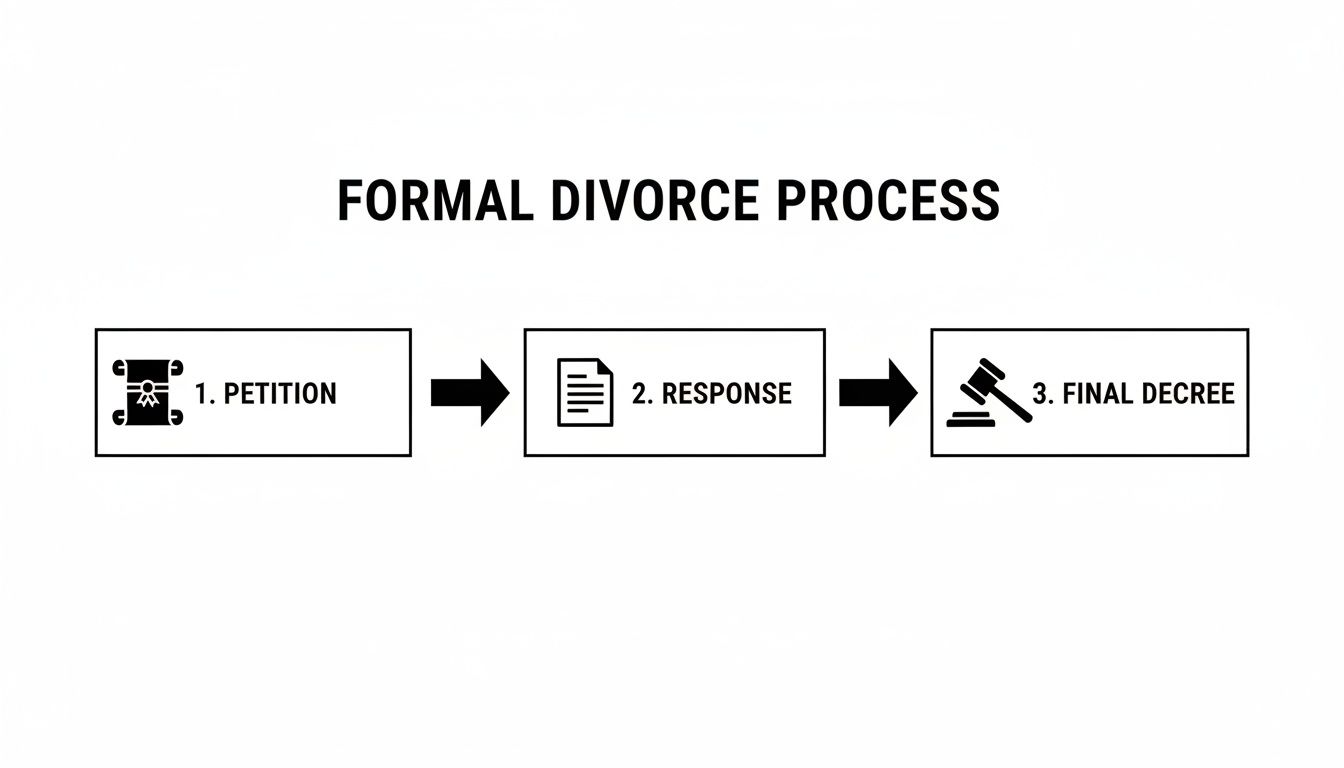
The legal process for ending a common-law marriage follows the same path as a traditional divorce. Understanding these stages can make the journey feel less intimidating and help you prepare for what’s ahead. We believe that clarity empowers you to make the best decisions for your future.
Step 1: Filing the Original Petition for Divorce
The first step is to file an Original Petition for Divorce. This document initiates the lawsuit. It lays out the basic facts of your marriage and tells the court what you are requesting regarding property, debts, and—if applicable—your children.
Critically, for an informal marriage, your petition must also ask the court to legally recognize that a valid common-law marriage existed. This two-part request is the key difference that sets a common-law divorce apart. If your partner denies the marriage, the court must resolve this issue before addressing the divorce itself.
Step 2: Service of Process and the Respondent’s Answer
Once the petition is filed, your partner (the Respondent) must be formally notified through a legal process called service of process. This is typically done by a sheriff’s deputy or a private process server.
After being "served," your partner has a specific timeframe to file a formal response, known as an Answer. In their Answer, they will state whether they agree or disagree with your petition—and most importantly, whether they agree a marriage existed. If they deny it, the first legal battle of your case has just begun.
Step 3: Temporary Orders and Discovery
Life doesn't pause during a divorce. To manage immediate needs, either party can request Temporary Orders from the court. These are short-term rules that address issues like:
- Who will live in the family home.
- How bills and expenses will be paid.
- A temporary child custody schedule and child support plan.
Simultaneously, both sides will engage in discovery—the formal process of gathering information and evidence. This can include requesting financial records, sending written questions (Interrogatories), and taking sworn testimony outside of court (depositions). Discovery is vital for uncovering the proof needed to establish the marriage.
Step 4: Mediation and Finalizing the Divorce
The vast majority of Texas divorces are resolved through negotiation, not a courtroom trial. The primary tool for this is mediation, where you, your partner, and your respective attorneys work with a neutral third-party mediator to find common ground.
If you reach an agreement, it is documented in a Mediated Settlement Agreement (MSA), a binding contract. Your attorneys will then draft the Final Decree of Divorce, which outlines all the terms. A judge will review and sign the decree, making it an official court order that legally ends your marriage and divides your lives.
How Texas Handles Property Division
Untangling your financial life is one of the toughest parts of any divorce. We understand the confusion, and our goal is to explain how Texas law works to protect your interests. In a common law divorce in Texas, property is divided using the same community property principles as in ceremonial marriages. The court aims for a "just and right" division, which doesn't always mean a 50/50 split but rather what is fair under the circumstances.
Community Property vs. Separate Property
Before anything can be divided, every asset and debt must be classified as either community or separate property. The court can only divide the community estate.
- Community Property: This includes all income, assets, and debts acquired by either spouse from the date your informal marriage began until the date of divorce. This can include wages, houses, cars, and retirement contributions earned during the marriage.
- Separate Property: This is anything you owned before the marriage, as well as any personal gifts or inheritances you received during the marriage.
This is why proving the start date of your informal marriage is so crucial—it establishes the starting line for your community estate. If you believe certain assets are yours alone, you will need to provide clear evidence. Our guide on how to prove separate property in a divorce offers a deeper dive into this topic.
Real-life finances are often messy. Funds get mixed (commingled), and separate assets can become intertwined with community property, creating complex legal puzzles.
Scenario: A couple began their informal marriage in 2018. One partner already owned a house (separate property). During the marriage, they used their joint income (community property) to pay the mortgage and remodel the kitchen. This commingling gives the community estate a financial interest in what was once a separate asset. A court will trace the funds to determine a fair reimbursement.
A "just and right" division considers many factors, including each spouse's health, earning potential, and even fault in the breakup. Organizing years of financial records is a significant task, and tools for converting bank statements to Excel can make this process more manageable.
What to Know About Child Custody and Support
When children are involved, their well-being is the primary concern. In Texas, the law does not differentiate between ceremonial and common-law marriages when it comes to children. Every decision a judge makes is guided by one principle: the best interest of the child, as mandated by the Texas Family Code.
How Custody Is Determined in Texas
In Texas, "custody" is legally termed conservatorship, which outlines each parent's rights and duties. In most cases, judges appoint both parents as Joint Managing Conservators, meaning you share the responsibilities of raising your children.
Even in a joint arrangement, one parent is typically named the "primary" parent, who has the right to determine the child's residence (within a geographic area) and receive child support. The other parent follows a possession order detailing their time with the children, often the Standard Possession Order (SPO), which provides a predictable schedule for weekends, holidays, and summer.
In rare cases involving family violence or substance abuse, a judge may appoint one parent as the Sole Managing Conservator, granting them the exclusive right to make most decisions for the child.
Calculating Child Support
Child support ensures both parents contribute financially to their children's needs. Texas uses a guideline-based formula based on the paying parent's net monthly resources and the number of children.
The basic guidelines are:
- One Child: 20% of net monthly resources
- Two Children: 25% of net monthly resources
- Three Children: 30% of net monthly resources
While a judge can adjust the amount for factors like a child's special needs, these percentages are the starting point for nearly every case.
It's worth noting an encouraging trend: as detailed in these Texas divorce statistics and trends, state divorce rates have fallen from 5.5 per 1,000 people in 1990 to around 1.4-1.9 per 1,000 in recent years. This may reflect a broader focus on stability, which aligns with the court’s goal for families.
Common Questions About Informal Marriages
Navigating the end of a long-term relationship brings uncertainty, especially in an informal marriage. Here are clear answers to common questions we hear from clients to help you move forward with confidence.
What Happens If My Partner Denies We Were Married?
This is a significant challenge in a common-law divorce. If your partner denies the marriage, your first task is to prove its existence to the court. The judge must rule on whether a valid informal marriage existed before the divorce can proceed. The court cannot divide property or issue custody orders until the marriage is legally recognized. This is why gathering strong evidence from day one is critical to protecting your rights in a common law divorce in Texas.
How Long Do We Have to Live Together for a Common Law Marriage?
There is no minimum time requirement in Texas. The number of years you lived together is not one of the three legal elements for proving a common-law marriage. The core of your case is proving you agreed to be married, lived together in Texas as a married couple, and presented yourselves to the public as married—all at the same time. While a longer relationship provides more opportunities to create evidence, the duration itself doesn’t create the marriage.
Is There a Deadline to File for a Common Law Divorce?
Yes, and this is a deadline you cannot afford to miss. Under the Texas Family Code, there is a "rebuttable presumption" that no marriage existed if you do not take legal action to prove it within two years of separating. If you wait more than two years after you stop living together, the court will assume there was no marriage. While you can still try to prove it, the legal burden becomes much higher, making your case significantly harder to win. Acting promptly after separation is vital.
If you need help navigating divorce, custody, or estate planning in Texas, contact The Law Office of Bryan Fagan today for a free consultation. We are here to provide the clear, calm, and reassuring guidance you deserve.