
When you're facing a child custody case, it can feel like the ground is shifting beneath your feet. The uncertainty about your rights, your family, and what comes next can be overwhelming. We understand. In Texas, every decision a judge makes boils down to one guiding principle: the "best interest of the child."
That phrase isn't just legal jargon; it's the standard that places your child’s physical and emotional well-being at the absolute center of the entire process. At The Law Office of Bryan Fagan, we believe that understanding your rights under Texas law can make this difficult transition less overwhelming. Our goal is to empower you with the knowledge to protect what matters most.

Walking through a custody case is emotionally draining, but understanding the legal road ahead can give you a sense of control and confidence. Think of this guide as your map. We're here to walk you through the process, explain your rights, and provide practical, actionable guidance for protecting your family.
Our experienced attorneys have seen firsthand how knowledge can empower parents. We're committed to cutting through the confusing legal language and providing you with a clear, calm, and reassuring explanation of how Texas family law works.
What This Guide Will Cover
This isn't just a collection of facts; it's a step-by-step roadmap to help you feel supported and understood. We will break down the core components of a Texas custody case so you know what to expect and how to prepare.
Here's what we'll get into:
- Conservatorship: We will explain what "custody" is actually called in Texas and detail the different rights and duties it involves.
- Possession Orders: We’ll look at how visitation schedules are created, including the default Texas Standard Possession Order, and provide practical examples.
- The Court Process: You'll get a step-by-step look at what happens, from the moment a case is filed to the day you get a final order.
- Evidence and Strategy: Learn how to build a strong case that effectively demonstrates what is truly in your child’s best interest.
Many of these steps run parallel to what happens in a divorce. If you're going through both, you may find our overview of the steps in a Texas divorce helpful.
A Texas judge’s most critical tool is the "best interest of the child" standard, found in Texas Family Code § 153.002. This means every ruling—from visitation schedules to decision-making rights—is filtered through one question: What is best for this child’s well-being?
Our commitment is to give you the clarity needed to make the best possible decisions during a tough time. Let's start by breaking down the key concepts you'll encounter in Texas custody law.
Understanding Conservatorship and Your Parental Rights

When you start talking to a Texas family lawyer, one of the first things you'll notice is that we rarely use the word "custody." Instead, we speak about "conservatorship." This isn't just legal jargon; it's a specific legal framework for a parent's role after a divorce or separation.
Conservatorship is the legal term in Texas that lays out your rights and responsibilities to your child. It’s less about "winning" and more about building a stable, predictable framework for your child’s life. Think of it as the blueprint for how you and the other parent will co-parent moving forward, defining who gets to make the big decisions.
Joint Managing Conservatorship: The Texas Standard
Texas law starts with a powerful assumption: having both parents actively involved is almost always what's best for a child. Because of this, Joint Managing Conservatorship (JMC) is the default and most common outcome in Texas courts, as outlined in the Texas Family Code.
A JMC means you and the other parent share the rights and duties of raising your child. This doesn't necessarily mean a 50/50 split of time, but it does mean you both have a say in major decisions.
These shared responsibilities typically cover critical areas, like:
- Educational Decisions: Working together on school choices and academic plans.
- Medical Decisions: Jointly agreeing on doctors, dentists, and non-emergency medical care.
- Legal Rights: Both parents having the right to access school and medical records.
Even with shared rights, a JMC order will almost always name one parent as the "primary" conservator. This parent has the exclusive right to determine where the child lives, though it's usually limited to a specific geographic area. You can get a much clearer picture by examining the rights and duties of Texas parents.
Sole Managing Conservatorship: A Rare Exception
While JMC is the standard, Texas courts recognize that some situations aren't safe for shared parenting. In these limited cases, a judge can name one parent as the Sole Managing Conservator (SMC).
This arrangement gives one parent the exclusive authority to make almost every major decision for the child. It's not granted lightly. SMC is typically reserved for cases where there's a documented history of family violence, child abuse, or chronic substance abuse that puts a child’s physical or emotional well-being at risk.
The legal bar for an SMC is extremely high. Under the Texas Family Code § 153.131, a judge needs to see credible, compelling evidence that naming both parents as joint conservators would actively harm the child.
Simply disagreeing with the other parent or not getting along won't be enough. You must prove that shared decision-making would create a danger to your child.
Joint vs. Sole Managing Conservatorship in Texas
The differences between these two arrangements are significant, affecting everything from school enrollment to medical treatments. Seeing them side-by-side helps clarify what’s at stake and allows you to make informed decisions.
Here is a quick breakdown to help you understand the practical differences.
| Feature | Joint Managing Conservatorship (JMC) | Sole Managing Conservatorship (SMC) |
|---|---|---|
| Decision-Making | Shared between both parents, either independently, jointly, or with one parent having the final say on certain issues. | Held exclusively by one parent (the Sole Managing Conservator). |
| Child's Residence | One parent is designated with the exclusive right to determine the child's primary residence. | The Sole Managing Conservator determines the child's residence without geographical restriction unless specified. |
| Court Preference | Strongly presumed to be in the child's best interest by Texas courts. | Ordered only in specific circumstances, such as family violence, substance abuse, or extreme conflict. |
| Parental Access | Both parents typically have access to records and are listed as emergency contacts. | The other parent (the Possessory Conservator) may have limited rights. |
While these legal paths seem far apart, it’s important to know that most families find a way to agree without a drawn-out court battle. In fact, approximately 90% of custody cases are settled without going to trial. This shows that even in tough situations, negotiation and compromise can work, saving families an immense amount of time, money, and heartache. You can discover more insights about family law trends in this report on family law statistics.
Creating Your Possession Order and Parenting Schedule
If conservatorship sets the rules for who makes decisions, the Possession Order is the calendar that maps out your life. It’s the practical, day-to-day blueprint dictating exactly when your child will be with each parent. This document is the heart of your custody arrangement, providing the predictability and structure that children desperately need when their parents live apart.
Without a clear possession order, you're setting yourself up for endless confusion and conflict over holidays, summer plans, and weekend pickups. A well-drafted order takes the guesswork out of co-parenting and gives everyone—especially your child—a reliable schedule they can count on.
The Texas Standard Possession Order
To bring consistency to custody arrangements across the state, the Texas legislature created a default template known as the Standard Possession Order (SPO). Found in the Texas Family Code, the SPO is legally presumed to be in the best interest of children aged three and older. It’s the starting point for most custody cases.
The goal of the SPO is simple: to make sure both parents get regular and meaningful time with their child. It outlines a specific schedule for weekends, holidays, and summer vacation, but the rules change based on one key factor: how far apart the parents live.
The law draws a line at a 100-mile radius:
- Parents Living Under 100 Miles Apart: The non-primary parent is typically scheduled to have the children on the first, third, and fifth weekends of a month.
- Parents Living Over 100 Miles Apart: To account for travel, the non-primary parent generally gets to choose one weekend a month but receives more time during the summer and a more generous holiday schedule to compensate.
The Standard Possession Order is designed to be a starting point. While it’s the legal default, it is not a one-size-fits-all solution. Every family has unique needs, and the law allows for flexibility.
How the SPO Works in Practice
Let's look at a common scenario for parents who live within 100 miles of each other. Under a standard order, the non-primary parent would typically have the children:
- On the first, third, and fifth weekends of the month. This often starts when school lets out on Thursday and ends when school resumes on Monday, giving that parent an extended weekend.
- On an alternating holiday schedule. For example, you might get Thanksgiving in even-numbered years and the second half of the Christmas break in odd-numbered years.
- For 30 days during the summer, which can usually be broken up into one or two blocks of time.
This framework creates a predictable rhythm that works for many families. But life isn’t always standard. What if you’re a firefighter with a rotating 48-hour shift, or your child has a demanding travel sports schedule that clashes with the SPO?
Customizing Your Parenting Schedule
Texas law is clear that the SPO doesn't fit every situation. In fact, judges encourage parents to work together to create a custom possession order that better reflects their family's reality. If you and the other parent can agree on a schedule, a judge will almost always sign off on it, provided it serves the child’s best interest.
For example, you might agree to a week-on, week-off schedule or a 2-2-5-5 rotation that gives both parents weekday and weekend time. The goal is to build a plan that is detailed, practical, and minimizes the chance of future arguments. You can see a more detailed breakdown of these custom schedules in our article explaining possession orders in Texas family law.
If you and the other parent can't agree, you’ll need to go before a judge and present clear evidence explaining why the SPO is unworkable or not in your child’s best interest. To succeed, you must propose a sensible alternative and back it up with a compelling argument grounded in the facts of your family’s life.
The Step-by-Step Texas Custody Case Process
Navigating the Texas family court system can feel like trying to read a map in a foreign language. The procedures, timelines, and legal jargon are often overwhelming, especially when you're already dealing with the emotional weight of a custody dispute.
Think of this section as your roadmap. It's a clear, step-by-step explanation to help you understand exactly what to expect. Knowing the process replaces anxiety with preparedness, giving you a sense of control and peace of mind.
Let’s walk through the major milestones of a typical Texas custody case, from the first filing to the final hearing.
Step 1: Filing the Initial Petition
Every custody case officially begins with a single document: the Original Petition in a Suit Affecting the Parent-Child Relationship (SAPCR). This is the legal paperwork that opens your case with the court.
The person who files this petition is called the "Petitioner," and the other parent is the "Respondent." In plain terms, the petition outlines what the filing parent is asking the court to do regarding conservatorship (your rights and duties), possession (the visitation schedule), and child support, all based on the Texas Family Code.
Once it's filed, the Respondent must be formally notified through a process called "service." This isn't just a formality; it's a constitutional requirement to ensure they have a fair opportunity to participate in the case.
Step 2: The Temporary Orders Hearing
Life doesn't pause just because a custody case has started. You and your child need immediate answers about where the child will live, who pays the bills, and what the schedule will look like while the case is ongoing. This is where the Temporary Orders Hearing comes in.
This hearing is arguably one of the most critical stages of your entire case. A judge will listen to limited evidence and arguments from both sides to make temporary rulings that stay in place until a final order is signed months or even a year later.
At this hearing, the judge will typically decide:
- Who has the right to decide where the child lives (primary residence).
- What the temporary visitation schedule will be.
- Which parent pays temporary child support and provides health insurance.
- Other ground rules, like geographic restrictions that prevent a parent from moving away with the child.
Because these temporary orders often set the tone for the final outcome, preparing thoroughly for this hearing with your attorney is absolutely essential.
Step 3: Discovery and Gathering Evidence
After temporary orders are in place, the case moves into what's known as the discovery phase. Think of it as the formal fact-finding mission where you and the other parent exchange information and evidence relevant to your case. This is how both sides build their arguments.
Common discovery tools include:
- Requests for Production: Formally asking the other party for documents like financial statements, emails, or text messages.
- Interrogatories: Sending written questions that the other party must answer under oath.
- Depositions: Questioning the other party or a witness in person, under oath, with a court reporter transcribing every word.
This phase is all about uncovering the facts a judge will need to make a final decision based on the child's best interest.
The legal process is designed to create stability for children when their parents separate. Child custody arrangements affect millions of families, with approximately 12.9 million custodial parents caring for 21.9 million children under 21. However, less than half of all custodial parents have a formal child support agreement. This statistic underscores why getting sound legal advice is so critical to protect your child's financial and emotional future. You can find more on this topic by exploring these insights on child custody statistics.
Step 4: Mediation and Negotiation
Before you can have a final trial in front of a judge, most Texas courts require parents to attend mediation. This is a confidential negotiation where you, the other parent, and your attorneys meet with a neutral third-party mediator to try and settle your case.
The mediator’s job isn't to make decisions for you but to help facilitate a productive conversation and find common ground. If you reach an agreement, it's written into a Mediated Settlement Agreement (MSA). Once signed, an MSA is binding and cannot be revoked. This is a powerful tool because it gives you control over the outcome rather than leaving it in a judge's hands.
The flowchart below illustrates the two main paths a possession order can take through the legal system.
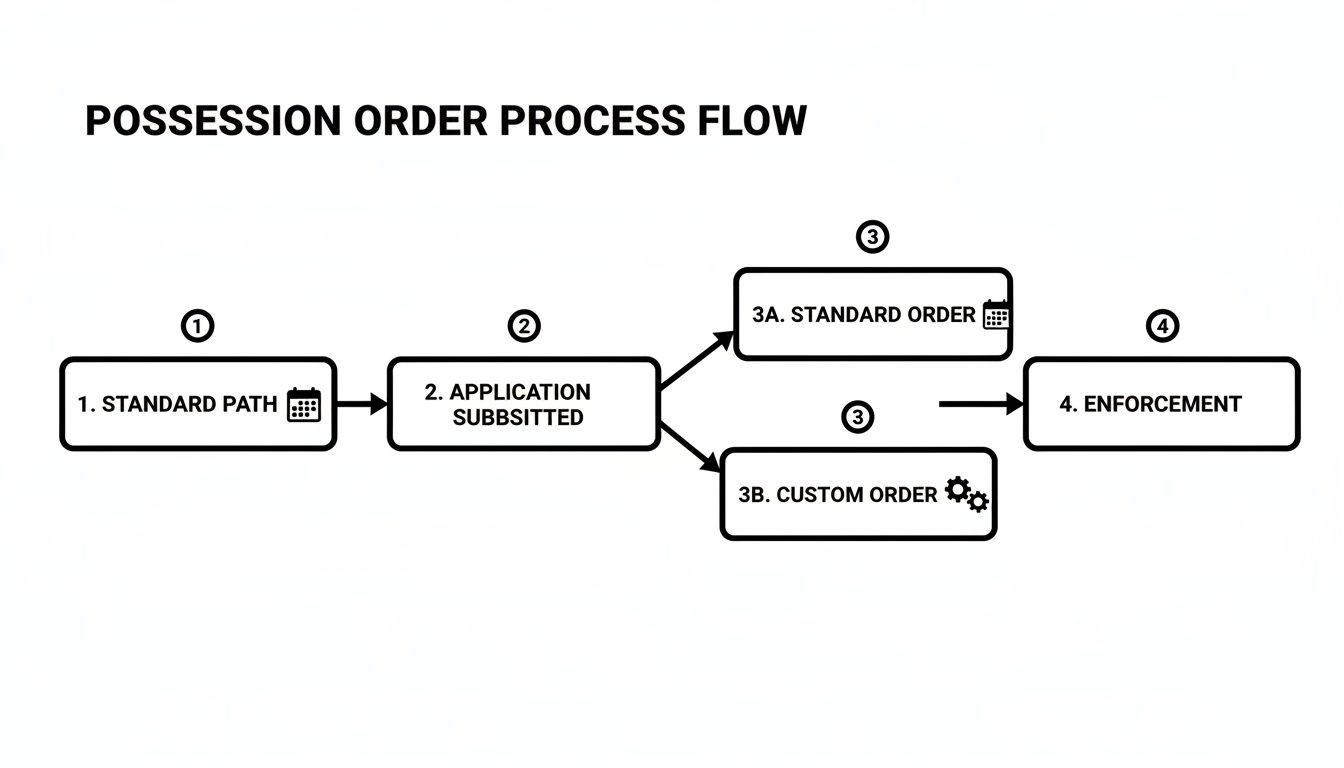
As you can see, a case can either follow the standard, court-prescribed path or be resolved through a customized agreement—an outcome often reached during mediation.
Step 5: The Final Hearing
If mediation is unsuccessful and you can't reach a settlement, your case will proceed to a Final Hearing, also known as a trial. This is where both you and the other parent present your evidence and arguments to a judge.
After hearing all the testimony and reviewing the evidence, the judge will make a final ruling that resolves all outstanding issues. This ruling is documented in a Final Order, which becomes the legally enforceable blueprint for your co-parenting relationship for years to come.
Building a Strong Case with Effective Evidence

In a Texas custody case, the parent with the most heart-wrenching story doesn't automatically win. The parent who wins is the one whose story is backed by clear, credible evidence. A judge’s decision must be based on the “best interest of the child,” and proving what that looks like requires more than your word against your ex’s—it demands proof.
Building a powerful case is a matter of systematically documenting your life as a parent. It’s about showing, not just telling, the judge that you are the stable, loving, and supportive presence your child needs. This is our practical, actionable guidance for gathering the right evidence.
Understanding the Holley Factors
To determine what is in a child’s best interest, Texas judges use a specific checklist of questions established in a landmark case called Holley v. Adams. These are the famous “Holley Factors,” and they are the lens through which a judge will examine your case. Every piece of evidence you gather should be aimed at answering these questions in your favor.
While the list is long, some of the most critical factors include:
- The child's emotional and physical needs, now and in the future.
- Any emotional or physical danger the child faces now or might face.
- The parenting skills and abilities of each person seeking custody.
- The stability of the home each parent provides or proposes to provide.
- Any actions or failures to act by a parent that suggest an unhealthy parent-child relationship.
Your job, with our help, is to collect proof that paints you as the parent who best meets these standards.
What to Document: A Playbook for Parents
Good evidence is organized, consistent, and directly tied to your child's well-being. Think of yourself as the historian of your child's life. Here’s what you can start tracking immediately:
- A Detailed Parenting Calendar: Keep a simple log of every day you have your child. Note pickup and drop-off times, and be sure to document every time the other parent is late, misses a visit, or cuts their time short.
- Communication Records: Save every single email and text message with the other parent. Your goal is to show the judge that you are a calm, reasonable, and child-focused co-parent. Stick to logistics and avoid getting pulled into digital arguments.
- School and Activity Involvement: Keep proof of your attendance at parent-teacher conferences, school plays, and sports practices. Save report cards, notes from teachers, and any emails showing you’re an engaged parent.
- Medical Appointment Log: Track every doctor, dentist, and therapy visit. Note who made the appointment, who took the child, and what the doctor said. This shows you are on top of your child’s health needs.
Crucial Tip: In high-conflict cases, a judge may appoint a professional, like a Child & Family Reporter (CFR), to gather facts for the court. Their final report carries enormous weight. Handing them a binder of well-organized records can be one of the most powerful moves you make in your case.
What to Avoid: How to Damage Your Own Case
Just as important as what you do is what you don't do. During a custody case, your behavior is under a microscope. One careless mistake can unravel months of hard work.
These are common missteps that can seriously hurt your credibility with a judge:
- Negative Social Media Posts: Never vent about the other parent, the judge, or your case online. Screen captures are forever. Assume that anything you post, comment, or "like" will end up as an exhibit in a courtroom.
- Using Your Child as a Messenger: Do not put your child in the middle of your conflict. Never ask them to relay messages, spy on the other parent, or choose sides. This is a classic move that judges absolutely despise.
- Denying Court-Ordered Visitation: Unless you have a legitimate, provable fear for your child’s immediate safety, you must follow the possession order to the letter. Unilaterally withholding visitation can land you in contempt of court and make you look like the uncooperative parent.
Your goal is to present yourself as the stable, thoughtful, and child-focused parent. Every piece of evidence you gather and every action you take should be geared toward reinforcing that image for the court.
If you need help navigating divorce, custody, or estate planning in Texas, contact The Law Office of Bryan Fagan today for a free consultation.
Handling Common and Complex Custody Scenarios
Life is rarely simple, and family situations don’t always fit neatly into a standard legal box. Once a custody order is in place, your circumstances can shift, creating new challenges that need clear legal guidance.
Whether you're dealing with a proposed move, a major life change, or a co-parent who won’t follow the rules, it’s critical to understand your rights and the proper legal channels for handling these issues. This section will walk you through some of the most common—and difficult—scenarios parents face, explaining the specific legal steps required to protect your child’s stability and your parental rights.
When a Parent Wants to Relocate
One of the most emotionally charged issues in Texas family law is when one parent wants to move away with the kids. Most Texas custody orders include a geographic restriction, which limits the child's primary residence to a specific county or its surrounding counties. If a parent wants to move outside this designated area, they must either get the other parent's written agreement or get permission from the court by modifying the order. They can't just decide to go.
A judge will only approve a relocation if the parent requesting the move can prove that it is in the best interest of the child, as required by the Texas Family Code. The court has to weigh the potential benefits of the move against the harm of disrupting the other parent's relationship with the child.
Example: Imagine your ex-wife is the primary conservator, and your order restricts the child’s residence to Harris County. She gets a fantastic job offer in Dallas and wants to move. She can't just pack up and go. She must first file a modification suit and convince a judge that the move is best for your child, even though it will fundamentally change your possession schedule.
Modifying an Existing Custody Order
Life changes. What worked for your family two years ago may no longer be practical or in your child's best interest. This is why Texas law allows parents to request a modification of their existing custody, visitation, or child support orders.
However, you can’t run back to court just because you and the other parent are disagreeing. To successfully modify an order, you have to prove two things to the judge:
- There has been a material and substantial change in the circumstances of the child or one of the parents.
- Changing the order would be in the best interest of the child.
A "material and substantial change" could be anything from a parent's remarriage or job loss to a child developing new health needs. In some complex cases, a parent's personal struggles, such as substance abuse, can also count as a significant change. In those situations, understanding the legal implications of court-mandated treatment can be a critical factor for the court.
Special Rules for Military Families
Military families face a unique set of challenges when it comes to custody. Frequent moves, deployments, and demanding schedules can make standard possession orders nearly impossible to follow. To address this, Texas has specific laws designed to protect the parental rights of service members.
For example, a service member parent can designate another person—like a new spouse or a grandparent—to exercise their possession time during a deployment. On top of that, the federal Servicemembers Civil Relief Act (SCRA) can protect a parent from having a default custody order entered against them while they are on active duty and unable to show up in court. These protections help ensure that serving our country doesn't mean sacrificing your rights as a parent.
Enforcing Your Custody Order
What do you do if the other parent is constantly violating the possession order? Maybe they are always late for exchanges, refuse to return the child on time, or flat-out deny you your court-ordered weekend visits. This is not something you have to tolerate.
Your legal remedy is to file a Motion for Enforcement. This is a serious legal action where you ask a judge to force the other parent to follow the order. If the judge agrees that the other parent violated the order, they can face severe penalties, including:
- Being ordered to pay fines or your attorney's fees.
- Being ordered to give you make-up visitation time.
- In extreme cases, even facing jail time for contempt of court.
Documentation is absolutely everything in an enforcement action. You must be able to show the judge specific dates, times, and detailed instances of the violations.
If you need help navigating divorce, custody, or estate planning in Texas, contact The Law Office of Bryan Fagan today for a free consultation.
When you're fighting for your kids, the questions and worries can feel constant and overwhelming. We find that most parents in Texas are wrestling with the same core concerns about their rights and their children's future.
This section tackles some of the most common and pressing questions we hear every day. Our goal is to give you a clear, straightforward understanding of the law and show you why getting personalized legal advice is so critical.
Can My Child Tell the Judge Who They Want to Live With?
This is one of the first questions we get, and for good reason. In Texas, once a child turns 12 years old, the law allows them to tell the judge their preference about which parent they want to live with most of the time. This conversation almost always happens privately in the judge's office, or "chambers," away from both parents.
However—and this is a big however—the child's preference is not the final word. A judge will listen carefully and give it real weight, but it's just one piece of a much larger puzzle. The court must consider all the "Holley Factors" to determine the child's overall best interest. A judge will also look at the child's maturity and the reasons behind their choice before making a final decision.
What Is a Texas Child Custody Case Going to Cost Me?
The cost of a child custody case really boils down to one thing: conflict. If you and the other parent can reach an amicable agreement, your costs will be relatively low. But if you're headed for a high-conflict battle that ends in a trial, the financial investment will be significantly higher.
You can generally expect costs to fall into these categories:
- Attorney's Fees: This is almost always the biggest expense and will depend on your case's complexity.
- Court Costs: These are standard fees for filing the lawsuit and serving papers.
- Mediation Fees: Most Texas courts require you to try mediation, and parents typically split the cost of the mediator's time.
- Expert Witness Fees: In some contested cases, you might need a child custody evaluator or another expert, which can add a substantial amount to the total cost.
The only way to get a realistic picture of the potential cost is to sit down with an attorney for a consultation to walk through the specific facts of your situation.
Do I Still Have to Let My Ex See the Kids if They Haven't Paid Child Support?
Yes. Absolutely, you do. This is a common point of confusion that can land a well-meaning parent in serious legal trouble. In Texas, your possession and access schedule (visitation) and child support are two completely separate court orders.
You are required to follow the court's possession order down to the letter, even if the other parent is months or even years behind on their child support payments. If you withhold visitation, you are violating a court order. That can lead to you being hauled back to court to face an enforcement action.
The proper way to handle unpaid child support is to file an enforcement case against the non-paying parent. It is not to deny them their court-ordered time with the children.
If you need help navigating divorce, custody, or estate planning in Texas, contact The Law Office of Bryan Fagan today for a free consultation.