
Your weekend bag is packed. Your child is crying. The other parent is texting that they're on the way. You're standing in the middle of a problem that feels impossible to solve without hurting someone.
This is one of the hardest custody situations a parent can face. You may want to respect your child's feelings, avoid a scene, and still follow the court order. At the same time, you're probably asking the question many Texas parents search for in panic: can a child be forced to visit a parent in Texas?
The short answer is uncomfortable. A court can enforce the order against the parents, but that doesn't mean a parent can or should physically drag a resisting child into a car. The primary legal consideration is usually whether the parent responsible for the exchange made a genuine effort to comply.
That distinction matters. It affects contempt risk, enforcement exposure, and whether you should keep trying under the current order or ask the court to change it. When you understand that difference, you can make better decisions in a tense moment and protect yourself legally at the same time.
The Heartbreak of Being Caught in the Middle
A common scene looks like this. A parent reminds a child that it's a visitation weekend. The child shuts down, cries, argues, or refuses to leave the bedroom. The clock keeps moving toward exchange time, and every option feels bad.
If you make the child go, you may feel like you're betraying them. If you don't, you may worry the other parent will file something in court. If the refusal has happened more than once, the stress gets heavier each time because now it's not just an emotional problem. It's a legal one.
Many parents in this position aren't trying to interfere with visitation. They're trying to keep the peace, avoid trauma, and survive a moment that no court order can manage neatly. Older children can be especially difficult because they're bigger, more verbal, and more determined. A parent may know that forcing the issue physically will only escalate the situation.
You can love your child, respect their distress, and still have legal duties under a Texas possession order.
Sometimes the reason is ordinary resistance. The child doesn't want to leave friends, activities, or the routine of one home. Sometimes the reason is more serious, such as conflict with the other parent, fear, or emotional strain that has been building for a long time.
That's why simple answers usually don't help. “Make them go” ignores reality. “Let them decide” ignores the court order. What works is a more careful approach. You need to know what Texas law requires, what effort the court expects from you, and how to document what happened if the exchange falls apart.
A Court Order Is a Command to the Parents Not the Child
Texas family law creates duties for the adults. That's the first point to understand. A possession order tells the parents what must happen. It does not operate like a direct command to a child.

What the law actually says
Under TexasLawHelp's discussion of court-ordered visitation and child safety, Texas law does not set a specific age at which a child can refuse court-ordered visitation. The bright line is adulthood. At 18, the person is no longer a minor and can decide whether to have contact with a parent. The same resource explains that under Texas Family Code § 153.009, a child who is at least 12 may be interviewed by the court about their wishes, but that interview is only one factor and does not let the child override the existing order.
That rule surprises many parents. They've heard some version of “once the child is 12, they can choose.” That is not how the law works. A child's views may matter to the court, but they are not self-executing. Until the court changes the order, the order remains in place.
What compliance means in real life
If you are the parent responsible for surrendering the child for visitation, the court expects you to make the child available. That's the legal duty. It does not mean you have legal permission to use physical force. It means you must act like a parent who is trying to comply, not a parent who is allowing the order to fail through inaction.
That difference shows up in details such as:
- Preparing the child for the exchange instead of undermining it
- Being ready at the correct time and place listed in the order
- Communicating with the other parent clearly
- Avoiding statements that suggest you are letting the child decide
- Keeping the focus on the order, not your frustration
Practical rule: If the exchange fails, the court will usually look first at the adults' conduct, not the child's defiance.
If you aren't sure what your current possession terms require, review your order carefully and compare it with how a standard possession order typically works in Texas. A lot of enforcement disputes start because parents rely on memory instead of the exact written language.
What to Do When Your Child Refuses to Go
When a child refuses visitation, the worst thing you can do is panic and improvise. You need a routine. Calm action protects your child better than an argument in the driveway, and it also protects you if the other parent later claims you denied visitation.
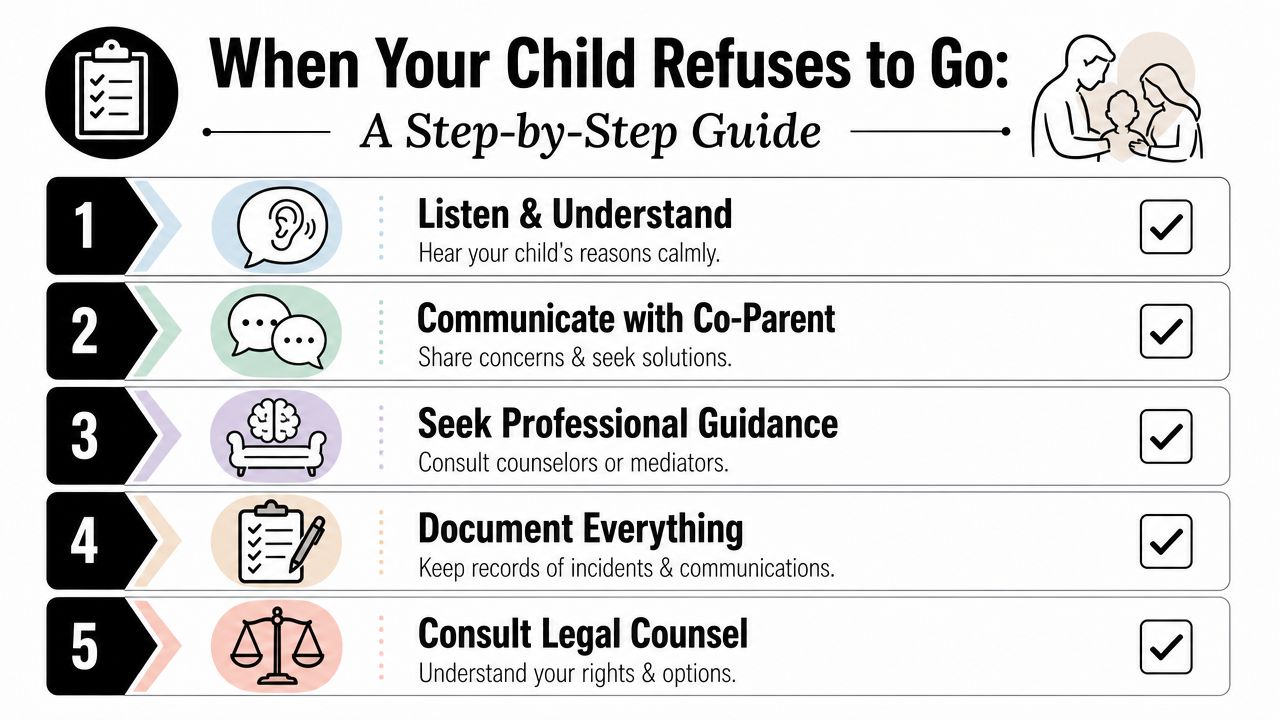
Under this discussion of child refusal and visitation enforcement in Texas, the only bright-line age at which a child can legally end visitation is 18. Before then, the parent seeking enforcement should appear at the pickup location at the exact ordered time, record the missed exchange, and preserve messages or journals as evidence. That practical advice is important because these cases often turn on proof, not emotion.
A calm response in the moment
Start with your child, not with a threat. Ask what's wrong. Listen. Don't promise they can skip the visit, but don't escalate the conflict by turning the conversation into a power struggle.
If your child is anxious, overwhelmed, or spiraling emotionally, outside support may help you respond in a steadier way. Resources like Orange Neurosciences' anxiety management guide for parents and caregivers can give you practical ideas for calming a distressed child without validating refusal of the court order itself.
The five actions that matter most
Tell the child the visit is still scheduled
Keep it short and age-appropriate. “The court order says it's time to go, and I expect you to get ready” is better than a lecture.Notify the other parent in writing if trouble starts
Use text or email. Be factual. Don't accuse, editorialize, or invite a fight. A short message is enough: the child is resisting, you are encouraging compliance, and you will be at the exchange as ordered.Show up at the exchange location if the order requires it
This point matters. If the other parent later files for enforcement, one of the first questions may be whether the adults appeared as required. Don't assume a refusal at home excuses the exchange procedure.Keep a written journal
Record the date, time, what you told the child, what the child said, what messages were sent, and whether the other parent arrived. Keep it factual. Avoid emotional commentary.Preserve all related communication
Save texts, emails, call logs, and any notes you made the same day. If there were witnesses, note who they were.
Don't write “my child refused so there was nothing I could do.” Write what you actually did to comply.
What doesn't help
The following choices often create more legal risk than parents realize:
| Action | Why it creates problems |
|---|---|
| Telling the other parent “she's old enough to decide” | That can sound like you surrendered control of the order to the child |
| Skipping the exchange entirely | It weakens your proof that you tried to comply |
| Sending angry messages | They distract from your good-faith effort |
| Physically wrestling a teen into the car | It can escalate the situation and create safety issues |
| Waiting months to get legal advice | Repeated failures under the same order usually get harder to fix |
If refusal becomes a pattern, legal help matters quickly. One option is to speak with a family law attorney about documentation, communication strategy, and whether modification is more appropriate than repeated failed exchanges. The Law Office of Bryan Fagan, PLLC handles Texas custody and visitation disputes, including enforcement and modification issues arising from child refusal cases.
Enforcement Actions and Your Legal Risk
If the other parent believes you did not follow the possession order, they may respond with an enforcement case. That is where many parents first realize the issue was never just “my child didn't want to go.” The issue is whether the court believes you failed to comply.

What an enforcement case usually focuses on
A motion to enforce asks the court to determine whether a parent violated a prior order. In a visitation dispute, the accusing parent typically claims a specific exchange did not happen as ordered. The details matter. Date, time, location, notice, and the exact language of the order all come into play.
If you want a better sense of how these cases are framed procedurally, this overview of a Texas motion to enforce is a useful starting point.
Judges often look for evidence that is concrete and organized. They want to know what the order required, what each parent did, and whether the alleged violation was deliberate, avoidable, or supported by a legitimate explanation.
Why good-faith effort matters
According to this Texas visitation refusal analysis, Texas courts can be reluctant to hold a parent in contempt if that parent made good-faith efforts to make a teenager available for visitation, but the burden of proof is on that parent. The same guidance highlights practical evidence that can reduce contempt risk, such as documenting your appearance at the exchange location and not claiming a denial unless the other parent showed up.
That's why your journal and written communication matter so much. “My child refused” is a conclusion. A judge needs the underlying facts.
Evidence that usually helps and evidence that usually hurts
Helpful proof can include
- A copy of the exact order with the exchange terms highlighted
- Texts or emails showing you informed the other parent of the resistance but still intended to comply
- A contemporaneous journal describing your efforts
- Proof you appeared at the exchange site when required
- Consistent records over time if refusal is ongoing
Risky facts often include
- Messages blaming the child's choice as the sole reason for noncompliance
- Inconsistent accounts of what happened
- No recordkeeping at all
- Refusal to communicate
- A pattern of failed exchanges with no motion to modify
This overview may help you think through the enforcement side of the issue:
Judges know teenagers can be difficult to control. What they want to see is whether the parent acted responsibly, consistently, and honestly.
Does a Child's Age and Preference Matter to the Court
Yes, age and preference matter. They just don't matter in the way many parents assume.

The legal importance of age 12
A key milestone appears in Texas Family Code § 153.009. As explained in this Texas custody discussion about when a child can refuse to see a parent, a child who is 12 or older may be interviewed by the judge in chambers about their preferences. But that is not the same as a legal right to refuse visitation. The custodial parent still has the duty to make the child available and can face enforcement consequences for failing to do so.
That distinction is where many cases go sideways. Parents hear that a child can “talk to the judge” and treat it like a veto. It isn't. The judge may listen, consider the child's maturity and reasons, and still leave the existing schedule in place.
What judges tend to care about
A child saying “I don't want to go” is not one issue. It can represent many different issues. The court will usually care about the reason behind the preference.
For example:
| Situation | How the court may view it |
|---|---|
| The child is upset about normal household rules | Often not enough to justify changing visitation |
| The child feels disconnected from the other parent | May call for counseling or schedule adjustments |
| The child's school and activities create repeated friction | May support a more practical modification request |
| The child describes serious fear or unsafe conditions | May require urgent legal action and court intervention |
When modification becomes the right move
If refusal keeps happening, you may be beyond the point where better communication will fix it. A modification request may be the proper legal path. That asks the court to change the possession terms rather than leaving everyone trapped in a schedule that no longer works in practice.
Parents often wait too long to file because they hope the next weekend will be different. Sometimes that hope is understandable, but repeated no-shows under the same order can make both households more entrenched and can increase legal exposure for the parent who must produce the child.
A practical approach usually looks like this:
- Track the pattern rather than treating each incident as isolated
- Separate ordinary resistance from serious safety concerns
- Gather school, counseling, and communication records if relevant
- Ask whether the current schedule is realistic for this child at this stage
- Consider court modification before the dispute turns into repeated enforcement litigation
A child's preference has legal relevance. It does not replace a signed court order.
A short example
Suppose a 13-year-old consistently refuses weekend visits. The child is not alleging abuse, but says the other parent's home is tense, the schedule interferes with activities, and every exchange ends in a confrontation. If the primary parent keeps missing exchanges without seeking court relief, that parent may still face enforcement risk. If the parent documents the pattern, encourages compliance, and then seeks a modification, the court has a lawful path to evaluate the child's concerns.
That is usually the better route. Courts can address persistent refusal through orders. They cannot fix it based on verbal side agreements or by parents abandoning the written schedule.
When Refusal Signals a Deeper Problem
Not every refusal is about preferences, convenience, or teenage independence. Sometimes a child is resisting because something is wrong.
If your child reports abuse, neglect, threats, substance abuse in the home, or conduct that makes you believe the child is unsafe, treat that differently from ordinary visitation conflict. Your first priority is the child's protection. In that kind of case, you need immediate legal guidance about emergency relief, temporary orders, or a modification request that directly addresses the safety concern.
You should also be careful not to confuse a real safety issue with high conflict between parents. Courts take both false accusations and ignored danger seriously. The facts matter, and so does how you respond in the first hours and days after learning about the concern.
In some families, refusal may also be tangled up with loyalty conflicts or allegations that one parent is influencing the child against the other. If that issue is part of your case, this discussion of parental alienation in Texas may help you understand how courts evaluate that kind of claim.
The key is this. Don't stop following the order and hope the court will understand later. If the refusal reflects a deeper problem, act promptly, document carefully, and ask the court for a lawful solution.
If you're dealing with a child who refuses visitation, you don't have to guess your way through it. A Texas custody order can expose you to enforcement risk even when your child is the one resisting, and the right response depends on the facts of your case. If you need help navigating divorce, custody, or estate planning in Texas, contact Law Office of Bryan Fagan, PLLC today for a free consultation.