
You may be thinking about this because something changed. Maybe you bought a home in Texas, remarried, welcomed a child, started a business, or watched a parent’s estate go through court and realized how stressful it can be for a family.
That moment matters. Estate planning isn’t only about death. It’s about making life easier for the people you love, protecting what you’ve built, and giving clear instructions before a crisis forces someone else to guess. When clients ask about estate planning wills and trusts, they usually want the same thing: a plan that works in real life, under Texas law, without unnecessary confusion.
Planning for Your Family’s Future in Texas
A common Texas scenario looks like this: a couple owns a house, one spouse has a retirement account, both have life insurance, and they have children from either the current marriage or a prior one. They’ve talked about “getting a will done” for years, but the details feel heavy, and no one knows where to start.
That hesitation is understandable. It’s also risky. Only 31% of Americans have a will and 11% have trusts, with 55% possessing no estate documents at all, according to the 2025 Trust & Will Estate Planning Report. When there’s no plan, Texas law steps in and decides who inherits, who handles the estate, and how the process unfolds.
For many families, that’s the opposite of what they want.
Estate planning is really a set of instructions. A will tells the probate court who should receive property and who should handle the estate. A trust can add privacy, control, and continuity. Alongside those tools, many people also need to think about beneficiary designations and how life insurance and estate planning fit together, because not every asset passes the same way.
Practical rule: If you care who receives your property, who raises your children, or who manages things if you become incapacitated, you already need an estate plan.
Texas families often discover that planning isn’t one-size-fits-all. A blended family may need to balance a current spouse’s security with children from a prior marriage. A military family may need a plan that still works after another relocation. A business owner may need more than a simple will.
If you’re trying to sort out what applies to you, this earlier discussion on evaluating your estate planning situation is a useful starting point.
What Is a Last Will and Testament in Texas
A Last Will and Testament is the written set of instructions you leave for the probate court. I often describe it as an instruction manual. It tells the court who should receive property that passes through your estate, who should manage the estate administration, and, if you have minor children, who you want to serve as guardian.
In Texas, wills are governed by the Texas Estates Code, including the rules for execution and probate. A will must meet Texas legal requirements to be valid. In general, that means the will must be in writing, signed by the person making it, and properly witnessed if it isn’t a handwritten will. For many formal wills, Texas law requires two credible witnesses. Those details matter because a technically flawed document can create avoidable disputes later.
What a Texas will actually does
A will usually serves three core jobs.
- Directs property distribution. You can say who receives your home, savings, personal property, or the residue of your estate.
- Names an executor. This is the person you trust to gather assets, handle debts and taxes, and work through probate.
- Names guardians for minor children. For parents, this is often the most emotionally important part of the document.
Those are powerful protections. But a will also has limits.
What a will does not do
Many people believe a will avoids probate. It doesn’t. A will usually goes through probate so the court can recognize it and authorize the executor to act. That’s one of the most common points of confusion in estate planning.
If your goal is to make your wishes known, a will is often the right starting place. If your goal is to keep assets out of probate, maintain privacy, or plan for incapacity management, a trust may need to be part of the conversation.
A will gives directions to the court. It doesn’t replace the court process.
A simple example
Suppose Maria, a Texas mother of two, wants everything to go to her children if she dies. She also wants her sister to serve as guardian if the children are still minors. A will lets Maria put both of those decisions in writing.
That said, if Maria owns a home, a brokerage account, and a small business interest in her individual name, those assets may still need to move through probate before the beneficiaries receive them. The will helps the court know what to do. It does not make the court unnecessary.
Why execution details matter in Texas
The Texas Estates Code is practical, but it’s not forgiving when a document is poorly prepared or improperly signed. A will that was copied from a generic form may not fit Texas terminology, family structure, or property issues. That can be especially important if you own separate and community property, have children from different relationships, or want to disinherit someone clearly.
A strong will also coordinates with the rest of your estate plan. For example, beneficiary designations on life insurance or retirement accounts may control those assets separately. That’s why planning should be done as a system, not as one isolated document.
If you want a clearer look at which assets a will may still send through court, this discussion of what in a will goes to probate in Texas can help.
When a will may be enough
For some Texans, a will is the right primary tool.
- Young parents who mainly need guardian designations.
- Single adults with straightforward assets.
- Families with modest complexity who want a basic legal foundation in place now and may build on it later.
That’s often far better than waiting for the “perfect time.” A valid will is not the final word for every family, but it is a meaningful act of protection.
How Trusts Offer Greater Control and Privacy
A trust works differently from a will. Instead of giving instructions to the probate court after death, a trust creates a private legal arrangement to hold and manage assets according to rules you set.
The most common trust people ask about is a Revocable Living Trust. “Revocable” means you can change it during your lifetime. “Living” means it’s created while you’re alive. In many plans, the person creating the trust is also the initial trustee, so day-to-day control stays with you.
The three key roles in a trust
Every trust has three basic roles.
- Grantor. The person who creates the trust.
- Trustee. The person or institution that manages trust assets.
- Beneficiary. The person who benefits from the trust property.
In a revocable living trust, you may serve as both grantor and trustee while you’re living and capable. Then, if you die or become incapacitated, a successor trustee steps in under the written terms you already created.
That’s one reason trusts can feel calmer for families. The plan is already in motion.
Why Texans use revocable living trusts
A Revocable Living Trust can bypass probate if it is properly funded. According to the Estate Planning 101 presentation, probate can last 6-18 months and cost 3-7% of the estate’s gross value, while a trust can allow a successor trustee to manage assets efficiently after death or incapacity.
That “if” matters. A trust only helps avoid probate for assets that are transferred into it.
Funding is the part people miss
Creating a trust document is only the first step. Funding the trust means retitling assets into the trust’s name. A deed may transfer real property to the trust. A financial account may be renamed. Certain personal property may be assigned to the trust.
If that step never happens, the trust may sit on a shelf while the assets remain in your personal name. Then your family can still end up in probate.
Important: An unfunded trust is one of the most common estate planning mistakes. The document exists, but the assets never made it into the structure meant to protect them.
How a trust helps during incapacity
A will speaks at death. A trust can help during life.
If you become unable to manage your finances because of illness, injury, or cognitive decline, your successor trustee can step in and manage trust assets according to the terms you created. That can reduce the need for a court-supervised guardianship or conservatorship process over those trust assets.
For many families, this is the hidden value of a trust. The planning isn’t just about what happens after death. It also provides continuity when life becomes unpredictable.
Privacy and practical administration
Probate filings generally become part of a public court process. A trust, by contrast, is typically a private agreement. Many Texas clients value that privacy, especially when they own a business, have a blended family, or don’t want detailed financial information aired in a public court record.
A trust can also give you more control over timing. Instead of leaving a child or young adult a full inheritance outright, you can stagger distributions or allow the trustee to make payments for health, education, support, or other purposes.
For readers who want a practical overview of post-death trustee work, this essential guide to trustee duties gives a helpful plain-language summary.
Trusts still need companion documents
A good trust plan usually works alongside a pour-over will, powers of attorney, and updated beneficiary designations. Retirement accounts and life insurance often pass by beneficiary designation, not by trust terms alone, unless the planning intentionally coordinates them.
That coordination is one reason trust-based plans need careful drafting. Texas law, family circumstances, and asset titling all have to line up.
If you’re comparing trusts with other ways assets pass outside probate, this article on non-probate transfers is a helpful companion read.
Will vs Trust A Side-by-Side Comparison for Texans
Instead of a lecture on legal theory, individuals often seek a practical answer to a direct question: Should I use a will, a trust, or both?
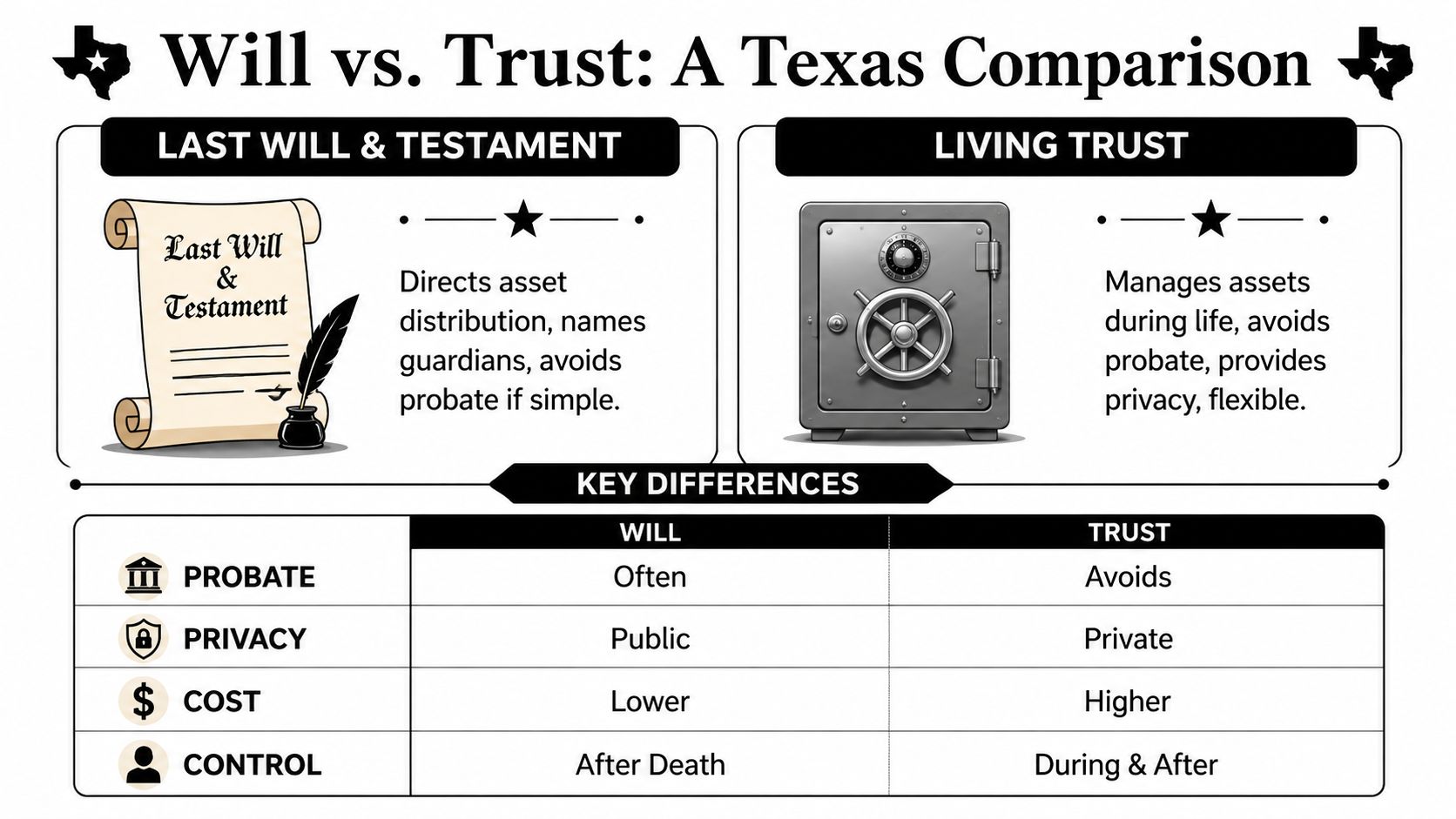
The honest answer is that many Texans benefit from both, but the right mix depends on your goals. A will is often the foundation. A trust adds stronger control over privacy, incapacity planning, and probate avoidance for funded assets.
The question to ask first
Start with this: what are you trying to protect your family from?
If your biggest concern is naming guardians and making clear inheritance instructions, a will may cover the essentials. If you also want to avoid probate for major assets, protect privacy, and prepare for incapacity management, a revocable living trust may be worth serious consideration.
Will vs Revocable Living Trust in Texas At a Glance
| Feature | Last Will and Testament | Revocable Living Trust |
|---|---|---|
| When it takes effect | At death | During life, and continues after death |
| Probate | Usually goes through probate | Can avoid probate for properly funded assets |
| Privacy | Probate is generally a court process | Administration is generally more private |
| Guardian nominations for minor children | Yes | Usually paired with a will for this purpose |
| Incapacity planning | Limited by itself | Successor trustee can manage trust assets |
| Asset titling required during life | No | Yes, funding is necessary |
| Upfront complexity | Lower | Higher |
| Best for | Straightforward planning and guardian designations | Families wanting control, continuity, and probate avoidance |
Where a will has the advantage
A will is often simpler to create and easier for a client to understand at first. If your estate is uncomplicated, your children are your primary concern, and you want to put basic legal protection in place quickly, a will may be the right first move.
It also remains necessary even in many trust-based plans because someone still needs to catch assets left outside the trust and nominate guardians for minor children.
Where a trust has the advantage
A trust usually shines when your life isn’t simple on paper.
- Blended families may need staged distributions and clear protections for children from prior relationships.
- Business owners often want continuity and privacy.
- Clients with property in more than one state may want to reduce the chance of multiple probate proceedings.
- People worried about incapacity often prefer a system where a successor trustee can step in without waiting for court involvement.
If your estate plan needs to do more than say “who gets what,” a trust often becomes part of the solution.
A practical Texas example
Consider two families.
One family has a single home, one checking account, no business interests, and young children. Their top priority is naming guardians and putting a basic plan in place. A will-centered plan may meet their immediate needs.
Another family owns a home in Texas, rental property in another state, investment accounts, and has children from prior marriages. Their concerns include privacy, management during incapacity, and making sure assets pass exactly as intended over time. That family often needs trust-based planning.
Neither option is automatically better. The right choice depends on family structure, asset type, and the level of control you want.
Estate Planning for Blended, Military, and High-Net-Worth Families
A Texas family can look settled on the surface and still face hard estate planning problems underneath. A second marriage may include children from prior relationships. A service member may be stationed outside Texas while still owning property here. A successful business owner may have wealth tied up in companies, investments, and real estate instead of a simple checking account. In each of those situations, the question is not only who inherits. The question is how to structure the plan so it works under the Texas Estates Code, during incapacity, and after death.

Blended families need clear rules on paper
Blended family planning often breaks down because a parent expects goodwill to solve legal problems. That is a risky plan.
A common Texas example is a husband who wants his current wife to remain in the home for life, while also preserving part of the estate for children from a prior marriage. If he leaves everything outright to his spouse, she becomes the full owner. After that, she may revise her own estate plan, remarry, face creditor issues, or make different choices than he expected. The children may receive less than intended, or nothing at all.
A trust works like a set of written guardrails. It can let a surviving spouse use certain assets for housing, income, or support, while also preserving what remains for the children later. That kind of structure matters in Texas because community property and separate property can become easy to confuse in second marriages, especially when families have been together for many years and assets have grown over time.
The goal is clarity before conflict starts.
High-net-worth families need more than a transfer plan
For higher-asset households, estate planning becomes a coordination project. The plan may need to address a closely held business, multiple LLCs, mineral interests, brokerage accounts, life insurance, and real estate in more than one state. A simple will may name beneficiaries, but it often does not answer the harder management questions.
For example, a Texas business owner may want one child involved in operations and another child to receive different assets of equal value. A parent may want beneficiaries to receive funds in stages instead of a lump sum at age 18 or 25. A family with substantial assets may also want to reduce public exposure during probate and make administration easier for the people left behind.
As noted earlier, families with significant wealth often use trusts because federal estate tax exposure, creditor concerns, and long-term control over distributions call for documents drafted with more precision than a basic form. In Texas, those plans also need to account for homestead rights, community property rules, and the practical reality that probate filings can place financial details into the court record.
Wealth creates options. It also creates more ways for a poorly drafted plan to go wrong.
Military families need documents that still work after the next move
Military families often deal with a different type of pressure. Orders change. Addresses change. Asset ownership may spread across state lines. The estate plan has to hold together through deployment, relocation, marriage, divorce, and the arrival of children.
For a Texas service member, that usually means coordinating more than a will. Powers of attorney, medical directives, guardian designations, beneficiary designations, and trust terms should all point in the same direction. If they do not, the family can end up sorting out conflicting instructions during a stressful time.
Texas law adds another layer. A family may keep Texas ties for residency or property purposes even while living elsewhere. That can affect probate, homestead treatment, and the handling of community property. If the service member owns property in another state, the plan should also consider whether probate might be required there unless ownership is arranged more carefully.
A short overview like this can also help frame the issue before you meet with counsel:
Blended, military, and high-net-worth families face different facts, but the planning questions are often similar. Who controls assets during incapacity. How are children from a prior relationship protected. What happens to a business interest. Which assets may trigger probate in Texas or in another state. Who has legal authority to act without delay.
Those questions usually require a specific plan rather than assumptions. That plan may include a will, a revocable living trust, financial and medical powers of attorney, physician directives, guardian designations, and updated beneficiary forms. It should also reflect how the family lives and owns property, not just what they hope will happen later.
Texas families often seek legal help for that process through Law Office of Bryan Fagan’s estate planning services, which include wills, trusts, and related planning documents.
Your Texas Estate Planning Checklist
Individuals often feel better once they see the process broken into manageable pieces. Estate planning doesn’t start with drafting. It starts with getting organized.
Start with what you own and owe
Make an asset list. Include your home, land, bank accounts, investments, retirement accounts, life insurance, business interests, vehicles, and valuable personal property. If you own something in another state, note that clearly.
List debts and obligations. Mortgages, business debts, personal loans, and recurring expenses help shape what your executor or trustee will need to handle.
Check how each asset is titled. Is it in your individual name, joint name, a business entity, or already in trust? This step often reveals why a plan needs more than a simple will.
Decide what you want the plan to accomplish
Some people want efficiency. Others want control. Others are focused on peace in the family.
Ask yourself:
- Who should receive what?
- Should anyone receive assets over time instead of all at once?
- Do you need to protect a current spouse and children from a prior marriage?
- Do you want someone to manage affairs if you become incapacitated?
Write those goals down in plain language. That gives your planning attorney a roadmap.
Choose the right people
This part deserves more thought than many people give it.
- Executor. Pick someone organized and dependable.
- Trustee or successor trustee. Choose someone who can follow instructions calmly and handle financial responsibility.
- Guardian for minor children. This decision should reflect parenting values, not only family seniority.
- Agents under powers of attorney. Select people who can act promptly in a crisis.
The right person for one role may be the wrong person for another. A loving relative isn’t automatically the best executor or trustee.
Gather your key documents
Bring together deeds, account statements, insurance information, beneficiary designations, business records, and any existing wills or trusts. If you’ve been divorced, include the decree. If you’ve moved states, include prior planning documents so they can be reviewed for Texas compliance.
Schedule legal guidance before life changes again
Once you’ve gathered the basics, meet with a Texas estate planning attorney. That conversation is where strategy becomes a real plan. It’s also where you can address community property questions, blended family concerns, trust funding, and incapacity planning in one coordinated approach.
Common Estate Planning Mistakes and FAQs
A Texas family can do many things right and still leave behind a plan that creates stress. I often see this after a remarriage, a military transfer, or a season of financial growth. The documents were signed with good intentions, but the plan no longer matches the family, the assets, or the probate rules that apply under the Texas Estates Code.
Estate planning works like a set of instructions for your family and the court. If those instructions are outdated, incomplete, or disconnected from your accounts and property titles, confusion follows at the worst possible time.
Common mistakes that create problems later
Using a simple will for a complex family
A short, generic will may work for a very simple estate. It often falls short for blended families, business owners, families with property in more than one state, or clients with significant wealth tied to real estate, retirement accounts, and closely held companies.
In Texas, details matter. Community property rules, homestead protections, and default inheritance rules can interact in ways families do not expect. A will that says "divide everything equally" may sound clear, yet that sentence can create hard questions about separate property, children from a prior relationship, or who has the right to occupy the home.
Creating a trust but never funding it
This mistake is common because signing the trust feels like finishing the job. It is only part of the job.
A trust controls only the assets that are transferred into it, or properly tied to it through beneficiary designations and related planning. If the deed to the house stays in your individual name, or accounts are never retitled, those assets may still pass through probate. For high-net-worth families, that can mean delay, extra cost, and a result that looks very different from what the trust document promised on paper.
Forgetting to update after divorce, remarriage, or birth of a child
Life changes faster than documents.
A divorce decree, a new spouse, a child, a grandchild with special needs, a major purchase, or a move back to Texas after military service can all change how your plan should be written. An older plan may still be legally valid in part, but validity is not the same as fit. The right question is whether the plan still reflects your family and your assets today.
Ignoring military and interstate issues
Military families face planning issues that civilian families often do not. A deployment, frequent relocation, property in another state, or a beneficiary who lives far from Texas can all complicate estate administration.
Texas law may govern part of the estate, while another state’s probate process affects real property located there. A carefully drafted plan can reduce those conflicts, clarify who has authority to act, and make it easier for a spouse or adult child to handle affairs during service-related absences or after death.
Failing to coordinate beneficiary designations
Beneficiary designations control many valuable assets, including life insurance and many retirement accounts. Those designations can override the instructions in a will and, in some cases, work against the broader plan if no one reviews them together.
This is a frequent problem in second marriages. A parent updates a will to provide for a current spouse and children from a prior marriage, but an old retirement account still names a former beneficiary. The family then learns that the account passes by contract, not by the newer language in the will.
Frequently asked questions
What happens if I die without a will in Texas
Your probate assets pass under Texas intestacy rules, which are the default inheritance rules in the Texas Estates Code. The court does not ask what you probably wanted. It follows the statute.
That can be especially hard on blended families. A surviving spouse may not receive what the family assumed, and children from a prior relationship may have rights that surprise everyone involved.
Can I disinherit someone in my Texas will
Often, yes. The language needs to be clear and deliberate.
Texas courts handle written instructions, not family assumptions. If you want to leave unequal shares, exclude a relative, or protect one branch of the family from conflict with another, the drafting should say that directly and fit with the rest of the plan.
Do I need both a will and a trust
Sometimes you do. They serve different jobs.
A trust can hold and manage assets with privacy and ongoing control, while a will can name guardians for minor children and act as a safety net for assets left outside the trust. For many Texas families, especially blended, military, and high-net-worth households, the better answer is not "will or trust." It is "which combination fits the family, the property, and the level of control you want."
How often should I review my estate plan
Review it after any major life change and also on a regular schedule, even if nothing dramatic has happened. Families grow. Assets change. Relationships shift. Texas law can change too.
A practical rule is to revisit the plan after marriage, divorce, birth or adoption, a significant increase in wealth, the purchase or sale of real estate, a move across state lines, retirement, serious illness, or a military relocation.
Is probate always bad in Texas
No. Some Texas probates are relatively straightforward, especially when the estate is simple and the documents are well prepared.
Still, probate is a public court process, and it can become more complicated when the estate includes a business, real property in multiple states, creditor issues, or conflict among family members. Many families use trusts and coordinated beneficiary planning because they want more privacy, more control over timing, and fewer opportunities for dispute.
If you need help with estate planning in Texas, contact Law Office of Bryan Fagan, PLLC for a free consultation. A customized plan can help protect your family, clarify your wishes, and reduce the risk of probate surprises later.


