
If you're asking how child support is calculated in Texas, you're probably not looking for a theory lesson. You're trying to answer real questions. Can I afford this? What counts as income? Why does one calculator say one thing and a lawyer say another?
Those worries are normal. During divorce or a custody case, financial uncertainty often feels just as stressful as the legal process itself. Parents want to do right by their children, but they also need clear numbers and a fair process.
Texas child support law is structured, but it isn't always simple. The percentage formula you see online is only part of the picture. The harder question is often what Texas counts as net resources, because that number drives everything else.
Understanding Child Support During Your Texas Divorce
A lot of parents come into this process with the same concern. They know Texas uses a formula, but they don't know where to begin. One parent may be paid a salary. Another may earn commissions, work for themselves, or have irregular income. Both want to understand what the court is likely to do.
Child support exists to help make sure a child continues receiving financial support from both parents after separation or divorce. In Texas family law, that usually means one parent is ordered to pay support to the other parent for the child's ongoing needs. The court's focus is the child's best interest, not punishing either parent.
Why parents get confused
The confusion usually starts with one mistaken assumption. Many people think child support is based on gross pay. In Texas, it isn't. The starting point is the paying parent's net monthly resources, a legal term from the Texas Family Code that means something more specific than take-home pay on a paycheck.
Another common issue is timing. A quick online estimate may help you get oriented, but it can't fully account for unusual deductions, self-employment records, multiple income streams, or arguments about what should count as income. That's why two people can look at the same paycheck and still disagree about the proper support amount.
Child support in Texas is often less about the percentage itself and more about correctly identifying the income the court will use.
When we slow the process down and examine it step by step, it becomes much easier to see where your number may come from and where disputes are likely to happen.
The Foundation What Texas Calls Net Resources
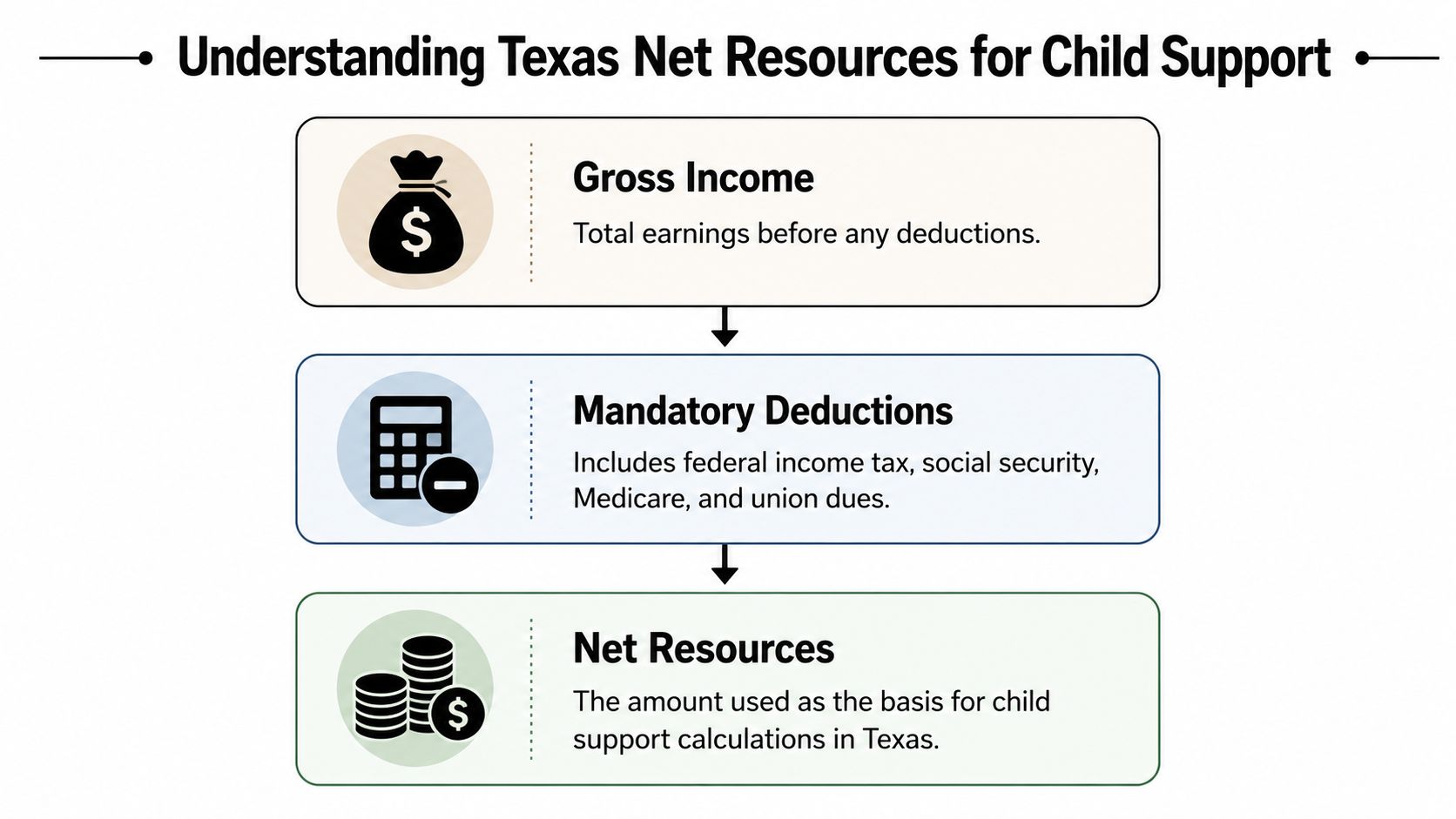
If you remember only one thing, remember this. Texas child support is built on net resources, not gross income.
That sounds technical, but the idea is manageable once you break it into parts. First, we identify the income available to the parent who may pay support. Then we subtract only the deductions Texas allows. The number left over is the figure used for support calculations.
What income Texas looks at
In many cases, parents assume the court only cares about regular wages. That isn't always true. The legal question is broader. If income comes in consistently or forms part of your available resources, it may be part of the conversation.
For a salaried employee, this may be straightforward. For a business owner, contractor, or parent with mixed income sources, it often becomes the central dispute. That's one reason formula-only explanations can feel incomplete.
What Texas allows as deductions
Texas Law Help explains that net resources are calculated after specific deductions, including Social Security taxes, income taxes for a single person, health or dental insurance for the child, union dues, and certain retirement contributions in lower-income cases. It also notes that a lower-income guideline applies in cases filed on or after September 1, 2021, and that if the noncustodial parent has $1,000 or less in monthly net resources, the percentage drops to 15% for one child, 20% for two, 25% for three, 30% for four, and 35% for five, with six or more set at no less than the five-child amount. Texas Law Help further explains that net resources are capped at $9,200 per month for that lower-income framework. You can review that explanation in Texas Law Help's article on child support and lower incomes.
Here is the practical takeaway:
- Social Security taxes matter: These are part of the calculation when determining net resources.
- Federal income taxes matter: Texas uses income taxes for a single person as part of the deduction analysis.
- Child-related health or dental coverage matters: If a parent pays health or dental insurance for the child, that cost may affect the calculation.
- Union dues may matter: If they apply, they may be included among the allowed deductions.
- Not every personal expense counts: A car payment, rent, groceries, and credit card bills may be very real to your budget, but that doesn't mean Texas subtracts them when setting support.
If you'd like a deeper breakdown of this issue, our discussion of how to calculate net resources for child support can help you compare paycheck deductions with what family court may recognize.
Why this is where many cases turn
For some families, net resources are easy to identify. A parent gets paid the same amount each pay period, and the deductions are easy to verify. For others, disputes frequently arise at this point.
A parent may receive bonuses, commissions, side income, or self-employment revenue. Another may argue that certain business deductions reduce what is available. In those situations, the numbers on a tax form, a pay stub, and a court worksheet may not match neatly.
Practical rule: If your income isn't simple, don't assume an online calculator is telling the full story. The calculation may be right only if the underlying net-resources figure is right.
Applying the Guideline Percentages
Once we know the correct monthly net-resources number, the next step is more mechanical. Texas applies a set percentage based on how many children are before the court, as reflected in the Texas Attorney General's child support guidance.
That part sounds simple. The reason families still get confused is that the percentage only works if we start with the right net-resources figure, and many online calculators skip over that problem.
Texas Child Support Guideline Percentages 2026
| Number of Children | Percentage of Net Resources |
|---|---|
| 1 | 20% |
| 2 | 25% |
| 3 | 30% |
| 4 | 35% |
| 5 | 40% |
| 6 or more | Not less than 40% |
A helpful way to read this table is to treat it like a measuring tool, not a final answer. If your monthly net resources are $5,000 and one child is before the court, the guideline starts with 20% of that amount. If two children are before the court, it starts with 25%.
The income cap many calculators miss
Texas also limits how much monthly net income is used in the standard guideline formula. Under the newer guideline updates, the cap is $11,700 per month in net resources. So for one child, the guideline amount under the cap is $2,340. For two children, it is $2,925. For three children, it is $3,510. Our article on the new Texas child support guideline cap and percentages 2025 update explains how that change affects current Texas cases.
Here is where many parents understandably pause. If a parent earns more than the cap, that does not automatically end the discussion at the capped guideline amount. It means the ordinary percentage formula applies up to the cap first. Then the court may look more closely at whether additional support is appropriate based on the child's proven needs and the parents' available resources.
A useful comparison is a speed limit sign. The sign gives you a clear rule for the ordinary case, but it does not answer every question about what happens in unusual conditions. The guideline percentages give courts a starting rule. High-income cases often need more analysis than a calculator can provide.
What if there are other children
The chart above also does not tell the whole story if the paying parent has other children to support, whether in another household or under another order. Texas has adjustment tables for those situations, and the percentage can change.
That is one reason broad statements like "Texas child support is always 20%" cause trouble. It may be 20% for one child before the court in a straightforward case. It may be different once other supported children, higher income, or disputed net resources enter the picture.
If you are trying to understand how child support is calculated in Texas, keep this point in mind. The percentage table is the easy part. The main work often lies in making sure the court is applying that table to the right number.
A Sample Child Support Calculation in Action
A concrete example often makes this much easier to understand.
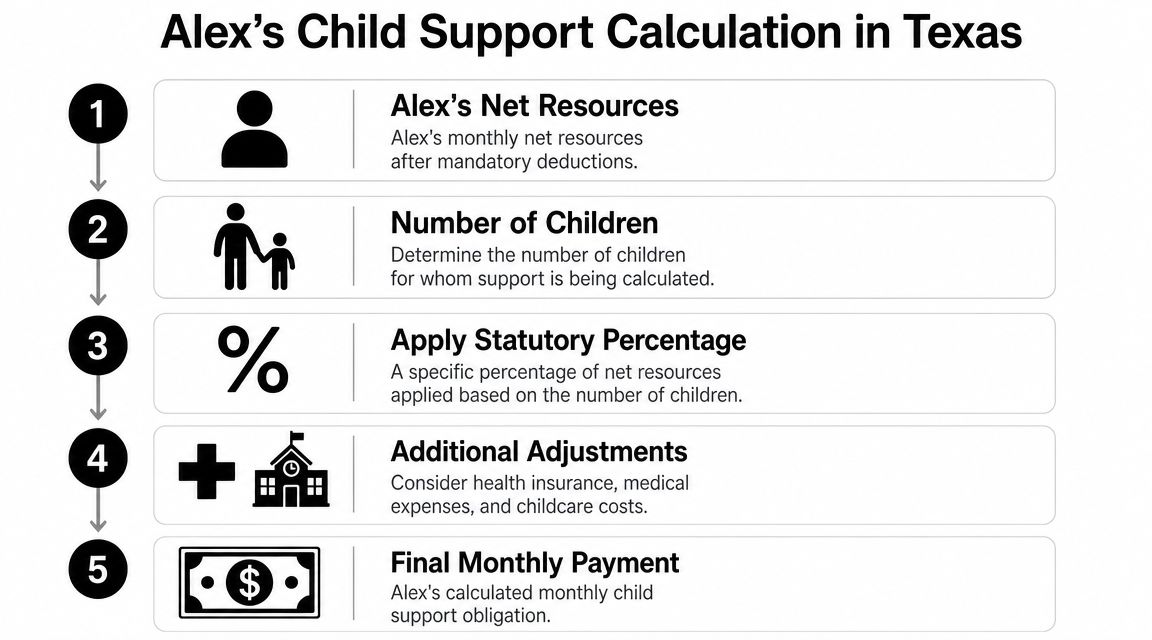
Take Alex. Alex is the parent who may be ordered to pay support for one child. Alex has regular income from work, and the court first needs to identify Alex's monthly net resources after the allowed deductions are applied.
How the process works in plain language
The judge or the lawyers don't start by picking a number that feels fair. They move through a sequence.
- Identify Alex's income: This includes the income the court decides belongs in the net-resources analysis.
- Subtract the allowed deductions: Only the deductions recognized under Texas law are used.
- Find the monthly net-resources amount: This becomes the working number.
- Apply the guideline percentage: For one child, the standard percentage is used unless an exception applies.
- Address related support items: Health coverage, medical support, or other child-related obligations may also appear in the order.
A short visual can help if you'd rather hear this process explained aloud:
Why the final order may not match a quick estimate
Now let's make Alex more relatable. Suppose Alex receives regular pay, but also gets occasional extra compensation. One side may argue those amounts should count because they increase available resources. The other may argue they are irregular and shouldn't drive a monthly obligation. That dispute affects the net-resources number before the percentage is ever applied.
Then there are the extras parents don't expect. If Alex provides the child's health coverage, the order may address that. If uninsured medical expenses need to be shared, that may be addressed too. If the possession schedule is unusual, the court may look more closely at whether a guideline amount fits the family's reality.
A sample calculation is useful, but it's only reliable when the income figure underneath it is accurate and well documented.
That's why two parents can each perform a "calculation" and still land in different places. The disagreement usually isn't basic math. It's about which income is in, which deductions are allowed, and whether the guideline result should be adjusted.
Adjustments for Custody Health Care and Childcare
The guideline amount isn't always the full picture. Parents also need to think about how the order handles day-to-day child expenses, especially health care, dental coverage, and work-related childcare.

Health and dental coverage
Texas courts usually address who will carry the child's health insurance and dental insurance. If one parent already has access to employer-based coverage, the order may require that parent to maintain it. In another family, the other parent may carry the coverage and seek reimbursement or an allocation of that cost.
This is one reason support conversations can feel disconnected from household budgeting. A parent may focus on the monthly support amount and overlook the fact that insurance obligations can significantly affect monthly cash flow.
Childcare expenses
Childcare often creates tension because it's necessary, recurring, and expensive for working parents, yet it doesn't always fit neatly into what people think of as basic child support. Courts and parents often have to address who pays for daycare, after-school care, summer care, or other supervision that allows a parent to work.
That practical planning issue matters almost as much as the legal one. Families often do better when they separate budgeting from long-term planning and understand the differences in financial planning so they can prepare for recurring child expenses, not just react to them month by month.
Many parents assume a near-equal parenting schedule means nobody pays support. Texas cases don't always work that way. If one parent earns much more than the other, support may still be part of the final order even when both parents spend significant time with the child.
Courts may also consider whether the usual guideline amount fits the actual arrangement. A standard possession order, an expanded schedule, or a more customized parenting plan can each shape the discussion.
A practical way to think about adjustments
Instead of asking only, "What's the support number?" it often helps to ask:
- Who carries insurance: That question affects monthly affordability and the structure of the order.
- How are unreimbursed expenses handled: Parents should be clear about medical, dental, and similar out-of-pocket costs.
- What childcare is necessary for work: Reliable care can be essential for a parent to keep employment.
- Does the custody schedule reflect the same financial reality: Parenting time and support aren't identical issues, but they do interact.
Parents usually feel less conflict when the order addresses the real expenses they know are coming, not just the headline child support figure.
When Courts Can Deviate from the Guidelines
A common moment in a Texas divorce goes like this. You run the numbers, apply the guideline percentage, and expect a clear answer. Then you realize your family does not fit neatly inside the standard formula. One child has ongoing therapy costs. One parent pays for long-distance travel so visits can happen. Or the paying parent's income is unusually low or well above the amount the guidelines fully cover.
That is when deviation becomes part of the conversation.
Texas courts start with the guideline amount, but they can order more or less if the standard result would be unjust or inappropriate. The legal authority for that comes from Texas Family Code Section 154.123, which lists factors a judge may consider. The key idea is simple. The guideline number is a starting point, not a ceiling or a guarantee.
Why the formula sometimes needs adjustment
A child support guideline works like a default setting. It fits many families reasonably well. It does not capture every family expense, income pattern, or parenting arrangement.
That matters even more under the newer guideline framework, because many online calculators stop after applying a percentage to one income figure. Real cases are often more detailed than that. A court may need to look closely at what counts as net resources, whether income reaches the guideline cap, and whether the child's actual needs justify a different result.
Lower-income cases can also be treated differently under the Family Code. If the obligor has limited monthly net resources, the court may use the lower-income guideline chart instead of the standard percentages. At the other end, if a parent's net resources exceed the cap used for guideline support, the court may consider whether the child's proven needs support an amount above the capped calculation. The Texas Attorney General explains these guideline principles and the role of proven needs in higher-income cases on its child support legal information page.
Situations that may support a deviation
Judges do not change the number just because one parent feels the result is unfair. They need a specific reason tied to the child, the parents' finances, or the practical cost of carrying out the order.
Examples include:
- A child with medical, developmental, or educational needs. Ongoing therapy, specialized tutoring, equipment, or recurring treatment may support a higher amount.
- Travel costs tied to possession. If parents live far apart, the expense of getting a child to and from visits may affect what is fair.
- A large difference in available resources between households. The court can examine whether the presumptive amount serves the child's best interest.
- Unusual income facts. Self-employment, irregular compensation, or disputes about what should count in net resources can make the guideline figure less reliable as a final answer.
- Temporary birth and postpartum expenses. In some families, short-term care needs affect budgeting during and after pregnancy. Parents looking for support resources may find Medicaid-approved doulas for Texans helpful.
Some deviations last only for a defined period. Others become part of the long-term order. The court's written findings matter, especially if one parent later needs to challenge, modify, or enforce a Texas child support order.
A helpful way to view this is to separate two questions. First, what does the guideline formula suggest? Second, does that number still make sense after we look at this child's actual situation and the parents' real financial picture?
That second question is where many cases are won or lost.
How to Modify or Enforce a Child Support Order
A child support order should fit your family's real life. If your income drops, the other parent's earnings rise, your child develops new medical needs, or the possession schedule changes in a meaningful way, the order may need to change too. In Texas, that change usually has to happen on paper through the court. A side agreement between parents often creates problems later, especially if payments stop or one parent remembers the agreement differently.
Modification cases often come down to one question. What has changed, and can you prove it?
That proof usually means pay stubs, tax returns, business records, health insurance information, childcare invoices, and school or medical records. Such detailed documentation is essential, as the court considers more than just gross pay or a quick online estimate. The judge is looking at net resources and at whether the current order still matches the facts under the Texas guidelines, including the 2026 income cap. Online calculators can also fall short in these situations, particularly when income is irregular, self-employment is involved, or more than one child support case affects the numbers.
Enforcement is a different problem. Here, the question is not whether the amount should change. The question is whether an existing court order has been followed.
If a parent misses payments, pays late, or ignores medical support obligations, Texas law gives courts tools to respond. Depending on the facts, enforcement may involve income withholding, a money judgment for arrears, contempt claims, or other remedies allowed by law. If you are dealing with missed payments now, this guide on enforcing a Texas child support order explains the process in more detail.
A simple way to separate these issues is to view modification and enforcement as two different lanes. Modification asks the court to update the order because life changed. Enforcement asks the court to require compliance with the order that already exists. Sometimes parents need both at once, such as when support has not been paid and the paying parent's income has also changed.
Families may also speak with a Texas family law attorney, including the Law Office of Bryan Fagan, PLLC, when they need help evaluating whether modification or enforcement makes sense under the facts.
If you need help with divorce, custody, or estate planning in Texas, contact Law Office of Bryan Fagan, PLLC today for a free consultation.