
When parents search how child support is calculated in Texas, they're usually not doing it out of curiosity. They're trying to answer a pressing question. Can I afford this? Is the number I was quoted even right? Will shared custody change anything? What happens if my income goes up, drops, or comes from more than a paycheck?
Those questions are normal. Child support cases sit at the intersection of family change and financial pressure, which is why even a straightforward formula can feel loaded. The good news is that Texas uses a guideline system, and that gives families a starting point that is more predictable than many people expect.
The harder part is that the final number often turns on details an online calculator can't fully capture. Courts don't only look at gross pay. They don't treat every expense the same way. And in some cases, they can move away from the guideline amount when the facts justify it. Knowing where the formula ends and judicial discretion begins is what helps parents make sound decisions early.
A parent may sit at the kitchen table with a paystub in one hand and a proposed parenting schedule in the other, trying to guess what life will look like after separation. Another may already have a temporary order and still feel unsure whether the amount reflects reality. Both situations are common.
Child support often feels more mysterious than it should. Parents hear phrases like “net resources,” “guideline support,” and “deviation,” but nobody explains them in plain language. That gap creates unnecessary fear. It also leads to bad assumptions, especially about shared custody, overtime, bonuses, and extra child-related expenses.
Texas child support law is detailed, but it isn't random. Courts generally begin with a formula and then evaluate whether the circumstances call for a different result. That means there is structure, but there are also judgment calls. If you understand both, you're in a much stronger position whether you're the parent paying support or the parent receiving it.
What usually works is careful preparation. Gather income records early. Review who pays for the child's health insurance. Look closely at the possession schedule you are requesting, not the one you assume the judge will sign. Parents get into trouble when they negotiate around rough guesses or rely on an online estimate as if it were a court order.
Child support disputes become more manageable when you separate the emotional issue from the math issue. The court will care about both, but it handles them differently.
The Foundation Understanding the Texas Guideline Formula
A lot of parents expect child support to turn on custody labels or a rough split of parenting time. In Texas, the court usually starts somewhere more mechanical. It identifies the paying parent, called the obligor, calculates that parent's monthly net resources, and applies a guideline percentage based on how many children are before the court.
That starting point matters because it explains why two cases that look similar on the surface can produce different support amounts. A parent with the same salary but different deductions, other children to support, or irregular income may not land at the same number. If you want a more detailed explanation of how courts build that monthly income figure, see this guide on calculating net resources for Texas child support.
The standard guideline percentages are 20% for one child, 25% for two, 30% for three, 35% for four, and 40% for five or more children, as summarized by TexasLawHelp's discussion of child support and lower incomes.
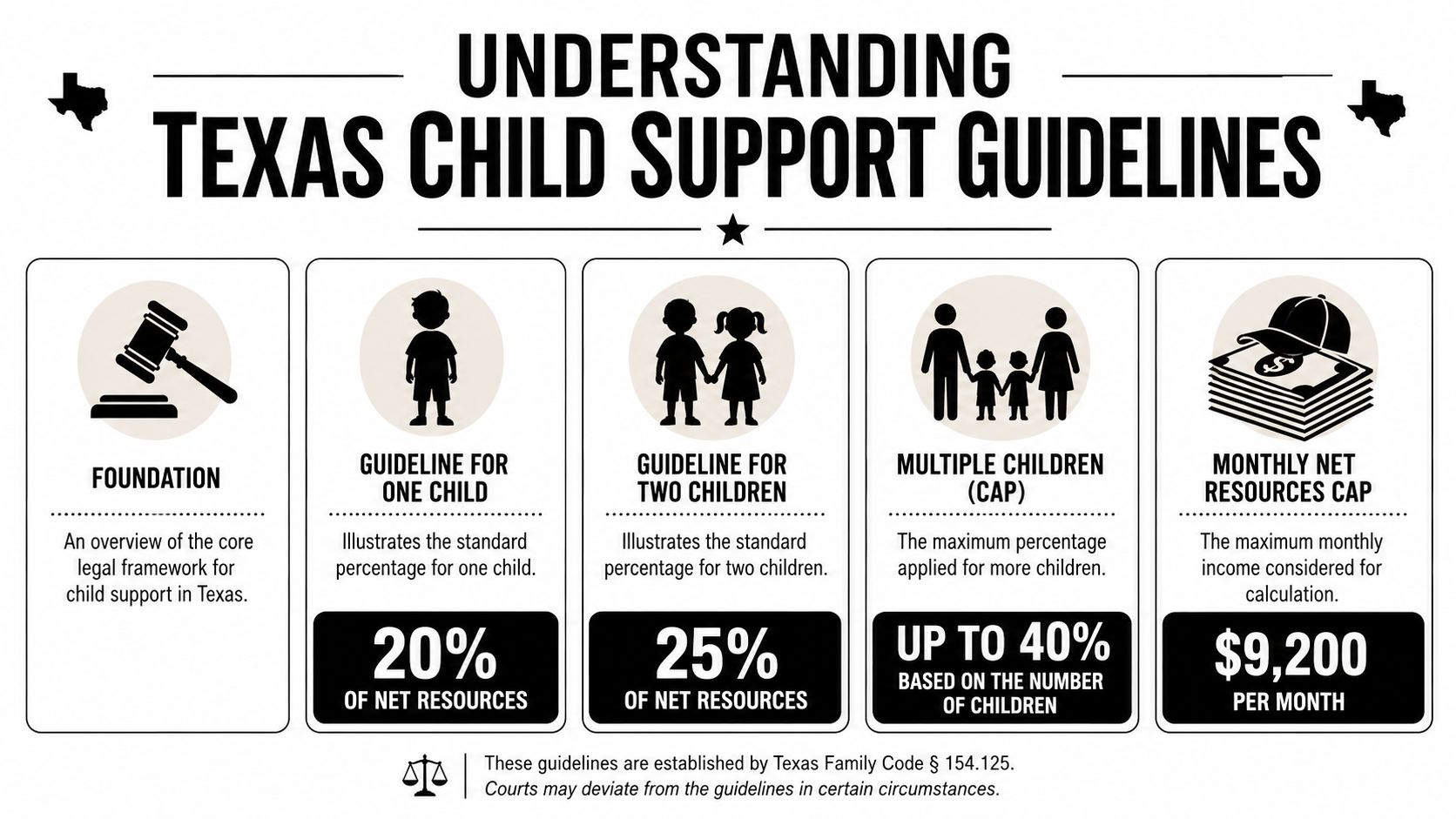
The percentages most parents need to know
Guideline percentages
One child: 20% of net resources
Two children: 25% of net resources
Three children: 30% of net resources
Four children: 35% of net resources
Five or more children: 40% of net resources
Those percentages are the baseline, not the full answer.
In practice, confusion usually starts here. Parents often assume support is based on gross income, or they assume a 50/50 schedule automatically eliminates support. Texas does not work that way. The formula begins with net resources, and shared custody alone does not replace the guideline analysis.
Why online calculators often miss the mark
Online calculators can be useful for a rough estimate, but they miss the judgment calls that affect actual orders. They usually do not capture disputed income, fluctuating pay, other children the obligor must support, or whether the court has a reason to depart from the guideline amount.
That is why I tell clients to treat any calculator result as a draft, not a prediction. The final number depends on how the court classifies income and applies the statute to your specific facts. That difference shows up often in cases involving bonuses, self-employment income, high earnings, or parenting schedules that look equal on paper but do not answer who is paying the child's day-to-day costs.
For many families, the formula is straightforward. The hard part is knowing which facts change the math, and which facts do not.
What Are Net Resources A Step-by-Step Breakdown
Most disputes about child support aren't really disputes about percentages. They're disputes about net resources. That term has a specific legal meaning, and it does not always match what a parent thinks of as take-home pay.
A useful way to think about it is this. Net resources are the court's version of your monthly income picture. It starts broad, then narrows only through certain deductions. Some parents expect the court to subtract every major bill they pay. It won't.
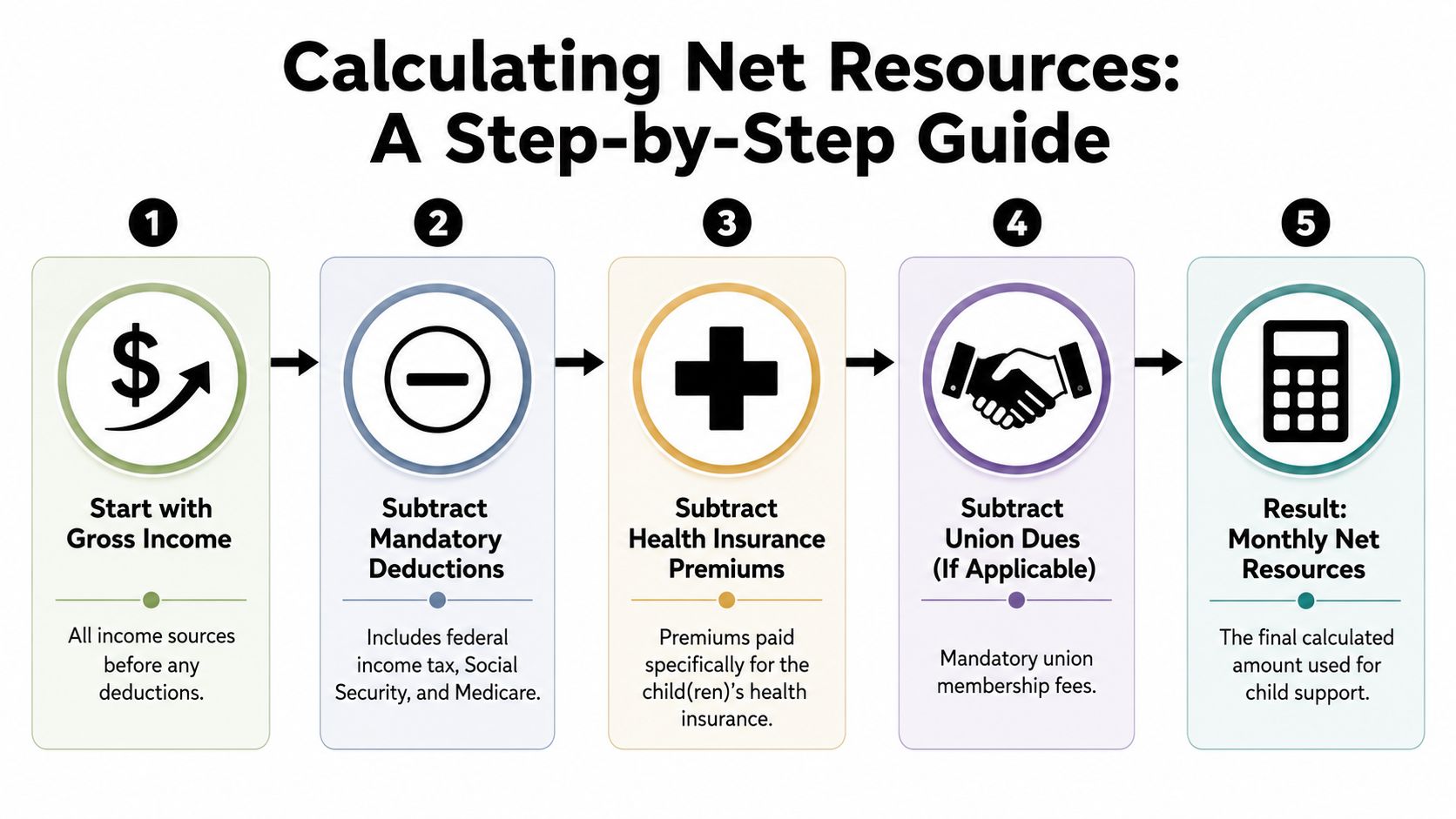
Step one starts with income from all relevant sources
For many parents, this begins with wages or salary. In a more complicated case, it may include variable pay, business income, or investment-related income. If your compensation doesn't come in the same amount every month, the court may need a broader look at your records to reach a fair monthly figure.
That's where preparation matters. A W-2 employee may need paystubs and tax returns. A self-employed parent may need profit-and-loss records, bank statements, and documents showing what is properly business-related versus personal spending.
Step two allows only certain deductions
Texas courts don't subtract whatever leaves your checking account. They look for allowable deductions recognized under the child support framework. In practice, parents often focus on taxes, required payroll deductions, and the cost of the child's health insurance if they are the parent paying it.
This is one reason confusion happens so often. A parent may say, “I can't afford support because I have a mortgage, truck payment, and credit cards.” Those obligations may be very real, but they are not automatically part of the net-resources calculation.
Here's a practical review process:
- Collect income documents for the most reliable recent period.
- Separate recurring income from one-time events so the court can see the true pattern.
- Identify only allowable deductions rather than assuming every expense counts.
- Compare your estimate to the likely court method before negotiating.
- Document anything unusual early if your income fluctuates or your compensation structure is complex.
For a deeper look at the mechanics, see this guide on how to calculate net resources for child support.
Later in the process, many parents benefit from seeing the calculation discussed visually:
What usually does not reduce support
A common mistake is treating lifestyle expenses as legal deductions. Courts usually won't reduce support because a parent has chosen expensive housing, carries high consumer debt, or makes discretionary contributions elsewhere. Those facts may explain financial strain, but they don't automatically change the formula.
Practical rule: Before you argue that a payment should lower support, ask whether the Family Code treats it as part of the child support calculation. Many everyday bills don't qualify.
Putting It All Together Sample Child Support Calculations
The formula makes more sense when you apply it to actual situations. One case may be routine. Another may involve income high enough that the cap changes the result. Those are very different conversations, even when both parents think they are talking about “guideline support.”
Scenario one with two children and income below the cap
Assume a parent has two children before the court. The lawyer gathers income records, works through allowable deductions, and arrives at a monthly net-resources figure. At that point, the standard guideline percentage for two children applies.
The math structure is simple even though the records review may not be:
| Line Item | Amount |
|---|---|
| Monthly net resources | Determined after allowable deductions |
| Guideline percentage for two children | 25% |
| Monthly child support | Net resources multiplied by 25% |
Many people tend to oversimplify this calculation. They jump straight from gross pay to a support figure. That shortcut often produces the wrong answer. A more reliable method is to do the net-resources work first and then apply the percentage.
If you want to see how lawyers walk through real-world examples, this article on calculating child support in Texas using real-world examples is a useful companion.
Scenario two with higher income
A major change took effect on September 1, 2025, when Texas raised the child-support cap on monthly net resources to $11,700. Under that updated cap, the maximum guideline support became $2,340 per month for one child, $2,925 for two, $3,510 for three, and $4,095 for four, assuming the case follows the standard percentage schedule, according to this explanation of the updated Texas cap.
That creates an important practical result. A high-income parent may earn well above the cap, but guideline support does not keep increasing dollar-for-dollar under the standard formula once that threshold is reached. At that point, the case may shift from basic arithmetic to proof-based argument.
For many higher-income families, the real dispute is no longer “What percentage applies?” It becomes “Should the court order more than the capped guideline amount, and why?”
That distinction is where good lawyering matters. If you represent the parent seeking more support, you need evidence tied to the child’s actual needs. If you represent the paying parent, you need to test whether those claimed needs are substantiated and whether they fit within the legal standard.
Beyond the Formula Adjustments and Special Cases
A parent can look at an online calculator, plug in income, and walk away with a number that feels final. Then the actual case starts. Shared parenting time, unusually high income, a child with extra needs, or income that does not show up neatly on a pay stub can all change how the court views support.

Texas courts use the guideline formula as a starting point. They can also move away from that number if applying it straight would be unjust or inappropriate under the facts. In practice, that means the final child support amount often turns on records, testimony, and whether a parent can connect the requested number to the child’s actual circumstances.
High-income cases need proof, not assumptions
In higher-income cases, Texas applies a cap on monthly net resources, which was raised to $11,700 effective September 1, 2025. The guideline formula stops at that cap. Income above it does not automatically increase support under the standard calculation, but the court may still consider whether the child has proven needs that justify more, as explained in this discussion of 2025 Texas child support guidelines.
That is where parents often get tripped up. One parent assumes a very high salary automatically means a very high order. The other assumes the cap shuts down any argument for additional support. Texas law lands in the middle.
If you are asking for more than the capped guideline amount, bring specifics. Tuition, recurring therapy, specialized care, and other child-focused expenses matter far more than general statements about the other parent’s income. If you are resisting an above-guideline request, the question is usually whether those claimed needs are real, necessary, and tied to the child rather than the household’s overall lifestyle.
Parents with a roughly equal possession schedule often expect child support to cancel out. Courts do not treat shared custody as an automatic waiver. A judge may still order support if one parent earns significantly more, if the child’s expenses are carried unevenly between homes, or if the overall arrangement would otherwise leave one household unable to meet the child’s day-to-day needs.
Offset agreements can make sense in settlement talks. They are also easy to oversimplify. I often see parents focus only on nights with the child and ignore who pays school costs, activity fees, transportation, or the practical expenses that follow the child between homes. A proposed offset works better when it reflects the full financial picture, not just the calendar.
Special circumstances can justify a different result
Texas Family Code § 154.123 allows courts to consider facts that make the guideline amount inappropriate. That matters in the cases online calculators handle poorly.
Common examples include:
- Special medical or developmental needs: Ongoing treatment, therapy, equipment, or care can support support a higher amount.
- Intentional underemployment or unemployment: A court may look at earning capacity if a parent appears to be earning less by choice.
- Unusual parenting schedules: A custom possession order can affect the fairness of a standard guideline result.
- Irregular or hard-to-verify income: Business owners, self-employed parents, and commission earners often require closer financial review than salaried employees.
These cases are usually won or lost on documentation. Bank records, tax returns, business statements, employment history, medical records, and a clear expense summary often matter more than broad arguments about fairness.
The Law Office of Bryan Fagan, PLLC handles Texas family law matters involving child support, custody, modification, and enforcement.
Accounting for Health Insurance and Childcare Costs
Parents often focus on the guideline number and overlook the expenses that sit beside it. That creates confusion later, especially when one parent thought the support amount already covered everything.
Health insurance is usually handled separately
Courts commonly order one parent to provide health insurance and dental coverage for the child if coverage is available. The cost of the child’s health insurance is often factored into the broader support analysis rather than ignored. That’s one reason a straight calculator estimate may not match a proposed order.
Uninsured medical costs also deserve attention. Families often argue more about reimbursement procedure than about the underlying principle. A clear order should address how those expenses are shared, how receipts are exchanged, and how quickly reimbursement must happen.
A support order works better when it answers the small practical questions before they become future disputes.
Childcare can change the real monthly picture
Work-related childcare is another expense parents frequently underestimate. It may not appear as part of the bare guideline percentage, yet it can significantly affect what each parent pays each month under the full order.
Precision matters. If childcare is necessary for a parent to work, the order should address it directly. If the expense is temporary, seasonal, or likely to change, the language should be careful enough to reduce future conflict.
Modifying or Enforcing a Texas Child Support Order
A child support order isn’t self-updating. If income changes, the child’s needs change, or the parenting arrangement changes, the old order remains in place until a court changes it. That catches many parents off guard.
Modification requires a formal process
Texas courts can modify support when there has been a material and substantial change in circumstances. In some situations, parents also look at whether enough time has passed and whether the current order no longer aligns with the guideline result. What doesn’t work is an informal side agreement between parents that never becomes a signed court order.
That’s true even when both parents mean well. If one parent pays less based on a handshake agreement, arrears can still build. If one parent accepts less for a while, they may later discover the written order still controls.
Enforcement is often more procedural than people expect
When support goes unpaid, the remedy is not just “tell the judge and it gets fixed.” Enforcement cases depend on records, payment histories, dates, and the exact language of the prior order. Good documentation matters.
If you’re dealing with missed payments, this guide to enforcing a delinquent Texas child support order and understanding the real process, timelines, and leverage is a strong place to start.
Whether you need a modification or enforcement action, the same rule applies. Act early, document thoroughly, and don’t rely on informal fixes when the court order says something else.
If you need help navigating divorce, custody, or estate planning in Texas, contact Law Office of Bryan Fagan, PLLC today for a free consultation. A child support calculation may look simple on the surface, but the outcome often depends on details involving income, possession, health insurance, childcare, and whether the court has a reason to deviate from the guidelines. Getting personalized advice early can help you avoid expensive mistakes and move forward with more clarity.