
Divorce can leave you staring at the same question over and over. How am I supposed to pay my bills when this is over, or what will I be expected to pay if my spouse asks for support?
That uncertainty is one of the hardest parts of any Texas divorce. People often hear the words “alimony” or “spousal support” and assume the answer will be simple. In Texas, it usually isn't. The rules are narrower than many people expect, and the outcome often turns on details like your marriage length, your earning history, and how clearly your finances can be documented.
For spousal support texas information, the most helpful starting point is this. Texas treats spousal maintenance as a limited form of support, not an automatic right. The law is structured, fact-specific, and focused on helping a spouse meet basic needs while moving toward self-support.
If you're newly separated, one issue usually shows up fast. One spouse has been paying most of the household expenses, and now the money flow has changed overnight. Mortgage payments, rent, groceries, insurance, and school costs don't pause just because a divorce has started.
That's where many people get confused. They use “alimony,” “maintenance,” and “support” as if they all mean the same thing. In Texas, they don't.

Temporary support and post-divorce maintenance are different
Temporary support is often addressed while the divorce is still pending. Its purpose is practical. It helps maintain financial stability until the court enters final orders.
Post-divorce spousal maintenance is different. It's a final, court-ordered support obligation after the marriage ends, and it has much stricter eligibility rules. As noted by Dana White Family Law on Texas maintenance eligibility, temporary support is more common during the case, while final maintenance is harder to obtain.
Many people walk into a divorce assuming that if one spouse earned more, support will automatically continue after divorce. Texas law doesn't work that way.
Court-ordered maintenance and contractual alimony are not the same
Texas lawyers often separate support into two buckets:
- Court-ordered spousal maintenance. This is support a judge may order if the legal requirements are met under Texas Family Code Chapter 8.
- Contractual alimony. This is support the spouses agree to in settlement, even when a judge might not order maintenance on the same facts.
That distinction matters. A negotiated agreement gives people more flexibility. A court order follows the statute.
What Texas is trying to do
Texas treats maintenance as a short-term, rehabilitative tool. The law is built around the idea that support should help a spouse cover minimum reasonable needs and move toward independence when possible. That's why courts pay close attention to earning ability, available property, and whether a spouse has made efforts to work, train, or re-enter the workforce.
For many families, the first real relief comes from understanding that there is a framework. Once you know whether you're dealing with temporary orders, final maintenance, or a negotiated support agreement, the rest of the conversation becomes much less intimidating.
Who Qualifies for Spousal Maintenance in Texas
Eligibility is where many cases are won or lost. A spouse doesn't receive maintenance solely because the other spouse earns more. The court starts with a stricter question. Can the spouse asking for maintenance meet minimum reasonable needs with the property and income available after divorce?
If the answer is no, the next step is to see whether one of the legal paths to maintenance applies.
The common qualification paths
A practical way to think about this is to use a checklist.
- Longer marriage with financial need. A spouse may have a maintenance claim if the marriage lasted long enough and they still can't meet minimum reasonable needs through available income or property.
- Family violence. A history of qualifying family violence can change the analysis and may allow maintenance even when a marriage was shorter.
- Disability of the spouse seeking support. If a spouse's physical or mental condition prevents sufficient earning, that can support a maintenance request.
- Care for a disabled child of the marriage. If one spouse must provide substantial care and supervision for a child whose condition limits that spouse's ability to work, that may also support a maintenance claim.
Texas courts look closely at facts, not labels. Saying “I sacrificed my career for the family” may be true and important, but a judge still wants evidence showing how that affects present earning ability and current need.
What courts want to see
Judges usually expect specific proof, such as:
- Financial records showing monthly expenses and available assets
- Employment history that explains time away from the workforce
- Medical evidence if disability is part of the claim
- Evidence of caregiving demands if care for a disabled child affects employability
- Proof of efforts to become self-supporting, such as job applications, training, certifications, or education
Texas law also tends to reward diligence. If a spouse can work, the court often wants to see that they've tried. That doesn't mean every person must already be fully employed before asking for help. It does mean the court may ask what steps have been taken to find work or gain training.
Practical rule: Keep records early. A notebook of job searches, interviews, training inquiries, and household expenses can become persuasive evidence later.
A simple example
Suppose a spouse spent many years out of the workforce raising children and now has limited current income. That fact alone doesn't guarantee maintenance. But if the spouse can show a long marriage, limited available property after divorce, and a real inability to meet basic needs right away, the request becomes much stronger.
If you want a deeper review of the legal standards, this guide to Texas spousal maintenance eligibility is a useful next step.
Calculating and Capping Spousal Support Payments
For many individuals, this is the most urgent question. If maintenance is possible, how much can a court order?
Texas answers that with a firm cap. Under Texas Law Help's explanation of spousal maintenance and Texas Family Code § 8.055, court-ordered maintenance cannot exceed the lesser of $5,000 or 20% of the paying spouse's average gross monthly income. That cap is one reason Texas is considered more restrictive than many states.
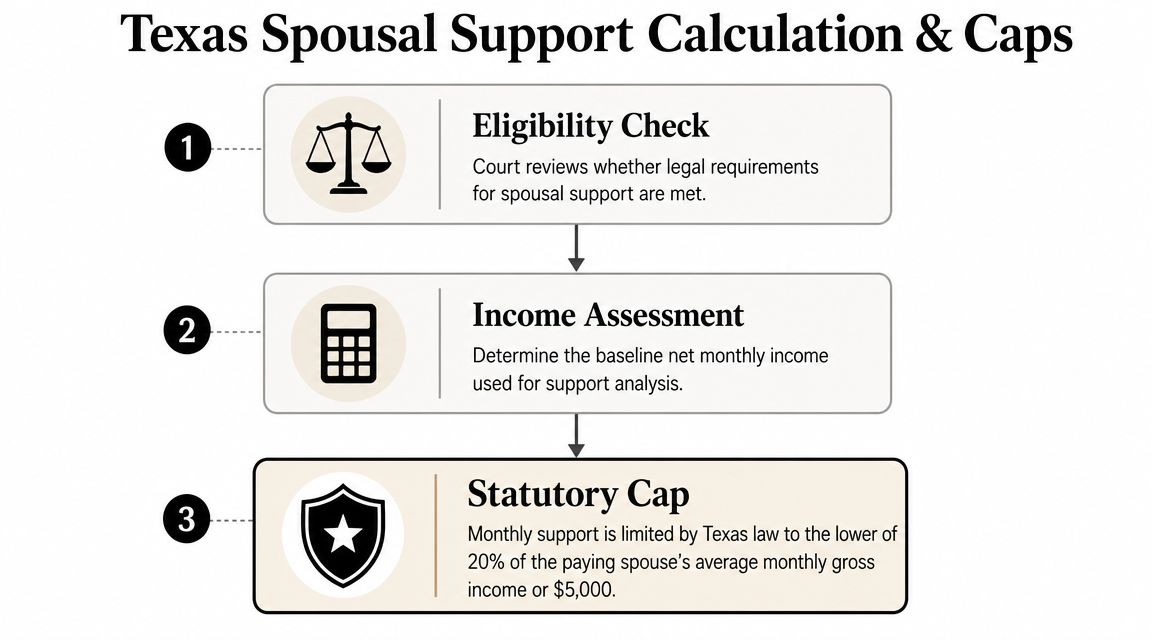
The three-part calculation in real life
The statute sounds simple. Real cases often aren't.
| Step | What the court examines | Why it matters |
|---|---|---|
| Eligibility | Whether the spouse qualifies under Chapter 8 | No maintenance order happens unless the threshold is met |
| Income review | The paying spouse's average gross monthly income | The cap depends on this figure |
| Final amount | The legal ceiling and the facts of the case | The maximum cap is not always the amount ordered |
A court still has to decide what amount is appropriate within the legal limit. The cap is a ceiling, not a promise.
Why variable income creates so much confusion
A salaried employee with a fixed paycheck is usually easier to evaluate. A physician with productivity bonuses, a salesperson with commissions, or a business owner with fluctuating draws is harder.
That's because the legal phrase is average monthly gross income. For a high-income earner or self-employed spouse, the argument often isn't just about what they made in one recent month. It's about what income should count, how it should be averaged, and what documents best show the full financial situation.
Common documents in these disputes include:
- Pay stubs and W-2s for traditional wage earners
- Bonus and commission records if compensation changes month to month
- Tax returns that show annual income patterns
- Business profit and loss statements for owners or partners
- Bank records that help trace actual cash flow
If income rises and falls, the court often needs a broader view than one paycheck. A single strong month or a single weak month usually doesn't tell the whole story.
High-income households and negotiated solutions
Texas also places a hard practical limit on what a judge can order. As explained in this discussion of Texas spousal support limits and negotiation issues, the statutory cap creates a major planning issue in high-income divorces and often makes contractual alimony a serious negotiation topic.
That matters in cases where one spouse has lived in a household with substantial income, but the court-ordered amount would still be limited by statute. In that setting, settlement strategy becomes important. Lawyers may compare after-divorce budgets, likely earning capacity, and available property options to see whether support should be handled by agreement rather than left entirely to the court's maintenance framework.
If you want to test scenarios before mediation or a temporary orders hearing, a tool like the LegesGPT spousal support calculator can help organize your thinking. It isn't a substitute for case-specific advice, but it can help you spot the questions your lawyer will need to answer.
For a more detailed breakdown of how these calculations are approached in practice, see this Texas spousal support calculations overview.
How Long Does Spousal Maintenance Last in Texas
The duration of maintenance matters almost as much as the amount. A support order can affect housing decisions, job planning, retirement timing, and settlement choices. Texas handles duration with relatively clear limits tied to the length of the marriage.

The general time limits
According to this explanation of permanent alimony versus spousal maintenance in Texas, support is generally capped as follows:
- At least 10 years of marriage. Support is generally capped at 5 years.
- At least 20 years but less than 30 years. Support can last up to 7 years.
- 30 years or more. Support can last up to 10 years.
These limits reflect Texas's preference for short-term, rehabilitative support, not permanent alimony.
Why Texas uses these limits
The policy is straightforward. Texas courts are supposed to favor the shortest reasonable period that allows a spouse to work toward self-sufficiency. For some people, that may mean enough time to complete training, re-enter the workforce, or stabilize after years spent outside paid employment.
For others, the issue is less about retraining and more about managing a transition. A spouse may need time to secure housing, rebuild credit, update professional credentials, or adjust from a single-income household to independent budgeting.
This video offers a helpful overview of how support issues can play out in Texas divorce cases:
When maintenance can end sooner
Even if an order allows maintenance for a certain period, payments may stop earlier if legally terminating events occur. In practice, people should review the final decree carefully so they understand what triggers an end to the obligation.
A few common examples include:
- Death of either party
- Remarriage of the receiving spouse
- Cohabitation issues, depending on the facts and court findings
- Other case-specific termination language in the decree or agreement
A maintenance order is not just about the monthly amount. The ending conditions matter just as much.
Disability cases can be different. In some circumstances, support may continue longer when a disability affects the spouse seeking maintenance or a child requiring substantial care. Those cases often depend on careful proof and detailed drafting.
Practical Scenarios for High-Net-Worth and Military Divorce
Rules make more sense when you can see how they affect real families. These scenarios aren't promises of outcome, but they show how Texas spousal support questions often unfold in more complex divorces.
A high-net-worth divorce with uneven cash flow
One spouse is a business owner whose income changes throughout the year. Some months are modest. Others include large owner distributions. The other spouse hasn't worked outside the home for years and is worried that a court-ordered maintenance amount won't match the household lifestyle.
In that case, the maintenance analysis often shifts from “What feels fair?” to “What can be ordered under Texas law?” Once the couple recognizes the statutory cap, settlement talks may focus on contractual alimony, property division, or a combination of both.
That conversation usually involves practical questions like these:
- Should support be fixed monthly, or step down over time?
- Should one asset award help replace long-term monthly support?
- How should the parties account for a business owner's fluctuating income?
- Would a buyout structure create more certainty than ongoing conflict?
A negotiated agreement can sometimes solve problems that a narrow court order can't fully address.
A military family balancing state and federal issues
Military divorce adds another layer. One spouse may have moved repeatedly, paused civilian career development, or carried most of the parenting load during deployments. The divorcing couple may also be dealing with military retirement issues and federal rules that affect how certain benefits are handled.
Spousal maintenance in a military case still follows Texas law if the divorce is in Texas, but the overall strategy often has to account for military pay structures, timing of separation, and the interaction between support requests and property division.
In real terms, that means the spouse seeking support may need especially clear documentation of:
- interrupted employment history,
- present monthly need,
- caregiving responsibilities,
- and how frequent relocations affected earning capacity.
Military families often benefit from a coordinated review of both state family law and federal military-related rules before they negotiate support.
A family violence case in a shorter marriage
A spouse in a shorter marriage may assume maintenance is off the table because the marriage didn't last long enough. That isn't always true.
If family violence is part of the case and the legal proof is there, maintenance may still become an issue. In those cases, the court's focus often turns to safety, immediate financial stability, and whether the spouse seeking support can realistically meet minimum needs after leaving the marriage.
These cases often require more than testimony alone. They may involve:
- police reports,
- protective order records,
- criminal case documents,
- medical records,
- or witness testimony.
The legal standard is still specific, but the path to qualifying can look very different from the typical long-marriage claim.
The Legal Process for Requesting and Enforcing Support
The legal process feels more manageable when you know the order of events. Support disputes usually develop through pleadings, financial disclosure, negotiation, and, if necessary, a hearing before the court.

Requesting support during the divorce
A spouse asking for maintenance typically needs to raise that request clearly in the divorce pleadings. Temporary support issues may also be addressed early through temporary orders if one spouse needs help while the case is pending.
After that, both sides usually begin gathering evidence. That may include:
- Income records such as pay statements or tax returns
- Expense records showing monthly living needs
- Asset information tied to property division
- Employment and education history
- Medical or caregiving evidence, if relevant
Mediation often plays a major role. Many support disputes settle there because both sides gain a clearer sense of the risks, the statutory limits, and the cost of continuing to fight.
What happens if the parties don't agree
If negotiation doesn't resolve the issue, the judge may hear evidence and decide whether support should be ordered, in what amount, and for how long. Preparation matters. Courts usually respond best to organized proof, not broad frustration.
A strong presentation often includes a simple budget, supporting records, and a clear explanation of why support is or isn't justified under the statute.
Bring the court a documented story. Judges make better decisions when the evidence is specific, chronological, and easy to follow.
Enforcement after the divorce
If support is ordered and payments stop, the receiving spouse may need to file an enforcement action. That can involve asking the court to confirm arrears, compel compliance, or use other available remedies allowed by law and the decree.
If your case has reached that point, this Texas spousal support enforcement guide explains the process in more detail.
In practice, many people also benefit from using structured legal guidance during this stage. Options may include private counsel, self-help court resources, and law firm case management systems that keep financial records, orders, and payment histories organized. The Law Office of Bryan Fagan, PLLC handles Texas family law matters that include divorce, maintenance, and enforcement proceedings.
Get the Legal Guidance You Deserve
Texas spousal maintenance is more limited than many people expect. Whether you're worried about receiving support or paying it, the answer usually depends on a careful review of eligibility, proof of need, income records, and the language in your final orders.
That's especially true when the facts are more complicated than a basic salary and a straightforward budget. Variable compensation, business income, military benefits, disability issues, family violence concerns, and temporary orders can all change the strategy. A small detail in your financial records or decree language can make a significant difference.
You also don't have to solve every part of this at once. Start with the right questions. Are you asking for temporary support, final maintenance, or a negotiated contractual arrangement? What records show your true monthly need or your actual earning capacity? What outcome is realistic under Texas law, and what issues are better handled in settlement?
Those are legal questions, but they're also personal ones. They affect where you live, how you budget, and how secure you feel moving into the next chapter of life.
If you need help navigating divorce, custody, or estate planning in Texas, contact Law Office of Bryan Fagan, PLLC today for a free consultation. A Texas family law attorney can review your situation, explain how the court is likely to view your support issue, and help you build a practical plan for the next step.