
Alimony isn't automatically required in Texas. If a court orders post-divorce support, it is generally limited to the lesser of $5,000 per month or 20% of the paying spouse's average monthly gross income, and the support usually lasts only for a limited period tied to the length of the marriage.
If you're in the middle of a divorce, this question probably isn't academic. You may be sitting at your kitchen table trying to figure out how you'll pay rent, keep health insurance, or rebuild after years of sharing one household income. Or you may be worried that divorce will leave you paying support indefinitely.
Texas law is narrower than many people expect. The word “alimony” gets used in everyday conversation, but Texas usually deals with post-divorce support through a more limited legal concept called spousal maintenance. For many families, that distinction matters a great deal.
The good news is that uncertainty gets smaller once you understand the rules. When you know what Texas courts can order, what they usually won't order, and where negotiated solutions may offer more flexibility, you can make better decisions and avoid a lot of unnecessary fear.
Understanding Your Financial Future During a Texas Divorce
One of the hardest parts of divorce is not knowing what your financial life will look like a few months from now. People often search “is alimony required in texas” because they want a simple yes or no. The honest answer is no, it usually isn't required, but that doesn't mean support is never part of a Texas divorce.
For many spouses, the bigger issue is control. Financial fear often grows when every possibility feels open-ended. A practical first step is to organize your current income, debts, monthly expenses, and immediate needs. If you're trying to achieve financial freedom after separation, a clear personal budget can help you understand what you actually need before you start making legal decisions.
Texas divorces often involve more than support alone. Property division, debt allocation, temporary orders, and custody arrangements all affect whether one spouse will need additional help after the divorce is final. If you're worried about protecting accounts, credit, or cash flow during the case, this guide on how to protect your finances during divorce is a useful place to start.
Practical rule: Don't treat “alimony” as the first or only financial question in a Texas divorce. Start with the full picture of income, property, debt, and day-to-day expenses.
Many people also assume that if one spouse earned more during the marriage, support must follow automatically. Texas law doesn't work that way. The court looks at support through a much narrower lens, which can be frustrating if you expected broad protection, but it can also help you focus on realistic options instead of internet myths.
Spousal Maintenance in Texas The Exception Not the Rule
Texas uses the term spousal maintenance for court-ordered post-divorce support. Under Texas law, it isn't a routine part of divorce. Courts treat it as a limited remedy for specific situations, not as a general entitlement after a marriage ends.

A helpful way to think about it is this. Texas generally prefers a clean break after divorce when that is possible. The court first looks to the division of marital property to help each spouse move forward. Only when that isn't enough to meet a spouse's minimum reasonable needs does maintenance become a serious issue.
What a spouse must prove
A spouse asking for court-ordered support has to do more than say, “I need help.” Texas follows a narrow statutory framework in Texas Family Code Chapter 8. As explained by TexasLawHelp's overview of spousal maintenance and alimony, a court may order maintenance only if the requesting spouse proves both financial need and a qualifying statutory trigger.
That means two things usually have to come together:
- Financial need: The spouse must show an inability to meet minimum reasonable needs.
- A legal pathway: The spouse must also fit within one of the recognized categories, such as a qualifying marriage length or a family violence situation.
Why people get confused
The confusion usually comes from everyday language. Friends, relatives, and online forums use “alimony” to describe any payment from one ex-spouse to the other. Texas law is more technical than that.
Texas courts don't begin with the idea that one spouse should continue supporting the other after every divorce. They begin with the question of whether the law allows maintenance at all.
That difference matters because many people walk into negotiations assuming support is guaranteed. It usually isn't. If maintenance is part of your case, the discussion has to be grounded in statutory eligibility, actual financial need, and the evidence available to prove both.
Who Is Eligible for Court-Ordered Spousal Maintenance
Eligibility is where many cases rise or fall. Texas law is strict. A judge generally may not award maintenance unless the requesting spouse lacks sufficient property to meet minimum reasonable needs and also fits within a limited statutory category, as summarized in this explanation of how alimony is determined in Texas.
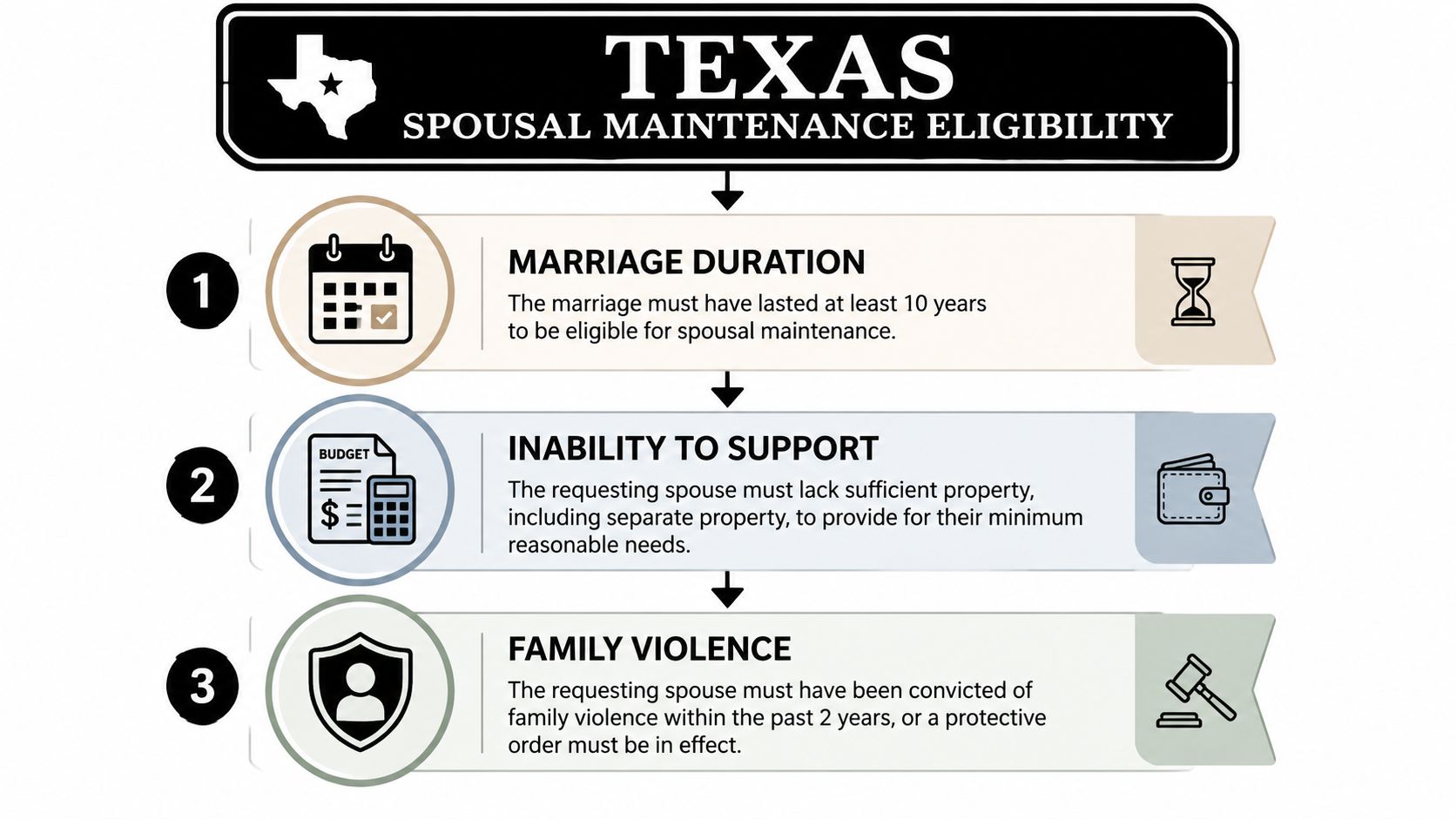
The ten-year marriage pathway
People often talk about a “10-year rule,” but that shorthand leaves out important details. A marriage lasting at least ten years may open the door to maintenance, but it does not guarantee it. The spouse asking for support still has to show an inability to meet minimum reasonable needs.
Readers often get frustrated because they assume crossing the ten-year mark means support follows automatically. It doesn't. The court still wants evidence that the spouse cannot currently support themselves despite efforts to earn income or become self-sufficient.
The family violence exception
Texas also allows maintenance in certain family violence cases. This pathway can apply even when the marriage did not last ten years, if the legal requirements are met.
That matters because the law recognizes that abuse can disrupt financial independence. A spouse who has been harmed may need support even if the marriage was shorter than people usually associate with maintenance claims.
Disability of the requesting spouse
If the spouse asking for maintenance has a physical or mental disability that affects earning ability, the court may consider maintenance. In these cases, the focus shifts from marriage length to actual ability to earn enough to meet basic needs.
Medical records, work history, and day-to-day limitations often become important here. The issue is not whether life has become harder. The issue is whether the disability keeps the spouse from earning sufficient income.
Caring for a disabled child
Another narrow path involves a spouse who must provide substantial care and personal supervision for a child of the marriage with a disability. If that caregiving role prevents the spouse from earning enough income, maintenance may be available.
This category is easy to overlook, but it can be central in the right case. Some parents are effectively pushed out of the workforce by caregiving demands that don't end when the divorce is final.
A strong maintenance claim usually depends on documents, not just testimony. Budgets, medical records, employment history, and evidence of caregiving duties often matter as much as the story itself.
If you're trying to understand whether one of these pathways applies to your situation, this comprehensive guide to Texas spousal maintenance eligibility offers a useful starting point for issue spotting before you speak with counsel.
How Courts Decide the Amount and Duration of Maintenance
Qualifying for maintenance and receiving a large or long-lasting award are two different things. Even when a spouse clears the eligibility hurdle, Texas law still places firm limits on both amount and duration. Courts also favor the shortest reasonable period necessary for the receiving spouse to become self-supporting, a point reflected in Texas practice discussions and in Texas Family Code § 8.052 and § 8.054.
The amount cap
Texas places a hard ceiling on court-ordered maintenance. As noted in this discussion of alimony in Texas, the maximum amount is the lesser of $5,000 per month or 20% of the paying spouse's monthly gross income.
That number is a cap, not a promise. A judge can order less. In many cases, the court focuses on the minimum amount needed to help the receiving spouse cover basic needs while working toward greater independence.
The time limit
Texas also limits how long maintenance can continue. The duration generally depends on the length of the marriage.
| Length of Marriage | Maximum Duration of Maintenance |
|---|---|
| 10 to 20 years | 5 years |
| 20 to 30 years | 7 years |
| 30 years or more | 10 years |
These are maximum periods, not automatic awards. A judge may order a shorter period if the evidence suggests the spouse can become self-supporting sooner.
What judges look at in practice
When setting amount and duration, courts may consider several practical factors under Texas Family Code § 8.052. These often include:
- Education and work history: Whether the spouse has recent job experience, training, or a realistic path back into the workforce.
- Health and age: Whether health conditions or age affect earning ability.
- Property received in the divorce: Whether the spouse received assets that help meet minimum reasonable needs.
- Efforts toward self-support: Whether the spouse has taken steps to seek work, obtain training, or otherwise improve financial independence.
Important distinction: “Eligible” does not mean “entitled to the maximum.” Texas courts can award less than the cap and for less than the maximum duration.
A simple example helps. If one spouse has been out of the workforce for years but has marketable skills and a clear path to employment, the court may view maintenance as short-term support while that spouse regains footing. If another spouse has serious barriers to earning income, the analysis may look different, but the statute still keeps the court within defined limits.
Contractual Alimony A Critical Alternative
This is the part many online articles gloss over. Even if court-ordered maintenance is hard to obtain, spouses can still negotiate contractual alimony in a divorce settlement.

That distinction is critical because it changes the conversation. Instead of asking only, “Will the judge order support?” the parties can also ask, “What terms are we willing to agree on to settle the case?”
Court-ordered maintenance and contractual alimony are not the same
According to Cordell & Cordell's explanation of Texas maintenance, couples may voluntarily agree to contractual alimony in a settlement, while court-ordered spousal maintenance is available only in narrow statutory circumstances. The legal basis for each is different as well. Contractual alimony is governed by contract principles, while court-ordered maintenance is a statutory remedy.
That means the rules, risks, and enforcement options can differ in very practical ways.
| Issue | Court-ordered spousal maintenance | Contractual alimony |
|---|---|---|
| Source of obligation | Texas Family Code Chapter 8 | Agreement between spouses |
| Availability | Limited by statute | Depends on what parties negotiate |
| Flexibility | Constrained by legal limits | Often more customizable |
| Enforcement framework | Statutory remedy | Contract principles |
Why this matters in settlement talks
A spouse may not qualify for court-ordered maintenance at all, but still may have influence to negotiate support as part of a broader settlement. For example, one spouse may accept a different property division in exchange for monthly payments over time. Another couple may use contractual alimony to bridge a transition period after one spouse relocates or completes training.
This is often where legal strategy matters more than internet answers. A lawyer, mediator, or settlement-focused team can help identify whether support should be traded against other terms such as retirement assets, debt allocation, or the timing of a home sale. The guide to creating a divorce agreement in Texas is a helpful resource if you're trying to understand how negotiated terms fit into a final decree.
For readers who want a general overview in video form, this discussion may help frame the issue before negotiations begin.
A practical negotiation mindset
If support is on the table, don't focus only on labels. Focus on terms.
- Amount: What monthly payment is realistic for both sides?
- Length: How long is support needed?
- Purpose: Is it helping with housing, retraining, childcare realities, or a broader property compromise?
- Enforcement: What happens if a payment is missed?
The Law Office of Bryan Fagan, PLLC handles Texas divorce and family law matters that can include spousal maintenance issues, property division disputes, and negotiated settlement terms. In many cases, the smartest path is not fighting over whether a judge might order maintenance, but structuring an agreement that addresses each spouse's actual needs and risks.
Texas has long taken a narrow approach to post-divorce support. As described in this discussion of alimony myths and facts in Texas, the law favors the shortest reasonable period needed for the receiving spouse to become self-sufficient. That makes support in Texas more temporary and rehabilitative than many people expect.
Two common real-life situations
Consider a spouse in a 12-year marriage who stayed home with children for much of the relationship and now has limited recent job history. That person may believe the ten-year mark guarantees support. It doesn't. The stronger question is whether the spouse can prove an inability to meet minimum reasonable needs and show why short-term support may be necessary while re-entering the workforce.
Now consider a spouse in an 8-year marriage where there's no qualifying family violence issue, no disability, and no disabled child requiring substantial care. Even if that spouse earned much less during the marriage, court-ordered maintenance may be difficult or impossible under the statute. In that situation, negotiated contractual alimony may be the more realistic path if support is needed to settle the case.
Some of the most important divorce decisions aren't about what a court might order. They're about what careful preparation allows you to negotiate.
What to gather before you ask about support
If spousal support may become an issue in your divorce, collect information early. That helps your attorney evaluate both statutory maintenance and settlement possibilities.
- Income records: Pay stubs, tax returns, and proof of any irregular income.
- Monthly budget: Housing, food, transportation, insurance, medical costs, and debt payments.
- Property information: Bank statements, retirement account records, and major asset details.
- Employment history: Resume, education records, licenses, and evidence of job searches or training efforts.
- Health or caregiving evidence: Medical records or documentation showing why work may be limited.
Questions worth asking in a consultation
Bring focused questions, not just general worry. Examples include:
- Do I appear to fit any maintenance category under Texas Family Code Chapter 8?
- If court-ordered maintenance looks unlikely, what settlement terms could still protect me?
- How might property division affect whether support is necessary?
- What evidence should I begin gathering right now?
Clarity is powerful in divorce. When you understand that court-ordered maintenance is limited, and that negotiated support may still be available, you can stop chasing assumptions and start making informed choices about your next step.
If you need help navigating divorce, custody, or estate planning in Texas, contact Law Office of Bryan Fagan, PLLC today for a free consultation. An experienced Texas family law attorney can help you evaluate whether spousal maintenance may apply, whether contractual alimony makes sense in settlement discussions, and what practical steps can protect your financial future.