
Divorce can leave you staring at the same house, the same bank accounts, and the same stack of bills, but with a completely different sense of uncertainty. Many people who ask how is property divided in texas divorce aren't really asking about legal theory. They're asking, "What happens to my home, my retirement, my debt, and the things I brought into this marriage?"
That anxiety is normal. Texas property division has rules, and once you understand those rules, the process becomes more manageable. You may still have hard decisions to make, but you won't be guessing in the dark.
Understanding Your Rights During a Texas Divorce
A common first reaction in divorce is financial panic. One spouse worries the other will take everything. The other worries they'll be left with the debt. Both fears usually come from not knowing how Texas courts approach property.
Texas starts with two basic ideas. Some property belongs to the marital estate, and some property may belong to one spouse alone. That distinction matters because the court only divides property that is part of the marital estate.
If you're early in the process, focus on this: property division is not random. A Texas court follows a legal framework. It identifies what exists, determines whether it is community or separate, values it, and then divides the community estate under Texas Family Code Section 7.001.
Practical rule: The more organized your records are, the more control you usually have over the outcome.
If you understand your rights before documents are exchanged and negotiations begin, you're in a stronger position to protect what matters most.
The Two Buckets of Texas Property Law
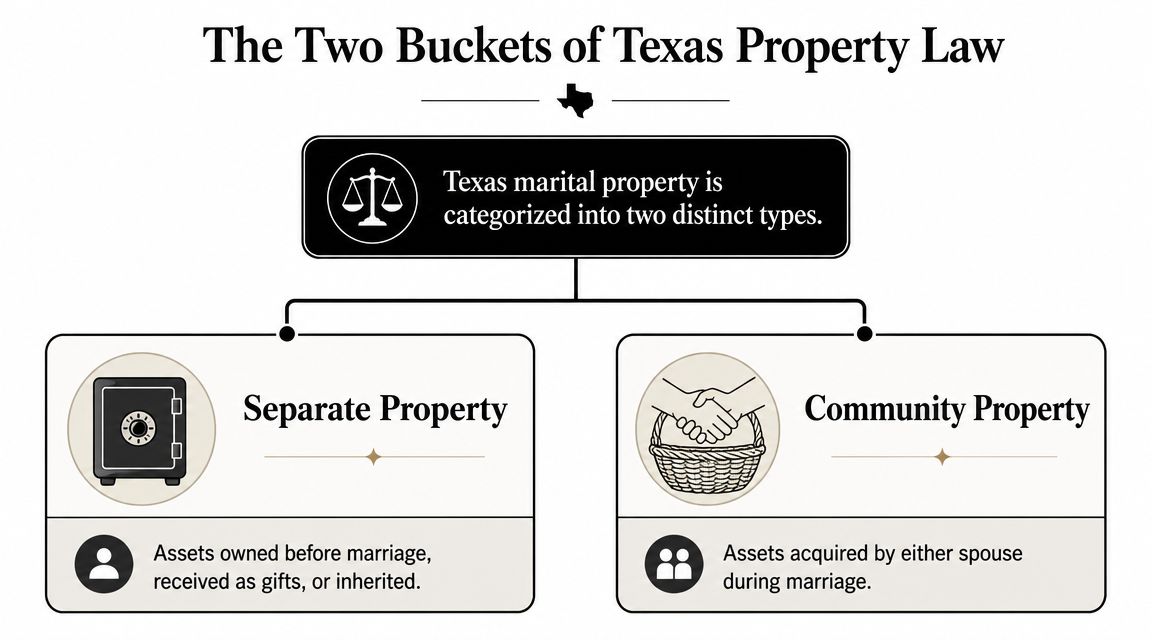
Texas divorce courts first sort property into two buckets. That isn't the legal term, but it's the easiest way to understand the process. One bucket is community property. The other is separate property.
What goes into each bucket
Texas courts classify every asset and debt before any division happens. According to TexasLawHelp's explanation of dividing property and debt in divorce, community property generally includes assets and liabilities acquired during marriage, even if they are titled in only one spouse's name, while separate property generally includes property owned before marriage and property received by gift, devise, or descent.
That means title alone doesn't answer the question. A car in your spouse's name only may still be community property if it was acquired during the marriage. A bank account in your name only may also be community property for the same reason.
Separate property is different. If you owned something before marriage, or received it as a gift or inheritance, that property may be confirmed to you as separate property. The court does not divide separate property in the divorce.
Here's a simple comparison:
| Characteristic | Community Property | Separate Property |
|---|---|---|
| General rule | Usually includes assets and debts acquired during marriage | Usually includes property owned before marriage |
| Title on account or deed | Title alone doesn't control | Title alone doesn't control |
| Examples | Wages earned during marriage, property bought during marriage, debts incurred during marriage | Premarital property, gifts, inheritances |
| Divided in divorce | Yes, subject to court division | No, confirmed to the owning spouse |
| Proof issues | Often presumed to belong to the marital estate | Must be proven if disputed |
The presumption that surprises people
Texas also applies a strong community-property presumption. If property is possessed by either spouse during the marriage or at the time of divorce, the law generally treats it as community unless someone proves otherwise.
That creates a very practical problem. If you say, "That was my inheritance," your statement alone usually won't carry the day. You need records that show where it came from and what happened to it afterward.
A helpful starting point is understanding whether Texas is a community property state. Once you grasp that foundation, many property division disputes make more sense.
Why this first step matters so much
People often want to jump straight to who gets the house or who keeps the retirement account. But the court can't divide anything fairly until it knows which bucket each asset belongs in.
If an asset is proven to be separate property by clear and convincing evidence, the court must confirm it as separate property.
That is why documentation matters so much in a Texas divorce. Deeds, account statements, gift records, and inheritance paperwork often become the difference between keeping a claim and losing one.
Beyond a 50/50 Split The Just and Right Division Standard
Many Texans assume property division means an automatic half-and-half split. That isn't the rule.
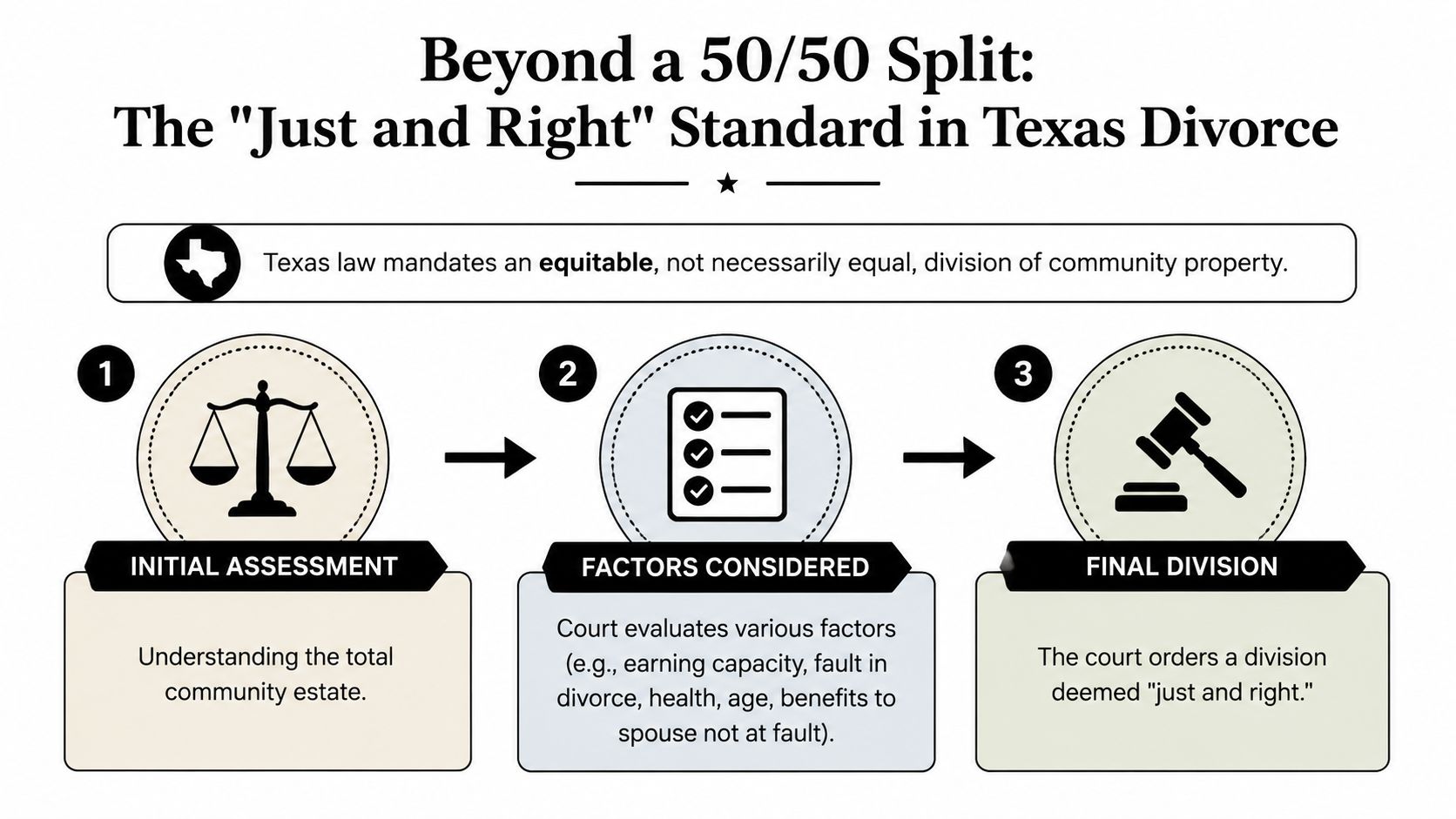
Texas Family Code Section 7.001 uses a just and right standard. In plain language, the court must divide the community estate in a way the judge considers fair under the facts of the case. Fair doesn't always mean equal.
Why unequal divisions happen
Recent Texas appellate discussion confirms that Texas does not require a mandatory 50/50 split. A court may award unequal shares when the facts justify it, and recent reporting notes that Texas courts have upheld divisions where one spouse received about 70% of the community estate in major disputes, as discussed in this Texas divorce property division case analysis.
That doesn't mean every case turns into a fight for a lopsided award. It means the judge has discretion.
A court may look at issues such as:
- Fault in the breakup of the marriage if the evidence supports it
- Differences in earning power between spouses
- Health concerns that affect one spouse's future financial stability
- Fraud or misuse of marital property
- The needs of children
Here is a short overview from a family law video that helps illustrate the concept in everyday terms.
What fair can look like in real life
Suppose one spouse stayed home for years to care for children while the other built a much higher earning capacity. A judge may decide that a strictly equal split would not be just and right if it leaves one spouse at a serious disadvantage.
Or suppose one spouse wasted community funds during the marriage. The court may consider that conduct when deciding how to divide what remains.
A Texas property division is better understood as a fairness analysis than a simple arithmetic exercise.
That matters because strategy changes when you understand the rule. The question isn't only "What do we own?" The question is also "What facts shape a fair result?"
Valuing and Dividing Common Divorce Assets
Once property has been identified, the next problem is practical. What is each asset worth, and how can it be divided?
The answer depends on the asset. A checking account is simple. A house, retirement plan, or closely held business takes more work.

The family home
For many families, the house is the emotional center of the case. It is also one of the largest financial issues.
A few common outcomes include:
- Selling the home and dividing the net proceeds
- One spouse keeping the home and offsetting the other spouse's share with other assets
- A delayed sale arrangement in some family situations, often when children are involved
The right option depends on affordability, mortgage terms, equity, and whether one spouse can realistically refinance.
Retirement accounts and similar assets
Retirement assets often surprise people because they may look untouchable until retirement, yet they can still be part of the property division analysis. In many cases, the portion accrued during the marriage is what matters.
Different plans are handled in different ways. A pension may require more detailed review than a standard IRA. Some employer-sponsored plans also require a separate court order, often called a QDRO, to divide benefits correctly.
Business interests and harder-to-value property
If one spouse owns a business, the case often becomes more technical. The court may need evidence about the company's value, debts, income stream, and whether part of its growth is tied to the marriage period.
That usually means paper records matter more than personal opinions. Tax returns, balance sheets, payroll records, shareholder documents, and expert valuation work can all become important.
Timing can change the outcome
Texas valuation rules can have a major effect on the final result. As explained in this discussion of valuation dates in Texas divorces, property possessed during marriage or at divorce is presumed community, and Texas generally looks to the evidence presented at trial rather than a separation date when valuing community assets. Courts usually value assets as close to trial as possible, though another date may be used to prevent injustice.
That matters when assets rise or fall while the divorce is pending. A retirement account can change. A business can grow. Real estate can move up or down in value.
What clients often miss: Waiting to gather records can make valuation disputes harder, especially when account balances and business performance shift over time.
If your estate includes a home, retirement funds, restricted compensation, or a business, valuation should never be treated as an afterthought.
Proving What Is Yours With Tracing and Characterization
Saying an asset is separate property and proving it are two different things. In Texas divorce cases, proof is often the primary battle.
If the court starts with the presumption that property is community, then the spouse claiming separate property has to overcome that presumption with clear and convincing evidence. In real life, that usually means a solid paper trail.

What tracing means
Tracing is the process of following money or property from its original source to its current form. If separate funds were never mixed with marital funds, tracing may be straightforward. If they were mixed together, the work becomes more detailed.
For example, suppose you received an inheritance during the marriage and deposited it into a joint account. Later, money from that account was used for the down payment on a home. If you want to argue that part of the home is tied to your separate property, you need records showing that path clearly.
Useful records often include:
- Bank statements that show deposits and transfers
- Closing documents from a home purchase or refinance
- Probate or inheritance papers showing where funds came from
- Gift records or letters if a family member gave money to one spouse only
- Account histories that help separate community funds from separate funds
When commingling creates problems
Commingling happens when separate and community funds are mixed together. Mixing does not automatically destroy a separate property claim, but it can make proof much harder.
A simple example helps. If a spouse had savings before marriage, then deposited paychecks, moved money between accounts, paid joint bills, and later claimed that the remaining balance was all separate, the court may need much more than testimony. It may need a full tracing analysis.
Some cases need a forensic accountant. Others can be proven with organized statements and transaction histories. Either way, evidence drives the result.
A deeper look at tracing marital and separate property in Texas divorce can help if your finances were mixed over time.
The best separate property claim is not the most emotional one. It's the one you can document from beginning to end.
Special Claims for Reimbursement and Hidden Assets
Some property disputes aren't just about ownership. They're about fairness when one estate benefited another, or when one spouse wasn't honest.
Reimbursement claims
A reimbursement claim may arise when one estate contributed to another estate in a way that should be recognized. A common example is separate property funds being used to reduce debt on a marital asset or improve it.
Suppose one spouse used inherited money to help pay down the mortgage on the marital home. The home itself may still require its own characterization analysis, but the contributing spouse may also have a reimbursement argument depending on the facts.
These claims are fact-specific. Records matter here too. Payment histories, account statements, loan documents, and proof of the source of funds are often central.
Hidden assets and fraud on the community
Another serious issue is hidden or wasted property. One spouse may transfer money, run up unusual spending, give away assets, or try to keep accounts off the books.
Texas courts can address that kind of misconduct. If a spouse proves that community property was hidden, wasted, or improperly diverted, the court can consider that when crafting a just and right division. In some cases, that may mean awarding a larger share of the remaining community estate to the other spouse.
Signs that deserve attention include:
- Unusual withdrawals from joint accounts
- Missing statements or sudden account closures
- Transfers to friends or relatives without a clear reason
- Business records that don't match reported income
- New debt that appears without explanation
If those issues are present, hidden assets and reimbursement claims in a Texas divorce can become an important part of your case strategy.
You do not have to ignore suspicious financial behavior because a divorce has already started.
Steps to Take Now to Protect Your Property
A lot of property problems in divorce start before anyone gets to court. They start when documents go missing, bills go unpaid, or one spouse assumes they can sort it all out later. In Texas, protecting your property often begins with something much more practical. Build a clear, organized picture of what exists, what is owed, and where the records are.
Start by gathering documents and saving copies in a secure place you control. That usually includes tax returns, bank and retirement statements, deeds, mortgage records, vehicle titles, credit card statements, business records, and any paperwork tied to gifts or inheritances. If property division feels overwhelming, this step helps cut the problem down to size. You are creating a working file, much like putting every puzzle piece on the table before trying to assemble the picture.
Next, make an inventory of every asset and debt you know about. Include the house, vehicles, checking and savings accounts, retirement plans, stock options, credit cards, personal loans, business interests, household items, and work-related benefits. If you are not sure whether something is separate or community property, list it anyway. Classification can be sorted out later. Missing an item is often a bigger problem than listing too much.
Here are a few practical rules that help protect your position early:
- Pause major financial changes. Do not sell property, drain accounts, retitle assets, or make unusual transfers without legal advice.
- Track the monthly money flow. Know which bills are due, which account pays them, and whether anything is past due.
- Protect your digital access. Secure your email, cloud storage, phone backups, and financial logins with updated passwords.
- Keep communication calm and documented. A short written message is often better than a heated phone call when money issues are disputed.
- Choose a process with intention. Some families resolve property issues through informal settlement talks or mediation. Others need temporary orders or a judge to decide disputed issues.
One more practical point matters. Do not rely on memory. A spouse may forget an account, a bonus, restricted stock, or an old debt. Writing things down early gives you a timeline and a checklist. That can make settlement discussions more productive and can also help your lawyer spot gaps, valuation issues, or records that need to be requested.
The goal at this stage is not to win every argument on day one. The goal is to protect information, preserve property, and put yourself in a position to make smart decisions as the case develops.
Frequently Asked Questions About Property Division
How are debts divided in a Texas divorce
Debts are part of the property division process too. The court can assign responsibility for mortgages, credit cards, vehicle loans, tax obligations, and other liabilities as part of the overall division of the marital estate. A debt in one spouse's name only may still matter in the case, depending on when and why it was incurred.
Who pays the mortgage while the divorce is pending
That depends on temporary agreements, temporary court orders, and the family's finances. Until there is a new order or written agreement, missed payments can create bigger problems for both spouses. Protecting credit and preserving the home often requires early planning.
What happens to gifts between spouses during the marriage
This can become fact-sensitive. The key question is usually who received the gift and how it can be proven. Documentation, the source of the gift, and how the property was handled afterward may all matter.
Can one spouse force the other out of the house
Not automatically. Moving out, staying in the home, or obtaining exclusive use often depends on safety concerns, temporary orders, and the facts of the case. If there is conflict in the home, get legal advice before making a move that affects possession, parenting, or finances.
Is settlement better than going to trial
Many families prefer settlement because it gives them more control over the result. Trial may still be necessary when there are major disputes over hidden assets, separate property, valuation, or fairness. The best path depends on the level of trust, the complexity of the estate, and each spouse's willingness to exchange information transparently.
If you need help navigating divorce, custody, or estate planning in Texas, contact The Law Office of Bryan Fagan, PLLC today for a free consultation. A clear review of your assets, debts, records, and goals can help you make informed decisions and protect your financial future.