
Divorce can make ordinary financial details feel loaded overnight. The checking account, the house, the retirement plan, even the car title can suddenly raise the same question: what is community property texas divorce law talking about, and what happens to my property now?
For many people, the hardest part isn't the legal term itself. It's the uncertainty behind it. You may know you owned some assets before marriage, or that one account contains inherited money, but you're not sure how Texas courts will classify it. You may also worry that "community property" automatically means a clean half-and-half split. In Texas, that isn't always how it works.
Understanding Your Financial Future in a Texas Divorce
A common client concern sounds like this: "My spouse and I built a life together, but some of what we have came from my side of the family, some came from my paycheck, and some is all mixed together. How will a court sort that out?" That concern is reasonable. Property division often feels like the most concrete and immediate part of divorce because it affects where you'll live, what resources you'll have, and how stable the next chapter will be.
Texas families deal with these questions every day. Texas's divorce rate has ranged from 1.4 to 1.9 per 1,000 people in recent years, affecting tens of thousands of families annually across major Texas markets such as Houston, Dallas-Fort Worth, and Austin, according to Modern Family Law's summary of Texas family law statistics. That doesn't make your case less personal, but it should reassure you that Texas courts and experienced family law attorneys handle these issues regularly.
The key is to slow the process down and separate it into manageable questions. First, what property counts as community property? Second, what counts as separate property? Third, if something started as separate but later got mixed with marital funds, can you still prove it? And finally, once property is classified, how does a Texas judge divide it?
Practical rule: In a Texas divorce, property division usually turns on documentation, timing, and clear explanations, not just whose name appears on an account or title.
If you're feeling overwhelmed, that's normal. The law is detailed, but it isn't impossible to understand. Once you know the rules and start gathering records, the situation usually becomes much more manageable.
The Foundation Community Property vs Separate Property
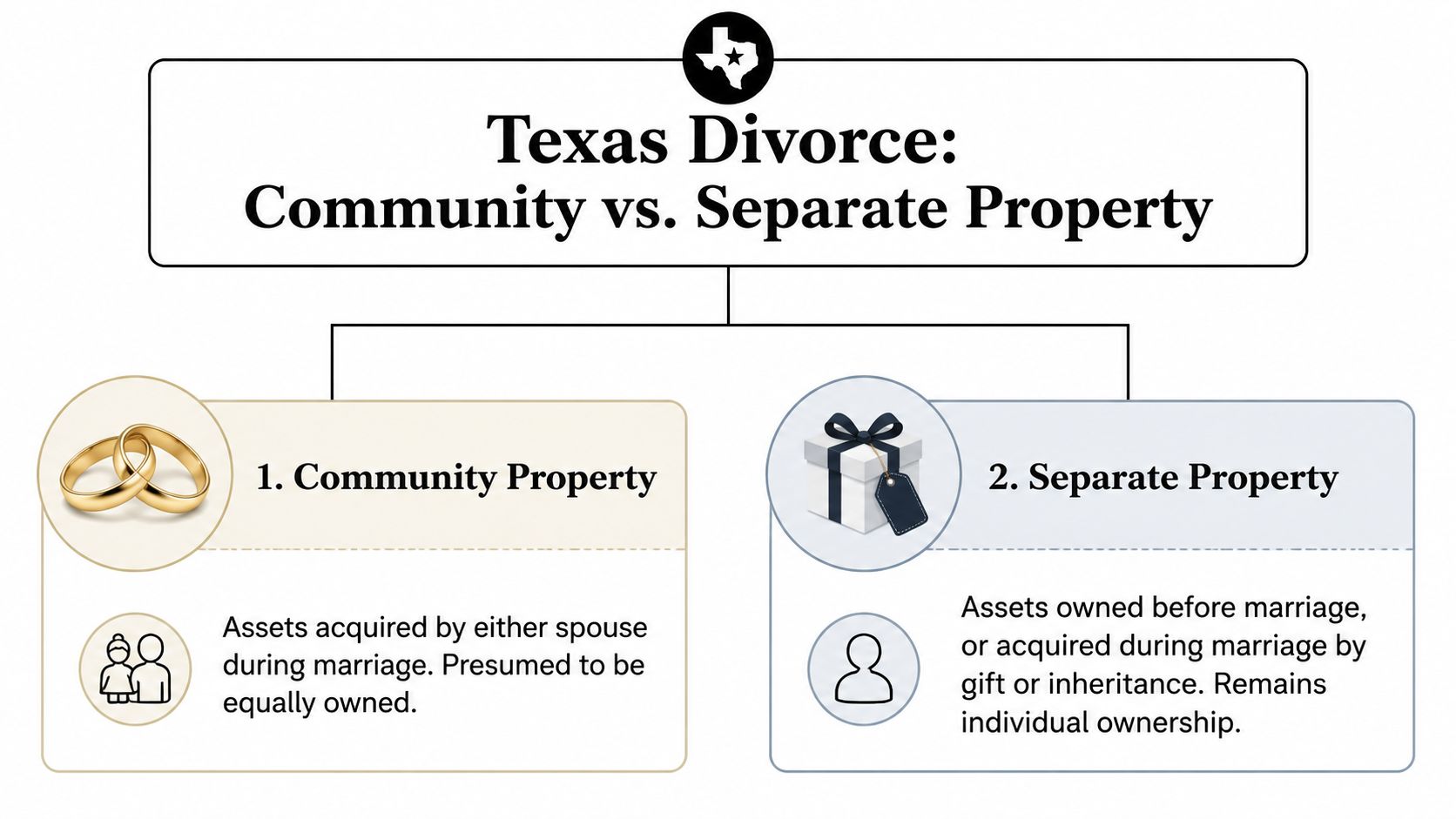
Texas is a community property state. Under Texas law, all property and earnings acquired by either spouse during the marriage are presumed to be community property, subject to a "just and right" division in divorce, and the spouse claiming an asset is separate property has the burden to prove it, as explained by the Texas State Law Library divorce guide.
A simple way to think about this is with buckets. Before marriage, each spouse has an individual bucket. During marriage, Texas law creates a shared bucket. Most property and income acquired during the marriage goes into that shared bucket unless there is a valid reason to classify it as separate.
What community property usually includes
Community property generally includes earnings from work during the marriage and property purchased during the marriage with those earnings. That can include a home, vehicles, savings, retirement contributions earned during marriage, and debts incurred during marriage.
This is why title alone doesn't settle the issue. A bank account in one spouse's name, or a car titled only to one spouse, may still be community property if it was acquired with marital earnings during the marriage.
What separate property usually includes
Separate property generally includes property owned before marriage and some property acquired during marriage by gift or inheritance. Certain personal injury recoveries may also fall into this category under Texas law, depending on what the recovery represents.
The challenge is proof. If you claim something is separate property, you need records that show where it came from and why it stayed separate.
| Asset Type | Community Property Examples | Separate Property Examples |
|---|---|---|
| Earnings and cash | Paychecks earned during marriage, funds saved from marital income | Money owned before marriage, inherited funds kept traceable |
| Real estate | A house purchased during marriage with marital earnings | A home owned before marriage |
| Vehicles | A car bought during marriage | A vehicle owned before marriage or received as a gift |
| Investments | Brokerage contributions made during marriage | An inherited investment account, if it remains traceable |
| Personal property | Furniture purchased during marriage | Jewelry gifted specifically to one spouse |
Many spouses get tripped up on mixed accounts. If inherited money, premarital savings, and marital deposits all pass through the same account, classification gets harder. This is where commingled property in Texas divorce becomes a very practical issue, not just a legal term.
Why this distinction matters so much
A Texas court can divide community property in divorce, but it cannot award one spouse’s proven separate property to the other. So the classification step matters. In many cases, the most important work happens before anyone argues over percentages. It happens when the parties identify what belongs in the marital estate and what does not.
Proving Your Case Exceptions and Tracing Separate Assets
Knowing the rule is one thing. Proving your exception to that rule is another.
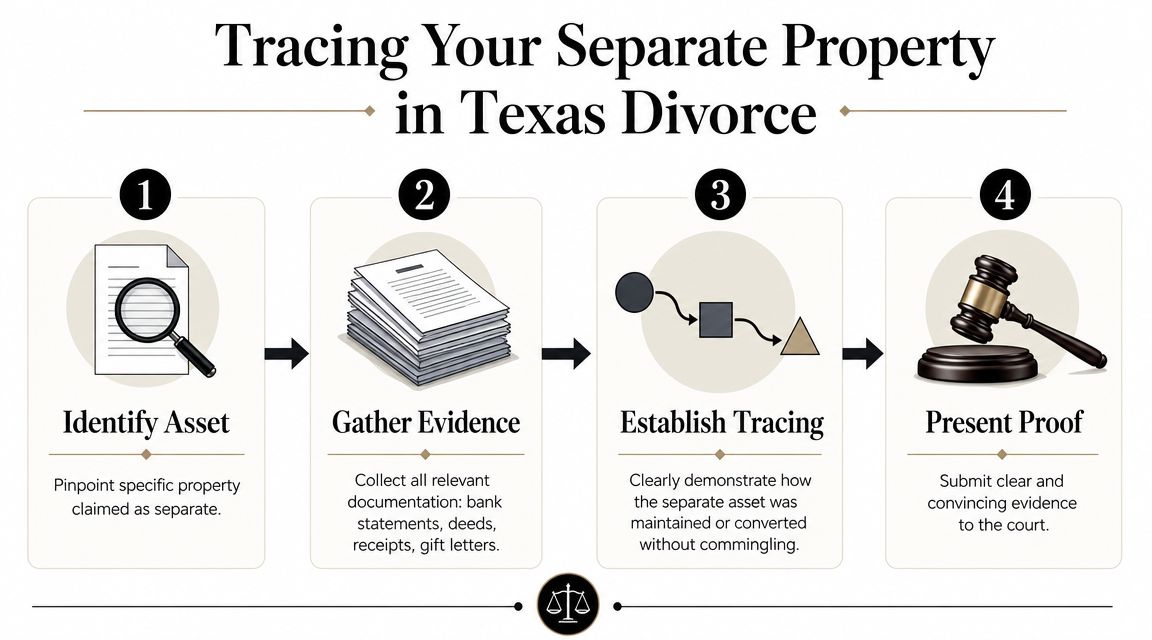
Texas law applies a strong presumption in favor of community property. That presumption can only be rebutted by “clear and convincing evidence,” which means a spouse needs documentation to trace an asset’s separate character, especially when funds have been commingled, as discussed in this Texas divorce property division explanation.
What clear and convincing evidence looks like in real life
In plain language, “clear and convincing” means more than a memory or a sincere statement. A judge usually wants to see records that create a reliable paper trail.
That often includes:
- Bank statements showing when money entered an account and where it came from
- Deeds and closing documents for real estate
- Gift or inheritance records that identify the recipient
- Retirement account statements showing balances before and during marriage
- Business records showing ownership dates and capital contributions
If the records line up, a separate property claim can be strong. If the records are incomplete and the money moved through multiple accounts with marital funds, the claim becomes more difficult.
A tracing example that mirrors real cases
Suppose you inherited money during the marriage. You deposited it into an account in your name. Later, you used part of that money for the down payment on a house. If you want to argue that part of the house should be characterized based on separate funds, you will likely need the inheritance records, the bank records showing the deposit, the statements showing the money remained identifiable, and the closing documents tying those funds to the purchase.
Now change one fact. Suppose the inherited money went into a joint checking account that also received paychecks, paid routine bills, and stayed active for years. The separate property claim may still be possible, but now tracing is far more complex because the court needs a reliable way to distinguish separate funds from community funds.
The more an asset moved, the more your records matter.
When commingling becomes the real problem
Commingling doesn’t automatically destroy a separate property claim. But it can. If separate and community funds are mixed so thoroughly that no reliable tracing is possible, a court may treat the asset as community property for division purposes.
That is why early document gathering matters. You may need:
- Statements from the date of marriage forward
- Documents showing premarital ownership
- Proof of gifts or inheritance
- A timeline of transfers between accounts
- Supporting records for major purchases
In more complicated cases, spouses and attorneys may work with financial professionals to prepare tracing analyses. For a deeper look at that process, this guide to tracing marital and separate property in a Texas divorce can help you understand the type of record reconstruction that may be involved.
Common misunderstandings about separate property
People often assume these statements are enough: “I had it first,” “my name is on it,” or “my family gave it to me.” Sometimes those facts help. By themselves, they usually don’t end the analysis.
A stronger approach is to think like an auditor. Where did the asset come from? When was it acquired? Did marital money contribute to it? Did the records preserve the story from start to finish? If you can answer those questions with documents, your position is much stronger.
The Division Process More Than Just a 50/50 Split
One of the most common misunderstandings in Texas divorce is that community property must be split equally. Texas law doesn’t require that result.
Under Texas Family Code § 7.001, courts divide community property in a manner that is “just and right.” As explained in this Texas community property overview, judges may consider factors such as fault, children’s needs, and earning capacity, and may award a disproportionate share, including a split such as 60/40 in an appropriate case. The same source also notes that retirement accounts earned during marriage are community property and often require a QDRO to divide.
What just and right means in practice
“Just and right” gives the court flexibility. A judge doesn’t look only at the asset list. The judge also looks at the people involved and the circumstances they will face after divorce.
Factors can include:
- Children’s needs: If one parent will carry more day-to-day responsibilities, that may affect the division.
- Earning capacity: A spouse with less ability to earn income may argue for a larger share of the community estate.
- Fault in the breakup: In some cases, marital misconduct may be raised as part of the property division discussion.
- Future financial stability: Courts can consider whether one spouse will leave the marriage with fewer resources or heavier burdens.
Key takeaway: Community property describes what goes into the divisible estate. It does not guarantee an equal result when the estate is divided.
How courts think about assets and debts together
People often focus on assets and forget debts. But the division process usually involves the full financial picture. That means identifying what exists, determining whether it is community or separate, assigning values, and then allocating both assets and liabilities in a way the court considers fair.
A simple example helps. One spouse may receive more equity in a house, while the other receives more retirement funds or cash accounts. A judge may also allocate debt in a way that balances the overall division. The analysis is broader than who gets one item.
Retirement accounts need special attention
Retirement assets often surprise people because they can feel personal, especially if they are tied to one spouse’s job. But if the retirement benefits were earned during the marriage, the marital portion may be community property.
Dividing certain retirement plans often requires a Qualified Domestic Relations Order, commonly called a QDRO. That document directs the plan administrator on how to divide the account consistent with the divorce decree. If a decree says a retirement account will be divided, but the paperwork isn’t handled correctly afterward, problems can follow.
If you’re trying to understand how fairness arguments work in real cases, this guide to just and right property division in Texas divorce settlements explains the practical side of presenting those issues.
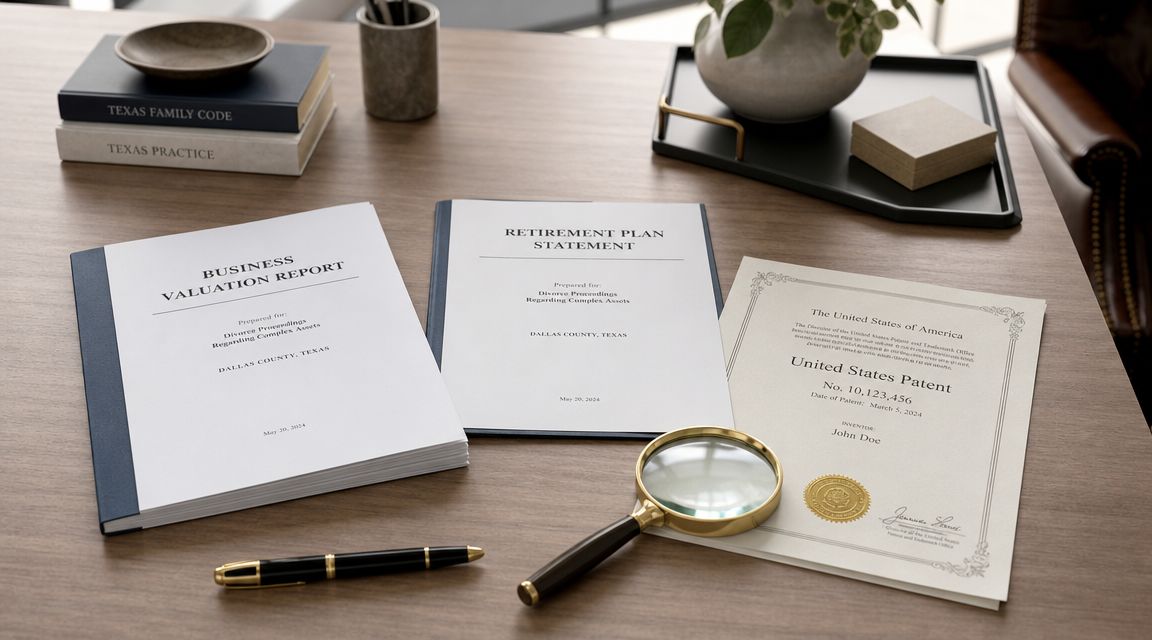
Some assets don’t fit neatly into everyday examples. They require more careful review because classification, valuation, and division can all become more technical.
Businesses and professional practices
A business interest often raises several separate questions. Was the business started before marriage or during marriage? Did community labor or community funds contribute to its growth? Are the books clean enough to separate personal and business transactions?
In these cases, valuation becomes just as important as classification. A business may be separate in origin but still involve reimbursement issues or disputes about the marital effort invested into it. Accurate records, tax returns, operating agreements, and payroll information often matter a great deal.
Retirement plans and pensions
Retirement accounts tend to involve timing. Part of an account may have been earned before marriage, with additional contributions or growth during marriage. That means one account can contain both separate and community components.
The legal rule may sound simple, but implementation can be detailed. Pension division orders, QDROs, and plan-specific language often need careful drafting so that the final paperwork matches the decree.
Real estate inside and outside Texas
Texas courts regularly deal with houses, rental property, and land. Real estate located outside Texas can create extra logistical issues, but the same property-characterization principles still matter. The first questions remain familiar: when was it acquired, how was it funded, and what records support its classification?
If a home was owned before marriage, later refinanced, improved, or paid down with marital earnings, the separate-versus-community analysis may become layered. The title document is important, but it usually isn’t the only document that matters.
A short overview like this can help frame the issue before you speak with counsel:
Military benefits and compensation structures
Military divorces can involve retirement benefits, service-related timelines, and benefits that require careful coordination with both state and federal rules. The same is true for stock options, deferred compensation, and executive pay structures. These aren’t impossible to divide, but they usually require closer review of grant dates, vesting schedules, and plan documents.
When special assets are involved, a clean inventory is essential. You need to know what exists, what documents govern it, and whether an additional order or valuation process will be required before the divorce can be fully carried out.
Practical Steps to Protect Your Property Rights
A common problem starts like this. One spouse says, “That brokerage account was mine before we got married.” The other spouse responds, “Then show me.” In Texas divorce cases, property rights often turn on what you can prove on paper, not what you clearly remember.

The safest approach is to treat your records like a timeline. If separate property is the starting point, tracing is the path that connects that starting point to the asset you still hold today. Once deposits, refinances, rollovers, or account transfers enter the picture, that path can become hard to follow unless you build it carefully.
A short checklist you can start today
-
Gather the oldest records first. Start with statements or closing documents from around the date of marriage, and then work forward. For claimed separate property, the earliest available record often matters more than the newest one.
-
Build a dated inventory of assets and debts. Include bank accounts, retirement funds, real estate, vehicles, credit cards, loans, business interests, insurance policies, and valuable personal property. Add the date acquired, whose name is on it, and what documents support its classification.
-
Flag tracing issues early. If an account existed before marriage but received paycheck deposits during marriage, mark it for closer review. The same is true for homes owned before marriage that were later refinanced, improved, or paid down with marital income.
-
Freeze casual financial changes. Avoid large transfers, unusual withdrawals, retitling property, or paying one debt from a different account without legal advice. Small moves can create big tracing problems later.
-
Download and preserve digital records. Many banks and investment platforms keep only limited online history. Save PDFs, back them up securely, and organize them by account and date.
-
Ask for targeted legal advice, not just general advice. You may need a tracing analysis, temporary orders to prevent account changes, or a valuation plan for a business or compensation package. The Law Office of Bryan Fagan, PLLC handles Texas divorce property division matters involving community property, separate property, and asset characterization.
Bring records in chronological order to your first attorney meeting. That simple step helps your lawyer see gaps, follow money between accounts, and spot where a separate-property claim may need stronger proof.
Focus on proof, not labels
Titles and account names can be misleading. An asset in one spouse’s name may still be community property, and a premarital asset can lose clarity if it was mixed with community funds without a clean paper trail.
A useful question is this: can a stranger look at your records and follow the story from beginning to end? If the answer is no, your next job is to fill the gaps before settlement talks or court deadlines put you under pressure.
What not to do
Do not hide assets, rely on memory, or assume the court will sort everything out later. Do not wait until mediation week to start collecting statements.
Early organization gives your attorney more than convenience. It gives you better arguments on tracing, a clearer response if your spouse asks for an unequal division, and a stronger position if the court must decide what is just and right.
Frequently Asked Questions About Property Division in Texas
What if I think my spouse is hiding assets
That concern comes up often. Hidden assets may show up through account statements, tax records, business records, or discovery requests in the divorce process. If something doesn’t make sense, say so early. Waiting can make the problem harder to untangle.
Does a premarital agreement change the analysis
It can. A valid premarital agreement may define what remains separate property, how certain property will be treated during marriage, or how property will be handled in divorce. The agreement needs to be reviewed alongside the financial records because the contract and the actual handling of assets both matter.
Does it matter who earned more money
Yes, it can matter. Not because the higher earner automatically keeps more, but because earning capacity may be one of the circumstances considered when arguing for a just and right division. A spouse who paused a career to care for children may have a different financial outlook after divorce than a spouse with ongoing high income.
If my name is the only one on an asset, is it mine alone
Not necessarily. In Texas, property classification usually depends more on when and how the asset was acquired than whose name appears on the paperwork. Title is relevant, but it usually isn’t the full answer.
Can separate property ever become difficult to protect
Yes. The biggest risk is poor recordkeeping. If separate funds are mixed with marital funds and the paper trail disappears, proving the separate claim becomes much harder. That’s why tracing is so important in real cases.
If you need help navigating divorce, custody, or estate planning in Texas, contact The Law Office of Bryan Fagan today for a free consultation.
If you’re facing questions about what is community property texas divorce law, and you want advice specific to your records, assets, and goals, schedule a free consultation with the Law Office of Bryan Fagan, PLLC. Clear answers early can help you protect your rights and make sound decisions for your next chapter.