
Divorce can be one of life's hardest transitions. If you've just been handed divorce papers, you may feel shocked, angry, or too overwhelmed to know what to do first.
Start with this: being served does not mean you've lost control. It means a legal process has started, and your next steps matter. If you understand how to respond to divorce petition texas cases the right way, you can protect your voice in decisions about property, children, support, and day-to-day stability.
You've Been Served Divorce Papers in Texas Here's What to Do First
Individuals often look at the packet, flip to the last page, and then freeze. That reaction is normal. The problem is that divorce procedure in Texas keeps moving whether you feel ready or not.
The first document to identify is usually the Original Petition for Divorce. That pleading tells you what your spouse is asking the court to do. Read it slowly. Look for requests about property division, debt, conservatorship of children, possession schedules, child support, spousal support, protective language, or a name change.
Then find the date you were served and write it down in more than one place. Texas guidance is clear that once served, the respondent should immediately calendar the service date, and the formal Answer deadline is 10:00 a.m. on the Monday after 20 days have elapsed from service. Missing it can trigger a default judgment, allowing the court to decide property, debt, and child-related issues without your input, as explained by the Texas State Law Library divorce answer guide.
Your first priorities in the next day or two
You do not need to solve the whole divorce immediately. You need to do the right first things.
- Confirm the service date: Use the exact date you received the papers through formal service.
- Read every page: Many people focus only on the petition and miss attached orders or notices.
- Watch for immediate restrictions: Some counties use standing orders, and some cases include temporary orders that affect conduct right away.
- Preserve documents: Gather account statements, tax returns, pay records, mortgage information, and anything related to the children's schedule.
Practical rule: Don't treat the papers as a relationship document. Treat them as a court deadline.
If you want a practical overview of service and what it means, this Bryan Fagan article on being served and responding in Texas is a useful starting point.
Calculating Your Response Deadline in a Texas Divorce
The most important early task is calculating your deadline correctly. In Texas, the legal deadline for responding to a divorce petition is 10:00 a.m. on the first Monday after 20 days from the date of service, and missing it can lead to a default judgment where the court may grant the petitioner's requests without your participation, as described in this Texas divorce response deadline explanation.
That deadline sounds simple until someone miscounts. I've seen people assume they have exactly 20 days. They don't. I've also seen people assume weekends don't count. They do.
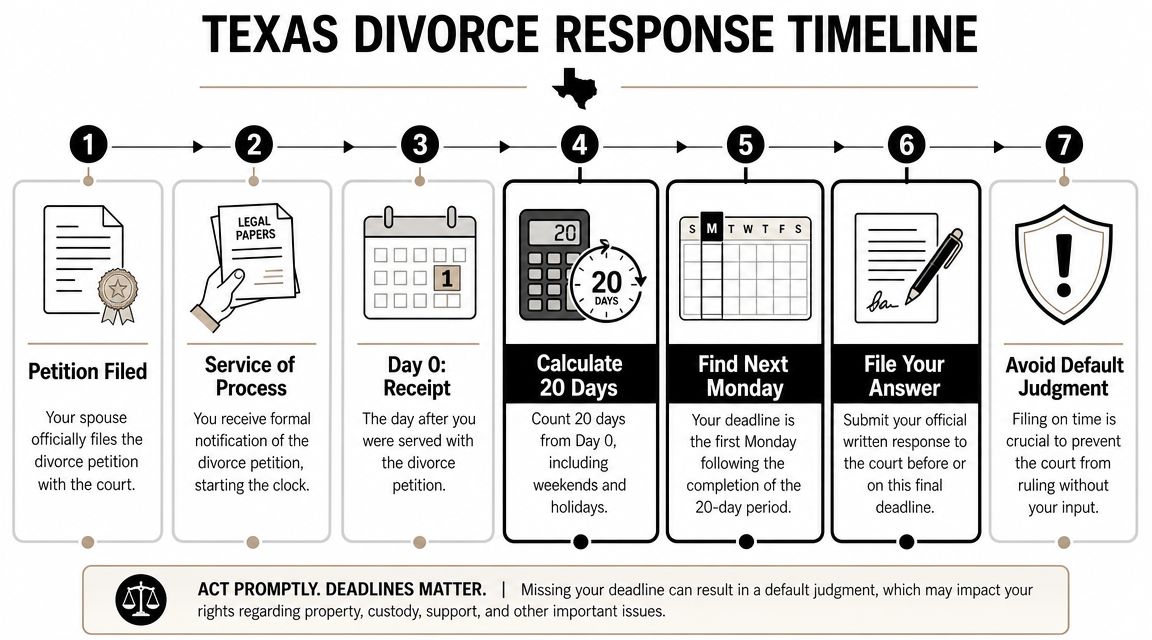
How the counting works
Use this approach:
- Start with the date of service. That is the anchor date.
- Count 20 calendar days. Include weekends and holidays.
- Find the next Monday. Your Answer is due by 10:00 a.m. on that Monday.
- If day 20 lands on a Monday, the deadline moves to the following Monday.
That last point trips people up. Many respondents think a Monday day-20 means the filing is due that same day. It isn't.
A practical example
Assume you were served on a Wednesday. Count forward 20 calendar days, including Saturday and Sunday. Once you reach day 20, look to the next Monday on the calendar. That Monday at 10:00 a.m. is your deadline.
The reason this matters is simple. If you miss the deadline, your spouse can try to move the case forward without your participation. That can affect issues that matter greatly, including who keeps certain property, who takes responsibility for debts, and what arrangement is proposed for the children.
Missing the Answer deadline is one of the easiest mistakes to make in a Texas divorce, and one of the hardest to fix later.
What works and what does not
A few habits help.
- What works: putting the deadline in your phone, on a paper calendar, and in an email reminder to yourself
- What works: preparing the Answer before the final week
- What works: checking the petition caption so your filing matches the right court and cause number
What does not work is relying on memory, assuming your spouse will “hold off,” or thinking an informal text exchange changes the court's rules.
Why this deadline deserves your full attention
Early divorce strategy often gets framed as a debate about custody, property, or settlement posture. Those questions matter, but they come after one basic reality. If you don't preserve your right to participate, strategy becomes much harder.
That is why people searching for how to respond to divorce petition texas should focus first on the deadline, not the drama. Procedure comes first. Then substance.
Choosing Your Response Strategy Answer, Waiver, or Counter-Petition
Once you know your deadline, the next question is strategic. How should you respond?
Many people assume there is one standard form and one standard answer. In practice, your choice depends on whether you want only to preserve your right to participate, whether you already agree on everything, or whether you need to ask the court for your own relief.
TexasLawHelp notes that a common strategic question is whether to file an answer or a waiver, and while a waiver may seem simpler in amicable cases, filing an Answer is often the safer route because it preserves your right to participate without escalating conflict and protects you from default if negotiations break down. You can still settle later after filing an Answer, as explained in this TexasLawHelp guide for spouses served with divorce papers.
Comparing Your Texas Divorce Response Options
| Response Type | Purpose | Best For… | Key Risk |
|---|---|---|---|
| Respondent's Original Answer | Tells the court you intend to participate | Most respondents, especially when facts are still developing | It protects participation, but it doesn't ask for your own affirmative relief |
| Waiver of Service | Acknowledges the case without formal service in limited cooperative situations | Very narrow cases where both spouses are fully aligned and documents are carefully reviewed | You may give up practical protections if you sign too quickly |
| Counter-Petition | Lets you ask the court for your own requested outcomes | Cases involving disputes over children, support, property, or possession of the home | If you skip it when needed, the court may not have your affirmative requests clearly before it |
Why an Answer is usually the safest first move
An Answer is often a short filing. In many cases, it functions as a general denial. That doesn't mean you are denying the marriage exists or denying that a divorce will happen. It means you are not conceding every allegation or requested term in the petition.
That distinction matters. Filing an Answer usually lowers your risk without forcing the case into unnecessary conflict. It keeps you in the room.
When a waiver looks simple but isn't
A Waiver of Service can make sense in a narrow set of agreed cases. But people often sign waivers because they want to be cooperative, not because the legal posture is safe.
That is where mistakes happen. If you are still negotiating property terms, parenting terms, or support, a waiver can leave you with less protection than you think. This Bryan Fagan article on whether you should sign a waiver of service in Texas walks through that trade-off in more detail.
Cooperation is good. Giving up procedural protection too early usually isn't.
When you need a counter-petition
A Counter-Petition is different from an Answer. It is how you ask the court for your own relief. If you want a different custody arrangement, a different possession schedule, a different position on support, or a specific request regarding property, that usually belongs in a counter-petition.
Here is the practical distinction:
- Answer: “I'm participating.”
- Counter-Petition: “Here is what I am asking the court to do.”
If your spouse's petition broadly asks for relief but does not reflect your goals, a simple Answer may be incomplete as a strategy. That is especially true in cases involving children, a home, retirement assets, a family business, separate property claims, or disputed debt.
A simple way to decide
Ask yourself three questions:
- Do I need immediate protection from default? If yes, an Answer is usually the first move.
- Do we agree on every material issue? If not, be careful about waivers.
- Do I want the court to award terms that differ from the petition? If yes, discuss a counter-petition promptly.
The strongest early response is often not just paperwork. It is the right paperwork for your situation.
How to Prepare and File Your Divorce Response
A missed deadline is not the only problem I see. I also see people file the wrong document, leave out a request that matters, or assume the court will sort out their side later. Your response should do more than prove you showed up. It should protect your position from the start.

Prepare the right document carefully
Start with the petition in front of you. The court, county, cause number, and party names in your response need to match the petition exactly. Small caption errors create avoidable filing problems, and avoidable problems cost time.
Then read the petition line by line with one practical question in mind: what, exactly, am I agreeing to if I stay silent on this point? That question helps you spot the difference between routine background allegations and requests that can affect possession of the children, support, debt, the house, or retirement accounts.
Create a short working list as you review:
- Agreed items: statements or requests you do not dispute
- Disputed items: custody terms, possession schedules, support, property division, debt allocation
- Missing issues: anything you want addressed that does not appear in the petition
That list matters because filing strategy and case strategy are connected. An Answer helps prevent a default. A Counter-Petition tells the court what outcome you want. If your spouse's petition asks for terms that do not reflect your goals, your paperwork should say so clearly.
The outside article already linked earlier on divorce response strategy covers that broader choice in more detail, so I will keep the focus here on preparing the filing correctly.
Filing mechanics matter
Many Texas divorce responses are filed electronically. If you are handling this yourself, slow down and check each field before you submit. The filing system will not protect you from using the wrong cause number, selecting the wrong document title, or uploading an incomplete file.
Use this checklist before you file:
- Match the caption exactly: Use the same party names, court, county, and cause number listed on the petition.
- Title the document correctly: Label it as an Original Answer, Counter-Petition, or other filing that fits what you are submitting.
- Review signatures and service language: Make sure the document is signed and includes the required certificate of service if applicable.
- Check readability: Confirm every page is legible and complete before uploading.
- Send notice to the other side: After filing, provide a copy to your spouse or the lawyer representing your spouse.
If you are filing your first response on your own, keep the goal narrow. Get the correct document on file, on time, and in the right court. Then get legal advice quickly if the case involves children, real property, retirement accounts, separate property claims, business interests, or a spouse who is already asking for temporary relief. The Law Office of Bryan Fagan, PLLC handles divorce responses, temporary orders, custody disputes, and property division cases in Texas.
Filing is only part of the job
Once the response is filed, start collecting the records your case will turn on. Judges make decisions from evidence, not from general frustration or broad claims that something feels unfair.
Focus on the documents that usually matter early:
- Recent pay stubs and tax returns
- Bank, credit card, and loan statements
- Retirement and investment account records
- Mortgage, lease, vehicle, and insurance documents
- School, daycare, medical, and possession schedule information for the children
If temporary orders are likely, organize these records now, not the night before the hearing. This overview of what happens at a Texas divorce temporary orders hearing will give you a clearer sense of what the court usually wants to see.
A short explainer on the response process can help if you want to see the basics in video form:
What filing should accomplish
A good response does two things. It preserves your right to participate, and it sets up the issues you may need to fight about later. That is the strategic reason to take this step seriously. The form matters, but the thinking behind the form matters just as much.
Protecting Your Rights with Temporary and Emergency Orders
Some divorce problems cannot wait for final orders. If one spouse is threatening to empty accounts, cut off access to funds, pull a child out of school, or lock the other spouse out of the house, the right response is not “let's deal with that later.”
Significantly, temporary orders matter. They create structure while the divorce is pending and can stabilize daily life quickly.

What temporary orders can address
Temporary orders often deal with the issues that create the most pressure at the beginning of a case.
- Children: temporary conservatorship, possession, exchange terms, school decision structure
- Money: temporary child support, temporary spousal support, responsibility for bills
- Property: who stays in the house, who uses a vehicle, who has access to certain accounts
- Conduct: restrictions against hiding property, disturbing the peace, or disrupting the children's routine
In many counties, standing orders may already impose automatic rules about finances, property transfers, and conduct. Those orders are easy to overlook, but judges expect compliance whether or not a party read them carefully.
Why early action often changes the case
Temporary orders are not just paperwork. They shape the next phase of the divorce.
If the children start following a temporary schedule, that arrangement often becomes the day-to-day reality while the case moves forward. If one spouse controls the bills and bank access without clear court direction, that financial pressure can distort settlement discussions.
Early orders don't decide every final issue, but they often shape leverage, routine, and expectations.
That is why waiting can be expensive in ways people don't expect. Not just financially, but emotionally and practically.
When emergency relief may be necessary
Some situations call for fast action. Common examples include a spouse threatening to remove a child, dispose of property, or interfere with access to records or funds.
If your case is moving toward a temporary orders hearing, it helps to prepare with documents, a clear list of requested relief, and a realistic explanation of what the household needs right now. This Bryan Fagan article on what happens at a Texas divorce temporary orders hearing gives a practical look at that process.
What works at this stage
The strongest requests are specific. Judges respond better to “I need an order allocating who pays the mortgage and setting an exchange schedule for the children” than to broad statements that the other spouse is being unfair.
Bring organization to the hearing. Courts want facts, documents, and workable proposals.
After You've Responded What Happens Next?
Filing your response is a major step, but it is the beginning of the case, not the end. Once the response is on file, the focus shifts from preserving rights to moving the divorce toward temporary arrangements, information exchange, negotiation, and, if needed, trial preparation.
Texas law imposes a mandatory 60-day waiting period before any divorce can be finalized, and that period starts on the day the original petition is filed. Even if a respondent does not answer and a default judgment is pursued, the court still cannot sign the final decree until that period has passed, as explained in this discussion of Texas divorce timing and unresponsive spouses.
What usually follows
Most cases move into a few familiar phases.
- Information gathering: each side collects financial records, property documents, and child-related information
- Temporary arrangements: if needed, the court enters orders that govern daily life during the case
- Negotiation and mediation: many divorces resolve through structured settlement discussions rather than a final trial
- Final paperwork or trial setting: either the parties sign a decree or prepare for the court to decide unresolved issues
When self-help stops being a good idea
Some people can file an initial Answer on their own. Fewer people should handle the entire case without legal guidance.
You should strongly consider hiring a Texas family law attorney if your case involves:
- Contested child custody
- A business or complex property division
- Separate property claims
- Retirement issues
- Interstate concerns
- Family violence or safety concerns
- A spouse who is hiding information or controlling finances
The right time to get legal help is usually before the case becomes harder to unwind.
If you need help navigating divorce, custody, or estate planning in Texas, contact Law Office of Bryan Fagan, PLLC today for a free consultation. A calm, informed response at the beginning of a divorce can protect your rights, reduce avoidable mistakes, and put you in a far better position for the decisions ahead.