
The house feels different when one parent moves out. Maybe it’s quieter. Maybe it’s tense. Maybe your child keeps asking the same question at bedtime: “Where am I going to live?” In the middle of packing boxes and sorting through emotions, you may find yourself searching for answers about what comes next in court. What happens at a Texas Divorce temporary orders hearing often determines who stays in the family home, how parenting time is structured, and how financial responsibilities are handled while the divorce moves forward.
For many Texas families, this hearing is the first time a judge creates formal rules during a deeply uncertain season. Under Texas Family Code §153.002, courts must prioritize the best interest of the child when making decisions about conservatorship and possession. Temporary orders entered under §§6.502 and 105.001 can address everything from child support to exclusive use of property. While these orders are not final, they establish patterns that courts frequently maintain through the conclusion of the case because stability matters.
At The Law Office of Bryan Fagan, PLLC, we understand that behind every legal issue is a family trying to protect what matters most. Founded by Bryan Joseph Fagan, a South Texas College of Law graduate and recognized authority in Texas divorce and custody law, our firm has guided thousands of families through temporary orders hearings across Houston and throughout Texas. We have seen how preparation, clarity, and steady counsel can transform anxiety into confidence.
Our mission is to empower people to reclaim freedom and peace of mind during life’s hardest transitions. We do that by combining compassionate guidance with precise legal strategy, helping you understand not just what the court may decide, but how those decisions shape your daily life.
In the sections ahead, you’ll learn what truly happens at a Texas Divorce temporary orders hearing, how Texas judges evaluate custody and financial issues, and what practical steps you can take to protect your future. When you understand the process, uncertainty gives way to clarity — and clarity restores control.
Key Takeaways
- Temporary orders establish interim rules for custody, support, and finances that remain in effect until your final divorce decree is signed—they are not permanent decisions.
- Under Texas law, judges prioritize the best interest of the child when making custody and possession decisions at temporary orders hearings.
- The arrangements established in temporary orders in Texas often influence final outcomes because judges value stability and proven patterns.
- Preparation matters significantly—gathering financial records, organizing testimony, and working with an experienced attorney can make all the difference in your hearing’s outcome.
- Temporary restraining orders and injunctions may be issued to protect property, children, and safety during the divorce proceeds.

Your Family’s Future Starts Here
Don’t navigate your legal journey alone. Schedule a consultation now and get the clarity and support you deserve.
What Happens at a Texas Divorce Temporary Orders Hearing? The Short Answer
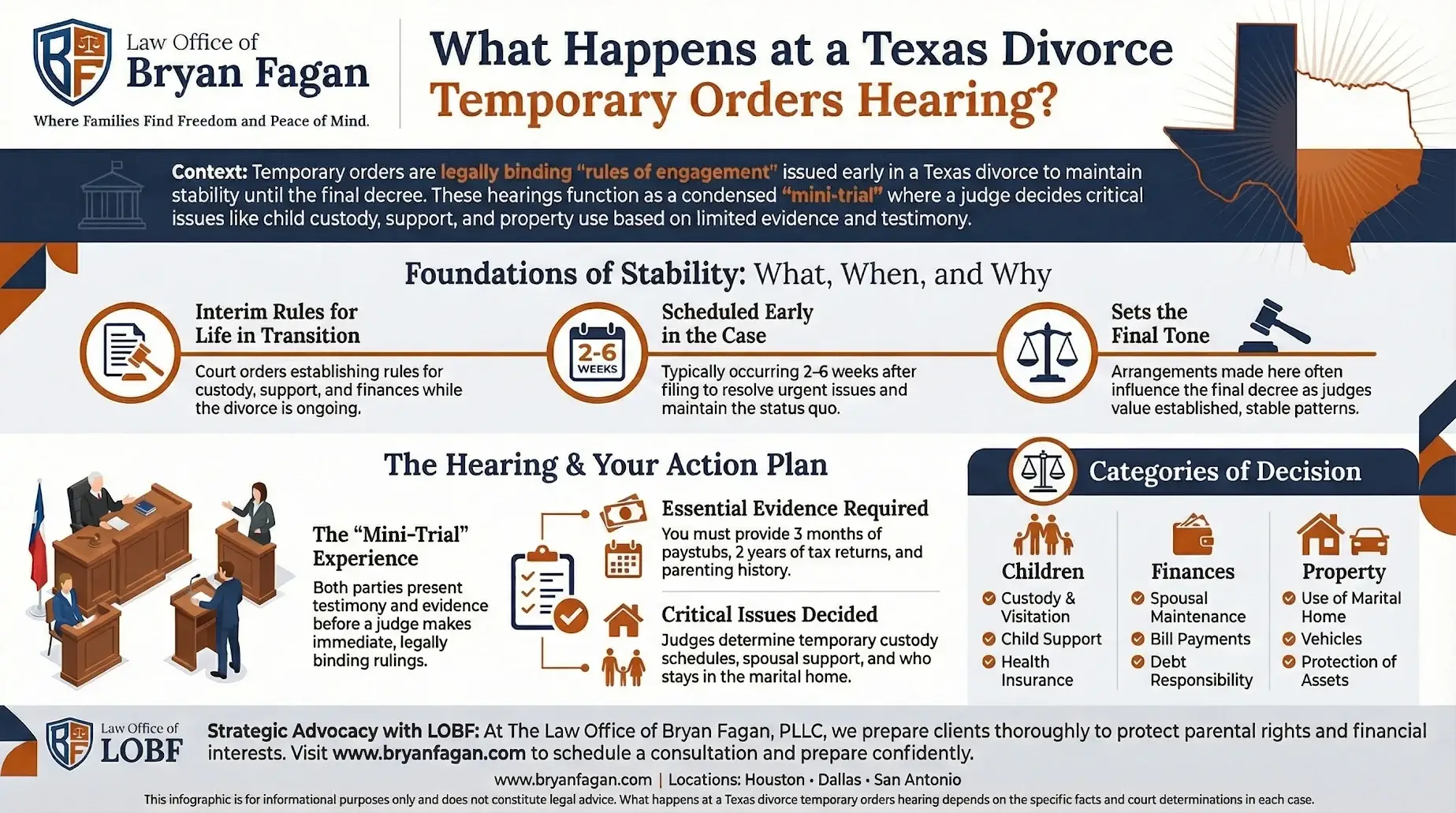
When families ask What happens at a Texas Divorce temporary orders, they are really asking how the court will bring order and stability to a season that often feels uncertain. At a temporary orders hearing, the judge establishes interim rules governing conservatorship, possession schedules, child support, spousal maintenance, use of property, and responsibility for debts. Under Texas Family Code §105.001 and §6.502, courts have broad authority to issue temporary orders designed to protect children and preserve the marital estate while the divorce is pending. In custody matters, Texas Family Code §153.002 requires judges to prioritize the best interest of the child, and §153.134 outlines how rights and duties—such as the exclusive right to designate a child’s primary residence—may be allocated. These early decisions are grounded in evidence, including sworn testimony, financial disclosures, and documentation of each parent’s involvement in the child’s life.
Temporary orders are not suggestions—they are enforceable court directives that typically remain in place for six to eighteen months, until a final decree is signed. Courts expect compliance, and violations may result in enforcement actions under Chapter 157 of the Texas Family Code, including contempt proceedings. Because judges value stability, the arrangements established during this phase often influence final outcomes. That is why thoughtful preparation, accurate financial information, and a clear parenting proposal are so important. For a deeper understanding of the process, you can review the firm’s detailed guide on temporary orders hearings in Texas, which explains what to expect and how to prepare effectively.
The attorneys at the Law Office of Bryan Fagan help clients approach this stage with clarity and confidence. By combining practical legal strategy with compassionate communication, our team ensures that temporary orders protect your children, safeguard your finances, and position you for long-term success. Getting these orders right matters because they shape daily life while your divorce moves toward resolution—and with the right guidance, that structure can provide peace of mind during a difficult transition.

What Are Temporary Orders in a Texas Divorce?
When families begin asking What happens at a Texas Divorce temporary orders, they are often surprised to learn how quickly the court can step in to create structure during an otherwise uncertain time. Temporary orders are court-issued directives that take effect while your divorce is pending and automatically terminate when the final decree is signed. Because Texas does not recognize legal separation, spouses remain legally married until the divorce is finalized. That legal reality creates a gap where clear rules are necessary to protect children, finances, and property.
These orders address immediate concerns that cannot wait months for trial. Who will remain in the marital residence? How will parenting time be structured under the best interest standard in Texas Family Code §153.002? Who will pay the mortgage, utilities, or temporary child support calculated under the updated guidelines in §154.125, including the revised net resource cap effective September 2025? Without judicial guidance, one party could restrict access to children, delay financial support, or dissipate community assets governed by Chapter 7 of the Texas Family Code. Temporary orders are designed to prevent that instability.
The court’s authority to issue these directives comes from Texas Family Code §§6.501 and 6.502, which empower judges to preserve the marital estate and protect the parties during litigation. For matters involving children, §105.001 grants courts broad discretion to establish temporary conservatorship arrangements, possession schedules, and support obligations. These provisions reflect the Legislature’s emphasis on maintaining stability and safeguarding children during family transitions.
Unlike final divorce decrees, temporary orders generally cannot be appealed through traditional appellate channels. Judges are afforded substantial discretion in crafting practical solutions tailored to the family’s circumstances. That discretion makes preparation critical. Organized financial disclosures, credible testimony, and a thoughtful parenting proposal often shape outcomes more than emotion or argument alone. For a deeper look at how these hearings unfold, we encourage you to review our guide on what to expect in a temporary orders hearing in Texas and explore our broader Texas divorce resource center for practical insight.
At The Law Office of Bryan Fagan, our legal team approaches temporary orders with both precision and compassion. We understand that these are not just procedural steps—they determine where children sleep, how bills are paid, and how stability is preserved during one of life’s most challenging seasons. By combining education with strategic advocacy, we help families protect their futures while navigating the legal realities of divorce with clarity and confidence.
When Does a Temporary Orders Hearing Occur?
A temporary orders hearing occurs after you file your Original Petition for Divorce and a Motion for Temporary Orders. Most Texas counties require 10-14 days’ notice before the hearing date, meaning you typically appear in court two to six weeks after filing.
Emergency situations change this timeline dramatically. If family violence, child endangerment, or asset dissipation threatens immediate harm, you may obtain a Temporary Restraining Order (TRO) without the other spouse present. Under Texas Family Code §6.503, these ex parte orders convert to full temporary orders within fourteen days at a follow-up hearing.
In Harris County, Texas district courts average 14-30 days from filing to hearing for non-emergency matters. Bexar County may require mediation first. Collin County sometimes limits arguments to thirty minutes per side. Understanding your local court’s practices helps you prepare appropriately.
Issues Decided at a Texas Divorce Temporary Orders Hearing
Temporary orders address nearly every aspect of family life during divorce. The judge determines arrangements across several critical areas:
Temporary Conservatorship (Custody): Courts designate parents as joint managing conservators or, in some cases, sole managing conservators. The Texas Family Code §153.002 requires decisions to serve the child’s best interest, considering emotional and physical needs, parental abilities, and stability.
Possession and Access Schedules: Judges establish when each parent has time with children. Many courts adapt the Standard Possession Order for temporary periods, though infants and special circumstances warrant customized possession schedules.
Temporary Child Support: Support calculations follow guidelines in Texas Family Code §154.125-129. For one child, support typically equals 20% of the paying parent’s net resources, scaling up to 40% for five or more children. Courts may require one parent to pay child support beginning immediately after the hearing.
Temporary Spousal Support: If one spouse lacks sufficient resources, temporary maintenance may be ordered—up to $5,000 monthly depending on marriage length and eligibility under §8.051.
Exclusive Use of Marital Residence: One party often receives temporary use of the family home while the other spouse relocates. Courts may order rent-equivalent payments to balance this arrangement.
Bill and Debt Payments: Orders specify which party pays the mortgage, utilities, credit cards, and other obligations, preventing estate dissipation during the divorce process.
Temporary Injunctions: Courts commonly prohibit asset transfers, harassment, substance use around children, and disparaging remarks about the other party. Violating a temporary injunction carries serious consequences including contempt.
Interim Attorney’s Fees: In some cases, courts order one spouse to contribute toward the other’s legal costs under §6.502(c).
How Judges Decide Temporary Orders
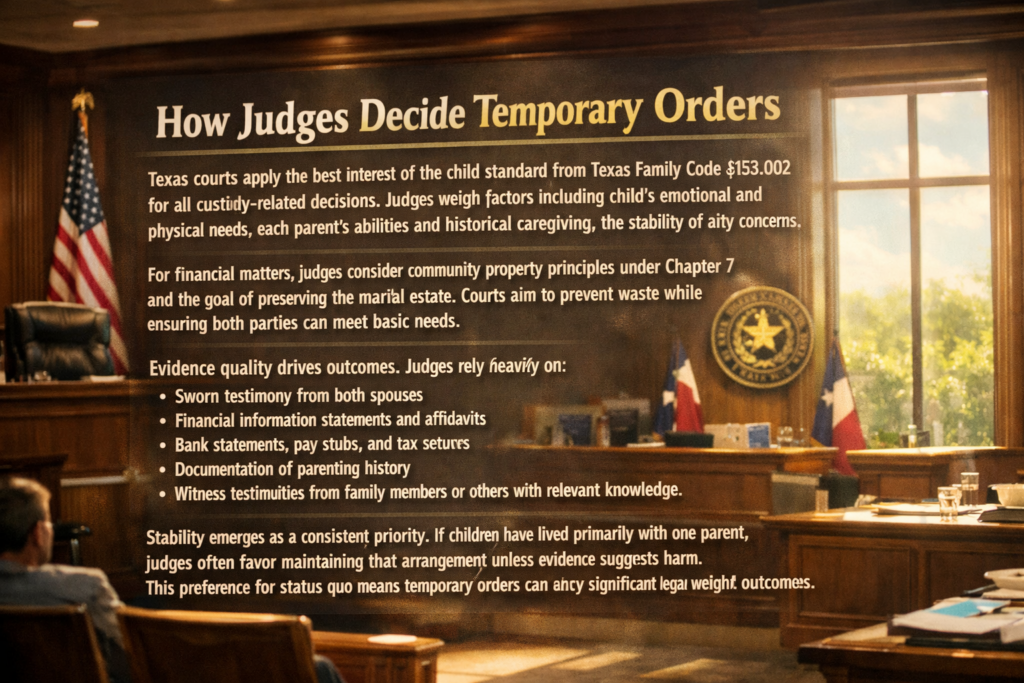
When families ask What happens at a Texas Divorce temporary orders, they are often trying to understand how a judge will evaluate custody, finances, and stability in a matter of hours that can shape life for months. Texas courts apply the “best interest of the child” standard under Texas Family Code §153.002 in all conservatorship and possession decisions. Judges examine the child’s emotional and physical needs, each parent’s caregiving history, the stability of proposed living arrangements, and any concerns involving safety or well-being. Section 153.134 further guides how rights and duties—such as the authority to designate a child’s primary residence—are allocated between parents. In practice, courts favor arrangements that minimize disruption and preserve consistency, particularly when children have been thriving in an established routine.
Financial determinations are grounded in community property principles outlined in Chapter 7 of the Texas Family Code, with temporary authority provided under §6.502 and §105.001 to protect property and ensure fairness while the case is pending. Judges aim to prevent waste of marital assets while making sure both parties can meet reasonable living expenses. For child support, courts apply the statutory guidelines in Chapter 154, including the updated net resource cap adjustments that took effect in September 2025 under §154.125. These updates reflect the Legislature’s ongoing effort to align child support calculations with economic realities in Texas.
Evidence is critical at this stage. Courts rely on sworn testimony, financial information statements, pay stubs, tax returns, bank records, and documentation showing each parent’s historical involvement in the child’s life. Witness testimony may also be considered when relevant and credible. The quality and organization of this evidence often influence how the court perceives stability and reliability. Because temporary orders frequently establish the status quo, they can carry significant weight in shaping final outcomes if the arrangement proves workable and safe.
The attorneys at The Law Office of Bryan Fagan approach temporary orders hearings with both legal precision and compassionate guidance. By thoroughly preparing clients and presenting organized, credible evidence, our team works to position families for long-term stability from the outset. For a deeper dive into preparation strategies and courtroom expectations, review our resource on what to know about Texas temporary orders hearings and explore our broader Texas family law resources to better understand your rights and options.
Temporary orders are not simply procedural steps—they are foundational decisions that shape daily life during divorce. With informed guidance and a clear strategy, families can move forward with greater clarity, confidence, and peace of mind.
What Evidence Is Presented at the Hearing?
Both parties present evidence supporting their requested temporary orders. Understanding what evidence matters helps you prepare effectively.
Sworn Testimony: You and your spouse will likely testify under oath. Attorneys conduct direct examination and cross-examination, probing claims about parenting, income, and conduct. Composure and honesty matter—judges observe demeanor carefully.
Financial Documentation: Courts require detailed financial disclosures. Bring pay stubs, bank statements, tax returns for two years, a sworn inventory of assets and debts, and documentation of monthly expenses. Incomplete financial records often lead judges to impute higher income or doubt credibility.
Parenting Evidence: Documentation of your involvement in children’s lives—school pickup records, medical appointment attendance, extracurricular participation—demonstrates your role as a parent. Parenting journals noting daily activities can prove valuable.
Communications: Text messages, emails, and voicemails may demonstrate concerning behavior, agreements, or the quality of co-parenting communication. Courts admit relevant, non-hearsay evidence under Texas Rules of Evidence.
Substance Abuse Concerns: If domestic violence or substance issues exist, courts may order drug testing, supervised visitation, or protective orders. Documentation of incidents strengthens these requests.
Court reporters transcribe everything, creating a record that may matter at trial.
How Temporary Orders Affect Daily Life
Once the judge signs your temporary orders, they become legally binding and reshape daily existence for everyone involved.
Parenting Schedules: Your children’s routine changes immediately. Whether the court establishes 50/50 possession or a primary-secondary arrangement, both parents must follow the schedule precisely. School pickup, bedtime routines, and weekend plans all revolve around the court order.
Financial Obligations: If ordered to pay child support or temporary spousal support, payments typically begin within days. Direct deposit arrangements, specific payment dates, and consequences for non-payment are spelled out clearly. The support order establishes expectations that persist throughout your case.
Living Arrangements: One spouse often relocates from the family home. Vehicle access, personal property retrieval, and communication about shared spaces all fall under the order’s terms.
Communication Restrictions: Orders commonly prohibit disparaging remarks about the other spouse in front of children, harassing communications, and contact beyond parenting coordination.
Behavioral Expectations: Judges may restrict dating partners from overnight stays when children are present, prohibit alcohol consumption during parenting time, or impose other behavioral boundaries.
These arrangements aren’t merely suggestions—they carry enforcement power including contempt proceedings for violations.
Can Temporary Orders Influence the Final Divorce Outcome?
Yes—and significantly. Texas courts value stability when making final custody decisions under Texas Family Code §153.254. Practitioners estimate 70-80% of temporary custody arrangements carry forward into final orders when parents demonstrate those arrangements work.
Think about it from the judge’s perspective: if children have thrived for twelve months under a particular possession schedule, changing that pattern requires compelling justification. The parent who establishes a strong temporary position often maintains it.
This reality cuts both ways. Poor performance during the temporary period—missed visitation, support arrears, violations of injunctions—undermines credibility when seeking favorable final terms. The temporary phase functions as an audition that judges watch closely.
Strong preparation for your temporary orders hearing isn’t just about the next few months—it’s about positioning yourself for the final outcome.
What Happens After the Temporary Orders Hearing?
Understanding What happens at a Texas Divorce temporary orders does not end when the hearing concludes. After both sides present evidence and arguments, the judge announces rulings from the bench or takes the matter under advisement. Those rulings are then reduced to written temporary orders, signed by the court, and filed with the clerk. Once signed, they become immediately enforceable under Texas Family Code §105.001 and §6.502, carrying the full authority of the court.
Enforcement is not optional. If a party violates temporary orders—whether by withholding child support, denying court-ordered possession, or dissipating community property—Chapter 157 of the Texas Family Code allows the other party to file a motion for enforcement. Courts may impose fines, order payment of attorney’s fees, and in serious cases hold a party in contempt, which can include confinement. Texas courts take compliance seriously because temporary orders are designed to protect children and preserve stability during litigation.
Modification is possible, but only when justified. Under §156.006 and related provisions, a court may modify temporary conservatorship or support orders if there has been a material and substantial change in circumstances, such as job loss, relocation, or a shift in a child’s needs. Courts will not alter orders simply because one party is dissatisfied. Judges prioritize continuity and the best interest of the child under §153.002, and any requested modification must align with that standard. Recent updates to Texas child support guidelines under §154.125, including the increased net resource cap effective September 2025, may also affect temporary child support calculations in appropriate cases.
With temporary orders in place, your divorce moves into its next phase. Discovery continues as both parties exchange financial documents, conduct depositions, and evaluate property division under Chapter 7 community property principles. Many Texas counties require mediation before trial, offering families an opportunity to resolve disputes outside the courtroom. If mediation is successful, a final decree may follow within months. If not, the case proceeds toward trial, where the court will make final determinations.
Temporary orders generally remain in effect for six to eighteen months, automatically terminating when the final divorce decree is signed. Because these orders often establish the status quo that shapes final outcomes, preparation and compliance are critical. For additional insight into courtroom expectations and strategy, review our detailed guide on what to expect in a Texas temporary orders hearing and explore our broader Texas divorce resources for practical guidance.
At The Law Office of Bryan Fagan, our team approaches each stage of litigation with clarity, compassion, and strategic precision. Temporary orders are not just paperwork—they are the framework for your family’s daily life while the case unfolds. With experienced counsel and informed decision-making, you can move forward with confidence, knowing your rights and your children’s stability are protected.

Common Mistakes at Temporary Orders Hearings
Understanding what goes wrong helps you avoid costly errors.
Appearing Unprepared: Walking into court without organized financial records, clear testimony, or understanding of your goals signals to judges that you’re not taking matters seriously. Practitioners report that unprepared parties lose advantageous positions in roughly 40% of cases.
Emotional Outbursts: Judges assess demeanor. Crying, shouting, interrupting, or visibly seething undermines credibility regardless of how justified your emotions feel. Courts reward composure.
Incomplete Financial Documentation: Missing pay stubs, unclear bank statements, or failure to complete required disclosures often leads to imputed income—sometimes higher than actual earnings. Judges don’t appreciate financial opacity.
Ignoring Court Etiquette: Arriving late, dressing inappropriately, arguing with opposing counsel, or addressing the judge improperly creates negative impressions that linger throughout your case.
Underestimating Importance: Some spouses treat temporary orders hearings as procedural formalities. They’re not. These hearings establish patterns that influence final outcomes and shape daily life for many months.
How to Prepare for a Texas Divorce Temporary Orders Hearing
Thorough preparation transforms anxiety into confidence.
Gathering Financial Documentation
Compile at least two years of financial records: tax returns, W-2s, pay stubs, bank statements for all accounts, credit card statements, mortgage documents, vehicle loans, and retirement account statements. Complete required sworn inventory forms accurately—courts penalize omissions.
Organize documents chronologically in labeled folders or binders. Your experienced attorney can advise on specific disclosure requirements in your county.
Preparing Your Testimony
Practice presenting facts clearly and concisely. Focus on demonstrating how your proposed parenting plan serves your children’s best interests—not on attacking your spouse. Prepare specific examples of your parenting involvement: doctor appointments you’ve attended, homework help you provide, bedtime routines you maintain.
Anticipate cross-examination. Opposing counsel will challenge your claims. Staying calm, answering directly, and avoiding defensive tangents serves you well.
How a Texas Divorce Attorney Protects You at Temporary Orders Hearings
Navigating a temporary orders hearing alone puts you at significant disadvantage. Family law attorneys provide critical protection:
Strategic Preparation: Experienced counsel identifies which issues matter most and develops arguments tailored to your situation. They know what evidence persuades local judges and how to present your case effectively.
Evidence Organization: Attorneys ensure your financial records, witness testimony, and documentary evidence meet legal requirements and tell a coherent story supporting your position.
Cross-Examination: When your spouse testifies, skilled attorneys expose inconsistencies, challenge credibility, and prevent unfounded allegations from going unchallenged.
Protecting Long-Term Position: Understanding how temporary orders influence final outcomes, attorneys work to establish arrangements that serve your interests throughout the case—not just today.
Preventing Financial Disadvantage: From temporary child support calculations to interim attorney’s fees, legal counsel ensures you’re not disadvantaged by unfair financial arrangements.
Why Choose The Law Office of Bryan Fagan, PLLC
When families want clarity about What happens at a Texas Divorce temporary orders, they deserve more than a procedural explanation—they deserve strategic guidance grounded in experience. The attorneys at The Law Office of Bryan Fagan bring extensive courtroom knowledge to every temporary orders hearing across Texas. Whether the matter involves conservatorship under Texas Family Code §153.002, allocation of parental rights under §153.134, or temporary financial relief authorized by §6.502 and §105.001, our team understands how judges analyze evidence and apply the law in real time. These hearings often establish the structure that governs a family’s daily life for months, and courts frequently maintain those arrangements if they prove stable and aligned with the child’s best interest.
Preparation is where outcomes are shaped. Our firm works closely with clients to organize financial disclosures required under Chapter 7 community property principles, develop persuasive testimony, and present documentation that reflects each parent’s involvement and reliability. When child support is at issue, we apply the updated guidelines under Texas Family Code §154.125, including the increased net resource cap effective September 2025, to ensure calculations are accurate and legally sound. We also explore whether agreed temporary orders may be appropriate in your case, as cooperative solutions can reduce conflict while still protecting your rights. You can learn more about that option in our guide to agreed temporary orders in Texas family law cases.
Our approach blends assertive advocacy with compassionate counsel because we recognize that temporary orders are not just legal directives—they affect where children sleep, how bills are paid, and how families begin rebuilding stability. With statewide representation and deep familiarity with local court practices from Houston to Dallas and beyond, our legal team positions clients for long-term success from the earliest stages of divorce. If you are seeking practical insight into custody and possession decisions, we also invite you to review our Texas child custody resource center for additional education and guidance.
At every step, the focus remains the same: educating families, protecting futures, and empowering you to move forward with clarity and confidence during one of life’s most difficult transitions.

Actionable Checklist: Preparing for Your Texas Temporary Orders Hearing
- [ ] Gather two years of tax returns, pay stubs, and bank statements
- [ ] Complete required sworn inventory and financial information statements accurately
- [ ] Document your parenting involvement with specific examples
- [ ] Prepare clear, focused testimony emphasizing children’s best interests
- [ ] Organize all documents in labeled, chronological order
- [ ] Review your county’s specific procedural requirements
- [ ] Arrive at court early, dressed appropriately, with copies of all documents
- [ ] Consult with an experienced attorney before your hearing date
Conclusion
Divorce can feel like standing in the middle of a storm, unsure which way the wind will shift next. But temporary orders are not about chaos — they are about creating structure when your family needs it most. When you understand what happens at this stage, you move from reacting to planning. You begin making decisions with intention instead of fear. And that shift alone can change everything.
Temporary orders set the rhythm of daily life while your case unfolds. They influence where children live, how parents share responsibility, and how financial stability is preserved. With thoughtful preparation and experienced legal guidance, this hearing becomes more than a court date — it becomes an opportunity to establish stability and protect your future.
At The Law Office of Bryan Fagan, PLLC, we believe families deserve clarity, compassion, and strong advocacy during life’s hardest transitions. Bryan Joseph Fagan and our team have helped thousands of Texas families navigate temporary orders hearings with confidence and purpose. We understand Texas courts, we understand the law, and just as importantly, we understand the emotional weight you are carrying.
If you are facing a temporary orders hearing, now is the time to ask questions, gather information, and build a strategy that protects what matters most. Consider scheduling a consultation with an experienced Texas family law attorney who can help you move forward with confidence. The right guidance does not just protect your legal position — it protects your peace of mind.
And as you take the next step, remember this: clarity creates calm. When you know the process, you regain control. When you regain control, your family can begin building a new foundation — one grounded in stability, strength, and hope.
Frequently Asked Questions
Temporary orders are court-issued rules that apply while your divorce is pending. They can address custody and visitation schedules, child support, who remains in the family home, who pays which bills, and restrictions designed to prevent financial harm or conflict. Their purpose is to stabilize daily life until the final divorce decree is signed.
One of the biggest mistakes is making major legal or financial decisions based purely on emotion. That can include moving out without a plan, hiding money, ignoring court orders, or agreeing to terms you do not fully understand. In Texas divorce cases, credibility and stability matter. Early missteps can affect both temporary orders and final outcomes.
Temporary orders typically remain in effect until the final divorce decree is entered, which can take several months or longer depending on the complexity of the case and court scheduling. If circumstances significantly change, either party may request a modification, but courts require a legitimate reason, not simply dissatisfaction.
At a temporary divorce hearing, a judge decides short-term arrangements regarding custody, possession, child support, spousal support, property use, and financial responsibilities. Both parties may present testimony and evidence. The goal is to create structure and prevent harm while the divorce proceeds toward resolution.
Certain separate property funds, such as inheritances or gifts kept separate from marital assets, may be protected under Texas law. However, how those funds were handled matters. Courts often issue temporary injunctions that restrict unusual spending, transfers, or asset withdrawals during divorce. Before moving significant funds, it is wise to consult a Texas family law attorney.
Moving out without a legal strategy can unintentionally shift the status quo, especially in custody disputes. If one parent leaves and sees the children less frequently, that pattern may influence future custody decisions. While moving out may sometimes be necessary for safety or emotional well-being, it should ideally be done with a clear plan and legal guidance.
Many people describe the 3 C’s as communication, cooperation, and consistency. Clear communication reduces misunderstandings. Cooperation helps limit conflict and legal costs. Consistency provides stability for children and demonstrates reliability to the court. Even when emotions run high, maintaining these principles can improve outcomes.
Avoid draining bank accounts, accumulating unnecessary debt, hiding assets, or posting inflammatory content on social media. Courts can consider financial misconduct and behavior that impacts children. Instead, gather financial records, clarify your goals, and speak with an experienced Texas family law attorney before making major decisions.
There is no universal answer. Many people experience relief when high-conflict relationships end and routines become more predictable. Long-term happiness often depends on financial planning, emotional support, co-parenting stability, and realistic expectations. With thoughtful legal guidance and a clear strategy, families can build a healthier and more stable next chapter.