
When David was handed divorce papers at his office in The Woodlands, his first thought wasn’t about dividing furniture or bank accounts—it was about the company logo on the wall behind his desk. He had spent fourteen years building that construction firm from a pickup truck and a single crew into a thriving operation with long-term contracts and loyal employees. How to Keep Your Business in a Texas Divorce suddenly became more than a search term; it became the question that kept him awake at night.
If you are a Texas business owner facing divorce, you may be asking the same thing. Will a judge force you to sell? Could your spouse become your business partner? Does community property law mean you automatically lose half? The truth is more reassuring than most people realize. Under Texas Family Code §7.001, courts divide marital property in a “just and right” manner—not necessarily 50/50. That distinction gives judges flexibility to preserve a functioning business while still ensuring fairness.
At The Law Office of Bryan Fagan, PLLC, we understand that a business is not just an asset on a spreadsheet. It represents risk, sacrifice, leadership, and future security. Bryan Joseph Fagan, a South Texas College of Law graduate and recognized authority on Texas divorce and custody law, has guided countless entrepreneurs across Houston and throughout Texas through high-stakes property division cases. Our firm was built on a mission to empower people to reclaim freedom and peace of mind during life’s hardest transitions. That means protecting what you have built while helping you move forward with clarity and confidence.
Texas law presumes property acquired during marriage is community property, but that presumption can be challenged with evidence. Ownership structure, operating agreements, buy-sell provisions, reimbursement claims, and business valuation methods all shape the outcome. Judges do not dismantle successful companies lightly, especially when thoughtful legal strategy presents viable alternatives like buyouts, asset offsets, or structured settlements.
In the sections that follow, you will learn how Texas courts actually evaluate business interests, what practical steps you can take now to protect your company, and how experienced legal guidance can reduce uncertainty. Divorce may feel overwhelming today—but with the right information and advocacy, your business does not have to become collateral damage.
Key Takeaways
- Under Texas law, businesses are treated as property subject to division, but courts use a “just and right” standard—not automatic 50/50 ownership splits
- A business started before marriage remains separate property unless commingling converts it to community property; documentation is critical to proving separate property claims
- Business valuation by professional business valuators determines divisible value using income, asset, or market approaches—with personal goodwill often excluded from division
- Strategic options including negotiated buyouts, asset offsets, and structured settlements allow business owners to retain full operational control
- Early preparation, clear financial records, and experienced family law attorney guidance dramatically improve outcomes for protecting your business

Your Family’s Future Starts Here
Don’t navigate your legal journey alone. Schedule a consultation now and get the clarity and support you deserve.
How to Keep Your Business in a Texas Divorce: The Big Picture
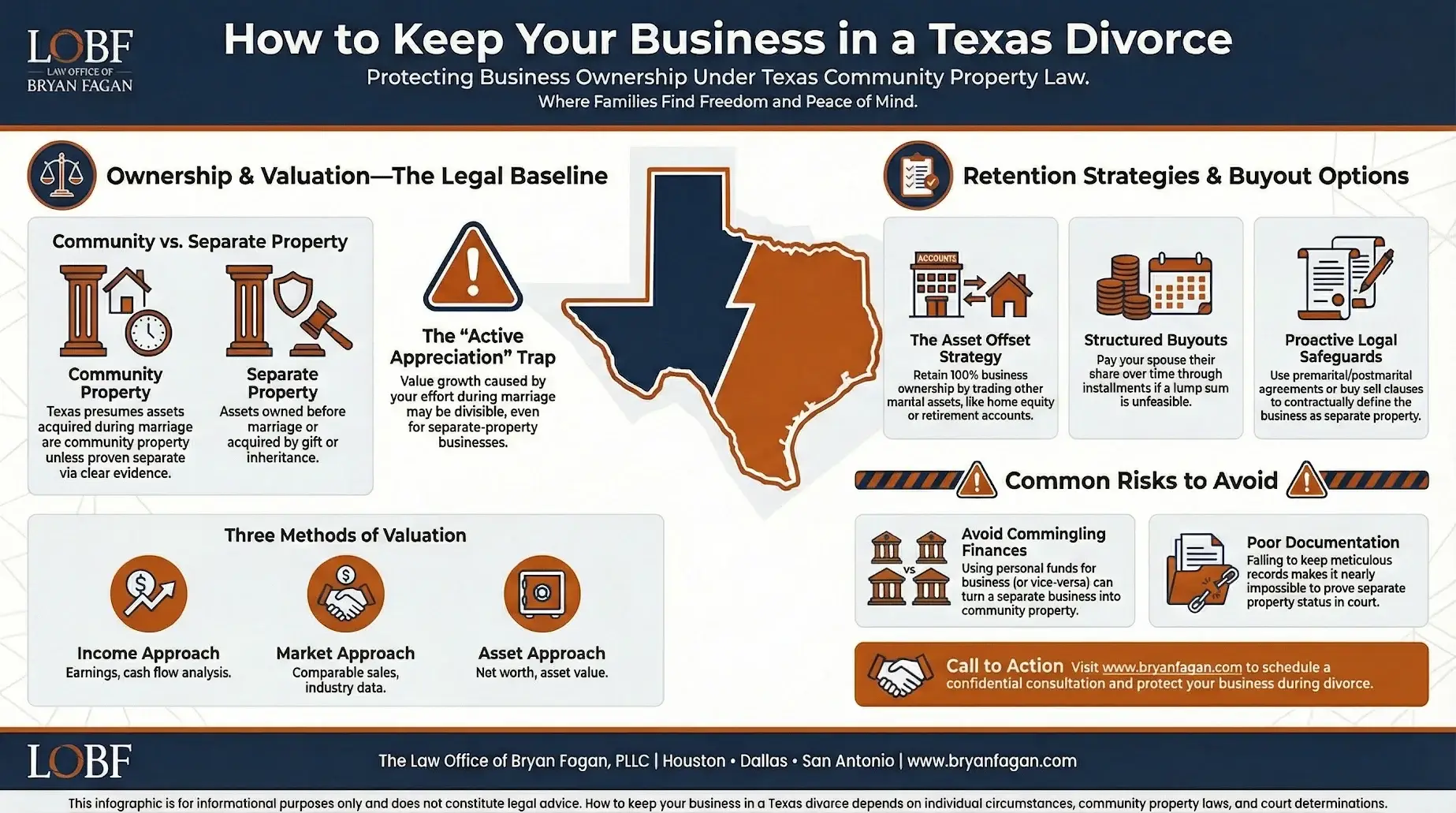
Texas courts treat businesses as property subject to division under Chapter 7 of the Texas Family Code, but that does not mean a judge will automatically split ownership in half. Under §7.001, community property must be divided in a manner the court considers “just and right,” giving judges meaningful discretion to reach fair outcomes without dismantling a thriving company. The central issue in any business-related divorce is classification—whether the business is community property under §3.002 and §3.003 or separate property under §3.001. That distinction often determines whether the company itself is divisible or whether only certain financial interests are at stake.
Understanding How to Keep Your Business in a Texas Divorce starts with recognizing that Texas law presumes property acquired during marriage is community property. However, that presumption can be overcome with clear and convincing evidence. A business formed before marriage, funded with separate assets, or acquired by gift or inheritance may qualify as separate property. At the same time, growth during the marriage, reinvested earnings, or uncompensated community labor may create reimbursement claims under §3.402. Proper tracing, documentation, and strategic planning are critical. For a deeper explanation of how ownership structure and separate property analysis intersect, explore our detailed guide on navigating business ownership and separate property in Texas.
Even when a business is determined to be community property, courts rarely rush to order liquidation. Judges recognize that forcing a sale can destroy enterprise value and harm both spouses. Instead, courts often award the business to one spouse while offsetting its value through other marital assets, structured payments, or negotiated settlements. This approach aligns with the “just and right” framework and reflects ongoing updates and clarifications within the Texas Family Code that emphasize equitable—not mechanical—division.
The attorneys at The Law Office of Bryan Fagan, PLLC regularly counsel Texas entrepreneurs through these high-stakes property division matters with a balance of precision and empathy. Protecting a business requires a coordinated strategy focused on classification, valuation, and negotiation. When handled thoughtfully, many business owners retain operational control while satisfying legitimate community property interests. If you are concerned about the future of your company, informed guidance from experienced Texas family law counsel can provide clarity, stability, and a plan designed to protect both your livelihood and your future.

Is Your Business Community Property or Separate Property?
Under Texas law, property acquired during marriage is presumed to be community property under Texas Family Code §3.003, while separate property is defined in §3.001 as assets owned before marriage, received by gift or inheritance, or recovered for certain personal injury claims (excluding lost earnings). This distinction is critical when evaluating business ownership in divorce. For entrepreneurs researching How to Keep Your Business in a Texas Divorce, proper classification is often the first and most decisive step. Whether your company is characterized as community or separate property determines how it will be treated under §7.001, which requires courts to divide community property in a manner that is “just and right.”
If you owned your business before marriage, it may qualify as separate property. However, the burden of proof rests on the spouse claiming separate ownership, and the evidence must meet the “clear and convincing” standard required by Texas law. Starting or acquiring a business during marriage using community funds typically results in community property classification, but real-world circumstances are rarely that simple. Accurate financial records, formation documents, and tracing evidence become essential in supporting a separate property claim. For a more detailed explanation of how valuation and classification intersect in these cases, our resource on divorce business valuation provides valuable guidance.
Even a premarital business can be affected by commingling. When separate business funds are mixed with marital assets in ways that make tracing difficult, courts may treat some or all of the business as community property. Depositing household income into business accounts, paying personal expenses from company funds, or using marital savings to expand operations can blur the line between separate and community estates. Texas courts examine these facts carefully, particularly in light of reimbursement principles outlined in §3.402 of the Family Code. If community funds or labor enhanced a separate property business, the community estate may be entitled to reimbursement, even if ownership itself remains separate.
For example, imagine a consulting firm started five years before marriage. During the marriage, family income is deposited into the business account, business revenue pays personal expenses, and marital savings fund new equipment purchases. Without detailed documentation, a court may presume community involvement and potentially award reimbursement or treat portions of the business value as community property. These outcomes often turn on evidence, accounting clarity, and credible expert testimony.
The attorneys at The Law Office of Bryan Fagan, PLLC guide Texas business owners through these complex classification and reimbursement issues with both legal precision and practical understanding. Recent updates and clarifications within the Texas Family Code continue to emphasize accurate tracing, equitable division, and evidence-based decision-making. If you are concerned about whether your business could be characterized as community property, our Texas property division overview offers additional context grounded in Chapter 7 of the Code.
Protecting your company during divorce requires proactive planning, disciplined recordkeeping, and experienced legal advocacy. When business owners understand how Texas courts analyze classification and reimbursement, they are better positioned to preserve ownership, protect value, and move forward with clarity and confidence.
Proving Your Business Remains Separate Property
To establish that your business remains separate property, you need documentary evidence showing clear origins and maintained separation. Formation documents, bank statements, tax returns, and financial statements spanning years before and during marriage become essential evidence.
Key documentation includes:
- Original formation documents with dates preceding marriage
- Business bank accounts showing no commingling with marital funds
- Separate property funds used for initial capitalization
- Records demonstrating growth from reinvested business earnings rather than community contributions
A forensic accountant can trace funds through complex transactions to establish separate property origins. This expert analysis often proves decisive in contested cases where your spouse challenges business classification.
How Texas Courts Value a Business in Divorce
When a business or an ownership interest is classified as community property, Texas courts must determine its fair market value before dividing the estate under Texas Family Code §7.001. The statute requires a “just and right” division of community property, which means valuation directly impacts what each spouse ultimately receives. If you are focused on How to Keep Your Business in a Texas Divorce, understanding how Texas courts calculate value is one of the most important steps in protecting your company and planning a strategic resolution.
Judges in Texas rely heavily on qualified business appraisers and financial experts to present evidence of fair market value. Although the Family Code does not mandate one single formula, courts commonly consider three recognized valuation approaches. The income approach projects future earnings and discounts them to present value, which is especially relevant for professional practices and service-based companies with predictable cash flow. The asset approach calculates net value by subtracting liabilities from tangible and intangible assets, often used in asset-heavy industries or where liquidation value is relevant. The market approach compares the company to similar businesses that have recently sold, though it can be more complex when dealing with closely held or specialized enterprises.
Goodwill frequently becomes a central issue. Texas courts distinguish between enterprise goodwill and personal goodwill. Enterprise goodwill is tied to the business entity itself—its brand, systems, customer base, and transferable reputation—and may be divisible as community property. Personal goodwill, however, is linked to the individual owner’s skills, relationships, and reputation and is generally treated as separate property. This distinction is critical when business owners ask whether a spouse can take part of the company. Our detailed discussion in Can My Wife Take My Business in a Divorce in Texas? helps clarify how courts approach this question in real-world cases.
Debt and liabilities also reduce net divisible value. A company worth $5 million on paper but carrying $2 million in legitimate debt may have a net value of $3 million for division purposes. Courts also evaluate reimbursement claims under Texas Family Code §3.402 if community funds or labor enhanced a separate property business. Recent updates to the Texas Family Code continue to reinforce careful characterization of assets and reimbursement principles, emphasizing evidence-based analysis rather than assumptions.
The attorneys at The Law Office of Bryan Fagan, PLLC regularly collaborate with certified appraisers, forensic accountants, and tax professionals to ensure that business valuations presented in court reflect economic reality—not speculation. Accurate valuation protects business continuity, supports fair negotiation, and positions owners to pursue structured settlements rather than forced sales. For additional guidance on property division strategy, you can explore our Texas property division overview, which explains how courts apply Chapter 7 of the Family Code in complex estates.
Protecting your business during divorce requires more than hope; it requires preparation, documentation, and experienced advocacy. When valuation is handled thoughtfully and strategically, many Texas business owners are able to preserve operational control while achieving a fair and lawful division under the Texas Family Code.

Strategies to Keep Your Business in a Texas Divorce
Protecting your company during divorce requires more than determination—it requires strategy grounded in Texas law. For business owners asking about How to Keep Your Business in a Texas Divorce, the answer often lies in negotiation techniques that satisfy a spouse’s community property interest without sacrificing ownership or operational control. Under Texas Family Code §7.001, courts divide community property in a manner that is “just and right,” which gives room for flexible solutions that preserve a functioning enterprise rather than dismantle it. When guided by experienced counsel, many business owners retain their companies while achieving a fair and legally sound division.
One of the most common approaches is a negotiated buyout. In this scenario, the business owner compensates the other spouse for their community interest using cash, refinancing options, or structured payments based on company cash flow. Because Texas law focuses on equitable division rather than mechanical splitting, courts often support buyouts that preserve business continuity. Accurate valuation is essential to this strategy, and our detailed analysis in divorce and business valuation explains how courts evaluate fair market value in accordance with Chapter 7 of the Family Code.
Asset offset strategies also provide effective solutions. A spouse may receive other marital assets—such as the family residence, retirement accounts, or investment portfolios—in exchange for relinquishing claims to business equity. This approach leverages the flexibility built into §7.001 and allows the company to remain intact. When structured carefully, these settlements can protect liquidity and avoid the operational disruption that often accompanies forced sales.
In some situations, structured payment agreements are more practical. Installment arrangements tied to profit distributions or long-term performance metrics can satisfy a spouse’s interest while preserving working capital. These agreements must be carefully drafted to address enforcement provisions and security interests, ensuring compliance with Texas law and protecting both parties from future disputes.
Mediation frequently plays a critical role in achieving these outcomes. Because business financial information can be highly sensitive, mediation offers confidentiality that courtroom litigation cannot. Many Texas divorces resolve through mediation, reducing legal expenses and allowing for creative settlements that courts may not impose on their own. The attorneys at The Law Office of Bryan Fagan, PLLC regularly guide clients through mediation with preparation grounded in statutory authority and valuation expertise.
For additional insight into how Texas courts approach equitable property division, our Texas property division resource provides helpful guidance based on the latest updates to the Texas Family Code. Preserving your business during divorce is not about avoiding fairness—it is about structuring a solution that complies with the law while protecting what you have built. With thoughtful negotiation and experienced advocacy, many business owners successfully retain full operational control and move forward with confidence.
What If Both Spouses Worked in the Business?
When both spouses contributed to the business, courts analyze compensation history, ownership roles, and the distinction between employment income and equity ownership. One spouse handling operations while the other managed administration creates different considerations than equal partnership arrangements.
Employment compensation is community income regardless of which spouse earned it. However, ownership claims require examining formation documents, capital contributions, and formal partnership or shareholder agreements. A spouse who provided administrative support may have claims for unpaid labor but not necessarily ownership equity.
Options include:
- Buyout of one spouse’s ownership interest
- Division of income streams rather than equity
- Business restructuring separating different functions
- Complete partnership dissolution with asset distribution
A legal team including both family law and business law attorneys can navigate complex restructuring while protecting both business viability and fair property division.
Prenuptial and Postnuptial Agreements
Prenuptial and postnuptial agreements under Texas Family Code Chapter 4 can explicitly designate businesses as separate property, overriding community property presumptions. These agreements provide the strongest protection when properly executed.
Valid agreements require full financial disclosure, voluntary execution without duress or coercion, and fair terms that don’t leave one spouse destitute. Texas courts enforce properly drafted agreements that meet statutory requirements.
Key provisions protecting business interests include:
- Explicit classification of the business as separate property
- Waiver of community reimbursement claims
- Defined treatment of future appreciation
- Protection against commingling challenges
Postnuptial agreements offer similar protection but face higher scrutiny for fairness. If divorce seems possible, a postnuptial partition agreement under Texas Family Code Chapter 4 can recharacterize community business interests as separate property when both spouses agree voluntarily.
Common Mistakes That Put Businesses at Risk
Many business owners are surprised to learn that small financial habits and informal recordkeeping can significantly impact the outcome of a divorce. If you are researching How to Keep Your Business in a Texas Divorce, avoiding preventable mistakes is just as important as building a strong legal strategy. Texas law presumes that property acquired during marriage is community property under Texas Family Code §3.003, and the burden of proving separate property falls on the spouse asserting it. Without clean documentation and disciplined financial practices, even a legitimately separate business can become difficult to defend.
One of the most common pitfalls is commingling personal and business finances. Paying personal expenses from business accounts or depositing household income into company accounts creates tracing challenges that can undermine separate property claims. When separate and community funds are mixed beyond clear identification, courts may treat the entire asset as community property. Under Texas Family Code §3.001 and §3.002, proper classification depends on evidence, and inadequate records can weaken your position significantly. Maintaining segregated accounts and accurate bookkeeping is not simply good business practice—it is legal protection.
Another frequent issue involves failing to document the origin of a business. Sole proprietorships or informal ventures formed before marriage may still be presumed community property if there is insufficient proof of separate origin. Formation documents, capitalization records, tax returns, and historical financial statements are essential to support a separate property claim. Under Texas Family Code §3.402, even if a business is separate property, the community estate may assert reimbursement claims if marital funds or labor enhanced its value. Clear documentation helps courts distinguish between original ownership and later growth attributable to community efforts.
Operating under informal structures such as a DBA without formal LLC or corporate filings can also create vulnerability. Formal entity formation, operating agreements, and shareholder agreements provide clearer evidence of ownership and valuation boundaries. When courts analyze a company’s worth, they rely on credible financial evidence and expert testimony, as discussed in our detailed guide on valuation of a company for divorce. Understanding how valuation works can prevent avoidable mistakes that inflate risk.
Attempting to hide assets or manipulate income is perhaps the most damaging error a business owner can make. Texas courts have broad discretion under Chapter 7 of the Family Code to divide community property in a “just and right” manner, and judges may impose sanctions or award disproportionate shares when concealment or fraud is discovered. Transparency and proactive strategy almost always produce better long-term outcomes than reactive decisions driven by fear.
Tax implications are another area where business owners can unknowingly jeopardize stability. Buyouts and asset transfers may trigger capital gains exposure if not structured properly. While certain interspousal transfers may qualify for favorable tax treatment under federal law, careful coordination with financial professionals is essential. The legal team at The Law Office of Bryan Fagan, PLLC often collaborates with valuation experts and tax advisors to structure settlements that protect both ownership and long-term financial health. For additional insight into how Texas courts approach property division more broadly, our Texas property division resource offers helpful context.
Protecting your company requires more than good intentions. It requires disciplined recordkeeping, thoughtful entity planning, full transparency, and experienced legal guidance grounded in the Texas Family Code. When business owners take these steps early, they strengthen their ability to preserve control, protect value, and move forward with confidence during a challenging season.

Mediation vs. Trial for Business Owners
Mediation offers significant advantages over trial for business owners concerned about protecting both their company and its reputation. Private mediation keeps sensitive financial statements, valuation disputes, and operational details confidential—unlike public court records accessible to competitors, employees, and customers.
Trial introduces uncertainty. A judge unfamiliar with your industry may accept inflated valuations, order unwanted arrangements, or disrupt operations through discovery demands. Litigation costs often exceed $50,000-$200,000 for complex business cases, compared to mediation’s typically 30-50% lower expenses.
Mediation allows creative settlements impossible in litigation. Payments tied to future business performance, earn-out arrangements, or deferred buyouts based on cash flow can preserve working capital while satisfying community claims. Courts can only divide existing assets; mediation can craft forward-looking solutions.
However, mediation requires both parties’ good-faith participation. If your spouse refuses reasonable settlement or makes unrealistic demands, preparing for litigation becomes necessary.
Tax and Financial Implications of Dividing a Business
Business division carries significant tax consequences that can dramatically affect net outcomes. Understanding these implications is essential for structuring settlements that protect business viability.
Capital gains taxes apply when business interests transfer for cash. Depending on income levels and asset holding periods, federal rates range from 20-37% plus potential state implications. CPAs estimate average high-asset divorces incur $100,000 or more in combined tax hits without proper planning.
In-kind property transfers between divorcing spouses qualify for tax-free treatment under IRC § 1041. This means transferring business equity or other property owned directly avoids immediate taxation, though the receiving spouse assumes the original tax basis.
Structured settlements spreading payments over time can defer and potentially reduce tax liability. Installment sales treatment may offer advantages compared to lump-sum buyouts.
Involving financial professionals—CPAs and tax advisors—early in divorce settlement negotiations prevents costly surprises and enables structuring that maximizes net value for both parties.
Can a Court Force the Sale of a Business?
Texas courts can order business liquidation, but this outcome is relatively rare. Under Texas precedent including Murff v. Murff (1981), courts prefer preserving functioning economic units through buyouts rather than forced sales that often destroy value.
Circumstances increasing forced sale risk include:
- Inability to finance buyout due to insufficient other assets
- High debt making offset arrangements impractical
- Both spouses refusing compromise
- Business dependent on both spouses’ participation
Forced liquidation often realizes only 40-50% of going-concern value. Courts recognize this destruction serves neither party’s interests. Demonstrating buyout ability—through financing pre-approval, asset liquidity, or structured payment capacity—significantly reduces forced sale risk.
How to Prepare If Divorce Is Imminent
If divorce appears likely, early preparation can significantly strengthen your position and reduce uncertainty. For business owners researching How to Keep Your Business in a Texas Divorce, the most powerful advantage is preparation grounded in the Texas Family Code. Under §3.003, property acquired during marriage is presumed to be community property unless proven otherwise, and under §7.001, courts divide community property in a “just and right” manner. The quality of your documentation and financial records can directly influence how a judge classifies and divides your business interest.
Start by organizing your financial records. Collect at least three to five years of business tax returns, profit and loss statements, balance sheets, bank statements, operating agreements, and any prior valuation reports. These documents support separate property claims under §3.001 and help valuation experts establish fair market value if the company is subject to division. Clear and complete financial documentation often prevents disputes from escalating and creates a stronger foundation for negotiation or mediation. For a broader explanation of how courts approach this issue, you may find our discussion on what happens to a business in a Texas divorce especially helpful.
It is equally important to halt any suspicious transfers. Moving assets to friends, relatives, or newly formed entities in anticipation of divorce can trigger serious consequences. Texas courts have authority to address fraud on the community and may reconstitute the estate under Chapter 7 if they find improper transfers. Judges may impose sanctions, award disproportionate shares, or reverse questionable transactions. Acting transparently and strategically protects both your credibility and your long-term financial interests.
Maintaining segregated accounting is another critical step. Commingling personal and business finances can weaken a separate property claim and complicate tracing efforts. Under §3.402, reimbursement claims may arise if community funds enhance separate property, so clean bookkeeping helps distinguish legitimate business growth from marital contributions. Separating accounts now—and avoiding future commingling—strengthens your legal position.
Documenting your individual contributions to the company can also be essential, particularly in cases involving goodwill disputes. Courts often distinguish between enterprise goodwill, which may be divisible, and personal goodwill, which is tied to an individual’s skill and reputation. Detailed records of your leadership role, decision-making authority, hours worked, and client relationships can help demonstrate that certain aspects of value are personal rather than community in nature. For additional guidance on property division principles under Texas law, our Texas property division overview provides helpful context.
Finally, consult experienced legal counsel as early as possible. The attorneys at The Law Office of Bryan Fagan, PLLC regularly guide Texas entrepreneurs through complex property classification and valuation issues with clarity and compassion. Early legal guidance often prevents costly mistakes and reduces the likelihood of drawn-out valuation battles. Preparation is not about anticipating conflict—it is about protecting your livelihood and moving forward with confidence, clarity, and peace of mind.

How a Texas Divorce Attorney Protects Business Owners
A divorce attorney experienced with business division provides strategic advantages at every stage. From initial property classification arguments through final divorce settlement negotiations, legal guidance shapes outcomes.
Your attorney challenges inflated valuations, engages appropriate financial experts, and presents evidence supporting separate property claims. During negotiations, experienced counsel structures buyouts, offsets, and settlements maximizing your retained ownership while minimizing tax liability and cash flow impact.
If litigation becomes necessary, trial preparation and presentation protect against judicial orders that could disrupt operations. Post-divorce enforcement ensures payment obligations are met and business remains protected long-term.
How to keep your business in a Texas divorce ultimately comes down to strategic planning, proper documentation, and skilled negotiation—areas where experienced legal counsel proves invaluable.
Why Choose The Law Office of Bryan Fagan, PLLC
When business ownership is at stake, experience and strategy matter. At The Law Office of Bryan Fagan, PLLC, our legal team has extensive experience handling complex property division cases involving closely held companies, professional practices, and family-owned enterprises across Texas. Understanding How to Keep Your Business in a Texas Divorce requires more than general divorce knowledge—it demands a deep understanding of Texas Family Code §§3.001–3.003 on property characterization and §7.001 governing the “just and right” division of community property. Our attorneys combine statutory knowledge with real-world business insight to help clients protect both ownership and long-term financial stability.
Proper valuation is often the turning point in these cases. Texas courts rely on credible financial evidence and expert testimony when determining a company’s fair market value, especially when a business is considered community property. We work closely with certified business appraisers, forensic accountants, and tax professionals to ensure valuations reflect economic reality and comply with Texas legal standards. For a deeper explanation of how courts approach this analysis, we encourage you to review our in-depth discussion on determining the value of a small business in a Texas divorce. Understanding valuation methodology is critical because inflated or unsupported numbers can dramatically impact property division outcomes.
In addition to valuation concerns, Texas courts may evaluate reimbursement claims under §3.402 if community funds or labor enhanced a separate property business. Recent updates and clarifications within the Texas Family Code continue to emphasize careful property characterization and equitable distribution. Our firm stays current with these developments to ensure our clients receive guidance that reflects the most up-to-date legal standards.
Whether your case resolves through mediation or requires courtroom advocacy, our team provides strategic guidance designed to protect business continuity. Mediation often allows for creative solutions such as structured buyouts or asset offsets that preserve operational control while satisfying community property obligations. When litigation is necessary, we present clear financial evidence and persuasive legal arguments rooted in statutory authority and case law.
With offices serving families throughout Houston and across the state, our firm offers experienced representation wherever your business operates or your divorce is filed. We prioritize clear communication so you understand each step of the process and the reasoning behind every strategic decision. For additional insight into how Texas courts divide complex marital estates, our Texas property division resource provides helpful guidance grounded in Chapter 7 of the Family Code.
Protecting a business during divorce is about more than numbers—it is about preserving the future you worked hard to build. With knowledgeable counsel, trusted financial experts, and a clear strategy grounded in Texas law, business owners can move forward with confidence and clarity.

Actionable Checklist: How to Keep Your Business in a Texas Divorce
- Document Business Origins: Locate formation documents, initial funding records, and evidence establishing when you acquired business assets
- Separate Finances Immediately: Open distinct business accounts and cease all commingling of personal and business funds
- Compile Financial Records: Gather 3-5 years of tax returns, financial statements, bank statements, and any prior valuations
- Identify Separate Property Evidence: Prepare documentation proving premarital ownership, inheritance, or gift status
- Assess Community Claims: Honestly evaluate potential reimbursement claims for community contributions to business growth
- Engage Professional Valuators: Retain a certified business appraiser early to establish defensible fair market value
- Consult Tax Advisors: Understand capital gains and transfer tax implications before agreeing to settlement terms
- Schedule Legal Consultation: Meet with an experienced divorce lawyer to develop protection strategy before proceedings advance
Conclusion
Divorce can feel like standing at a crossroads you never planned to reach. When you own a business, the stakes feel even higher because your livelihood, your employees, and your long-term security are all tied to the outcome. But protecting your company in a Texas divorce is not about luck—it is about strategy, preparation, and understanding how the law actually works. When you have clear information and a steady legal hand guiding you, fear starts to give way to focus.
The path forward is rarely about tearing everything apart. More often, it is about structuring smart solutions that preserve what you have built while fairly resolving what must be divided. That is where experience matters. An experienced Texas Family Law Attorney understands how to navigate community property rules, valuation disputes, negotiation strategy, and courtroom dynamics without losing sight of the bigger picture—your future stability and peace of mind.
At The Law Office of Bryan Fagan, PLLC, we believe families deserve more than legal answers. They deserve clarity. They deserve options. And they deserve a plan that protects what matters most. If you are facing divorce and wondering what happens next for your business, this is the moment to ask questions, gather information, and make decisions from a position of strength rather than stress.
You worked hard to build your company. It represents years of risk, persistence, and belief in yourself. The right legal guidance can help ensure that one chapter ending does not erase everything you have created. When you are ready to talk through your situation, our team is here to listen, to advise, and to help you move forward with confidence.
Frequently Asked Questions
In Texas, an LLC membership interest is treated as property. The court first determines whether your ownership interest is separate property (owned before marriage or received by gift or inheritance) or community property (acquired during marriage). Even if the LLC itself is not physically divided, the value of the community portion may be subject to division under Texas’s “just and right” standard. Often, one spouse keeps the LLC while the other receives a financial offset through other assets or structured payments. Operating agreements and transfer restrictions can significantly impact the outcome.
Separate property is generally not subject to division in a Texas divorce. This can include assets owned before marriage, inheritances, gifts received by one spouse, and certain personal injury recoveries. However, Texas law presumes property is community unless proven otherwise. Clear documentation and tracing are essential to establish that an asset is truly separate and protected.
Avoid hiding assets, draining accounts, altering business income without explanation, or involving children in conflict. Emotional decisions—especially financial ones—can damage your credibility in court. Business owners should also avoid transferring assets or manipulating payroll in ways that could appear deceptive. Judges closely evaluate transparency and fairness.
One of the biggest mistakes is acting out of fear instead of strategy. Rushed financial moves, inflammatory communication, or refusal to negotiate reasonably can escalate conflict and increase costs. Divorce is as much about careful planning as it is about legal rights. Staying calm and informed often leads to better long-term outcomes.
Your former spouse can make a claim against the value of your membership interest if it is considered community property or if community funds or labor increased its value. However, that does not necessarily mean they become your business partner. Courts frequently award the business to one spouse and compensate the other with a financial award instead.
If you keep your LLC active, it continues to exist and must comply with state requirements, including tax filings and reporting obligations. In a divorce context, maintaining the LLC can mean continued scrutiny of its income, distributions, and expenses. Dissolution is not automatically required during divorce, but the decision should align with your broader legal and financial strategy.
While not a formal legal doctrine, many professionals refer to Communication, Cooperation, and Clarity as the “3 C’s.” Clear communication reduces misunderstandings, cooperation can lower conflict and costs, and clarity about finances and parenting expectations leads to stronger outcomes. Even in high-conflict situations, pursuing clarity is essential.
A “silent divorce” is not a legal term in Texas. It usually describes a marriage where spouses live emotionally or practically separate lives without formally ending the marriage. Over time, financial entanglements and unresolved issues can grow more complicated. Understanding your legal rights early can prevent future complications.
Accounts that qualify as separate property may be protected from division, but proof is critical. Retirement accounts are often partially divisible if contributions occurred during marriage. Even accounts opened before marriage can become partially community property if marital funds were added. The classification depends on documentation and tracing, not simply whose name is on the account.