
The first night after Dad moved into an apartment across town, eight-year-old Mason stood in the hallway clutching his favorite blanket and asked, “So… what happens now?” That quiet question is at the heart of what families face during divorce. In that moment of uncertainty, understanding Texas Divorce Timeline and Procedures becomes more than a legal concern—it becomes a source of stability. When you know what happens next and how long each stage may take, the unknown begins to feel manageable.
At The Law Office of Bryan Fagan, PLLC, we recognize that divorce is not simply the end of a marriage; it is a restructuring of daily life. Bryan Joseph Fagan, a South Texas College of Law graduate and recognized authority on Texas divorce and custody law, founded this firm with a clear purpose: to empower people to reclaim freedom and peace of mind during life’s hardest transitions. Through compassionate counsel, education, and innovative legal solutions that simplify complexity, our team helps families replace fear with clarity.
Texas law provides a structured roadmap. Under Texas Family Code §6.702, a mandatory 60-day waiting period applies before any divorce can be finalized. When children are involved, Texas Family Code §153.002 requires courts to prioritize the best interest of the child above all else. These statutes are not just technical rules—they are designed to slow down emotional decisions and encourage thoughtful planning. Understanding how the Texas Divorce Timeline and Procedures unfold allows parents to plan housing arrangements, financial transitions, and co-parenting schedules with greater confidence.
We have guided countless Houston-area families who initially felt overwhelmed by paperwork, deadlines, and court settings. Once they understood each phase—filing, service, temporary orders, mediation, and final decree—the path forward felt clearer. Structure brings calm. Knowledge brings confidence.
If you are standing in your own hallway wondering what happens next, you deserve clear answers and steady guidance. In the sections that follow, we will walk through Texas Divorce Timeline and Procedures step by step so you can move forward with clarity, protect what matters most, and begin rebuilding with peace of mind.
Key Takeaways
- The mandatory 60-day waiting period under Texas Family Code §6.702 applies to nearly all Texas divorces—no divorce can be finalized faster than 61 days from filing, regardless of how quickly spouses agree.
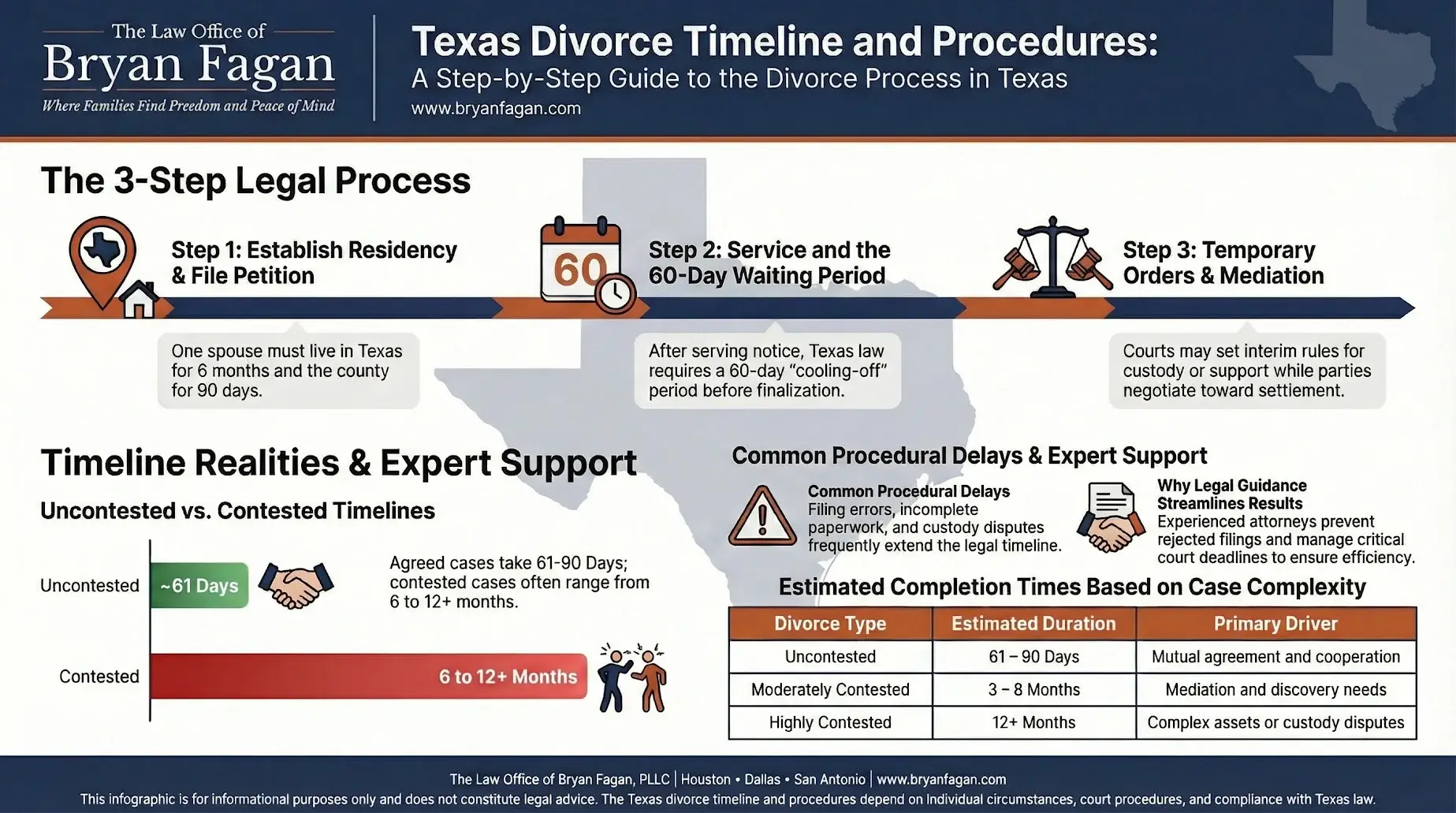
- Uncontested divorces typically take 60-90 days when both parties agree and cooperate, while contested divorces involving disputed issues often take 6-12 months or longer.
- Proper preparation and legal representation significantly impact timeline efficiency—organized financial disclosures, proper service of process, and strategic negotiation prevent unnecessary delays.
- Most divorce cases settle before trial through mediation or negotiation, avoiding the extended timelines associated with courtroom litigation.
- Understanding each procedural step empowers you to work effectively with your attorney and make decisions that keep your case moving forward.

Your Family’s Future Starts Here
Don’t navigate your legal journey alone. Schedule a consultation now and get the clarity and support you deserve.
Texas Divorce Timeline and Procedures: The Complete Overview
Understanding Texas Divorce Timeline and Procedures starts with recognizing that every divorce in this state follows a structured legal roadmap established by the Texas Family Code. Whether your case is uncontested or contested, the sequence of events remains consistent. What changes is the pace at which you move through those stages. As we explain in our article, What Everyone Gets Wrong About the Divorce Timeline in Texas, many people assume there are shortcuts. Texas law, however, is clear—while cooperation can improve efficiency, required steps cannot be skipped.
Every divorce begins with the filing of an Original Petition for Divorce in the appropriate Texas district court. Before filing, residency requirements under Texas Family Code §6.301 must be met. At least one spouse must have lived in Texas for the preceding six months and in the county of filing for at least 90 days. Once the petition is filed, Texas Family Code §6.702 imposes a mandatory 60-day waiting period before a judge can grant the divorce, except in limited cases involving family violence. This statutory waiting period applies regardless of how quickly the parties reach agreement.
After filing, the other spouse must be formally served or sign a waiver of service under the Texas Rules of Civil Procedure. From there, the process moves into negotiations, temporary orders if needed, and financial disclosures. When children are involved, the court’s focus intensifies. Texas Family Code §153.002 mandates that the best interest of the child is the primary consideration in conservatorship decisions. Judges evaluate stability, parental involvement, and the child’s needs when entering orders. Child support calculations are governed by Texas Family Code §154.125, including the updated $11,700 net monthly resource cap effective September 1, 2025. These provisions ensure that financial support reflects modern statutory standards while protecting children’s welfare.
Where timelines truly diverge is in how parties handle disagreement. When spouses cooperate, exchange financial documents promptly, and participate constructively in mediation, cases often resolve efficiently after the 60-day waiting period expires. When disputes arise over community versus separate property under §3.002 and §3.001, or over possession schedules under §153.134, the process expands to include discovery, court hearings, and potentially trial. The structure remains the same, but the intensity and duration of each phase increase.
At our Houston-based divorce practice, we consistently emphasize that preparation is powerful. Filing complete and accurate pleadings, complying with service requirements, and drafting a precise Final Decree of Divorce prevent costly delays and enforcement issues later. Many frustrations families experience stem not from the law itself, but from procedural missteps that could have been avoided with experienced guidance.
For readers who want a deeper understanding of common misunderstandings about timing, we recommend reviewing our in-depth resource on divorce timeline myths in Texas. Education is central to our mission. When you understand how each phase fits together—from petition to final decree—you replace uncertainty with strategy.
Texas law does not allow shortcuts, but it does reward preparation, cooperation, and clarity. By understanding Texas Divorce Timeline and Procedures, you equip yourself to move forward confidently, protect your children, safeguard your financial interests, and approach the future with greater peace of mind.

Step 1: Filing the Original Petition for Divorce
The Original Petition for Divorce is the document that officially begins Texas Divorce Timeline and Procedures, and it sets the tone for everything that follows. This filing identifies both spouses, states the legal grounds for divorce—most commonly “insupportability” under Texas Family Code §6.001—and outlines the relief requested, including division of community property under §7.001, conservatorship and possession terms under §153.002, and child support pursuant to §154.125. Even in amicable cases, this first step must be handled with precision because it establishes the legal framework for the court’s authority moving forward. For families considering a cooperative resolution, our in-depth guide on uncontested divorce in Texas and what it means for you offers additional insight into how early decisions affect the overall process.
Before a petition can be filed, Texas residency requirements must be satisfied under Texas Family Code §6.301. At least one spouse must have lived in Texas for six months and in the county of filing for at least 90 days. These jurisdictional requirements are not technicalities—they ensure the district court has proper authority over your case. Filing in the wrong county or failing to meet statutory residency standards can lead to delays, dismissed pleadings, or the need to refile.
Once the petition is submitted to the district court clerk, several important legal events occur simultaneously. The case is assigned a cause number, the mandatory 60-day waiting period under §6.702 begins, and deadlines for service and response are triggered under the Texas Rules of Civil Procedure. This filing date becomes the anchor point for subsequent procedural steps, including temporary orders hearings and mediation scheduling. Because the waiting period cannot be shortened except in limited family violence circumstances, the timing of filing itself becomes a strategic consideration.
Accuracy at this stage is essential. Errors in describing assets, omitting claims for relief, misstating residency dates, or failing to properly request conservatorship or support can complicate the case unnecessarily. Courts rely on the pleadings to determine what issues are before them. Incomplete or vague petitions may require amendment, which can extend the timeline and increase costs. Our Houston-based family law team frequently advises clients that careful preparation at the beginning often determines how smoothly the rest of the process unfolds.
For readers seeking further clarity on how property division is addressed once a petition is filed, our Texas community property overview explains how courts apply §7.001 when dividing marital assets. Education is central to our mission. By understanding how the Original Petition initiates Texas Divorce Timeline and Procedures, families can move forward confidently, knowing they have laid a solid legal foundation for the steps ahead.
Step 2: Service of Process and Response Procedures
After filing for divorce, Texas law requires formally notifying your other spouse about the legal proceedings. This notification process, called service of process, ensures both parties receive proper notice and opportunity to participate.
Service can occur through several methods. A constable or process server can formally deliver the divorce papers, or your spouse can voluntarily sign a Waiver of Service acknowledging receipt of the documents. When spouses cooperate and execute a Waiver of Service early, this eliminates waiting time associated with formal service.
Once served, the responding spouse generally has 20 days to file a formal response with the court. If this deadline falls on a weekend, the deadline extends to the following Monday. The response allows the other spouse to contest any claims, present their own requests, and formally enter the case.
If the respondent fails to answer within the required timeframe, the divorce process may proceed through default procedures. However, courts prefer both parties to participate, and most attorneys encourage responsive participation to protect both parties’ interests.
The Mandatory 60-Day Waiting Period
Under Texas Family Code §6.702, a judge cannot grant a final divorce decree until at least 60 days have passed since the divorce petition was filed. This cooling off period represents the absolute minimum timeline for any Texas divorce.
The waiting period begins on the date you file the Original Petition—not when your spouse receives service or when they file a response. Even if both spouses agree on every issue immediately, the law requires waiting at least 60 full days before the judge can sign your final decree.
Texas courts provide limited exceptions to this rule only in cases involving domestic violence. If there’s a documented history of family violence or an existing protective order, the court may waive the waiting period to protect the endangered spouse.
For everyone else, the 60-day requirement is non-negotiable. This means the fastest possible uncontested divorce takes at least 61 days—the mandatory waiting period plus time for a brief prove-up hearing. Any claim of faster resolution simply doesn’t align with Texas law.
Temporary Orders and Early Court Hearings
Temporary orders are one of the most important early stages within Texas Divorce Timeline and Procedures, especially when families need immediate stability while a case is pending. Divorce does not pause everyday responsibilities. Mortgage payments are still due, children still need routines, and financial obligations continue. Because Texas Family Code §6.702 imposes a mandatory 60-day waiting period before a divorce can be finalized, temporary orders exist to bridge the gap between filing and final decree. For a broader understanding of how these early rulings fit into the overall process, we encourage reviewing our detailed guide on how long divorce takes in Texas.
Under Texas Family Code §6.502, courts may issue temporary restraining orders and temporary injunctions to preserve property and maintain the status quo. When children are involved, temporary conservatorship and possession decisions are guided by the “best interest of the child” standard in §153.002. Judges evaluate stability, caregiving history, and the child’s needs when entering interim custody orders. Child support is calculated pursuant to §154.125, which now reflects the updated $11,700 net monthly resource cap effective September 1, 2025. Courts may also address spousal maintenance under Chapter 8 if eligibility factors are met. These statutory provisions ensure that while the divorce moves forward, families are protected financially and children remain supported.
In practical terms, temporary orders often determine who remains in the marital home, how parenting time is structured, how bills are paid, and how access to bank accounts is managed. Hearings typically occur within a few weeks of filing, and both parties present evidence to support their requested arrangements. At this stage, preparation and strategy matter. A thoughtfully presented temporary hearing can establish routines that promote stability and may influence the tone of settlement negotiations moving forward.
Our Houston-based family law team frequently reminds clients that temporary orders are not the final outcome, but they can significantly shape the trajectory of the case. When parties approach these hearings cooperatively and with long-term goals in mind, the overall divorce timeline often becomes more efficient. When hearings become highly contentious, positions may harden, potentially extending the process.
For parents seeking deeper insight into how temporary child support is calculated and enforced, our Texas child support guidelines resource provides clear, statute-based explanations designed to help families make informed decisions.
Temporary orders exist to provide structure during uncertainty. By understanding how they function within Texas Divorce Timeline and Procedures, families can make steady, informed choices rather than reactive ones. As a firm dedicated to educating families and protecting futures, we believe clarity reduces fear and preparation builds confidence.

Discovery and Financial Disclosure Procedures
Discovery is the formal process through which parties obtain information from each other and third parties during contested divorces. This process includes written questions (interrogatories), requests for document production, depositions, and requests for admissions.
Texas requires both spouses to exchange financial disclosures identifying all assets, debts, and income. This includes bank statements, retirement account information, real estate valuations, business interests, credit card statements, and income documentation. Complete financial transparency ensures any settlement or court judgment reflects the full marital estate.
Complex property significantly extends discovery timelines. When the community property includes significant assets, retirement accounts requiring QDROs (Qualified Domestic Relations Orders), business ownership interests, or separate property claims, thorough documentation and expert valuations take time.
Cooperation dramatically affects this phase. When both parties organize their financial documentation early and exchange disclosures promptly, attorneys can move quickly into settlement negotiations. When one spouse delays, hides information, or refuses cooperation, court intervention becomes necessary, extending the timeline substantially.
Mediation and Settlement Procedures
Mediation is a structured settlement process where a neutral third party helps divorcing spouses negotiate agreements on contested issues. Texas courts frequently require mediation before allowing cases to proceed to trial, particularly in family law cases involving child custody disputes.
During mediation, both spouses (typically accompanied by their attorneys) work with the mediator to discuss property division, custody arrangements, support obligations, and other disputed issues. The mediator facilitates communication but doesn’t impose decisions—reaching agreement remains the parties’ responsibility.
When mediation succeeds, the parties sign a Mediated Settlement Agreement (MSA), which is legally binding under Texas law. Once an MSA is executed, attorneys quickly draft the Final Decree of Divorce reflecting the agreed terms, and the case moves toward finalization without trial.
Mediation often shortens the overall divorce timeline substantially. Rather than waiting months for a trial date and spending days in court, parties who reach mutual agreement through mediation can finalize their divorce shortly after the 60-day waiting period ends.
Trial Procedures When Settlement Fails
When settlement negotiations and mediation fail to resolve all disputed issues, the divorce case proceeds to trial. A divorce trial is a contested hearing where both parties present evidence, testimony, and legal arguments to the judge (or sometimes a jury for specific issues).
Trial doesn’t happen immediately after negotiations fail. Your case joins the court’s docket, and scheduling depends heavily on court schedules and existing backlogs in your county. Depending on the court’s availability, trial dates may be weeks or months away.
The trial itself may last from a single day to multiple days depending on case complexity. Afterward, the judge issues findings of fact and conclusions of law before signing the final divorce decree. This entire process—from failed mediation through trial completion—can extend a divorce timeline to a year or longer.
However, here’s important perspective: most divorce cases settle before reaching trial. The expense, emotional toll, and unpredictability of trial motivate most parties to reach negotiated settlements. Trial remains the backstop when parties simply cannot agree, but it’s the exception rather than the rule.
Drafting and Signing the Final Decree of Divorce
The Final Decree of Divorce is the document that brings Texas Divorce Timeline and Procedures to their legal conclusion. It is far more than a formality. This decree officially dissolves the marriage and sets out binding, enforceable orders regarding property division, conservatorship and possession of children, child support, spousal maintenance, and any additional relief granted by the court. Under Texas Family Code §7.001, a court must divide community property in a manner that is “just and right.” When children are involved, conservatorship and possession orders must reflect the best interest of the child under §153.002. Child support must comply with statutory guidelines in §154.125, including the updated $11,700 net monthly resource cap that took effect September 1, 2025. Because the decree controls these critical issues, precision in drafting is essential. Even minor ambiguities can create enforcement disputes years later.
In uncontested cases, the decree is drafted to mirror the parties’ negotiated settlement. Both spouses review the language carefully before signing to ensure it accurately reflects their agreement. In contested cases that proceed to trial, the decree must track the judge’s rulings and findings, including any orders relating to conservatorship under §153.134 or spousal maintenance eligibility under Chapter 8 of the Texas Family Code. The court does not simply “approve” a divorce; it signs a detailed legal instrument that governs future rights and responsibilities.
Certain provisions require particular attention to detail. Retirement accounts often require Qualified Domestic Relations Orders (QDROs) to divide benefits properly. Real property transfers must include precise legal descriptions. Ongoing support obligations must reflect statutory calculations and payment terms. Custody schedules must clearly outline possession periods to avoid confusion. Attorney’s fees, if awarded, must be addressed explicitly. Our Houston-based divorce team frequently counsels clients that careful drafting at this stage prevents unnecessary return trips to court for clarification or enforcement.
Once the Final Decree is signed by both parties—or entered following trial—a brief prove-up hearing finalizes the case in uncontested matters. During that hearing, the petitioner confirms under oath that residency requirements under §6.301 are met and that the marriage has become insupportable under §6.001. After the judge signs the decree, the divorce becomes legally final. For many families, this moment represents not just the end of litigation, but the beginning of a new chapter structured by clear legal boundaries.
For readers seeking a broader explanation of how the final decree fits into the overall process, we recommend reviewing our in-depth guide on how long divorce takes in Texas, which explains each phase from filing through finalization. We also provide additional insight on property division in our Texas community property overview, designed to help families better understand how courts apply §7.001 in real-world cases.
At The Law Office of Bryan Fagan, PLLC, our mission is to educate families and protect futures. The Final Decree of Divorce is not simply the last document in the case—it is the framework that shapes your financial security, parental rights, and long-term stability. By approaching this final stage of Texas Divorce Timeline and Procedures with careful preparation and experienced legal guidance, families can move forward with confidence, clarity, and peace of mind.

Realistic Timeline Ranges for Texas Divorces
Understanding realistic timeframes helps set appropriate expectations for your specific situation:
Uncontested Divorce: When spouses agree on all major issues and cooperate fully, divorce can be finalized in 60-90 days from filing. The minimum possible timeline is 61 days—the mandatory waiting period plus one day for the prove-up hearing.
Moderately Contested Divorce: When parties disagree on some issues but remain willing to negotiate through mediation, expect 3-8 months. This range accounts for discovery, mediation attempts, and court scheduling.
Highly Contested Divorce: Cases involving significant child custody disputes, complex asset division, or parties unwilling to negotiate often take over a year. Court scheduling backlogs, extended discovery, and trial preparation contribute to these longer timelines.
Your specific circumstances determine which category applies. The presence of minor children, significant assets, retirement accounts, real property, or high-conflict dynamics all influence where your case falls on this spectrum.
Factors That Speed Up the Texas Divorce Timeline
Several factors consistently accelerate divorce proceedings:
- Early agreement on major issues—property division, custody, and support—eliminates need for discovery and trial
- Organized financial documentation prepared before or immediately after filing enables quick disclosure exchange
- Proper service of process through Waiver of Service rather than formal constable service saves weeks
- Effective mediation with both parties genuinely willing to negotiate reaches resolution faster
- Strategic legal representation that manages deadlines, anticipates issues, and prevents procedural errors
These factors are largely within your control or influence. Choosing cooperation over conflict, organizing documents early, and working with experienced family law attorneys all contribute to efficient case resolution.
Factors That Delay the Texas Divorce Timeline
Conversely, several factors extend timelines:
- Child custody disputes requiring extensive investigation and court intervention
- Complex property division involving business valuations, multiple properties, or disputed characterization of community property versus separate property
- Retirement account division requiring carefully drafted QDROs
- Court scheduling backlogs in busy counties
- Emotional escalation preventing reasonable negotiations
- Uncooperative behavior including discovery delays or unnecessary motions
Understanding these factors helps you recognize potential delays early and work proactively with your attorney to address them.
Can You Shorten the Texas Divorce Timeline?
Within Texas Divorce Timeline and Procedures, one of the most common questions families ask is whether the process can be shortened. Under Texas Family Code §6.702, the answer is clear: the mandatory 60-day waiting period cannot be waived except in limited circumstances involving documented family violence. This statutory safeguard applies regardless of how quickly spouses reach agreement. The Legislature designed this provision to ensure thoughtful decision-making rather than rushed resolutions, reinforcing the principle that divorce is a serious legal transition.
While the 60-day minimum cannot be eliminated, much of what follows is influenced by preparation and cooperation. After filing and satisfying residency requirements under §6.301, parties can streamline the remainder of the process by organizing financial records early, exchanging disclosures promptly, and working constructively toward settlement. When children are involved, careful attention to conservatorship provisions under §153.002 and support calculations under §154.125—including the updated $11,700 net monthly resource cap effective September 1, 2025—can prevent unnecessary disputes. Mediation, frequently required by Texas courts, often provides an efficient path to resolution when both parties approach it in good faith.
Our Houston-based family law team consistently advises clients that accuracy matters as much as speed. Errors in pleadings, improper service under the Texas Rules of Civil Procedure, or incomplete financial disclosures often create avoidable delays. Rejected filings, re-service of documents, or unclear drafting in temporary or final orders can significantly extend the divorce timeline. Strategic preparation at the outset helps ensure that each procedural requirement is satisfied correctly the first time.
For readers seeking a deeper understanding of how to approach the process strategically, we recommend reviewing our detailed guide on handling the divorce timeline in Texas the right way, which outlines practical steps families can take to avoid common pitfalls. Additional insights on financial preparation and statutory requirements can also be found in our Texas child support guidelines resource, designed to clarify how courts calculate support obligations.
At The Law Office of Bryan Fagan, PLLC, our mission is to educate families and protect futures. Understanding Texas Divorce Timeline and Procedures empowers you to move deliberately rather than reactively. While the law establishes certain fixed timelines, informed preparation, cooperative negotiation, and experienced legal guidance can make the journey more efficient and far less overwhelming.

How a Texas Divorce Attorney Guides You Through Procedures Efficiently
An experienced Texas divorce attorney provides crucial guidance throughout the legal process:
- Managing deadlines through systematic calendar tracking ensures no deadlines are missed
- Preventing rejected filings by ensuring all documents meet court requirements
- Strategically preparing for mediation by helping you understand your positions and realistic alternatives
- Reducing unnecessary court appearances by resolving issues through negotiation when possible
- Keeping cases on track through regular communication with opposing counsel and the court
Understanding the complete Texas divorce timeline and procedures empowers you to work effectively with your attorney. When you understand what happens at each stage, you can provide the information your attorney needs, make timely decisions, and avoid delays caused by confusion or unpreparedness.
Why Choose The Law Office of Bryan Fagan, PLLC
Navigating Texas Divorce Timeline and Procedures requires more than simply filing paperwork—it demands strategy, clarity, and a steady understanding of how each stage connects to the next. At The Law Office of Bryan Fagan, PLLC, our legal team has guided families across Texas through every phase of the divorce process, from initial filing under Texas Family Code §6.001 (insupportability) through final decree under §7.001. We recognize that efficiency matters, but so does accuracy. The statutory waiting period under §6.702, conservatorship standards under §153.002, and child support calculations governed by §154.125—including the updated $11,700 net monthly resource cap effective September 1, 2025—are not just legal technicalities. They are structural safeguards that shape outcomes for families.
Our Houston-based divorce practice emphasizes strategic timeline management because uncertainty is often the most stressful part of divorce. By walking clients step-by-step through filing requirements under §6.301, service procedures under the Texas Rules of Civil Procedure, temporary orders under §6.502, and mediation expectations required by many Texas courts, we ensure that you always know where your case stands. We believe education reduces fear. That is why we encourage clients to review our comprehensive overview of the Texas divorce process, which explains how each statutory requirement fits within the broader legal framework.
Whether your case is uncontested or involves complex property division, business interests, or contested conservatorship under §153.134, our team approaches it with the same commitment to preparation and compassion. In cooperative divorces, we focus on drafting precise agreements that reflect statutory standards and prevent enforcement disputes later. In contested matters, we prepare thoroughly for hearings and trial, ensuring that evidence presented aligns with the Family Code’s requirements and the best-interest analysis courts must apply.
For families seeking additional clarity on financial obligations during divorce, our Texas child support guidelines resource provides clear explanations rooted in current statutory updates. Our mission is not only to represent you but to empower you with knowledge.
At its core, understanding Texas Divorce Timeline and Procedures allows families to move forward deliberately rather than reactively. Through compassionate counsel, consistent communication, and meticulous attention to the Texas Family Code, our firm remains dedicated to educating families and protecting futures—every step of the way.
Checklist: Texas Divorce Timeline and Procedures
Use this checklist to prepare for your Texas divorce:
- ☐ Confirm you meet residency requirements (6 months in Texas, 90 days in filing county)
- ☐ Gather necessary documentation including financial records, property information, and income verification
- ☐ File the Original Petition for Divorce correctly with the district court
- ☐ Ensure proper service of process on your spouse
- ☐ Prepare comprehensive financial disclosures early in the process
- ☐ Approach negotiations constructively and attempt mediation before proceeding toward trial
- ☐ Consult an experienced Texas divorce attorney to avoid unnecessary delays
Conclusion
Divorce can feel like standing at the edge of a map you’ve never seen before. But when you understand the legal landscape, the next steps don’t feel quite as overwhelming. Texas Divorce Timeline and Procedures exist to bring structure to a difficult season, and when handled thoughtfully, that structure can create stability instead of stress. The goal isn’t just to move a case from filing to final decree—it’s to protect your peace of mind and your family’s future along the way.
At The Law Office of Bryan Fagan, PLLC, we believe informed families make stronger decisions. Whether you’re worried about custody schedules, financial security, or simply what tomorrow will look like, you don’t have to navigate those questions alone. An experienced Texas Family Law Attorney can help you avoid unnecessary delays, reduce conflict, and design solutions that fit your real life—not just the courtroom.
If you’re considering divorce or already in the middle of the process, this may be the moment to pause and ask yourself: what would clarity feel like right now? A conversation with the right legal team can replace uncertainty with a plan. We invite you to schedule a consultation, ask your questions, and explore your options in a supportive, judgment-free environment. When you’re ready to move forward, we’re here to help you do it with confidence, stability, and a clear path ahead.
Frequently Asked Questions
In most cases, a Texas divorce takes at least 60 days because state law requires a mandatory waiting period before a judge can finalize the divorce. That 60-day clock starts the day the Original Petition for Divorce is filed. If the case is uncontested and paperwork is handled properly, many divorces are finalized shortly after the waiting period ends. Contested cases—especially those involving custody disputes, complex assets, or high conflict—can take several months to over a year.
Texas divorces typically follow a structured path. First, one spouse files the Original Petition for Divorce. Next comes service of process (or a waiver of service), followed by the other spouse filing an answer. If needed, the court may issue temporary orders to address custody, support, or property use. In contested cases, the parties exchange financial information through discovery. Most courts require mediation before trial. If settlement is reached, a Final Decree of Divorce is submitted for approval. If not, the case proceeds to trial.
Technically, no divorce can be finalized before 60 days have passed from the filing date, except in limited family violence situations. Even in the simplest uncontested case, the fastest practical timeline is typically 61 days—the waiting period plus the time required to present the final paperwork to the judge.
The fastest divorce in Texas is an uncontested divorce where both spouses agree on all issues, complete financial disclosures promptly, and submit a properly drafted Final Decree as soon as the waiting period ends. Cooperation, organization, and experienced legal guidance can significantly streamline the process.
Avoid making emotional or impulsive decisions. Do not hide assets, drain bank accounts, violate standing orders, involve children in adult conflicts, or post inflammatory comments on social media. Sudden moves, financial secrecy, or aggressive tactics often lead to court intervention and longer timelines. Thoughtful planning and professional guidance are always safer than reactionary decisions.
Texas imposes a 60-day waiting period as a “cooling off” time. The goal is to reduce impulsive decisions and allow families to consider reconciliation or carefully plan for the future. It also gives both parties time to gather documentation and negotiate thoughtfully. While it may feel inconvenient, it often provides valuable space for clearer decision-making.
Moving out without a written agreement or court order can unintentionally change the status quo—especially in custody cases. If one parent leaves the marital home, the other parent may become the primary day-to-day caregiver, which can influence temporary orders. However, there are situations where moving out is necessary for safety or emotional well-being. Before making that decision, it’s wise to consult with an experienced Texas Family Law Attorney.
The “10-year rule” usually refers to one pathway for qualifying for spousal maintenance. In Texas, a spouse may request maintenance if the marriage lasted at least 10 years and they cannot meet their minimum reasonable needs, among other statutory requirements. It does not automatically guarantee alimony, nor does it change how property is divided. Each case is evaluated individually.
The biggest mistake is allowing emotion to drive major legal and financial decisions. Divorce is stressful, but long-term outcomes depend on careful planning, full financial transparency, and thoughtful negotiation. Acting strategically—rather than reactively—helps protect your children, your financial future, and your peace of mind.