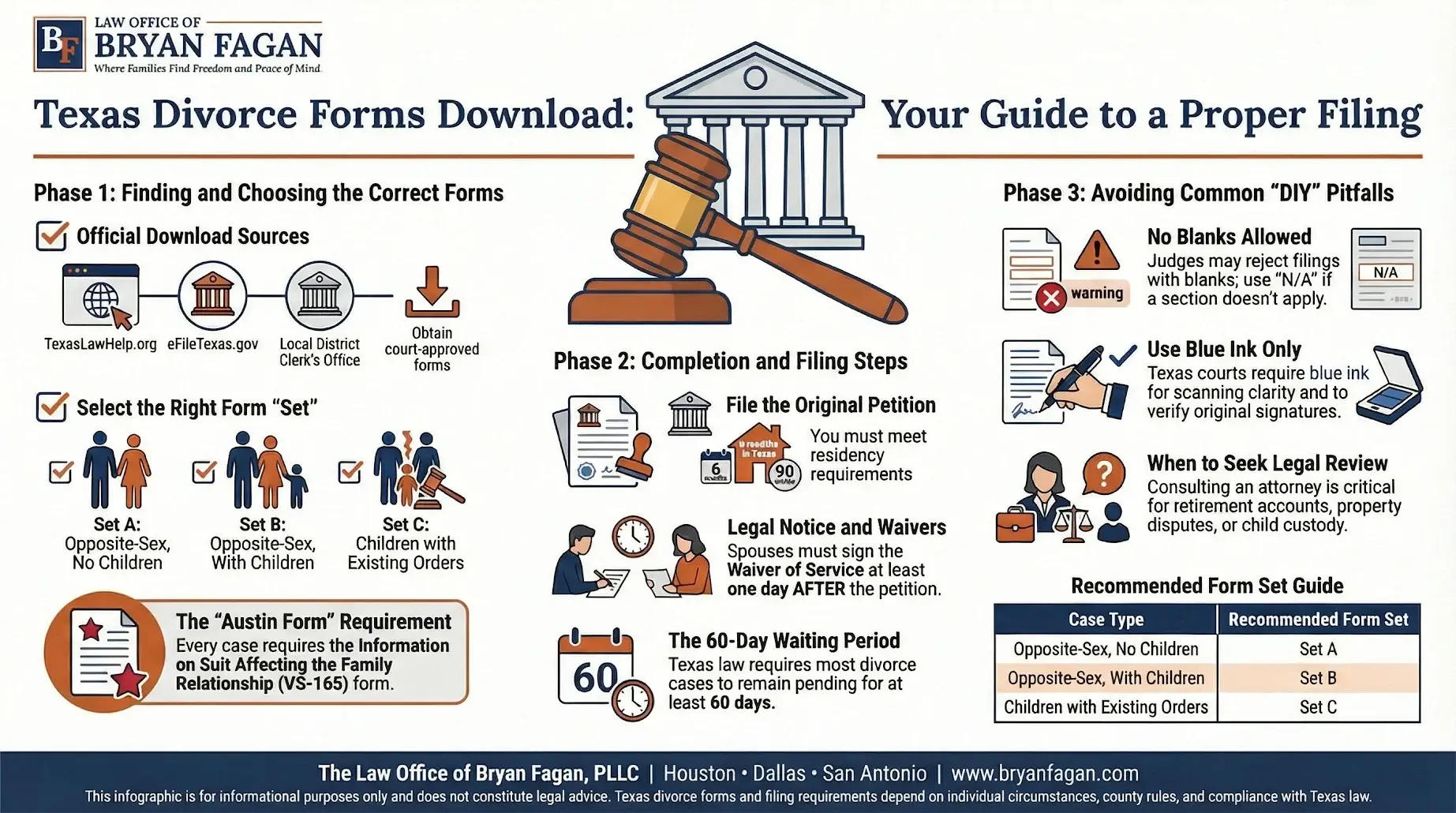
Texas Divorce Forms Download is often typed into a search bar during one of the hardest weeks of a person’s life. I remember a father who sat across from me in our Houston office, still wearing his work boots, staring at a folded stack of printed forms. He said, “I found these online. I just don’t want to mess this up.” He wasn’t angry. He wasn’t looking for revenge. He just wanted to protect his children, his home, and his future.
That moment captures what divorce really feels like. It’s not just legal paperwork. It’s uncertainty. It’s fear of making a mistake that could affect your family for years. Under Texas Family Code §153.002, courts must focus on the best interest of the child. Under §6.301, residency requirements determine whether your case can even be filed. The law has structure and rules, but when you are living through it, the process can feel overwhelming and deeply personal.
At The Law Office of Bryan Fagan, PLLC, we understand both sides of that reality. Founded in 2012 by Bryan Joseph Fagan, a South Texas College of Law graduate and recognized authority on Texas divorce and custody law, our Houston-based firm has helped families across Texas navigate this transition with clarity and confidence. We have seen firsthand how small procedural mistakes—an incomplete decree, vague custody language, improperly filed service—can create years of stress. We have also seen how the right guidance restores peace of mind.
Our “Why” is simple: to empower people to reclaim freedom and peace of mind during life’s hardest transitions. We do that by educating families, simplifying complex legal requirements, and crafting solutions that protect what matters most. Divorce may change the shape of your family, but it should not destroy your stability or your sense of direction.
In this article, you will learn how Texas Divorce Forms Download options actually work, how courts evaluate custody and property issues, and how thoughtful legal planning can protect your child’s well-being and your long-term future. Most importantly, you will see that this process—while serious and complex—is manageable with the right knowledge and support.
If you are holding a stack of forms right now, wondering whether you are doing it correctly, take a breath. Let’s walk through this together.
Key Takeaways
- Official Texas divorce forms are available through the Texas Judicial Branch website, not third-party sites that may provide outdated or incomplete versions.
- Different forms are required depending on whether children are involved—divorces with minor children require child support worksheets, parenting plans, and additional custody documentation.
- Every form must be completed accurately and completely—Texas courts regularly reject filings with blanks, vague language, or missing signatures.
- Property and retirement division requires specific language in the Final Decree—generic forms often omit critical provisions that make orders enforceable.
- Legal review before filing can prevent expensive problems later—an attorney can identify issues that would otherwise lead to rejected filings or unenforceable orders.

Your Family’s Future Starts Here
Don’t navigate your legal journey alone. Schedule a consultation now and get the clarity and support you deserve.
Texas Divorce Forms Download: Where to Get Official Forms
When families begin searching for Texas Divorce Forms Download, the first priority should always be accuracy and reliability. The only officially approved statewide divorce form sets are published through the Texas Judicial Branch pursuant to Misc. Docket No. 13-9085, originally issued in 2013 and later updated for agreed divorces. While these forms provide a helpful starting point for certain uncontested cases, they must still comply with the Texas Family Code, including residency requirements under §6.301 and child-related provisions governed by §153.002, which requires that all custody decisions serve the best interest of the child.
To access legitimate forms, individuals should visit the Texas Judicial Branch website and locate the approved pro se divorce form sets. For uncontested divorces without minor children or real property, Divorce Set 1 is commonly used and includes the Original Petition for Divorce, Waiver of Service, Final Decree of Divorce, Statement of Inability to Afford Payment of Court Costs (formerly called an Affidavit of Indigency), Certificate of Last Known Address, Notice of Change of Address, and a Military Status Affidavit required under federal Servicemembers Civil Relief Act protections. These documents must be carefully completed to align with current Texas Family Code provisions governing property division under §7.001 and child-related orders under Chapters 153 and 154.
TexasLawHelp.org is another reputable resource supported by the Texas Access to Justice Foundation. The site provides downloadable kits organized by case type, including Divorce Set B for cases involving children. When children are involved, the legal complexity increases significantly. Parenting plans must comply with conservatorship standards in §153.134, and child support calculations must follow Chapter 154 guidelines. Importantly, as of September 1, 2025, Texas Family Code §154.125(a-1) raised the net resource cap for guideline child support from $9,200 to $11,700 per month. High-income parents navigating this updated cap can review a deeper explanation in our resource on Texas child support guidelines for high-income parents, which explains how courts analyze support above guideline limits.
County-specific requirements also matter. While Harris County generally links directly to the Supreme Court-approved forms, other counties may provide customized packets or standing order attachments. Local standing orders often restrict financial transfers, relocation of children, and disruptive conduct during the case. Because these orders carry the force of law, reviewing your specific county clerk’s website before filing is essential.
One of the most common mistakes we see at The Law Office of Bryan Fagan is the use of unofficial third-party forms. These websites may offer outdated templates or incomplete decrees that omit critical enforceability language. An incomplete Final Decree can create serious problems under Texas Family Code §9.007, which limits a court’s ability to modify property divisions after divorce. What appears to be a shortcut can ultimately cost far more in corrective litigation.
As a Houston-based family law team committed to educating families and protecting futures, we encourage parents and spouses to approach divorce paperwork with both diligence and perspective. Downloading forms is only the first step. Ensuring those forms are accurate, enforceable, and aligned with current Texas law is what truly protects your rights and your family’s future. For additional guidance on divorce procedures, custody planning, and child support, you can explore our broader Texas Divorce Resource Center, where we break down complex legal issues into clear, practical information designed to give you confidence during uncertain times.

What Divorce Forms Are Required in Texas
When families begin researching Texas Divorce Forms Download, it is important to understand that every divorce in Texas formally begins with the filing of an Original Petition for Divorce. Under Texas Family Code §6.301, the petition must establish jurisdiction by confirming that at least one spouse has lived in Texas for six months and in the filing county for at least 90 days. Without meeting these residency requirements, the court does not have authority to grant the divorce. The petition must also state the legal grounds for divorce, most commonly “insupportability” under §6.001, which is Texas’s no-fault ground and does not require proof of wrongdoing.
In prior years, many counties required a Civil Case Information Sheet, but procedural updates from the Texas Supreme Court have eliminated or modified that requirement in several jurisdictions. Because local rules can still vary, it is wise to confirm current filing requirements with your district clerk before submitting documents. The Houston-based team at The Law Office of Bryan Fagan often advises clients that small procedural missteps at filing can delay the entire case.
If the divorce is agreed, the responding spouse may sign a Waiver of Service, acknowledging receipt of the petition without formal service. Alternatively, the spouse may file a Respondent’s Original Answer if they intend to participate actively in the case. Both documents must be properly filed and stamped by the court to preserve procedural rights. Failure to complete service correctly can create jurisdictional issues that complicate even the simplest divorce.
The Final Decree of Divorce is the most important document in the process. After a prove-up hearing, the judge signs this order, making it legally binding. The decree must address property division under Texas Family Code §7.001, child conservatorship and possession under Chapter 153, and child support under Chapter 154, including the updated §154.125(a-1) net resource cap. The decree must be complete and contain no blanks other than the judge’s signature line. Courts will not sign an incomplete order, and vague language can result in enforcement problems later.
Additional documents in agreed cases often include the Affidavit for Prove-Up of Agreed Divorce, the Information on Suit Affecting the Family Relationship (often called the “Austin form”), and the Certificate of Last Known Address. Filing fees vary by county, typically ranging within the standard civil filing fee structure, and individuals who qualify may file a Statement of Inability to Afford Payment of Court Costs to request a waiver.
Understanding how these documents fit together is essential to protecting your future. Families seeking a clear overview of what to expect from beginning to end can review our step-by-step guide to The Divorce Process in Texas. While Texas Divorce Forms Download may provide a starting point, thoughtful preparation and legal guidance ensure that your case complies with the Texas Family Code and reflects your family’s specific needs. Our mission remains focused on educating families and protecting futures by transforming complex legal requirements into manageable, confident next steps.
Texas Divorce Forms Download With Children vs. Without Children
Divorces without minor children or real property use the simplified Divorce Set 1, focusing on the basic petition, waiver, and decree. When children are involved, however, the paperwork becomes substantially more complex.
For divorces with children, additional required forms include the child support worksheet calculating support under Texas Family Code Chapter 154 guidelines. The standard calculation assigns 20% of net resources for one child to the noncustodial parent, with percentages increasing for additional children. A Low Income variant of the guidelines may apply in certain situations.
The Income Withholding Order for Support is mandatory in cases involving child support. This form directs an employer to withhold support payments directly from wages, ensuring consistent payment. The Office of the Attorney General of Texas must be notified via certified mail if public assistance is involved.
Parenting plans must specify conservatorship arrangements. Texas Family Code §153.131 establishes a preference for joint managing conservatorship. The plan must detail possession and access schedules—typically following the Standard Possession Order—and decision-making authority for education, medical care, and other major decisions.
Courts reject vague parenting plans. Specific provisions protect children’s interests and prevent future disputes. Texas courts show data indicating that child-involved divorces average 6-12 months for completion compared to the 60-day minimum for uncontested cases without children.
Forms Required for Property and Retirement Division
When families begin researching Texas Divorce Forms Download, property division is often one of the most critical—and most misunderstood—parts of the process. Under Texas Family Code §7.001, a court must divide community property in a manner that is “just and right,” considering the rights of both spouses and any children of the marriage. That standard requires precision. A Final Decree of Divorce is not simply a summary of agreements; it is a legally binding order that must clearly and specifically allocate every asset and debt to prevent future conflict.
Each significant asset must be properly identified. Real estate should be described using the full legal description found in the deed, not just a mailing address. Vehicles must include the VIN, make, model, and year. Bank accounts, retirement funds, and investment accounts should list the institution and sufficient identifying details. Debts must name the creditor and corresponding account information. Broad phrases such as “personal property divided fairly” often create enforcement problems. Under Texas Family Code §9.007, courts are restricted in their ability to alter property divisions after the divorce is finalized, meaning drafting errors can become permanent and expensive to correct.
Retirement accounts require special attention. Many 401(k) plans and pensions cannot be divided solely by language in the decree. They require a Qualified Domestic Relations Order (QDRO), a separate court order directing the plan administrator how to divide benefits. Without properly drafted QDRO language, even a clearly stated award in the decree may be unenforceable. Unfortunately, many generic forms found through a Texas Divorce Forms Download search do not include the detailed provisions necessary to protect retirement interests.
Recent updates to the Texas Family Code also highlight how financial decisions intersect with property division. While the “just and right” framework under Chapter 7 remains intact, courts continue to evaluate earning capacity, fault grounds under §6.001 and related provisions, and the needs of minor children when crafting equitable divisions. Additionally, child support guidelines under Chapter 154—including the updated §154.125(a-1) net resource cap of $11,700 in monthly net resources—can influence overall financial planning. Families navigating these higher-income considerations may find helpful guidance in our article on Understanding Texas Child Support for High-Income Parents.
As the Houston-based team at The Law Office of Bryan Fagan has seen repeatedly, unclear property language often leads families back into court months or years later. Judicial statistics consistently show that a meaningful percentage of post-divorce cases involve enforcement or clarification disputes. Proper drafting at the outset protects your financial future and reduces the likelihood of costly litigation.
Our firm’s mission is to educate families and protect futures. Divorce forms are a starting point, not a safeguard. With careful attention to Texas Family Code requirements and thoughtful legal planning, you can avoid preventable mistakes and move forward with confidence, stability, and peace of mind.

How to Fill Out Texas Divorce Forms Correctly
Accurate completion is essential. Texas courts regularly reject improperly filled forms, causing delays that extend an already difficult process.
Begin by confirming residency requirements. You must have resided in Texas for at least six months and in your filing county for at least 90 days. These requirements exist under Texas Family Code §6.301, and you’ll need to swear to them in the petition.
For grounds, most filers choose insupportability under Texas Family Code §6.001. This no-fault ground states that the marriage has become insupportable because of discord or conflict that destroys the legitimate ends of the marriage relationship, with no reasonable expectation of reconciliation. Alternative grounds like cruelty or abandonment require supporting evidence.
Financial disclosures must be completely accurate. List all assets and debts with specific identifying information. Omitting property—whether intentionally or accidentally—can result in an unenforceable decree or grounds for a fraud claim later.
Use blue or black ink for all handwritten portions. Obtain notarization where required—the Waiver of Service, for example, typically requires notarization. Make two copies of everything: one for your spouse and one for your records.
Courts report that approximately 40% of initial pro se filings are rejected for completion errors. Taking time to fill out every field correctly prevents these setbacks.
Filing Downloaded Texas Divorce Forms
When families begin searching for Texas Divorce Forms Download, understanding how and where to properly file those documents is just as important as completing them accurately. Under Texas Family Code §6.301, you must file your divorce petition in the district court of the county where residency requirements are met—at least six months in Texas and 90 days in the filing county. Most Texas courts now require electronic filing through the statewide eFile system, which allows filers to upload signed PDF documents and pay filing fees online. While this system streamlines the process, formatting errors, missing signatures, or incorrect document selections can result in rejected filings and costly delays.
For those filing electronically, you must create an account, upload completed pleadings, and pay applicable fees. If filing in person is permitted by your county, bring original signed documents to the district clerk’s office and request file-stamped copies for your records. The team at The Law Office of Bryan Fagan often reminds families that filing is not simply a procedural step—it is the moment your case officially begins, and it triggers important legal timelines.
After filing, proper service of process must occur. Texas Rules of Civil Procedure and Texas Family Code provisions require that your spouse receive formal notice unless they sign a Waiver of Service. Service may be completed by certified mail, a constable, sheriff, or private process server. In cases involving safety concerns, protective measures may apply, and courts strictly prohibit improper hand-delivery in potentially volatile situations. Ensuring proper service protects the validity of your case and avoids jurisdictional challenges later.
Texas Family Code §6.702 establishes a mandatory 60-day waiting period from the date the petition is filed before a divorce may be finalized. This cooling-off period applies even in agreed cases and cannot be waived except in limited situations involving family violence. During this period, temporary orders under Chapter 105 may address issues such as child custody, support, or use of property. If children are involved, courts must ensure that conservatorship and possession provisions align with the best interest standard in §153.002 and, where applicable, comply with updated child support guidelines under Chapter 154, including the revised net resource cap in §154.125(a-1).
The final step is the prove-up hearing. Even in uncontested divorces, a brief court appearance is typically required so the judge can confirm that statutory requirements have been met and that the Final Decree complies with Texas law. Some counties allow affidavit prove-ups or virtual appearances, while others require in-person testimony. Judges will not sign a decree that lacks required findings or contains incomplete property or custody language. For a deeper look at whether downloaded agreements truly safeguard your long-term interests, we encourage families to review our guide on Is a Texas Divorce Agreement Download Enough to Protect Your Future?.
Once the judge signs the Final Decree, request certified copies from the clerk’s office. Most families need multiple certified copies—for name changes, financial institutions, retirement administrators, and personal records. The court charges a fee per certified copy, and having these documents readily available helps ensure smooth implementation of your divorce orders.
At our Houston-based family law practice, we believe that educating families about each step of the process empowers them to move forward with clarity and confidence. Filing divorce paperwork is more than submitting forms; it is initiating a legal transition that affects your property, your children, and your future. With careful attention to Texas Family Code requirements and thoughtful planning beyond a simple Texas Divorce Forms Download, you can protect what matters most and avoid preventable setbacks.

Common Mistakes When Using Texas Divorce Forms Download
The most frequent error is using outdated forms. Dallas County packets from before July 2022, for example, may not match current requirements. Always download forms from official sources and verify the form date.
Leaving out assets or debts creates enforcement problems later. Every significant item—including cryptocurrency, retirement accounts, and timeshares—must appear in the Final Decree. What isn’t listed often cannot be divided later without filing a new action.
Improper service voids the court’s jurisdiction over your spouse. If service isn’t completed correctly, any resulting decree may be unenforceable. Follow service instructions precisely.
Missing signatures and notarization cause automatic rejections. Both spouses must sign the Final Decree in agreed cases. Notarization requirements vary by document but must be followed exactly.
Many filers assume judges will fix minor errors. Texas courts don’t work that way. Judges dismiss or reject incomplete filings rather than correcting them. Court clerk reports indicate that 30-50% of pro se filings are initially rejected for correctness issues.
Failure to notify the Office of the Attorney General in child support cases can halt enforcement later. If public assistance is involved, OAG notification is mandatory.
Risks of Downloading Divorce Forms Without Legal Review
An unreviewed divorce can create problems that last years. Unenforceable decrees fail when you need them most—attempting to refinance the house, divide a pension, or enforce custody provisions.
Omitted retirement provisions are particularly problematic. Without proper QDRO language, a plan administrator will refuse to divide retirement accounts, regardless of what the divorce decree says. Fixing this requires filing a new motion and potentially hiring a QDRO specialist.
Custody gaps invite modifications and enforcement difficulties. If your parenting plan lacks specificity about holidays, transportation, or decision-making, you may find yourself back in court within months of finalizing your divorce.
Post-divorce modifications under Texas Family Code §156.101 typically cost two to three times the original filing expense and take six months or longer to complete. The cost of legal review before filing is almost always far less than the cost of correcting preventable errors afterward.
When You Should Not Rely on Downloaded Texas Divorce Forms Alone
While many families begin their journey with a Texas Divorce Forms Download, there are certain situations where experienced legal representation is not just helpful—it is essential. Divorce is governed by detailed provisions in the Texas Family Code, and when disputes arise or financial circumstances are complex, generic forms simply cannot provide the level of protection your future deserves.
Contested divorces, for example, require far more than filling out paperwork. When one spouse files an answer disputing custody, property division, or support, the case may involve formal discovery, negotiation, mediation, and potentially trial. Texas courts evaluate conservatorship under the best interest standard in §153.002, and contested matters often require presenting evidence, witness testimony, and detailed financial disclosures. No downloadable form can prepare you for courtroom advocacy or strategic litigation decisions.
Complex property division also demands careful legal drafting. Under Texas Family Code §7.001, courts must divide community property in a “just and right” manner, but identifying what qualifies as community versus separate property can be complicated. Business interests, real estate portfolios, mineral rights, and oil and gas holdings require specialized valuation and precise decree language. Retirement accounts—particularly pensions and defined benefit plans—frequently require Qualified Domestic Relations Orders (QDROs) that comply with both federal ERISA requirements and plan-specific rules. These technical documents are not addressed in most standard form sets, and mistakes can jeopardize long-term financial security.
Families over age 50 face additional considerations. Divorcing later in life often involves retirement planning, Social Security timing, healthcare coverage, and long-term asset preservation. For those navigating divorce in this stage of life, we provide deeper guidance in our resource on Divorcing After Age 50 in Texas, which explores how later-life divorce affects retirement benefits and financial planning. Relying solely on a Texas Divorce Forms Download in these circumstances can leave important protections unaddressed.
Child-related matters can add further complexity. If there has been prior involvement with Child Protective Services under Texas Family Code Chapter 262, custody provisions must account for statutory safeguards and court oversight. High-conflict custody disputes under §153.131 often involve detailed conservatorship language, psychological evaluations, and structured possession schedules. Courts may appoint parenting facilitators or amicus attorneys to protect the child’s interests. These cases require strategic preparation, not template language.
As a Houston-based family law practice committed to educating families and protecting futures, The Law Office of Bryan Fagan understands that paperwork is only one part of the process. Our team works closely with clients to assess risk, anticipate challenges, and craft tailored legal strategies that align with the most recent updates to the Texas Family Code, including evolving child support standards under Chapter 154 and conservatorship provisions under Chapter 153. Families seeking broader guidance on divorce strategy can also explore our Texas Divorce Resource Center for additional insights.
Divorce can feel overwhelming, especially when complicated assets or custody disputes are involved. While forms may begin the process, experienced counsel helps protect what matters most. With the right legal support, you can move forward with confidence, knowing your rights—and your future—are secure.

How a Texas Divorce Attorney Can Help With Divorce Forms
Many families begin with a Texas Divorce Forms Download, believing that completing the paperwork correctly is simply a matter of filling in blanks. In reality, even minor omissions can result in rejected filings or, worse, unenforceable court orders. An experienced Texas family law attorney can review your downloaded documents for completeness before filing, identifying missing signatures, improper service language, incomplete property descriptions, or custody provisions that fail to meet statutory standards. Investing in limited-scope review services is often far more cost-effective than returning to court months later to correct preventable mistakes.
Under Texas Family Code §7.001, property must be divided in a “just and right” manner, and that division must be clearly articulated in the Final Decree of Divorce. Courts will not interpret vague language or fill in missing details for you. Real estate requires full legal descriptions, retirement accounts may require Qualified Domestic Relations Orders under federal and state law, and debts must be specifically allocated. In cases involving children, conservatorship and possession provisions must comply with Chapter 153, including the best interest standard in §153.002 and the requirements for joint managing conservatorship under §153.134. Child support must align with Chapter 154, including the updated §154.125(a-1) net resource cap. An attorney ensures that every provision complies with the most current version of the Texas Family Code so your decree is both enforceable and protective of your family’s future.
When disputes arise, representation becomes even more critical. Contested divorces require formal service of process, discovery under the Texas Rules of Civil Procedure, mediation, and potentially trial. High-conflict custody cases may involve modifications under §156.101 if circumstances materially and substantially change. For families facing post-divorce parenting disputes, we provide in-depth guidance in our resource on Visitation Modification in Texas, which explains how courts evaluate modification requests and what evidence is required. Relying solely on a Texas Divorce Forms Download in contested or evolving custody situations can leave families unprepared for procedural and evidentiary demands.
The Houston-based legal team at The Law Office of Bryan Fagan offers flexible representation options designed to meet families where they are. Some clients need comprehensive representation from filing through final decree, while others benefit from targeted document review or preparation for a prove-up hearing. Our approach reflects our mission of educating families and protecting futures by combining legal precision with practical guidance. Families can also explore our broader Texas Divorce Resource Center for additional educational materials that simplify complex legal processes.
Divorce is not just a paperwork exercise; it is a legal restructuring of your life. With experienced guidance, you can complete the process correctly the first time and move forward with clarity, stability, and peace of mind.
Checklist: Texas Divorce Forms Download
- Download forms only from official Texas Judicial Branch sources or TexasLawHelp.org
- Confirm whether children are involved in your case and download the appropriate form set
- Address all property and debts with specific identifying information
- Review Texas residency and filing requirements before completing your petition
- Obtain proper service of process and maintain documentation
- Follow all signature and notarization requirements exactly
- Consult a Texas divorce attorney before submitting final documents to the court
Conclusion
Divorce paperwork may start with a simple search for Texas Divorce Forms Download, but what you are really building is a new foundation for your family’s future. The forms matter. The deadlines matter. The legal language absolutely matters. But what matters most is the stability, clarity, and protection you create for yourself and your children as you move forward.
If you take one thing from this discussion, let it be this: thoughtful planning today prevents painful conflict tomorrow. Whether it is carefully drafting custody provisions, protecting financial interests, or ensuring your child’s routine remains steady, small legal decisions can have lasting impact. When handled correctly, divorce is not just an ending. It is a restructuring that can restore peace of mind and create space for healthier chapters ahead.
You do not have to figure it all out alone. Working with an experienced Texas Family Law Attorney can mean the difference between simply filing forms and truly protecting your future. At The Law Office of Bryan Fagan, PLLC, we are committed to educating families, simplifying complex legal processes, and guiding you with compassion and integrity. Our goal is not just to complete paperwork, but to help you move forward with confidence.
If you have questions about your situation, consider scheduling a consultation. Even a single conversation can provide clarity and direction. And as you think about your next steps, ask yourself this: what would peace of mind look like for you and your family a year from now? The choices you make today can help you get there.
Frequently Asked Questions About Texas Divorce Forms Download
Official Texas divorce forms are available through the Texas Judicial Branch website and TexasLawHelp.org. These sources provide Supreme Court–approved form sets for certain uncontested divorces. Be cautious when downloading forms from third-party websites, as they may be outdated or incomplete. If your case involves children, real estate, retirement accounts, or safety concerns, having an experienced Texas family law attorney review your documents can help prevent costly mistakes.
Yes. Texas allows you to represent yourself and prepare your own divorce paperwork. However, the forms must be completed accurately and fully comply with Texas court requirements. Even in agreed divorces, unclear language about custody, property division, or retirement accounts can create long-term problems. Many individuals choose a limited-scope attorney review to ensure their Final Decree is enforceable and complete.
In most counties, yes. Texas courts use an electronic filing system that allows you to submit your divorce paperwork online. However, each county may have specific formatting and filing requirements. Common e-filing errors include missing signatures, incorrect document labels, or incomplete PDFs. Confirm your local district clerk’s requirements before submitting your forms to avoid rejection.
The process typically begins by filing an Original Petition for Divorce in the district court of the county where you meet the residency requirements. After filing, your spouse must be formally served unless they sign a Waiver of Service. Texas law also requires a mandatory waiting period before a divorce can be finalized. In some cases, temporary orders may be needed to address custody, child support, or use of property while the case is pending.
Filing fees vary by county and generally fall within a range set for civil cases. Additional e-filing vendor fees may apply. If you cannot afford the filing costs, you may qualify to request a fee waiver by submitting a Statement of Inability to Afford Payment of Court Costs. Always verify the current fee schedule with your county clerk before filing.
Even in agreed divorces, a judge must sign the Final Decree of Divorce. Some counties allow a brief prove-up hearing that may be completed quickly, and certain courts permit virtual appearances. Whether you must physically appear in court depends on your county, the judge, and whether your case involves children or contested issues.
An uncontested divorce, where both spouses agree on all terms, is typically the fastest and least expensive option. However, Texas law still requires a waiting period before finalization. While downloading and filing your own forms may reduce initial costs, errors in property division or custody language can lead to expensive future disputes. Careful preparation—or a limited attorney review—can help ensure long-term stability.
Common mistakes include using outdated forms, failing to properly serve the other party, leaving blanks in the Final Decree, missing required notarizations, or failing to address all assets and debts. Overlooking retirement accounts or drafting vague custody provisions can create enforcement problems later. Taking time to ensure accuracy helps prevent rejected filings and future litigation.
You will need your completed petition and any required county-specific documents. It is helpful to have full legal names, addresses, marriage dates, separation dates, and detailed information about assets and debts. If children are involved, you will need their full names, birthdates, and information about their residence and schooling. Bringing organized information makes the filing process smoother and more accurate.