
Have you ever stood in your kitchen after everyone has gone to bed, staring at the quiet house and wondering how everything changed so quickly? The routines feel fragile. The future feels uncertain. You may be asking yourself how long this will last, what comes next, and how to protect the people you love most during the transition. That is why understanding the Texas Divorce Timeline Process matters far beyond paperwork and court hearings. It is about restoring structure when life feels unsettled.
At The Law Office of Bryan Fagan, PLLC, we have guided thousands of Texas families through this exact moment. Bryan Joseph Fagan, a South Texas College of Law graduate and recognized authority on Texas divorce and custody law, has built a Houston-based practice focused on clarity, stability, and forward movement. Texas law provides a defined structure, including the mandatory 60-day waiting period under Texas Family Code §6.702 and the “best interest of the child” standard in §153.002. But within that framework, every family’s timeline is shaped by real human decisions—communication, preparation, and the willingness to resolve conflict thoughtfully.
Many clients come to us believing divorce is chaotic and unpredictable. The truth is that the Texas Divorce Timeline Process follows a clear legal path: filing, service, temporary orders, discovery, mediation, and, if necessary, trial. While emotions may feel overwhelming, the legal structure is steady. That predictability is powerful. It gives families a roadmap. It creates space for thoughtful decisions instead of reactive ones.
Our mission is rooted in a simple but meaningful purpose: to empower people to reclaim freedom and peace of mind during life’s hardest transitions. We accomplish that through compassionate counsel, education, and innovative legal solutions that simplify complexity. Divorce is not just about ending a marriage. It is about protecting your future, preserving dignity, and creating a stable foundation for the next chapter of your life.
In the sections that follow, you will learn what truly affects the Texas Divorce Timeline Process, how courts approach custody and property decisions, and what proactive steps can help move your case forward efficiently. More importantly, you will gain clarity. And clarity, especially during uncertainty, is the first step toward peace of mind.
Key Takeaways
- Texas requires a mandatory 60-day waiting period under Texas Family Code §6.702 before any divorce can be finalized—no exceptions for most cases
- Uncontested divorces typically take 3-4 months from filing to finalization, while contested divorces can take 6 months to over a year
- The seven-step Texas divorce process includes filing, service, temporary orders, discovery, mediation, trial (if needed), and final decree
- Cooperation, organized documentation, and early mutual agreement significantly speed up the divorce timeline
- Working with experienced family law attorneys helps navigate each step efficiently and avoid costly unnecessary delays

Your Family’s Future Starts Here
Don’t navigate your legal journey alone. Schedule a consultation now and get the clarity and support you deserve.
Texas Divorce Timeline Process: The Big Picture
Every divorce filed in Texas moves through the same legal structure outlined in the Texas Family Code, whether you were married for two years or twenty. The Texas Divorce Timeline Process begins with the Original Petition for Divorce and proceeds through clearly defined procedural stages governed by state law. Under Texas Family Code §6.702, courts must observe a mandatory 60-day waiting period before finalizing most divorces, reinforcing that even the most amicable cases cannot conclude overnight. From issues of conservatorship under §153.002’s “best interest of the child” standard to property division under §7.001’s “just and right” requirement, the framework is steady—even when emotions are not.
One of the most significant variables in the Texas Divorce Timeline Process is whether spouses can reach agreement on the key issues. When couples align early on conservatorship, possession schedules, child support, and division of community property, the legal system allows the case to move efficiently from filing to prove-up hearing shortly after the waiting period ends. However, when disputes arise—particularly involving minor children or complex financial matters—the court may require temporary orders hearings under §6.502, mediation, discovery, or even trial. These structured safeguards exist to protect families, but they naturally extend the timeline.
It is also important to recognize that Texas law continues to evolve. Recent updates to the Texas Family Code, including the adjustment to the child support guideline cap under §154.125, reflect the legislature’s effort to keep financial standards aligned with modern economic realities. Staying informed about these updates is critical, which is why our legal team prioritizes ongoing education and transparent client communication. Many families are surprised to learn that common assumptions about divorce timelines are inaccurate, a topic we address in depth in What Everyone Gets Wrong About the Divorce Timeline in Texas.
Understanding the distinction between agreed and contested cases helps set realistic expectations. An uncontested divorce cannot be finalized before day 61, but it may conclude shortly thereafter if paperwork is properly prepared and all statutory requirements are met. A contested case involving custody evaluations, property tracing, or business valuation can take significantly longer, sometimes extending beyond a year depending on court availability and the complexity of the issues. For families navigating child-related concerns, reviewing a trusted Texas Child Custody Resource can provide valuable insight into how courts evaluate stability and parental decision-making authority.
The encouraging reality is that preparation and cooperation make a measurable difference. Organized financial disclosures, timely responses, and a genuine willingness to engage in mediation often shorten the path to resolution. As a Houston-based family law team committed to educating families and protecting futures, our attorneys focus not only on moving cases forward efficiently but on ensuring that each decision reflects both the letter of Texas law and the long-term well-being of your family. When approached thoughtfully, the Texas Divorce Timeline Process becomes less about uncertainty and more about structured progress toward a stable next chapter.

The Mandatory 60-Day Waiting Period in Texas
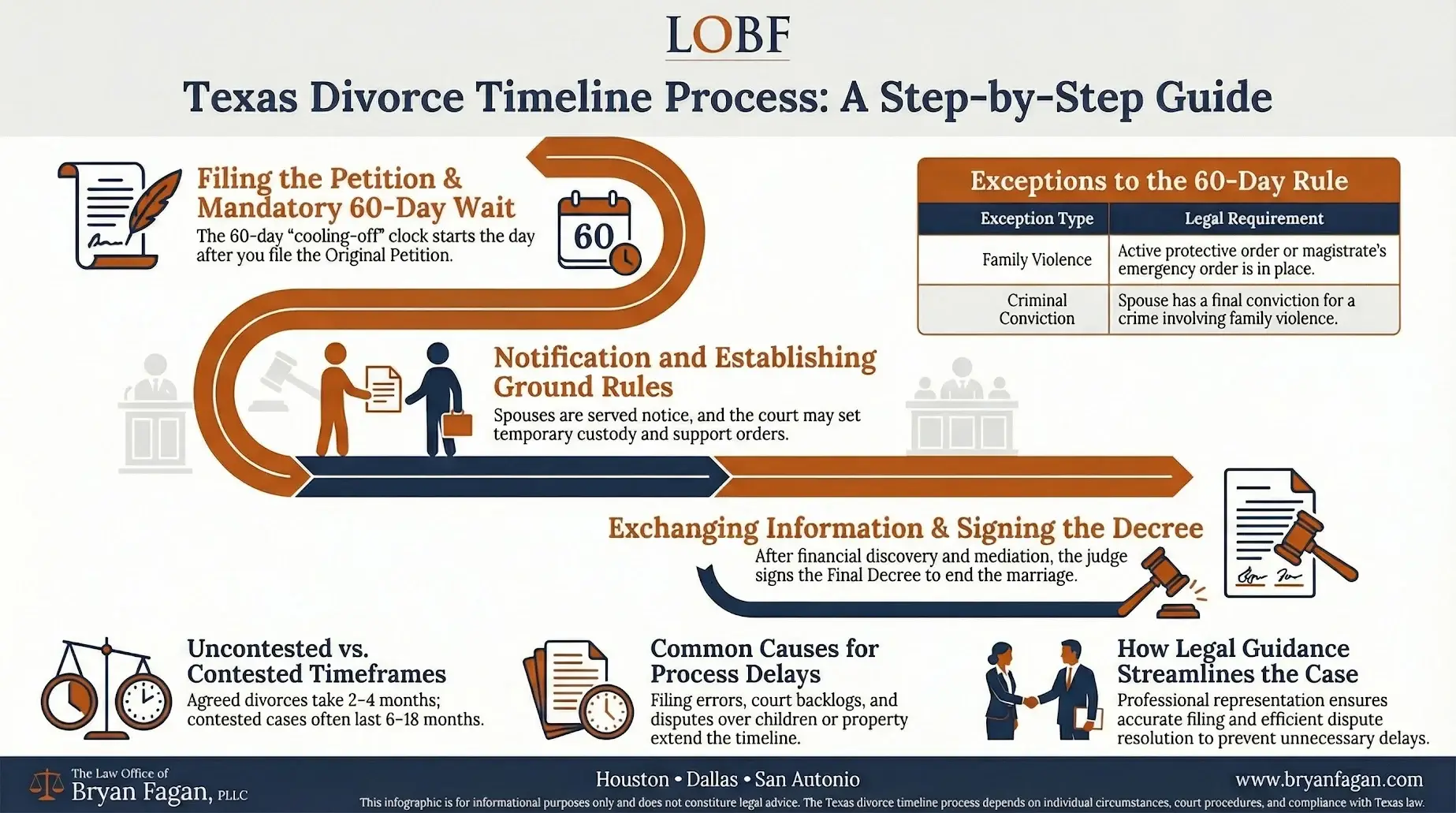
Under the Texas Divorce Timeline Process, state law sets a clear starting point that every family must respect. Texas Family Code §6.702 requires a mandatory 60-day waiting period after the Original Petition for Divorce is filed before a court may grant a final decree. This statutory “cooling-off” period is designed to allow space for reflection and, in some cases, reconciliation. No amount of agreement between spouses, negotiation between attorneys, or urgency in scheduling can override this requirement. The earliest most divorces can be finalized is day 61.
There are limited exceptions. Under Texas Family Code §6.702(b), a court may waive the waiting period in cases involving family violence, such as when there is an existing protective order or a conviction for a qualifying offense. Outside of those specific circumstances, the 60-day rule applies uniformly across Texas courts. That is why understanding the Texas Divorce Timeline Process is so important. Many people assume that an uncontested divorce can be completed immediately, but even the smoothest case must comply with this statutory timeline. For a deeper discussion on what realistic timing looks like, see How Long Does a Divorce Take in Texas? What It Means for You.
It is equally important to recognize that 61 days is simply the legal minimum, not the average. While some agreed divorces conclude shortly after the waiting period expires, contested matters involving conservatorship under §153.002, property division under §7.001’s “just and right” standard, or updated child support calculations under §154.125 (which now reflects the increased guideline cap on net monthly resources) often require additional hearings, mediation, and formal discovery. These procedural safeguards exist to protect families and ensure fairness, but they naturally extend the timeline.
At The Law Office of Bryan Fagan, PLLC, our Houston-based family law team emphasizes education because informed clients make stronger decisions. Knowing what the law requires allows you to plan wisely rather than react emotionally. If you are navigating custody or support concerns during this waiting period, our Texas Child Support Resource offers practical guidance grounded in current Texas law.
The key takeaway is simple but reassuring: the timeline is structured, not arbitrary. The waiting period is a legal safeguard, and what happens after filing depends largely on preparation, cooperation, and the complexity of the issues involved. With experienced counsel and a clear strategy, families can move through the Texas Divorce Timeline Process with greater confidence, clarity, and peace of mind.

The Seven-Step Texas Divorce Timeline Process
Step 1: Filing the Original Petition for Divorce
The divorce process begins when one spouse files the Original Petition for Divorce with the appropriate Texas district court. Before filing, Texas law requires that at least one spouse has resided in Texas for six months and in the filing county for at least 90 days.
When you file your divorce petition, the 60-day clock officially starts. The petition outlines basic marriage information, grounds for divorce (typically no fault divorce based on “insupportability”), and initial requests regarding property division, child custody, and support.
Filing immediately triggers certain legal requirements. Most Texas courts issue automatic temporary restraining orders preventing both parties from hiding marital assets, making major financial changes, or taking other actions that could harm the marital estate.
A well-prepared petition filed with complete initial disclosures positions your case for efficient resolution. Paperwork errors or incomplete filings trigger clerk rejections, potentially adding two to four weeks per correction cycle.
Step 2: Service of Process and Response
After filing, the other spouse must be formally notified. This “service of process” typically occurs within a few weeks through a constable, sheriff, or private process server.
Once served, the responding spouse has until the Monday after 20 days have passed to file an answer. In practice, this means 20-23 days depending on weekends.
In uncontested divorces where both parties agree to proceed amicably, the responding spouse can sign a waiver of service. This eliminates service costs and delays, often saving one to two weeks.
When service is contested or a spouse evades service, alternative methods like service by publication can add 30-60 days to your divorce timeline. Non-response after proper service results in a default judgment, though Texas courts prefer actual service to avoid later appeals.
Step 3: Temporary Orders (If Needed)
Many divorce cases—especially those involving minor children—require temporary orders to address urgent issues while the divorce proceedings continue.
A court hearing for temporary orders typically occurs within 14 days of the request. These orders address critical interim issues:
- Child custody and visitation schedules
- Temporary child support
- Spousal maintenance during the divorce
- Exclusive use of the family home
- Bill payments and financial support
- Restraining orders to prevent asset dissipation
When parties agree on temporary arrangements, the process moves quickly. When spouses disagree, contested temporary order hearings preview the complexities ahead and can add two to six weeks to the overall timeline.
Temporary orders remain enforceable like final decrees until the court issues its final judgment, providing stability during an uncertain time.

Step 4: Discovery and Information Exchange
The discovery phase involves gathering and exchanging financial information essential for fair property division and support calculations.
Texas Family Code §6.502 requires both spouses to provide financial disclosures within 30 days of filing or response. This includes:
- Complete inventory of marital assets and debts
- Income statements and tax returns
- Retirement accounts and investment holdings
- Insurance policies and other financial documents
In uncontested divorces where both parties cooperate, informal information exchange can wrap up in two to four weeks.
Contested divorce cases often require formal discovery tools: interrogatories (written questions), requests for production, depositions, and subpoenas. When disputes arise over separate versus community property, or when one spouse suspects hidden assets, this phase can stretch to one to three months.
Organized documentation from the start cuts this stage significantly. Cooperation here prevents the adversarial nature of formal discovery from escalating costs and extending timelines.
Step 5: Mediation and Settlement
Across Texas, mediation plays a pivotal role in the Texas Divorce Timeline Process, particularly in counties that require parties to attempt mediation before a case may proceed to trial. Mediation brings both spouses together with a neutral third party who facilitates productive discussion on contested issues such as conservatorship, possession schedules, property division, and support. While Texas Family Code §6.602 formally governs Mediated Settlement Agreements (MSAs), the statute gives these agreements powerful legal effect when properly executed. An MSA that meets statutory requirements is binding and enforceable, meaning the court must enter judgment on its terms in most circumstances.
Statewide data from the Texas Office of Court Administration consistently reflects that a significant percentage of divorce cases resolve through mediation rather than trial. That success rate is not accidental. Mediation allows families to maintain control over decisions instead of leaving outcomes solely to a judge applying §153.002’s “best interest of the child” standard or §7.001’s “just and right” division of community property. When families reach agreement early, the court process becomes far more efficient. In many cases, once the mandatory 60-day waiting period under §6.702 expires, a prove-up hearing can be scheduled promptly. For a detailed explanation of how the waiting period affects timing, see Divorce Waiting Period in Texas.
Successful mediation often allows divorces to conclude within approximately three to four months, depending on court availability and how quickly final documents are prepared. This can be especially beneficial in cases involving updated financial considerations such as child support calculations under Texas Family Code §154.125, which now reflects the increased guideline cap on net monthly resources. Resolving disputes cooperatively reduces the emotional and financial toll that extended litigation can create.
If mediation does not fully resolve every issue, the case may proceed to trial, but even partial agreements significantly narrow the scope of contested matters. Reducing the number of unresolved disputes shortens hearings, limits discovery, and streamlines court involvement. Families seeking additional insight into child-related considerations can review our Texas Child Custody Resource for guidance grounded in current law.
At our Houston-based family law practice, we view mediation not simply as a procedural requirement but as an opportunity for families to move forward with clarity and dignity. By approaching mediation thoughtfully and strategically, many families are able to shorten the Texas Divorce Timeline Process while preserving stability and protecting what matters most.

Step 6: Trial (If Necessary)
When spouses can’t reach agreement through mediation, a trial becomes necessary. A judge hears evidence and makes decisions on contested issues—property division, child custody arrangements, spousal support, and other matters.
Trial significantly extends the Texas Divorce Timeline Process. Court scheduling delays are common, with wait times of three to twelve months in urban areas like Houston and Dallas. The actual trial may last one to five days for moderately complex cases, longer for high-conflict disputes involving expert testimony or business valuations.
Highly contested divorces involving trial can take 12-24 months or longer from filing to final decree. Appeals add additional time.
This is why experienced family law attorneys emphasize settlement whenever possible. Trial should be a last resort, not a first response.
Step 7: Drafting and Signing the Final Decree of Divorce
The final divorce decree is a comprehensive court order detailing:
- Property division (applying Texas’s “just and right” standard)
- Child custody and conservatorship arrangements
- Child support obligations
- Spousal maintenance (if applicable)
- Any name changes
In uncontested divorces, a brief prove-up hearing (typically 5-15 minutes) confirms that both parties voluntarily agree to all terms. The judge reviews the decree, signs it, and your divorce becomes legally final.
For contested cases, the final decree reflects the judge’s rulings after trial. Either way, accurate drafting is essential—errors prompt amendments that can add 30-60 days.
Once signed, you’ll need certified copies of your divorce decree to update records, close accounts, and move forward with your new life.
Typical Timeline for Uncontested vs. Contested Texas Divorces
Understanding how different scenarios affect the Texas Divorce Timeline Process helps families set realistic expectations and make informed decisions. While every case is unique, the timeline often depends on the level of agreement between spouses and the complexity of the issues involved. For a comprehensive overview of each stage, families can review The Divorce Process, which outlines the statutory framework governing divorce in Texas.
In an uncontested divorce, where both spouses agree on conservatorship, possession schedules, property division, and support from the outset, the timeline can move efficiently. Texas Family Code §6.702 requires a mandatory 60-day waiting period after filing, meaning the earliest most divorces can finalize is day 61. Once that statutory period expires, courts may schedule a brief prove-up hearing, and many agreed cases conclude within approximately two to four months. Even in these smoother cases, courts must still ensure compliance with §7.001’s “just and right” property division standard and §153.002’s “best interest of the child” requirement if minor children are involved.
Moderately contested divorces, where initial disagreements are resolved through mediation under Texas Family Code §6.602, often take three to six months. Mediation provides an opportunity to reach a binding Mediated Settlement Agreement while avoiding extended litigation. When disputes over updated financial considerations—such as child support calculations under §154.125, which now reflects the increased guideline cap on net monthly resources—are addressed cooperatively, the timeline remains manageable.
Highly contested divorces, however, can extend twelve to twenty-four months or longer, particularly when cases proceed to trial. Custody disputes involving complex conservatorship determinations, significant community property tracing, or business valuations require formal discovery and court hearings. Urban court backlogs may add additional time. Yet even in contested matters, cases can shift toward resolution at any stage. It is not uncommon for couples who initially appear headed for trial to reach agreement after productive mediation sessions or strategic negotiation.
At our Houston-based family law firm, we have seen firsthand how preparation and informed decision-making shape the Texas Divorce Timeline Process. Families seeking additional clarity on financial responsibilities during divorce may also find guidance in our Texas Child Support Resource. With experienced legal guidance and a clear understanding of the statutory framework, families can move forward with confidence, knowing that the timeline is structured by law but influenced by cooperation and preparation.

Factors That Speed Up the Texas Divorce Timeline Process
Several factors can help your divorce finalize faster:
Early full agreement: The most powerful accelerator. When spouses agree on all key issues before or shortly after filing, the divorce process can conclude within days of the waiting period ending.
Organized financial documentation: Having complete records of marital assets, debts, income, and expenses ready from day one eliminates weeks of document gathering.
Prompt responses: Meeting every deadline for responses, document requests, and court filings prevents the delays that compound throughout legal proceedings.
Professional legal guidance: Experienced family law attorneys prevent filing rejections, ensure proper service, and navigate procedural requirements efficiently.
Willingness to mediate: Approaching mediation with genuine commitment to resolution dramatically increases success rates.
Factors That Delay the Texas Divorce Timeline Process
Certain circumstances inevitably extend timelines:
Custody disputes: When parents can’t agree on child custody arrangements, courts may order custody evaluations, appoint guardians ad litem, or schedule multiple hearings. These processes add four to eight months.
Complex property division: Businesses requiring valuation, multiple real estate holdings, stock options, and other complex marital assets require expert analysis.
Retirement accounts: Dividing retirement accounts requires Qualified Domestic Relations Orders (QDROs), which need plan administrator approval—often adding two to four months after the final decree.
Emotional conflict: When one spouse is determined to fight or refuses to cooperate, every step takes longer. Poor communication compounds delays.
Court scheduling: Factors beyond your control—court backlog, judge availability, scheduling hearings—affect timelines, particularly in busy urban counties.
Can You Speed Up a Divorce in Texas?
You can take steps to move efficiently through each phase, but you cannot bypass certain legal requirements.
The mandatory waiting period cannot be waived except in narrow family violence circumstances. No amount of agreement or urgency changes this requirement.
You also shouldn’t rush paperwork or skip important steps. Errors in your final divorce decree create expensive problems later—modification proceedings, enforcement actions, or issues with retirement account division.
The goal isn’t the fastest possible divorce. It’s a divorce done correctly the first time, protecting your interests and your children’s welfare.
How a Texas Divorce Attorney Helps Manage the Timeline
Experienced legal representation can have a meaningful impact on how efficiently your case moves through the Texas Divorce Timeline Process. Divorce in Texas is governed by detailed statutory requirements, and even small procedural missteps can create avoidable delays. An experienced Texas family law attorney ensures that the Original Petition complies with residency requirements under Texas Family Code §6.301, that service of process is properly completed in accordance with the Texas Rules of Civil Procedure, and that mandatory waiting period rules under §6.702 are respected. When filings are accurate from the beginning, courts are far less likely to reject paperwork or require corrections that push hearings back by weeks.
Strategic preparation also matters. Temporary orders under §6.502 often shape the trajectory of a divorce, especially in cases involving conservatorship governed by §153.002’s “best interest of the child” standard. A well-prepared attorney anticipates potential disputes, gathers financial documentation early, and structures mediation presentations effectively under §6.602, which governs binding Mediated Settlement Agreements. This proactive approach increases the likelihood of early resolution and reduces the need for repeated hearings or trial settings.
Keeping a case moving requires more than filing documents. It involves meeting deadlines, responding promptly to discovery requests, and addressing updated financial considerations such as child support calculations under §154.125, which now reflects the increased guideline cap on net monthly resources. By staying ahead of these legal requirements, families can avoid unnecessary extensions of the timeline. For practical guidance on navigating this process wisely, see How to Handle the Divorce Timeline in Texas the Right Way.
Families who work with experienced counsel often find that their cases resolve more efficiently than those attempting to manage the legal system alone. While every situation is unique, careful legal planning frequently reduces procedural delays and limits avoidable conflict. Clients seeking additional clarity on financial responsibilities during divorce may also find value in our Texas Child Support Resource, which explains current statutory guidelines in accessible language.
At our Houston-based family law firm, we believe representation is not just about courtroom advocacy; it is about creating structure during uncertainty. When handled thoughtfully, the Texas Divorce Timeline Process becomes more predictable, more manageable, and ultimately more empowering for families working toward a stable future.

Why Choose The Law Office of Bryan Fagan, PLLC
Navigating the Texas Divorce Timeline Process requires more than simply filing paperwork—it requires strategic planning, clear communication, and a steady understanding of Texas law. At our Houston-based family law practice, we guide families through each statutory step, from the filing requirements under Texas Family Code §6.301 to the mandatory waiting period set forth in §6.702 and the “just and right” property division standard in §7.001. Whether a case involves agreed conservatorship guided by §153.002 or updated child support calculations under §154.125, which now reflects the increased guideline cap on net monthly resources, our approach is rooted in legal precision and compassionate advocacy.
We focus on thoughtful timeline management because efficiency and protection go hand in hand. Properly prepared pleadings reduce the risk of rejected filings. Careful service of process prevents avoidable delays. Early preparation for mediation under §6.602 increases the likelihood of a binding Mediated Settlement Agreement and shortens the overall process. For families pursuing an agreed resolution, our detailed resource Making Sense of Uncontested Divorce in Texas: The Timeline and What It Means for You provides helpful insight into how cooperation can significantly streamline the path forward.
Clear communication is equally important. Divorce can feel overwhelming, but when clients understand how each procedural stage fits into the broader Texas Divorce Timeline Process, uncertainty becomes manageable. We believe families make better decisions when they are informed. That is why we prioritize education and transparency at every step. Clients seeking additional clarity on financial responsibilities during divorce can review our Texas Child Support Resource for practical guidance grounded in current law.
Above all, our legal team understands that divorce is not just about statutes and deadlines—it is about families in transition. Whether your case is straightforward or involves complex property division, contested custody, or evolving financial circumstances, our role is to provide steady guidance anchored in Texas law while protecting your long-term stability. When handled with strategy and empathy, the Texas Divorce Timeline Process becomes not a source of fear, but a structured path toward clarity, confidence, and a protected future.
Checklist: Texas Divorce Timeline Process
- ☐ Confirm you meet Texas residency requirements (6 months state, 90 days county)
- ☐ Determine whether your case will likely be contested or uncontested
- ☐ Gather financial documents: tax returns, bank statements, retirement accounts, insurance policies
- ☐ Prepare parenting information if you have minor children
- ☐ Respond promptly to all court deadlines and attorney requests
- ☐ Consider mediation as soon as disputes arise
- ☐ Consult with an experienced Texas divorce attorney to avoid unnecessary delays
Conclusion
Divorce can feel like life pressed pause—but the truth is, it’s a transition, not an ending. When you understand how the Texas Divorce Timeline Process works, uncertainty begins to shrink. Structure replaces chaos. Clear next steps replace late-night worry. And when you approach the process intentionally, you create space not just for legal resolution, but for emotional stability and forward momentum.
At The Law Office of Bryan Fagan, PLLC, we believe families deserve more than paperwork and court dates. You deserve clarity. You deserve a plan. And you deserve experienced guidance from a Texas Family Law Attorney who understands both the law and the human side of what you’re walking through. Bryan Joseph Fagan and our team have helped families across Houston and throughout Texas navigate complex divorces with strategy, compassion, and steady leadership.
If you’re facing questions about your timeline, custody, property division, or simply what tomorrow looks like, now is the time to get informed. Schedule a consultation, ask the hard questions, and begin building a path forward that protects what matters most. Even small steps toward clarity can bring meaningful peace of mind.
Transitions are never easy—but they can be handled wisely. And sometimes, the most empowering thing you can do for your future is simply decide you’re ready to move forward with the right support beside you.
Frequently Asked Questions
The divorce process in Texas takes a minimum of 61 days due to the mandatory 60-day waiting period after filing. That said, most cases take longer. An agreed, uncontested divorce may be finalized in two to four months, while contested divorces involving custody disputes or complex property division can take six months to a year or more. The timeline largely depends on cooperation, court scheduling, and how quickly issues are resolved.
In most situations, no. Texas law requires a 60-day waiting period before a judge can finalize a divorce, meaning the earliest possible finalization is typically on day 61. There are limited exceptions involving family violence, but for most couples, the waiting period cannot be waived.
Avoid actions that create unnecessary conflict or harm your legal position. Do not hide assets, drain bank accounts, violate court orders, or use children as leverage in disputes. It is also wise to avoid emotional social media posts or major financial decisions without legal guidance. Calm, strategic decisions tend to protect both your case and your peace of mind.
The fastest path is an agreed divorce where both spouses reach a full settlement early in the process. When financial disclosures are exchanged promptly and paperwork is prepared correctly the first time, the case can often be finalized shortly after the waiting period ends. Working with an experienced Texas Family Law Attorney can prevent costly delays caused by filing errors or incomplete agreements.
The “10-year rule” commonly refers to eligibility for spousal maintenance. In certain circumstances, if a marriage lasted 10 years or longer, a spouse may request maintenance. However, the length of marriage alone does not guarantee support. Courts also evaluate income, earning capacity, financial need, and other statutory factors before awarding maintenance.
The “6-month rule” refers to residency requirements. To file for divorce in Texas, at least one spouse must have lived in the state for six months and in the county of filing for at least 90 days. If these requirements are not met, the court may dismiss or delay the case until residency is established.
Moving out is not automatically a mistake, but doing so without a plan can create complications. It may impact temporary custody arrangements, access to property, or how a court views the status quo. Before leaving the marital home, it is important to understand how the decision could affect your case and to speak with an attorney about protecting your interests.
While you cannot bypass the mandatory waiting period, you can reduce avoidable delays. Gather financial documents early, respond promptly to requests, consider mediation, and avoid unnecessary disputes. Clear communication and proper preparation often shorten the overall timeline.
Financial outcomes vary widely depending on income levels, debt, property division, and support obligations. Often, both spouses experience financial strain because one household becomes two. The long-term impact depends on the settlement structure, earning capacity, and post-divorce planning. Careful negotiation and strategic legal guidance can help minimize unnecessary financial hardship for both parties.