
Divorce Application Online Texas is often searched during a moment that feels small but carries a lot of weight. Maybe it’s late at night, the house is finally quiet, and you’re standing in the kitchen staring at two coffee mugs left in the sink. Or maybe it’s early morning, scrolling on your phone before the kids wake up, wondering how you got here and how to move forward without everything falling apart. In those moments, people aren’t just looking for a legal process—they’re looking for peace, clarity, and reassurance that their family will be okay on the other side of this.
Many Texans assume that filing for divorce online means the process will be simple, automatic, and emotionally distant. But Texas law doesn’t work that way. Even when documents are submitted electronically, the decisions made during a divorce—especially when children are involved—shape daily life in lasting ways. Under Texas Family Code §153.002, courts must focus on the best interest of the child, weighing stability, consistency, and each parent’s ability to provide a safe, structured environment. Online filing may change how paperwork gets to the courthouse, but it does not lessen the responsibility parents carry or the scrutiny courts apply.
At The Law Office of Bryan Fagan, PLLC, we’ve walked alongside families across Texas during these exact moments of uncertainty. Founded by Bryan Joseph Fagan, a South Texas College of Law graduate and recognized authority on Texas divorce and custody law, our Houston-based firm understands that divorce is not just a legal event—it’s a life transition. We’ve seen how rushed decisions and generic online forms can create unnecessary conflict, and how thoughtful, compassionate legal guidance can restore calm, protect children, and give parents confidence about what comes next.
This article will explain what a divorce application online Texas really involves, how Texas courts evaluate parenting arrangements, and how families can move through divorce with intention rather than fear. If you’re searching for more than instructions—if you want understanding, protection, and a path toward peace of mind—you’re in the right place.
Key Takeaways
- Texas does not have a single “divorce application”—divorce begins with filing an Original Petition for Divorce, which can be submitted electronically through the eFileTexas system.
- Online filing is a submission method, not an automated divorce—you still must comply with Texas Family Code requirements, serve your spouse properly, wait 60 days, and obtain a judge’s approval.
- Uncontested divorces are best suited for online tools—if you and your spouse disagree on custody, property, or support, online document services cannot resolve those disputes.
- Generic online forms frequently get rejected—Texas courts require Texas-specific language and compliance with local court rules.
- Attorney review before final submission can prevent expensive post-divorce problems—even a one-time document review catches errors that would otherwise become permanent.

Your Family’s Future Starts Here
Don’t navigate your legal journey alone. Schedule a consultation now and get the clarity and support you deserve.
Divorce Application Online Texas: What It Really Means
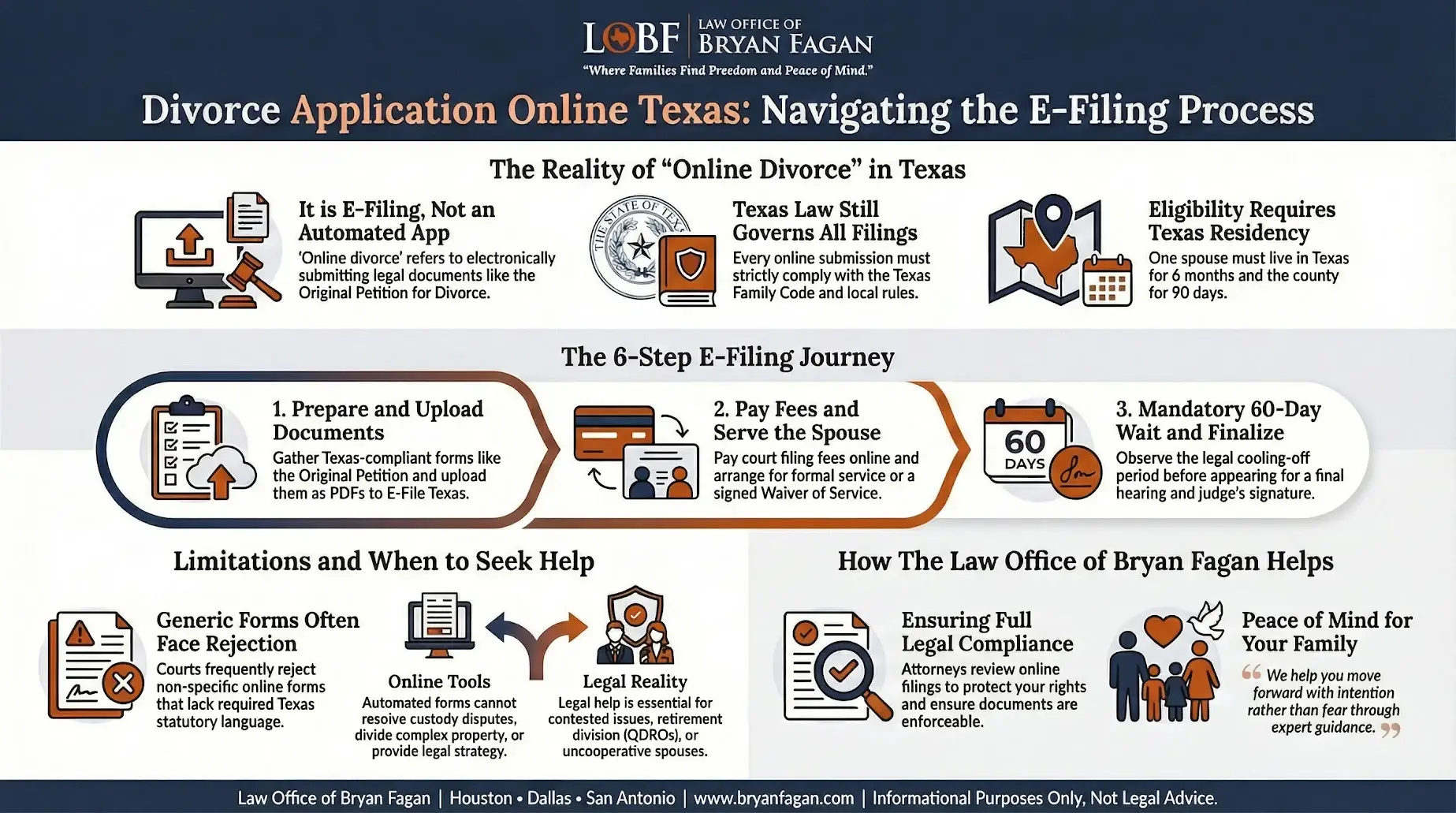
Under Texas law, there is no single form officially called a divorce application, even though many people begin their search with the phrase Divorce Application Online Texas. That wording is understandable, but it blends together two very different concepts: electronically submitting divorce paperwork to a Texas court and using private online services that generate divorce forms. Texas statutes do not recognize “online divorce” as a separate legal process. Instead, the Texas Family Code governs how a divorce must be initiated, what information is required, and how courts evaluate each case, regardless of whether documents are filed online or in person.
The document that formally starts a divorce in Texas is the Original Petition for Divorce. This required pleading identifies the parties, states the legal grounds for divorce, and describes the relief being requested, all in compliance with the Texas Family Code. For example, Texas Family Code §6.301 establishes residency requirements that must be met before filing, and §6.702 imposes a mandatory waiting period in most cases before a divorce can be finalized. The petition is filed with the district court in the appropriate county, and while Texas courts allow electronic submission through the approved e-filing system, electronic filing changes only how documents are delivered to the court—not the legal standards, disclosures, or precision the law requires.
When people search for an “online divorce application,” they are usually referring to one of two things: using the Texas court system’s e-filing platform or relying on a private document-preparation service that produces forms based on a questionnaire. These options are not interchangeable. E-filing is a court-approved procedural method, while document-preparation services are private businesses that do not provide legal advice, do not represent you, and cannot ensure a judge will accept or enforce the documents they generate. Attorneys at the Law Office of Bryan Fagan, PLLC regularly help families understand these distinctions and avoid preventable mistakes by explaining how Texas law actually works in practice. If you want a deeper, practical discussion of whether online filing makes sense for your situation, see our detailed guide on whether filing for divorce online in Texas is the best option for you, along with our broader Texas divorce resources designed to educate families and protect their futures.

Does Texas Allow a Divorce Application Online?
Yes, Texas allows electronic filing of divorce documents through the official eFileTexas.gov system. However, the divorce process still follows traditional legal steps—online filing simply changes how you submit paperwork, not what the law requires.
The eFileTexas system provides guided interviews to help you complete Texas-compliant divorce forms. You can file your Original Petition for Divorce, pay court filing fees electronically, submit agreed orders, and receive court notices through the system. The Texas Supreme Court has approved this e-filing process, and all Texas courts accept electronic submissions.
But here’s what electronic filing does not do: it does not provide legal advice, resolve disagreements between spouses, guarantee court approval, or replace the mandatory 60-day waiting period required by Texas Family Code Section 6.702. A judge must still review and sign your Final Decree of Divorce before your marriage is legally dissolved.
Who Can Use a Divorce Application Online in Texas
Texas Residency Requirements
Before you can file any divorce documents—online or otherwise—you must satisfy Texas jurisdictional requirements. Under Texas Family Code Section 6.301, at least one spouse must have been a domiciliary of Texas for six months immediately before filing. Additionally, that spouse must have resided in the specific county where you file for at least 90 days.
For example, if you moved to Harris County from California five months ago, you cannot yet file for divorce in Texas—even if your spouse still lives in California and you both want the divorce. You must wait until you’ve lived in Texas for six full months and in Harris County for 90 days. No online service or e-filing system can bypass these requirements.
Best Candidates for Online Filing
Online divorce tools work best for uncontested divorces—situations where both spouses agree on all major issues including property division, debt allocation, child custody, child support, and spousal maintenance. If you and your spouse have already worked out these details and simply need help preparing the paperwork, online filing can be efficient and cost-effective.
Pro se (self-represented) divorce is permitted in Texas, meaning you can file without an attorney. However, self-representation does not mean you can avoid legal requirements. Your documents must still comply with the Texas Family Code, Texas Rules of Civil Procedure, and any local court rules (called standing orders) that apply in your county.
If you and your spouse disagree on custody, property division, or support—or if you have complex assets like retirement accounts, business interests, or real property—online document services cannot resolve those disputes. Contested divorces require negotiation, mediation, or court hearings that no automated system can handle.
Step-by-Step: How to File a Divorce Application Online Texas
Filing a Divorce Application Online Texas is often described as a simple checklist, but in reality it is a structured legal process governed by the Texas Family Code and local court rules. Before anything is filed, spouses must prepare Texas-compliant documents, beginning with the Original Petition for Divorce. This petition sets the foundation for the case by identifying the parties, stating the legal grounds for divorce, and outlining the relief requested, all while complying with statutory requirements such as the residency rules in Texas Family Code §6.301. Supporting documents may also be required, including a Waiver of Service if both spouses are cooperating, a proposed Final Decree of Divorce, and sworn financial disclosures when property or support issues are involved.
Once the paperwork is ready, the next step is creating an account through the state’s approved electronic filing system. Selecting the correct county and court is critical, as divorces are typically filed in district court and local rules vary widely across Texas. When the Original Petition is uploaded, it must meet strict formatting and file-size requirements. Documents that fail to comply are often rejected by the clerk, which can delay the case and increase stress during an already difficult time. Families working with experienced Texas family law counsel often avoid these setbacks by ensuring filings are accurate before submission.
After filing, court costs must be paid unless the filer qualifies for a waiver. Filing fees differ by county, but Texas law allows individuals who cannot afford these costs to request relief by filing a Statement of Inability to Afford Payment of Court Costs. Proper service of process must then occur. Even in an online filing scenario, Texas courts still require formal notice to the other spouse unless a Waiver of Service is signed. This step is essential for due process and cannot be handled automatically by the e-filing system.
From there, the case enters the mandatory waiting period required by Texas Family Code §6.702, which generally imposes a 60-day pause between filing and finalization. This period applies regardless of how efficiently documents are submitted online and is intended to ensure thoughtful decision-making. Once the waiting period has passed and all issues are resolved, the proposed Final Decree of Divorce may be submitted for judicial review. A judge must still approve and sign the decree before the divorce becomes legally effective.
Most uncontested divorces conclude with a brief prove-up hearing or, in some counties, sworn affidavits in lieu of a hearing. Judges use this final step to confirm that the agreement is voluntary, complete, and consistent with Texas law. Throughout this process, it is important to remain cautious about third-party online services and digital communications, particularly in an era where impersonation and fraud are growing concerns. Families are encouraged to stay informed through resources such as our discussion on online impersonation risks and to rely on verified guidance rather than anonymous online platforms.
The attorneys at The Law Office of Bryan Fagan, PLLC regularly guide families through each of these steps with clarity and care, blending legal precision with compassion. For additional education on filing requirements and divorce procedures, readers may also find our broader Texas divorce resources helpful as they work to protect their rights and their future during this transition.

What Parts of a Texas Divorce Can Be Done Online
The eFileTexas system allows you to handle many administrative aspects of your divorce electronically:
- Filing pleadings and court documents including your Original Petition, responses, and agreed orders
- Paying court costs securely through the electronic payment system
- Receiving court notices and citations electronically
- Submitting agreed orders including your Final Decree of Divorce when both parties have signed
These capabilities streamline the administrative process and eliminate trips to the courthouse for document filing. For straightforward, uncontested divorces, this can save significant time and hassle.
However, online filing is a submission mechanism—it does not replace the substantive legal requirements of divorce. The court must still review your documents, verify compliance with Texas law, and approve your final decree.
What Cannot Be Done Through a Divorce Application Online Texas
Understanding the limitations of online divorce tools is just as important as knowing their capabilities. Here’s what you cannot accomplish through an online “divorce application”:
Receiving legal advice or strategy. Neither eFileTexas nor private document-preparation services can tell you whether a proposed settlement is fair, what rights you may be waiving, or how Texas law applies to your specific situation.
Resolving contested issues automatically. If you and your spouse disagree about custody, property division, child support, or any other major issue, no online system can resolve those disputes. Contested divorces require negotiation, mediation, or court hearings with a judge.
Creating enforceable custody or property provisions without review. Online form services often provide boilerplate language that may not address your family’s specific circumstances. A custody provision that works for one family may be inadequate or unenforceable for another.
Guaranteeing court approval. Judges regularly reject or request modifications to divorce decrees that are incomplete, internally inconsistent, or don’t comply with Texas law. Filing documents online does not guarantee the court will accept them.
Replacing judicial oversight. No matter how perfectly you complete your forms, a judge must still review and sign your Final Decree before your divorce is final. This judicial review is mandatory and cannot be bypassed.
Online Divorce Services in Texas: Forms vs. Legal Representation
Document Preparation Services
Private online divorce services typically provide questionnaires that collect basic information about your marriage, assets, debts, and children. Based on your answers, the service generates divorce forms automatically. These services usually cost between $100 and $300 (not including court filing fees).
What these services provide: form generation, document assembly, formatting for court requirements, and instructions for how to e-file or submit paper documents.
What these services do not provide: legal advice, analysis of whether your settlement is fair, identification of overlooked assets, customization for unusual circumstances, or representation in court.
The critical distinction is that document preparation is not legal representation. If the forms generated by an online service prove inadequate, inaccurate, or unenforceable, the service bears no legal responsibility. You’re on your own to fix the problems.
Why Many Online Applications Get Rejected
Texas courts frequently reject divorce filings that fail to meet the strict requirements set out by state law and local court rules, even when those documents are submitted through a Divorce Application Online Texas process. Online filing does not relax the legal standards judges must apply. Under the Texas Family Code, pleadings must include specific statutory language, accurate disclosures, and legally correct terminology. For example, Texas Family Code §6.701 and §6.702 outline foundational requirements for divorce pleadings and timing, while child-related cases must comply with the “best interest of the child” standard in §153.002. When filings omit required information or rely on generic language not tailored to Texas law, courts are obligated to reject them.
One of the most common problems arises when online-generated documents use terminology borrowed from other states, such as referring to “custody” instead of Texas’s legally defined concepts of conservatorship and possession. Judges also routinely reject petitions that fail to properly state grounds for divorce, ignore county-specific standing orders, or include formatting and file-size errors that do not meet eFileTexas specifications. These issues are not merely technical. They affect whether the court has the information it needs to exercise jurisdiction and issue enforceable orders under the Texas Family Code, including provisions related to property division, child support, and parenting arrangements.
When a filing is rejected, the case does not move forward. Instead, the errors must be corrected and the documents re-filed, often adding weeks or even months to the process. In many situations, families end up seeking legal help after a rejection to fix mistakes that could have been avoided with proper guidance from the start. The legal team at the Law Office of Bryan Fagan, PLLC regularly assists clients in correcting rejected filings and explaining why certain online shortcuts create long-term risks. For families weighing convenience against accuracy, our article on the pros and cons of filing for divorce online in Texas provides valuable perspective on when online filing may help and when it may complicate matters.
For readers who want a broader understanding of how Texas courts expect divorce cases to be presented, our Texas divorce resources offer clear explanations grounded in current law and real courtroom experience. By combining careful legal preparation with compassionate guidance, our firm helps families avoid unnecessary delays and move through the divorce process with greater confidence and peace of mind.
Divorce Application Online Texas When Children Are Involved
When a Divorce Application Online Texas involves children, the legal landscape becomes far more detailed and unforgiving of mistakes. Texas law imposes additional requirements specifically designed to protect children, and courts apply heightened scrutiny to every provision that affects the parent-child relationship. Under Texas Family Code §153.0061, any order involving children must include a comprehensive parenting plan that clearly defines each parent’s rights, duties, and possession schedule. This is not an area where vague language or generic templates are acceptable, even if documents are filed electronically.
Child support is another area where online tools often fall short. Texas Family Code §154.125 sets out guideline calculations based on the obligor’s net resources and the number of children, creating rebuttable presumptions rather than automatic outcomes. While many online services apply these guidelines mechanically, Texas courts expect support orders to reflect the realities of each family’s circumstances. Factors such as health insurance costs, educational expenses, and deviations from the guideline amount must be handled carefully to avoid future disputes or enforcement problems. For parents seeking a deeper understanding of how these rules apply, our Texas child support resources provide practical guidance grounded in current law.
Parenting plans themselves must address a wide range of issues, including decision-making authority, possession and access schedules, holiday and summer arrangements, communication between parents, and medical support obligations. Courts review these provisions closely to ensure they serve the child’s best interest under Texas Family Code §153.002. Boilerplate language generated by online forms often fails to reflect the unique needs of a family, increasing the likelihood of rejection or future modification. In addition, Texas law requires notification to the Office of the Attorney General if a child has ever received Medicaid or TANF benefits, and failing to comply with that requirement can delay finalization or even reopen a case after the divorce is granted.
Attorneys with the Law Office of Bryan Fagan, PLLC frequently see parents surprised by how complex child-related issues become when handled through online-only tools. Many of these misunderstandings stem from persistent myths about online divorce, which are addressed in the top 10 myths about filing for divorce online in Texas. Because Texas courts take their responsibility to children seriously, divorces involving minors are far more likely to encounter delays or complications without experienced legal review. By combining compassionate guidance with a thorough understanding of the Texas Family Code, our firm helps families create parenting and support arrangements that are not only legally sound but also built to protect children and provide lasting stability.
Common Mistakes When Using a Divorce Application Online Texas
Understanding common pitfalls helps you avoid them. Here are the mistakes we see most frequently:
Filing incomplete or incorrect forms. Online questionnaires may not ask about all relevant assets, debts, or circumstances. If information is omitted from your sworn inventory, it’s likely omitted from your Final Decree—creating potential for post-divorce disputes.
Improper service of process. Many people file their petition electronically and assume the process is moving forward, only to discover weeks later that their spouse was never properly served and the case cannot proceed.
Missing retirement accounts or property provisions. Retirement accounts accumulated during marriage are community property under Texas law and must be divided. Dividing these accounts often requires a Qualified Domestic Relations Order (QDRO). Online services frequently overlook this requirement.
Submitting unenforceable final decrees. If your Final Decree contains ambiguous language about property division or custody, you may face post-divorce litigation to clarify or enforce the terms—at far greater expense than getting it right the first time.
Assuming courts will catch and correct errors. Judges expect parties to provide complete, accurate documents. While a judge may question a provision during a hearing, the court is not obligated to identify and fix every error. If mistakes slip through, post-divorce modification through a separate lawsuit is often the only remedy.
How a Texas Divorce Attorney Helps With Online Divorce Applications
Even when families rely on online tools to begin a Divorce Application Online Texas, experienced legal guidance can be the difference between a smooth outcome and years of avoidable problems. Online platforms may help assemble paperwork, but they cannot evaluate whether documents comply with the Texas Family Code or whether the proposed terms truly protect your rights. Having an attorney involved, even in a limited role, adds a critical layer of protection by ensuring that what you file today will hold up tomorrow.
A careful document review allows a Texas family law attorney to identify missing disclosures, incorrect language, or provisions that do not align with current statutory requirements. Compliance with the Texas Family Code is not optional. For example, property division must meet the “just and right” standard under Texas Family Code §7.001, child-related provisions must satisfy the best-interest standard in §153.002, and most cases remain subject to the mandatory waiting period in §6.702. A one-time legal review is often far less expensive than correcting errors after a judge has signed a Final Decree of Divorce.
Local court procedures also matter. Standing orders and filing practices vary by county, and an attorney familiar with those local rules can ensure that documents meet both statewide statutory requirements and county-specific expectations. This attention to detail is especially important when drafting enforceable final decrees. Precise language is essential in areas such as conservatorship, possession schedules, child support under Texas Family Code §154.125, and the division of retirement accounts or real property. Ambiguity in a final decree often leads to enforcement actions or modification lawsuits long after the divorce is complete.
The team at the Law Office of Bryan Fagan, PLLC frequently sees clients who thought they were finished, only to discover that a poorly drafted decree created new disputes. Preventing post-divorce litigation is one of the most valuable services an attorney provides, because fixing mistakes later usually requires additional court proceedings and significant expense. Getting the decree right the first time protects your financial stability and your peace of mind.
To make quality legal guidance accessible, many Texas family law practices—including ours—offer limited-scope and flat-fee services. These options bridge the gap between do-it-yourself online tools and full representation, allowing families to receive professional oversight without unnecessary cost. For readers who want a broader understanding of how each stage fits together, our overview of the Texas divorce process provides clear, step-by-step insight grounded in current law. Additional guidance can also be found in our Texas divorce resource center, where families can continue learning and feel supported as they move forward.
Why Choose The Law Office of Bryan Fagan, PLLC
Families exploring a Divorce Application Online Texas option are often looking for efficiency, but not at the expense of their rights or their future. The attorneys at this Houston-based family law firm recognize that convenience must be balanced with legal precision, especially under the Texas Family Code, which governs everything from residency requirements under §6.301 to mandatory waiting periods in §6.702 and child-related protections rooted in the best-interest standard of §153.002. Online filing can be a useful procedural tool, but it does not change the law or reduce the court’s expectations for accurate, enforceable documents.
What sets the Law Office of Bryan Fagan, PLLC apart is the ability to meet families where they are while ensuring their filings comply with both statewide statutes and local court rules. The legal team brings extensive experience with Texas e-filing systems across multiple counties, allowing them to anticipate technical issues and jurisdiction-specific requirements that often trip up self-represented litigants. Clients also benefit from flexible representation options, ranging from targeted document review and limited-scope assistance to full representation in uncontested divorces, all designed to prevent ambiguity that can lead to post-divorce disputes.
Clear communication is a cornerstone of the firm’s approach. Complex legal concepts—such as conservatorship versus possession, or how property division under Texas Family Code §7.001 must be structured—are explained in plain language so clients can make informed decisions with confidence. This commitment to education and compassion reflects the firm’s broader mission of protecting families while helping them move forward with peace of mind. For readers weighing whether online filing truly fits their situation, the firm encourages reviewing the benefits and drawbacks of filing for divorce online in Texas, which offers a practical, balanced analysis.
Whether you need a careful review of documents you have already prepared or comprehensive guidance through every stage of the divorce process, the team is prepared to help. Additional insights and resources are available through the firm’s Texas divorce information center, where families can continue learning and feel supported as they navigate one of life’s most challenging transitions.

Checklist: Divorce Application Online Texas
Before you file, confirm you’ve addressed each of these items:
☐ Confirm Texas residency requirements—at least one spouse has lived in Texas for 6 months and in your county for 90 days
☐ Ensure your divorce is uncontested—you and your spouse agree on all major issues including property, custody, and support
☐ Use Texas-specific divorce forms—generic forms from other states will likely be rejected
☐ Complete mandatory financial disclosures—list all assets and debts in your sworn inventory
☐ Arrange for service of process—either obtain a signed Waiver of Service or arrange formal service
☐ Review all documents carefully before e-filing—check for completeness, accuracy, and compliance with formatting requirements
☐ Consult a Texas divorce attorney before final submission—even a one-time review can catch errors that would otherwise become permanent
Conclusion
Choosing how to move forward with a divorce—especially when children are involved—rarely feels simple, even when the internet promises otherwise. Online filing tools can be helpful, but they’re only one piece of a much bigger picture. What truly matters is how the decisions made during this process shape your family’s daily life, emotional balance, and long-term stability. When handled thoughtfully, divorce can become a reset rather than a rupture.
If you’re navigating a divorce application online Texas and finding yourself unsure about next steps, that uncertainty is normal. The law is detailed, the emotions are real, and the stakes are personal. This is where working with an experienced Texas family law attorney makes a difference—not to complicate things, but to bring clarity, calm, and confidence to choices that shouldn’t be left to guesswork or generic forms.
At The Law Office of Bryan Fagan, PLLC, the goal is not just to help families finish a case, but to help them move forward with peace of mind. If you’re ready for answers, guidance, or simply a steady hand through the process, reaching out for a conversation can be the first step toward protecting what matters most. And if nothing else, remember this: taking the time to do things right now often makes everything feel a little lighter later.
Frequently Asked Questions About Divorce Application Online Texas
You can file divorce documents electronically in Texas through the state’s e-filing system, commonly referred to as eFileTexas. However, Texas does not offer a single online form that automatically completes your divorce. Filing online only changes how paperwork is submitted to the court. You must still prepare the correct documents, follow service rules, comply with waiting periods, and obtain a judge’s signature before the divorce is final.
The Texas divorce process typically begins by filing an Original Petition for Divorce in the appropriate county. This filing formally opens the case. Afterward, the other spouse must be legally notified unless they sign a Waiver of Service. From there, the case moves through required steps such as service, waiting periods, and final court approval.
Yes, Texas allows individuals to represent themselves in divorce cases, often referred to as filing “pro se.” That said, self-filing still requires strict compliance with Texas law, correct legal language, and enforceable final orders. Many people choose to work with a Texas family law attorney for limited assistance, such as reviewing documents, to avoid mistakes that can cause delays or problems later.
Court filing fees vary by county but commonly fall in the several-hundred-dollar range. Additional costs may include service of process, certified copies, or assistance with document preparation. If paying the filing fee is a hardship, Texas courts allow you to request a fee waiver by filing a Statement of Inability to Afford Payment of Court Costs.
An uncontested divorce, where both spouses agree on all major issues, is usually the fastest and least expensive option. Even then, Texas requires a waiting period and court approval. While online tools can reduce some costs, accuracy matters. Errors in paperwork often lead to delays and added expenses, which is why many families seek legal guidance even in uncontested cases.
The “10-10-10 rule” is not a Texas legal standard. It is often used as a personal decision-making concept, encouraging people to consider how a choice may affect them in 10 days, 10 months, and 10 years. While it can be helpful for reflection, it does not replace Texas laws governing property division, custody, or support.
The first step is gaining clarity about your situation, including children, property, debts, and safety concerns. From a legal standpoint, the process usually starts with filing the Original Petition for Divorce in the correct county. Speaking with a Texas family law attorney early can help you understand your options and avoid missteps that complicate the process.
Texas law generally requires a waiting period between filing and finalizing a divorce, even when both parties agree. Some divorces can be finalized shortly after that period ends if all paperwork is correct and uncontested. Contested cases or cases involving children and complex property issues often take longer due to court scheduling and additional legal steps.
Texas does not require spouses to be separated for any specific length of time before filing for divorce. However, the state does impose a mandatory waiting period after the case is filed before it can be finalized in most situations. Separation can still play a practical role in temporary arrangements and financial planning while the case is pending.