
The envelope sat on the kitchen counter all morning, unopened, while you juggled breakfast, work emails, and the quiet tension that’s been hanging in the house for weeks. When you finally tore it open, one sentence seemed to jump off the page: the court is ordering mediation. Confusion sets in fast. Can a judge really force this? Is this just another hurdle in an already exhausting divorce? Why Is Mediation Mandatory In Texas is often the first question parents ask in that moment—usually followed by a deeper fear about losing control over their family’s future.
The answer is rooted in how Texas courts view families in crisis. Under Texas Family Code §153.002, judges are legally required to focus on the best interest of the child, and over decades, Texas courts have learned a hard truth: prolonged conflict between parents causes lasting damage, even when no one intends it. Mediation isn’t ordered as punishment or pressure. It’s ordered because it gives families a structured, calmer space to make decisions themselves—before a judge who doesn’t know your family has to do it for you.
At The Law Office of Bryan Fagan, PLLC, this understanding shapes everything we do. Bryan Joseph Fagan, a South Texas College of Law graduate and recognized authority on Texas divorce and custody law, has seen firsthand how the right legal guidance can turn fear into clarity. Our mission is simple but powerful: to empower people to reclaim peace of mind during life’s hardest transitions through education, compassion, and smart legal strategy. As you continue reading, you’ll learn not only why mediation is mandatory in Texas, but how this process—when handled correctly—can protect what matters most and help your family move forward with confidence instead of chaos.
Key Takeaways
- Texas courts have broad authority under Texas Family Code §153.0071 to order mandatory mediation in family law cases, making it a routine requirement in contested divorce, child custody, and child support disputes
- Mediation is required by court order rather than automatically by statute, meaning judges use discretion to determine when mediation is appropriate for your specific case
- Mediated Settlement Agreements (MSAs) become legally binding once properly signed and are strongly enforced by Texas courts with limited grounds for challenge
- While attendance at mediation is mandatory when ordered, you cannot be forced to reach an agreement—the decision to settle remains entirely voluntary
- Experienced legal representation during mediation protects your rights, ensures accurate calculations, and produces enforceable agreements that serve your long-term interests

Your Family’s Future Starts Here
Don’t navigate your legal journey alone. Schedule a consultation now and get the clarity and support you deserve.
Why Is Mediation Mandatory in Texas? The Short Answer
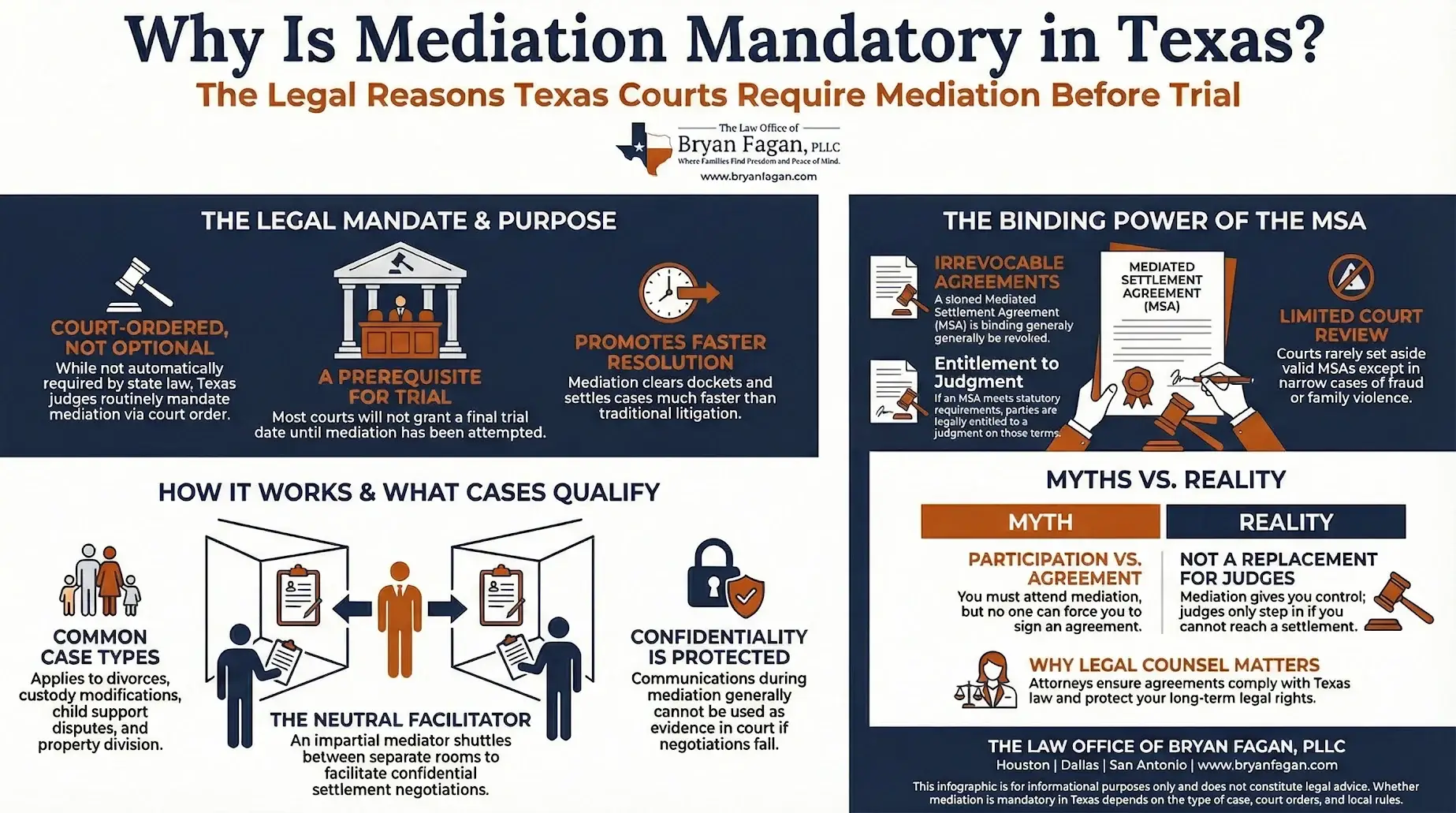
Texas courts require mediation because it consistently produces better outcomes for families navigating divorce and custody disputes. When parents resolve issues through mediation instead of extended courtroom battles, cases tend to move faster, costs are lower, and conflict is reduced. Judges across Texas have seen, over decades on the bench, that mediation helps families maintain stability during emotionally charged transitions, which is why understanding Why Is Mediation Mandatory In Texas is so important for anyone entering the family law system.
Mediation is not mandatory because Texas law imposes a blanket requirement, but because judges are granted broad discretion to order it when circumstances call for it. Under the current version of Texas Family Code §153.0071, courts may refer any suit affecting the parent-child relationship to mediation, including divorce cases, child custody disputes, child support matters, post-divorce modifications, and enforcement proceedings. This discretion allows judges to encourage resolution while still honoring the guiding principle set out in Texas Family Code §153.002—that every decision must serve the best interest of the child. As Texas courts continue to prioritize efficiency and child-focused outcomes, mediation has become a trusted and widely used tool.
The distinction between mandatory participation and voluntary resolution is critical. When a court orders mediation, parties are required to attend and participate in good faith, but they cannot be forced to settle. You always retain control over whether to sign a Mediated Settlement Agreement, and Texas law strongly protects that choice. For families who want a clearer understanding of how this process works in practice, our attorneys often recommend reviewing resources like Understanding the Role of Mediation in Texas Family Law, which explains what to expect before, during, and after mediation.
At our firm, this approach reflects a larger commitment to education and empowerment. By pairing compassionate guidance with clear explanations of the Texas Family Code, experienced Texas family law counsel helps families approach mediation with confidence rather than fear. When parents understand both their legal rights and the purpose behind court-ordered mediation, they are better positioned to move forward with clarity, peace of mind, and solutions that protect their children and their future.

The Legal Authority Behind Mandatory Mediation in Texas
The legal foundation behind court-ordered mediation in Texas begins with the Texas Alternative Dispute Resolution Act, enacted in 1987 and codified in Chapter 154 of the Texas Civil Practice and Remedies Code. Under Section 154.021, courts are expressly authorized to refer pending disputes to mediation either on their own initiative or at the request of a party. This statutory framework reflects a long-standing policy decision by Texas lawmakers to encourage efficient, constructive resolution of disputes outside the courtroom—an approach that directly informs Why Is Mediation Mandatory In Texas in modern family law cases.
For matters involving families and children, the authority becomes even more specific. Texas Family Code §153.0071 grants courts the power to order mediation in any suit affecting the parent-child relationship and establishes the requirements for enforceable Mediated Settlement Agreements. This statute works alongside the Texas Rules of Civil Procedure, which give judges broad discretion to manage their dockets and require alternative dispute resolution when it serves the interests of justice. Together, these laws allow courts to tailor mediation orders to the facts of each case while remaining anchored to the overarching mandate in Texas Family Code §153.002 that all decisions must promote the best interest of the child.
Judicial discretion plays a central role in how mediation is applied. Judges evaluate the complexity of the issues, the level of conflict between the parties, and the potential impact on children before ordering mediation. Over time, particularly in major Texas jurisdictions such as Houston, Dallas, Austin, and San Antonio, this discretion has evolved into a near-standard practice in contested family law cases. Courts have found that mediation frequently leads to resolutions parents are more likely to follow, reducing the need for repeated court involvement and enforcement actions.
The historical context explains why mediation is now so deeply embedded in Texas family law. In the late 1980s and early 1990s, Texas courts faced overwhelming backlogs, with some cases taking years to reach trial. Early adopters of mandatory mediation demonstrated that cases could be resolved more quickly and with greater compliance when parties were given structured opportunities to negotiate. Today, mediation remains a critical step before trial, and our legal team often encourages families to explore educational resources like Mediation: The Hidden Gem of Texas Family Law to better understand how this process can work to their advantage.
This emphasis on education and informed decision-making reflects the broader mission of our Texas family law practice. By grounding mediation in clear statutory authority and real-world experience, families are better equipped to approach the process with confidence rather than uncertainty. When parents understand both the legal basis and the practical purpose behind court-ordered mediation, they are far more likely to reach outcomes that protect their children, reduce conflict, and support long-term stability.

Types of Texas Cases Where Mediation Is Commonly Mandatory
Texas courts routinely order mediation in the following family law disputes:
Contested Divorce Cases When spouses disagree about property division, asset division, debt allocation, or spousal maintenance, courts typically require mediation before trial. This applies whether your marriage involves retirement accounts, real estate, business interests, or straightforward community property disputes.
Child Custody and Visitation Disputes Disagreements about conservatorship, custody arrangements, and possession schedules are prime candidates for mandatory mediation. Courts recognize that parents who negotiate their own parenting plans are more likely to follow them and maintain productive co-parenting relationships.
Child Support Establishment and Modification Whether you are establishing initial support obligations or seeking modification based on changed circumstances, courts frequently order mediation to encourage agreement on amounts and terms.
Enforcement of Existing Court Orders When one party alleges the other has violated court orders, mediation can resolve disputes about compliance before formal enforcement proceedings.
CPS-Related Family Law Cases In appropriate circumstances—particularly when reunification is the goal—courts may order mediation in cases involving Child Protective Services to help families reach agreements about safety plans and services.
Local rules in many counties across Texas establish specific mediation requirements and procedures, meaning the exact process may vary depending on where your case is filed.
How Mediation Works in Texas Family Law Cases
Understanding the mediation process reduces anxiety and helps you prepare effectively. Here is what to expect when courts order mediation in your Texas divorce or custody case.
The Neutral Third Party Mediator A neutral mediator facilitates discussions between you and the other party. The mediator may be a retired judge, experienced family law attorney, or trained mediation professional. The mediator’s role is to help parties communicate, identify interests, and explore solutions—not to decide the case or impose outcomes.
Confidential Nature of Mediation Under Texas law, mediation communications are confidential and protected from use in court proceedings. Section 154.073 of the Texas Civil Practice and Remedies Code bars disclosure of what is said during mediation, with limited exceptions. This confidentiality encourages open communication and honest negotiation.
Typical Mediation Structure Most mediations begin with a joint session where the mediator explains the process and each party may present their perspective. The mediator then typically moves parties to separate rooms for private caucuses. The mediator moves between rooms, carrying offers and exploring positions, while maintaining confidentiality about each side’s strategy.
Sessions often last a full day, though some mediations conclude in a few hours while complex cases may require multiple sessions. Pre-mediation submissions of position statements and relevant documents help the mediator understand the issues before everyone arrives.
Difference from Court Hearings Unlike trials where a judge makes final decisions after hearing evidence, mediation is collaborative. The mediator guides discussions but has no authority to impose outcomes. You maintain more control over the resolution of your disputes than you would in litigation.
What Issues Can Be Resolved in Mandatory Texas Mediation
Mediation offers families a flexible and practical way to resolve nearly every major issue that arises in a Texas family law case, which helps explain Why Is Mediation Mandatory In Texas for so many parents navigating divorce or custody disputes. Rather than leaving deeply personal decisions to a judge, mediation gives parents the opportunity to craft agreements that reflect their financial realities, parenting goals, and long-term needs. Texas courts encourage this approach because negotiated resolutions tend to be more durable, less adversarial, and better aligned with the best interest of the child under Texas Family Code §153.002.
Property division is a common focus during mediation. Although Texas law presumes an equal division of community property, judges have wide discretion, and mediation allows spouses to negotiate creative solutions that fit their circumstances. Homes, vehicles, retirement accounts, investments, and business interests can all be addressed in a way that avoids the uncertainty of trial. Debt allocation is often resolved at the same time, giving families clarity about responsibility for mortgages, credit cards, and other financial obligations that might otherwise remain points of conflict.
Mediation is especially valuable in cases involving children. Parents can negotiate conservatorship arrangements under Texas Family Code §153.134, determining who will serve as managing conservator and how decisions about education, medical care, and religious upbringing will be made. Possession and visitation schedules can also be customized beyond the standard possession order to reflect work schedules, school calendars, and the children’s daily routines. This level of flexibility is difficult to achieve in a courtroom but is often critical to maintaining stability for children during and after a divorce.
Financial support issues are also commonly resolved through mediation. Texas Family Code Chapter 154 sets out child support guidelines, including the commonly referenced percentage-based calculations, but mediation allows parents to agree on guideline support or carefully structured deviations when justified by the family’s circumstances. Spousal maintenance, governed by Texas Family Code Chapter 8, can likewise be negotiated within statutory limits to address each spouse’s needs and future earning capacity. Temporary orders related to support, possession, and use of property can also be addressed in mediation, helping families establish workable arrangements while a case is pending.
It is important to understand the limits of mediation as well. Mediators cannot decide non-justiciable issues, override public policy, or resolve criminal matters, and any agreement involving children must still receive court approval. Texas judges will only approve mediated agreements that serve the child’s best interests, reinforcing the protective role of the court even when parents reach consensus. For families looking to better understand how mediation works in real cases, our attorneys often recommend reviewing Mediation in Texas Family Law Cases, which explains how this process is used to resolve disputes while reducing conflict and preserving family stability.
This balanced approach reflects the broader mission of our Texas family law team: to educate families and help them make informed decisions that protect their futures. By understanding what mediation can—and cannot—accomplish, parents are better prepared to engage in the process with confidence, compassion, and a clear focus on what matters most.

Mediated Settlement Agreements (MSAs) and Why Courts Enforce Them
When mediation succeeds, parties sign a Mediated Settlement Agreement that becomes the foundation for final court orders. Understanding MSAs is essential because these written agreements carry significant legal weight.
Under Texas Family Code §153.0071(d), an MSA is binding if it:
- Is signed by each party and their attorney, if represented
- Contains a prominently displayed statement that the agreement is not subject to revocation
- States that the agreement is binding on the parties
Texas courts strongly favor and enforce MSAs. Once you sign a properly drafted mediated agreement, you cannot simply change your mind. The agreement becomes legally binding, and courts will enter judgment consistent with its terms.
Judges must approve MSAs in cases involving children to ensure the terms serve the children’s best interests. However, courts have limited grounds to reject otherwise valid agreements. The narrow exceptions for challenging an MSA include:
- Fraud in obtaining the agreement
- Duress or coercion
- Unconscionability
- Violation of public policy
Case law, including decisions like In re Marriage of Harrison, has established that courts scrutinize claims challenging MSAs carefully. Simply experiencing “buyer’s remorse” or later deciding you could have negotiated better terms does not provide grounds to set aside your mediated settlement agreement.
Why Texas Courts Prefer Mediation Over Trials
Texas courts actively encourage mediation because experience demonstrates its advantages over traditional litigation:
Faster Resolution Mediations often conclude in a single day. Compare this to contested trials that may take months or years to schedule, prepare for, and complete. Families benefit from resolving disputes quickly and moving forward with their lives.
Lower Costs While mediation involves fees—typically shared between parties—the cost effective nature of mediation compared to full litigation is substantial. Avoiding extensive discovery, motion practice, and trial preparation saves thousands of dollars.
Reduced Emotional Toll Trials are adversarial by nature. Cross-examination, contested testimony, and public courtroom proceedings increase stress for everyone, especially children. Mediation’s collaborative approach reduces conflict and helps preserve co-parenting relationships.
Greater Party Control In mediation, you decide the outcome. At trial, a judge who has limited time to understand your family makes final decisions that you must live with. Mediation offers more control over arrangements affecting your children, your finances, and your future.
Higher Compliance Research consistently shows that parties comply with agreements they helped create more readily than orders imposed by courts. Mediated agreements tend to produce long-term stability because both parties have ownership of the terms.
Reduced Court Congestion From the court’s perspective, mediation helps manage overwhelming caseloads. Settlements allow judicial resources to focus on cases that genuinely require trial.
What Happens If Mediation Fails in Texas
Not every mediation ends with a signed agreement, and Texas law fully anticipates that outcome. Courts do not require parents to settle—only to participate in mediation in good faith. This principle sits at the heart of Why Is Mediation Mandatory In Texas, because the purpose of mediation is opportunity, not coercion. Under Texas Family Code §153.0071, judges may order parties to mediation, but the law preserves each party’s right to decide whether a resolution is acceptable.
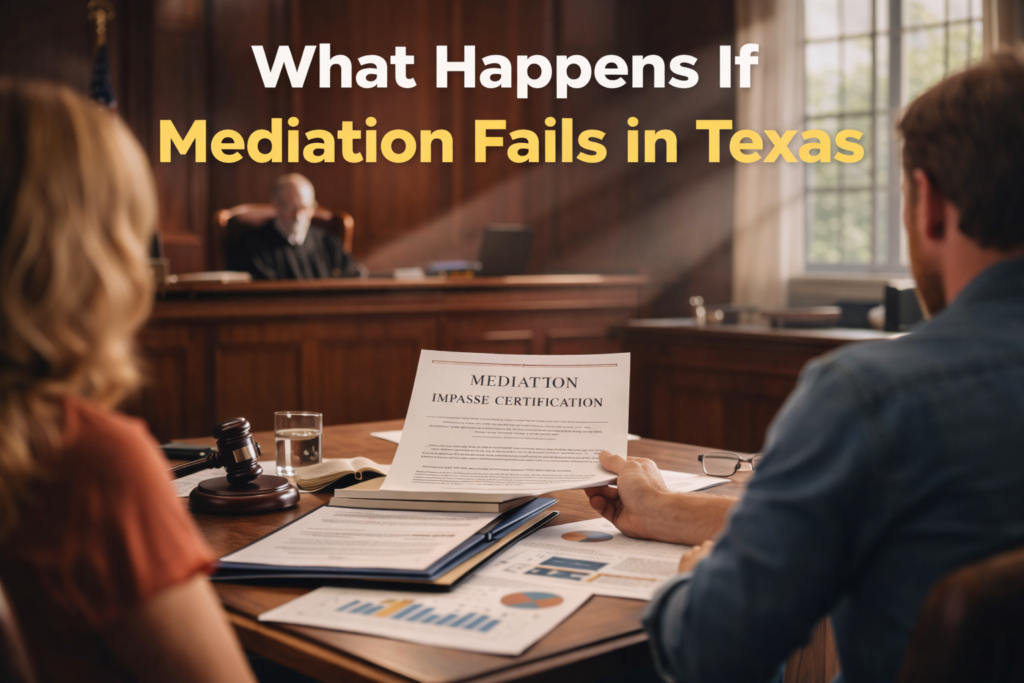
When mediation concludes without a full agreement, the mediator typically issues an impasse certification and the case returns to the court’s trial docket. At that point, unresolved issues proceed toward a contested hearing where a judge will make final determinations. Even so, Texas courts consistently recognize that mediation—successful or not—serves an important role in case management and fairness, aligning with the court’s authority to manage proceedings efficiently under the Texas Rules of Civil Procedure.
In practice, mediation often produces meaningful progress even without a complete settlement. Parties frequently resolve individual disputes, narrowing the issues a judge must decide and shortening the eventual trial. Mediation also clarifies each side’s priorities and concerns, giving attorneys valuable insight that strengthens trial preparation. Judges expect genuine participation in mediation, and while sanctions for bad faith conduct are rare, a party’s willingness to engage can influence credibility and discretionary rulings later in the case.
Another overlooked benefit is momentum. Many cases settle after an initial impasse once emotions settle and parties reflect on what they learned during mediation. For families seeking a deeper understanding of how mediation can still work in their favor—even when agreement feels out of reach—our attorneys often recommend reviewing What Mediation Can Do for You, a resource that explains how mediation can provide clarity, direction, and strategic advantage at multiple stages of a family law case.
This approach reflects the broader mission of our Texas family law team: educating families so they can move forward with confidence and peace of mind. By understanding that mediation is a process rather than a pass-or-fail moment, parents are better equipped to approach their case strategically, knowing that even an unsuccessful mediation can still protect their interests and help shape a stronger path forward.
Common Myths About Mandatory Mediation in Texas
Misconceptions about mediation create unnecessary anxiety. Let’s correct the most common myths:
Myth: “Mediation forces you to settle.” Reality: Mediation is mandatory; settlement is not. You must attend and participate in good faith, but no one can force you to sign an agreement. If you cannot reach terms you find acceptable, you proceed to trial.
Myth: “The mediator decides the case.” Reality: Mediators are neutral facilitators, not judges. The mediator helps parties communicate and explore solutions but has absolutely no authority to impose decisions. You and the other party make all final decisions.
Myth: “You can skip mediation if you disagree.” Reality: When courts order mediation, attendance is mandatory. Failing to appear can result in sanctions, including payment of the other party’s attorney’s fees or mediation costs. Some courts address non-compliance directly with contempt proceedings.
Myth: “Mediation favors one side.” Reality: Mediation is designed to be neutral and balanced. Both parties have equal opportunity to present positions and negotiate terms. Having an experienced attorney present ensures your interests receive proper advocacy.
How to Prepare for Mandatory Mediation in Texas
Preparation plays a decisive role in whether mediation is productive, which is one of the key reasons courts emphasize readiness when explaining Why Is Mediation Mandatory In Texas. Texas judges expect parties to come to mediation informed, organized, and prepared to engage in good faith, as authorized under Texas Family Code §153.0071. When parents arrive prepared, mediation is far more likely to reduce conflict, narrow disputes, and move the case toward resolution that aligns with the child’s best interests under Texas Family Code §153.002.
A strong starting point is gathering essential documentation. Financial records such as tax returns, pay stubs, bank statements, retirement account summaries, and property appraisals provide the factual foundation for discussions about property division, spousal maintenance, and child support under Texas Family Code Chapters 7, 8, and 154. In cases involving children, preparation should also include medical records, parenting schedules, and other documentation that demonstrates day-to-day involvement, which courts consider when evaluating conservatorship and possession issues under Texas Family Code §153.134.
Equally important is understanding your legal rights and obligations before mediation begins. Knowing how Texas law typically approaches community property division, child support guidelines, and custody presumptions allows you to evaluate proposals realistically rather than emotionally. An experienced Texas family law attorney can explain how courts commonly rule on these issues, helping you distinguish between what the law requires and where negotiation is possible. Families who want a deeper understanding of how mediation fits into the larger legal framework often benefit from reviewing resources like Why Mediation Doesn’t Always Work in Texas Family Law Cases, which explains common obstacles and how preparation helps overcome them.
Setting realistic goals is another critical step. Productive mediation requires clarity about priorities—what truly matters versus what may be negotiable. Unrealistic expectations can derail negotiations and increase frustration, while well-defined goals help keep discussions focused and forward-looking. Developing negotiation strategies with your attorney, such as identifying potential trade-offs or anticipating the other party’s likely concerns, further strengthens your position and reduces the risk of impasse.
Finally, emotional preparation should not be overlooked. Mediation requires calm, rational decision-making at a time when emotions often run high. Practicing techniques to stay focused on long-term outcomes rather than past grievances can make a meaningful difference in how negotiations unfold. At our firm, we emphasize that preparation is not just about paperwork or strategy—it is about empowering families to approach mediation with confidence, clarity, and a steady focus on protecting their future.

How a Texas Family Law Attorney Helps You Succeed in Mediation
While mediation can technically proceed without legal representation, experienced guidance often makes a decisive difference in outcomes, which helps explain Why Is Mediation Mandatory In Texas in so many family law cases. Texas courts expect parties to participate in mediation in good faith under Texas Family Code §153.0071, but navigating that process effectively requires more than simply showing up. Skilled legal counsel helps families approach mediation with preparation, clarity, and a strategy grounded in both the law and their long-term goals.
An experienced Texas family law attorney begins by developing a tailored mediation strategy. This includes analyzing the facts of your case, applying relevant provisions of the Texas Family Code, and setting realistic objectives based on how courts typically rule on issues like conservatorship, possession, and property division. Understanding the legal framework behind mediation—such as how the best interest of the child standard in Texas Family Code §153.002 influences custody-related negotiations—allows clients to make informed decisions rather than reacting under pressure. Families seeking a clearer overview of how mediation works within Texas law often benefit from reviewing What Is Mediation in Texas Family Law?, which explains the process in practical terms.
Accurate financial analysis is another critical advantage of having legal representation during mediation. Child support calculations under Texas Family Code Chapter 154, spousal maintenance considerations under Chapter 8, and community property division under Chapter 7 all involve detailed statutory requirements. An attorney ensures these calculations are correct, reducing the risk of agreements based on incomplete or inaccurate information. This attention to detail protects clients from long-term financial consequences that can arise from seemingly small errors made during mediation.
Legal counsel also plays a key role in protecting the enforceability of any agreement reached. Mediated Settlement Agreements must meet specific statutory requirements to be binding, and mistakes in language or structure can create serious problems later. By drafting or carefully reviewing the MSA, an attorney ensures it complies with Texas Family Code §153.0071 and accurately reflects the terms negotiated. Attorneys also provide real-time advocacy during mediation, explaining the legal implications of proposals and helping clients compare settlement options against the potential outcomes at trial.
After mediation concludes, legal guidance remains essential. An attorney shepherds the agreement through court approval, ensuring the judge enters orders consistent with the mediated terms and that those orders are enforceable. When families understand both the purpose of mediation and the value of experienced representation, the process becomes less intimidating and far more effective. With proper preparation and trusted legal support, mediation is not just a requirement—it becomes an opportunity to secure outcomes that protect your well-being and your children’s future.
Why Choose The Law Office of Bryan Fagan, PLLC for Your Texas Mediation
The Law Office of Bryan Fagan, PLLC brings extensive experience in Texas family law mediation and litigation. Our attorneys understand Texas Family Code §153.0071 and the practical realities of mediation in Texas courts across the state.
We approach mediation strategically, preparing thoroughly while remaining flexible enough to capitalize on opportunities as they arise. Our client-centered advocacy focuses on your priorities and your family’s long-term interests.
Clear communication matters. We explain the mediation process, your legal rights, and realistic outcomes so you make informed decisions. Our compassionate guidance recognizes the emotional challenges you face while maintaining focus on achieving results.
Whether your case is in Houston, San Antonio, Dallas, Austin, or anywhere in Texas, The Law Office of Bryan Fagan, PLLC provides statewide representation with local knowledge and dedicated advocacy.
Actionable Checklist: Why Is Mediation Mandatory in Texas
Use this checklist to prepare for court-ordered mediation:
- [ ] Understand the court’s authority under Texas Family Code §153.0071 to order mediation
- [ ] Identify all issues that can potentially be resolved through mediation
- [ ] Gather complete financial documentation (tax returns, pay stubs, account statements)
- [ ] Compile parenting documentation (schedules, school records, activity calendars)
- [ ] List your priorities and identify acceptable compromises
- [ ] Prepare realistic negotiation goals based on Texas law guidelines
- [ ] Develop alternative positions if initial proposals are rejected
- [ ] Consult with a Texas family law attorney before your mediation session
- [ ] Review potential MSA terms and enforceability requirements with your attorney
Conclusion
When a Texas judge orders mediation, it can feel like just one more thing being decided for you during a time when everything already feels uncertain. But when you understand why the courts require it—and how much control it actually gives back to parents—the process starts to look less like an obstacle and more like an opportunity. Mediation creates space for calmer conversations, clearer decisions, and outcomes that reflect your family’s real needs instead of a one-size-fits-all court ruling.
What matters most is that you don’t have to navigate that process alone. An experienced Texas family law attorney helps you walk into mediation prepared, protected, and confident—able to advocate for your future without adding fuel to an already emotional situation. At The Law Office of Bryan Fagan, PLLC, we believe that knowledge restores peace of mind and that informed parents make better decisions for themselves and their families.
If you’re facing mediation in a divorce or custody case and feeling unsure about what comes next, that’s completely normal. Sometimes the most empowering step is simply asking the right questions and getting clear answers from someone who understands both the law and the human side of what you’re going through. And if nothing else, remember this: the goal isn’t to “win” mediation—it’s to move forward with clarity, stability, and the confidence that you’re protecting what matters most.
Frequently Asked Questions About Mediation in Texas
Mediation is not automatically required in every case by statute, but Texas judges have broad authority to order it in family law matters. Under laws such as Texas Family Code §153.0071 and the Texas Alternative Dispute Resolution Act, courts frequently require parties to attend mediation before moving forward to trial. While attendance may be mandatory, reaching an agreement is always voluntary.
If a judge has ordered mediation, you generally do not have the right to refuse outright. However, you do retain important protections. You cannot be forced to agree to any settlement, and you have the right to consult with an attorney before and during mediation. If there are valid concerns—such as safety issues, coercion, or family violence—you may ask the court to waive or modify the mediation requirement.
Refusing to attend court-ordered mediation can result in consequences. Courts may impose sanctions, require payment of the other party’s attorney’s fees, or issue additional orders to compel participation. In serious cases, continued refusal may negatively affect how the judge views your cooperation in the case. If you have a legitimate reason for declining mediation, it is important to raise that issue formally with the court.
Mediation gives parties an opportunity to resolve disputes more efficiently and with less emotional and financial strain than a contested trial. Judges often require mediation because agreements reached by parents themselves tend to be more practical, longer-lasting, and less damaging to family relationships. Mediation also allows for flexible solutions that courts may not be able to impose.
A Texas court can require you to attend mediation and participate in good faith. What the court cannot do is force you to sign an agreement. You remain in control of whether you accept or reject any proposed settlement terms.
In most cases, the cost of mediation is split between the parties. However, judges may allocate fees differently based on income, financial hardship, or fairness considerations. For parties with limited resources, courts may allow the use of reduced-fee or court-approved mediators.
If mediation has been ordered by the court, you generally cannot skip it without permission. To bypass mediation, you would need to file a motion asking the court to waive the requirement and explain why mediation is inappropriate in your case. Even then, many judges prefer that mediation be attempted before scheduling a trial.
Mediation may be ineffective when there is a significant power imbalance or history of abuse, as one party may feel pressured to agree. It can also be problematic if key information or assets have not been disclosed, which can lead to unfair settlements. Additionally, once a mediated settlement agreement is signed and approved, it is often difficult to change, even if circumstances later shift.
When a parent refuses to attend court-ordered mediation without a valid excuse, the court may respond with sanctions, fee awards, or scheduling penalties. The mediator may also notify the court of non-compliance, which can influence future rulings. Courts expect cooperation with mediation orders, and unjustified refusal can create unnecessary setbacks in the case.