
How to Fill Out Uncontested Texas Divorce Papers often becomes the focus late at night, long after the house has gone quiet. The kids are asleep, the dishes are finally done, and you’re sitting at the kitchen table scrolling through forms, wondering how something so deeply personal turned into so much paperwork. You and your spouse may agree on the big things, but the weight of doing it “right” still lingers—because you know a single mistake can slow everything down or create problems you never intended.
At The Law Office of Bryan Fagan, PLLC, we understand that an uncontested divorce is not just a legal process—it’s a moment of transition when families are trying to regain their footing. Texas courts don’t simply glance at agreed paperwork and sign off. Judges review each case through the lens of the Texas Family Code, including §153.002, which requires every decision involving children to reflect their best interests. Even when parents are aligned, unclear language, missing details, or improperly completed forms can lead to delays that prolong stress and uncertainty for everyone involved.
Led by Bryan Joseph Fagan, a South Texas College of Law graduate and a recognized authority on Texas divorce and custody law, our firm is grounded in one core belief: families deserve clarity and peace of mind during life’s hardest transitions. Through compassionate counsel, education, and practical legal guidance, we help Texans understand not just how to complete uncontested divorce paperwork, but how to do it in a way that protects what matters most and allows families to move forward with confidence. As you continue reading, you’ll gain insight into how properly prepared divorce documents can reduce conflict, avoid setbacks, and help you close this chapter with stability and dignity.
Key Takeaways
- An uncontested divorce in Texas requires complete agreement on all terms before you file any paperwork—not after
- Core documents include the Original Petition for Divorce, Waiver of Service, and Final Decree of Divorce, each serving specific legal functions that Texas courts strictly review
- Paperwork involving minor children requires additional forms and faces heightened court scrutiny, particularly regarding conservatorship, child support calculations, and possession schedules
- Common mistakes that cause rejection include using out-of-state forms, vague property descriptions, missing notarization on waivers, and omitting assets or debts from the Final Decree
- Having a Texas family lawyer review your completed forms before filing often saves significant time, money, and stress compared to correcting rejected documents

Your Family’s Future Starts Here
Don’t navigate your legal journey alone. Schedule a consultation now and get the clarity and support you deserve.
How to Fill Out Uncontested Texas Divorce Papers: The Big Picture
An uncontested divorce in Texas occurs only when both spouses reach complete agreement on every issue before any paperwork is filed with the court, including property division, debt allocation, and all matters involving children. Under Texas Family Code Chapter 6, including §§ 6.001 and 6.301, this means the respondent does not challenge the petitioner’s requests, allowing the case to proceed without a contested hearing or trial. Understanding How to Fill Out Uncontested Texas Divorce Papers at this stage is critical, because the court relies entirely on what is written in the documents to determine whether the divorce truly qualifies as uncontested.
One of the most common—and expensive—mistakes couples make is assuming they can resolve remaining details after filing. Texas law does not permit that approach in uncontested cases. All terms must be fully negotiated and clearly documented before completing the Original Petition for Divorce and related forms. If disagreements arise later, whether over retirement accounts, debts, or parenting schedules, the case can quickly shift into a contested divorce. That change often brings additional filings, court appearances, and legal fees that could have been avoided. For many families, reviewing detailed guidance such as the firm’s step-by-step resource on how to fill out Texas uncontested divorce forms helps ensure nothing important is overlooked before filing.
Paperwork accuracy is what keeps an agreed divorce on track. Texas district courts carefully scrutinize every document for compliance with the Texas Family Code, the Texas Rules of Civil Procedure, and local county rules. Even small issues—such as an improperly executed Waiver of Service, an incorrect residency statement under § 6.301, or vague descriptions of property—can result in rejection by the clerk or a judge’s refusal to sign the Final Decree. Courts do not correct these errors for the parties; the judge’s role is to approve legally sufficient documents, not to complete them. Families seeking clarity and peace of mind often benefit from reviewing educational resources like the firm’s Uncontested Divorce in Texas overview, which explains how careful drafting protects both your time and your future.

Overview of Required Uncontested Texas Divorce Forms
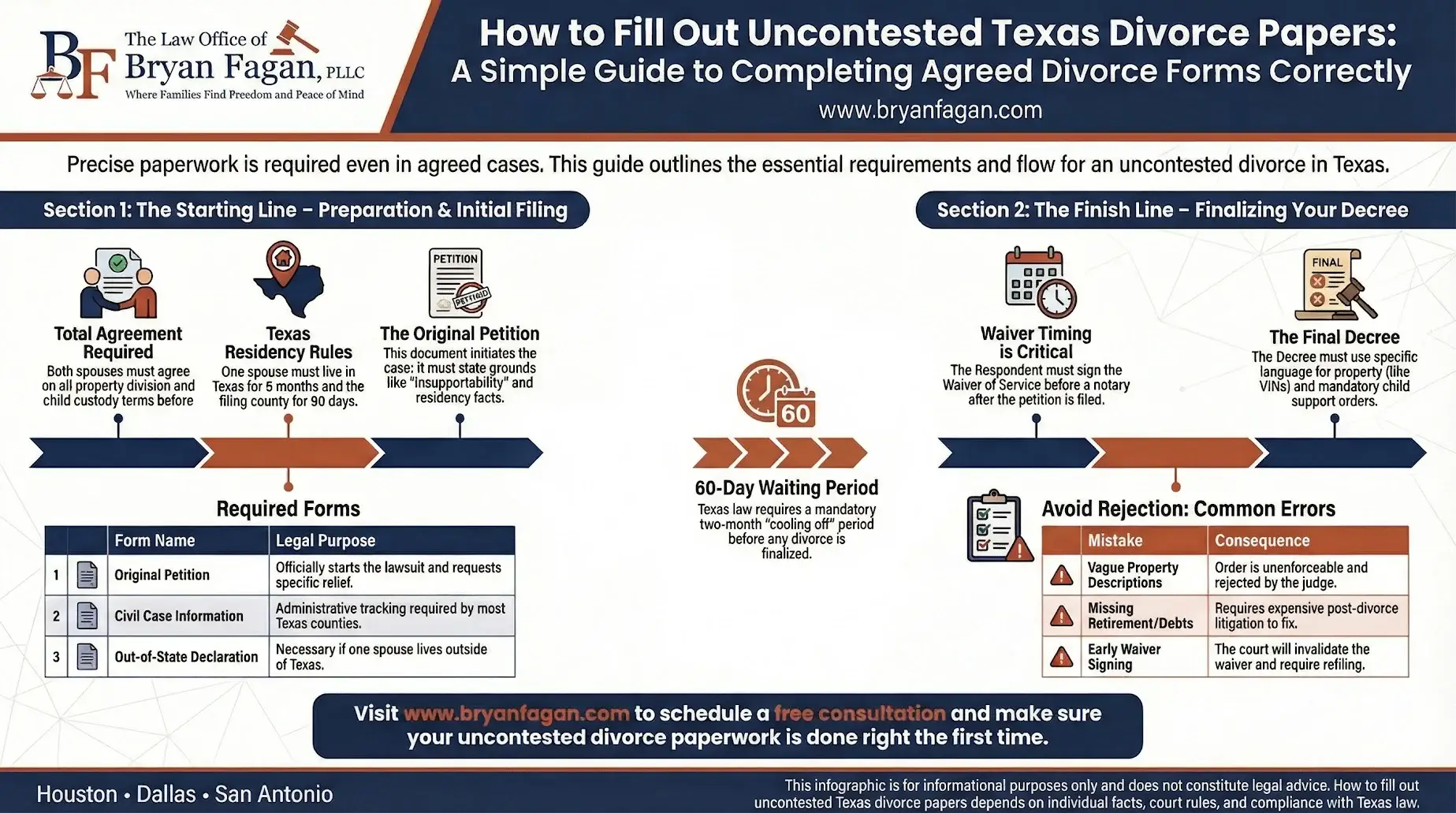
Every uncontested divorce in Texas requires several forms working together to initiate the case, provide proper notice, and finalize the marriage dissolution.
Original Petition for Divorce – This document initiates your family law case, stating your grounds for divorce (typically insupportability under Texas Family Code Section 6.001) and requesting specific relief from the court.
Civil Case Information Sheet – Many Texas counties require this form for case tracking and administrative purposes. Check your county’s local rules to determine if this applies to your filing.
Waiver of Service – When spouses agree, the respondent can sign this document to waive formal citation service, avoiding the cost of a process server or constable (typically around $100).
Final Decree of Divorce – This is the most critical document. Once signed by the judge, it becomes the enforceable court order dissolving your marriage and addressing all property, debt, and child-related matters.
| Situation | Required Forms |
|---|---|
| No children, no significant property | Original Petition, Waiver of Service, Final Decree |
| No children, property involved | Original Petition, Waiver of Service, Final Decree with detailed property schedules |
| Children involved | Original Petition, Waiver of Service, Final Decree, Information on Suit Affecting Family Relationship, Child Support Orders, Income Withholding Order |
How to Fill Out the Original Petition for Divorce
The Original Petition for Divorce formally requests that a Texas district court grant your divorce and provide specific relief. This divorce petition must include accurate information or the clerk’s office may reject your filing.
Petitioner Information: Provide your full legal name and current mailing address. The petitioner is the spouse who files first.
Respondent Information: Include your spouse’s full legal name and address. Accuracy matters for proper service.
Residency Requirements: Under Texas Family Code Section 6.301, you must state that either you or your spouse has been a domiciliary of Texas for at least six months and a resident of the filing county for at least 90 days. This is a jurisdictional requirement—without it, the court cannot hear your case.
Grounds for Divorce: Most uncontested cases in Texas use no-fault grounds of insupportability, meaning the marriage has become insupportable due to discord or conflict that destroys the legitimate ends of the marriage and prevents any reasonable expectation of reconciliation.
Requests for Relief: Specify what you’re asking the court to order—divorce, property division “as just and right,” restoration of a former name if desired, and specific arrangements for children if applicable.
Common mistakes include vague residency statements (stating “I have lived in Texas” rather than confirming the specific six-month and 90-day requirements), failing to check the “agreed divorce” box, and omitting required local court forms.
Completing a Waiver of Service or Respondent’s Answer Correctly
A Waiver of Service allows your spouse to formally acknowledge receiving notice of the divorce filing without being served by a process server or constable. This option works perfectly when parties agree to the divorce and saves approximately $100 in service costs.
Critical timing requirement: The respondent cannot sign the Waiver of Service until at least one day after the Original Petition has been filed. The waiver must reference the file-stamp date on the petition. If your spouse signs the waiver before the petition is officially filed, it is invalid and must be redone.
Notarization requirements: The Waiver of Service must be signed before a notary public. The notary must verify identity, witness the signature, and apply their seal. An improperly notarized waiver renders the entire document void.
When an Answer is required: If your spouse will not sign a waiver, they must be formally served with citation. The respondent then has until 10:00 a.m. on the first Monday after 20 days from service to file a Respondent’s Original Answer. In uncontested cases where spouses agree, the waiver approach is faster and cheaper.
Improper service invalidates your entire case. If the court later discovers the respondent was never properly notified, any divorce decree entered can be challenged and potentially voided.
How to Fill Out the Final Decree of Divorce
The Final Decree of Divorce is the single most important document in an uncontested Texas divorce. Once a judge signs it, the decree becomes a binding court order that controls property rights, debt responsibility, and all arrangements involving children. From the perspective of experienced Texas family law practitioners, this is where understanding How to Fill Out Uncontested Texas Divorce Papers truly matters. A decree that is vague, incomplete, or poorly drafted can create serious problems months or even years later, often forcing families back into court to resolve issues that should have been addressed the first time.
Texas law requires specific language and confirmations in every Final Decree. Under Texas Family Code § 6.702, the decree must clearly state that the mandatory 60-day waiting period has expired unless a statutory exception applies. It must also confirm that the divorce is granted on no-fault grounds, typically insupportability under § 6.001, and that the case is uncontested. Judges look for these required recitals because they establish the court’s authority to grant the divorce and finalize the parties’ agreement.
Property division provisions demand particular care because Texas is a community property state. Texas Family Code § 7.001 requires courts to divide community property in a manner that is “just and right,” and the decree must reflect that standard with precise, enforceable language. Real property must be identified using the full legal description from the deed, vehicles must include the year, make, model, and VIN, and debts should list the creditor and account number. General phrases like “the house” or “the car” often lead to enforcement disputes later, which is why detailed drafting is essential.
The decree must also address name restoration if either spouse wishes to return to a former name, as Texas courts cannot grant that relief unless it is specifically requested and included in the Final Decree. Both spouses typically sign the decree to confirm agreement, but the divorce does not become final until the judge’s signature is added. Courts regularly report that vague or missing terms account for a significant percentage of prove-up failures, underscoring how critical precision is at this stage of the process.
For families who want deeper guidance, the firm offers educational resources such as the uncontested divorce ebook, which walks readers through common pitfalls and best practices in clear, practical language. Additional insight can also be found in the firm’s Uncontested Divorce in Texas overview, which explains how careful drafting protects your rights and helps you move forward with confidence.

Filling Out Uncontested Texas Divorce Papers When Children Are Involved
When minor children are involved, uncontested divorce paperwork is reviewed with far greater scrutiny because Texas courts place the best interest of the child above the convenience of either parent. Judges closely examine child-related provisions to ensure they comply with the Texas Family Code and provide stability, consistency, and fairness for the children involved. This is where understanding How to Fill Out Uncontested Texas Divorce Papers becomes especially important, as even small drafting errors can delay final approval and extend an already stressful process.
Conservatorship decisions are governed by Texas Family Code Chapter 153, which creates a presumption that parents should be appointed Joint Managing Conservators unless evidence shows that arrangement would not serve the child’s best interest. Your Final Decree must clearly define each parent’s rights and duties, including decision-making authority over education, medical care, and other significant issues. Courts expect this language to be specific and internally consistent, not generic or copied from incomplete forms.
Possession and access schedules receive equal attention. Under Texas Family Code § 153.312, the Standard Possession Order serves as the default arrangement for parents who live within 100 miles of one another, outlining weekends, midweek time, holidays, and extended summer possession. Parents may agree to a different schedule, but the alternative must be clearly written and workable. Vague or contradictory schedules are a common reason uncontested decrees are rejected. For additional guidance on how timing and scheduling affect the overall process, readers often find value in the firm’s discussion of how long an uncontested divorce takes in Texas.
Child support provisions must comply with Texas Family Code § 154.125, which establishes guideline support amounts based on a percentage of the obligor’s net resources. Any deviation from guideline support requires specific findings explaining why the alternative amount is in the child’s best interest. If support is ordered, an Income Withholding Order is mandatory under § 154.061, directing the paying parent’s employer to deduct payments directly from wages. Medical and dental support must also be addressed, including which parent provides insurance and how uninsured expenses are divided. Courts routinely reject decrees that deviate from these statutory requirements without proper explanation, which is why careful drafting is essential.
Families navigating these issues often benefit from reviewing educational resources such as the firm’s Uncontested Divorce in Texas overview, which explains how child-related provisions are evaluated by Texas judges. By approaching custody, support, and possession issues with clarity and precision, parents give themselves the best chance of securing approval without delays while protecting their children’s stability and future.
Filling Out Uncontested Texas Divorce Papers When Property or Retirement Is Involved
Understanding the distinction between community property and separate property is essential when completing your divorce forms. Under Texas law, property acquired during the marriage is generally community property, subject to division. Property owned before marriage, inherited, or received as a gift during marriage is typically separate property.
Real property: Include the complete legal description from the deed, including lot number, block, subdivision name, and county. “The house on Main Street” is insufficient.
Vehicles: List year, make, model, color, and complete VIN for each vehicle being divided.
Debts: Specify creditor name, account number, approximate balance, and which spouse assumes responsibility. Remember—assigning a debt to one spouse in your decree doesn’t prevent creditors from pursuing both spouses if the debt was jointly incurred.
Retirement accounts: Dividing retirement accounts requires a Qualified Domestic Relations Order (QDRO) in addition to your Final Decree. The decree should reference that a QDRO will be prepared and entered. Failing to properly address retirement accounts can result in forfeiting pension benefits worth tens of thousands of dollars.
| Asset Type | Required Information |
|---|---|
| Real Estate | Full legal description from deed |
| Vehicles | Year, make, model, VIN |
| Bank Accounts | Bank name, account type, last 4 digits |
| Retirement | Account type, administrator, approximate value, QDRO reference |
| Debts | Creditor name, account number, balance |
Omitted assets create future litigation risk under Texas Family Code Section 9.201, potentially requiring partition actions years after your divorce is finalized.
Common Mistakes When Filling Out Uncontested Texas Divorce Papers
Understanding why divorces get rejected helps you avoid the same pitfalls. These are the errors that most frequently delay or derail uncontested cases:
Using generic or out-of-state forms: Texas courts require Texas-specific forms that comply with state law and local rules. Forms downloaded from general legal websites often lack required provisions or use incorrect formatting.
Vague property descriptions: Writing “husband gets the car” instead of listing the specific vehicle with VIN causes rejection. Courts require precision to create enforceable orders.
Missing assets or debts: Every significant asset and debt must appear in your decree. Intentionally or accidentally omitting items can lead to fraud claims and post-divorce litigation.
Signature and notarization errors: Waivers must be notarized after the petition is filed. Both spouses must sign the decree before submission. Missing or incorrectly placed signatures require refiling.
Assuming the judge will fix problems: Texas judges approve or reject paperwork—they don’t edit it. If your decree contains errors, you’ll receive a rejection notice and must correct and resubmit.
These mistakes typically cause 30 to 60 day delays as you correct and refile documents, potentially resetting your waiting period.
Filing and Submitting Completed Divorce Papers in Texas
Texas requires electronic filing for divorce cases in district courts, and understanding this step is just as important as knowing How to Fill Out Uncontested Texas Divorce Papers correctly. All filings are submitted through the state’s approved e-filing system, which accepts PDF documents and assigns your case directly to the appropriate court. Once the Original Petition for Divorce is filed, the statutory 60-day waiting period under Texas Family Code § 6.702 begins to run, even in cases where both spouses are in full agreement. This filing date becomes the legal anchor point for the rest of your divorce timeline.
Filing fees vary by county and generally fall within a few hundred dollars, but Texas law provides options for those who cannot afford the cost. Under the Texas Rules of Civil Procedure, particularly Rule 145, a party may submit an Affidavit of Indigency asking the court to waive filing fees. Courts routinely review these affidavits, and many are approved when the financial criteria are met. Taking time to prepare this paperwork accurately can prevent delays and ensure your case proceeds smoothly from the start.
Local rules also matter more than many people expect. Counties such as Harris County impose additional filing requirements, formatting standards, or supplemental forms that must accompany your divorce documents. Missing a county-specific requirement can result in a rejected filing, even if the rest of your paperwork is correct. Resources like the firm’s Uncontested Divorce in Texas overview help families understand how local rules interact with statewide requirements before documents are submitted.
After your documents are filed, the district clerk reviews the submission, assigns a cause number, and issues citation unless service has been properly waived. From that point forward, you can track your case through the e-filing system or your county’s online records while the waiting period runs. If disagreements arise after filing and the case can no longer remain uncontested, families may find it helpful to review educational materials such as the firm’s contested divorce ebook, which explains how the process changes when litigation becomes necessary. By approaching filing with clarity and preparation, families give themselves the best chance to move forward without unnecessary delays or complications.

Prove-Up Hearing or Final Submission Requirements
Before a judge can sign a Final Decree of Divorce, the court requires a “prove-up,” which is the formal step where the petitioner demonstrates that the divorce meets all legal requirements under Texas law. Under Texas Family Code § 6.702, this usually occurs at a brief final hearing after the mandatory 60-day waiting period has passed. Understanding How to Fill Out Uncontested Texas Divorce Papers plays a critical role at this stage, because the judge’s questions and ultimate approval are based almost entirely on the accuracy and completeness of the documents submitted.
During a typical prove-up, the judge confirms key statutory elements, including whether at least one spouse has met the residency requirements outlined in Texas Family Code § 6.301, whether the marriage has become insupportable under § 6.001, and whether the required waiting period has expired. The court also verifies that the terms of the divorce are fair, complete, and fully agreed upon by both parties. These questions may seem simple, but inconsistent answers or unclear paperwork can delay final approval even in cases where both spouses believe everything has been settled.
In many uncontested divorces without children, Texas courts allow the prove-up to be completed by affidavit rather than requiring a personal appearance. When this option is available, the submission packet generally includes the signed Final Decree of Divorce, a properly executed prove-up affidavit, and the Information on Suit Affecting the Family Relationship form if applicable. Families who want a deeper understanding of how judges evaluate these submissions often benefit from reviewing practical guidance such as the firm’s resource on how to handle uncontested divorce paperwork in Texas the right way, which explains how preparation directly affects court approval.
The quality of your paperwork is often the deciding factor in whether a prove-up succeeds on the first attempt. Well-prepared, legally compliant documents are far more likely to be approved without delays, allowing families to move forward with clarity and peace of mind. For additional context on the uncontested process and what courts expect, readers may also find value in the firm’s Uncontested Divorce in Texas overview, which walks through each stage of the case with an emphasis on avoiding common setbacks.
Can You Fill Out Uncontested Texas Divorce Papers Without a Lawyer?
Pro se divorce (handling your own case without an attorney) is possible in Texas, and resources like TexasLawHelp.org provide free forms used by over 100,000 Texans annually. For truly simple cases—short marriages, no children, minimal property—self-preparation may work.
However, court clerk statistics suggest 25 to 50 percent error rates for self-prepared filings. These errors cause delays, rejected documents, and in worst cases, unenforceable decrees that create expensive problems years later.
Limited-scope review offers a middle ground. Many Texas family lawyers provide unbundled services, reviewing your completed forms for $200 to $500 before you file. This catches errors without the cost of full legal representation.
The math often favors professional review. Paying a few hundred dollars for a lawyer to check your documents typically costs far less than fixing rejected filings or litigating enforcement problems from a poorly drafted decree.
How a Texas Divorce Attorney Ensures Paperwork Is Done Right
A Texas divorce attorney adds value beyond simply filling out forms. Understanding How to Fill Out Uncontested Texas Divorce Papers is one thing—ensuring every document will withstand scrutiny and remain enforceable is another.
Attorneys review all forms for compliance with the Texas Family Code and Texas Rules of Civil Procedure. They draft precise language that leaves no room for future disputes about what property went to whom. They coordinate proper service, handle e-filing requirements, and ensure documents are submitted to the correct court in the correct format.
Perhaps most importantly, attorneys anticipate problems. They include QDRO provisions for retirement accounts, ensure child support complies with guidelines or includes required findings for deviations, and use property descriptions that will hold up if enforcement becomes necessary.
Flat-fee uncontested divorce services typically range from $1,000 to $2,500—a modest investment compared to the $10,000 or more that fixing an unenforceable decree often costs.
Why Choose The Law Office of Bryan Fagan, PLLC
Families across Texas turn to this firm because they want clarity, efficiency, and confidence when navigating an uncontested divorce. With years of statewide experience, the legal team understands exactly what Texas judges expect when reviewing agreed cases and how compliance with the Texas Family Code determines whether paperwork is approved or rejected. From residency requirements under § 6.301 to the mandatory waiting period in § 6.702, careful attention to statutory details is essential. That is why guidance on How to Fill Out Uncontested Texas Divorce Papers is approached with both legal precision and practical insight, ensuring every document reflects current Texas law and court expectations.
Cost certainty is another priority for families seeking peace of mind. The firm offers flat-fee options for uncontested divorces, allowing clients to plan financially without fear of escalating legal bills. Judge-approved drafting helps prevent the enforcement issues that often arise from vague or incomplete decrees, particularly in areas governed by Texas Family Code §§ 7.001 and 153.002. By focusing on accuracy from the outset, families avoid delays, re-filings, and future disputes that can undermine the very purpose of choosing an uncontested process.
The motivation behind this work is simple: helping Texans complete their divorces correctly the first time, without unnecessary complications. That commitment shows in how cases are handled—through clear explanations, careful document preparation, and efficient filing procedures that respect both time and budget. Families who want a broader understanding of what to expect can explore resources like the firm’s overview of the Texas divorce process, which explains each stage in plain language.
What clients receive is comprehensive support tailored to uncontested cases, including full representation, document preparation, and legal review with compassionate guidance throughout. Because Texas requires electronic filing in district courts, statewide e-filing capabilities allow assistance regardless of county. For those seeking deeper educational support alongside legal representation, resources such as handling uncontested divorce paperwork the right way further reflect the firm’s mission of educating families while protecting their futures.

Checklist: How to Fill Out Uncontested Texas Divorce Papers
Use this checklist before filing:
- [ ] Confirm you and your spouse agree on all terms—property, debts, and children
- [ ] Gather financial records, property deeds, vehicle titles, and retirement account statements
- [ ] Use only Texas-specific divorce forms from approved sources
- [ ] Complete the Original Petition with accurate residency information
- [ ] Have respondent sign Waiver of Service before a notary (after petition is filed)
- [ ] Draft Final Decree with specific property descriptions and VINs
- [ ] Include all assets and all debts in the decree
- [ ] If children are involved, complete conservatorship, support, and possession provisions
- [ ] Verify all signatures are present and in the correct locations
- [ ] Consider having a Texas divorce attorney review all documents before filing
Conclusion
Divorce paperwork may look like just another stack of forms, but when it’s done thoughtfully and correctly, it becomes something more—a roadmap out of uncertainty and into stability. Taking the time to understand how uncontested Texas divorce papers work, and why each detail matters, can spare you unnecessary delays, reduce stress, and help your family move forward without reopening wounds down the road. This process isn’t about winning or losing; it’s about closing one chapter with clarity so the next one can begin with confidence.
If you’ve found yourself thinking, “I just want this done the right way,” you’re not alone—and you don’t have to figure it out by trial and error. Working with an experienced Texas family law attorney can make the difference between paperwork that merely gets filed and documents that truly protect your future. A seasoned lawyer knows what judges expect, where people commonly get tripped up, and how to draft agreements that hold up long after the ink dries.
At The Law Office of Bryan Fagan, PLLC, our goal is to make a difficult transition feel manageable and informed, not overwhelming. If you have questions, need guidance, or simply want reassurance that you’re on the right path, reaching out for a consultation is a solid next step. Sometimes peace of mind starts with a simple conversation—and occasionally with realizing you don’t have to do everything alone.
Frequently Asked Questions About Uncontested Divorce in Texas
The 10-10-10 rule is not an official Texas legal standard, but a common decision-making framework people use during major life transitions. It encourages you to ask how a decision will affect you in 10 minutes, 10 months, and 10 years. In divorce, this mindset can be helpful when negotiating uncontested terms, reminding spouses to focus on long-term stability rather than short-term emotions.
A judge may refuse to sign an uncontested divorce decree if legal requirements are not met or the paperwork is unclear or incomplete. Common reasons include missing signatures, improper notarization on a Waiver of Service, vague property or debt descriptions, incorrect residency statements, or child-related terms that do not appear to serve a child’s best interests. In most cases, the judge is asking for corrections rather than permanently denying the divorce.
Filing can happen as soon as your paperwork is ready, often the same day it is submitted through Texas’s electronic filing system. Finalizing the divorce, however, usually takes longer because Texas requires a 60-day waiting period from the date the Original Petition is filed before a judge can sign the Final Decree, unless a limited exception applies. Delays most often come from paperwork errors or missing documents.
The cost varies depending on filing fees, service options, and whether you hire legal assistance. Filing fees in many Texas counties are several hundred dollars. If your spouse signs a properly notarized Waiver of Service, you may avoid service fees. Attorney fees depend on complexity, but many Texas family law firms offer flat-fee uncontested divorce services or limited-scope reviews to keep costs predictable.
There is no single legal definition of the four C’s in Texas law, but they are often described as Communication, Cooperation, Clarity, and Consistency. In an uncontested divorce, these principles matter because clear communication and consistent agreements make it far easier to draft enforceable orders that the court is willing to approve.
The 20/20 rule typically comes up in military divorce cases and refers to eligibility for certain military benefits when there are at least 20 years of marriage and 20 years of military service with overlap. It is not a general rule that applies to most Texas divorces. When military benefits or pensions are involved, careful legal drafting is especially important.
The three C’s are often described as Communication, Compromise, and Compliance. These concepts are especially relevant in uncontested divorces because both spouses must share information honestly, reach workable agreements, and follow through with court requirements for the divorce to remain truly uncontested.
In most cases, the minimum time is tied to the mandatory 60-day waiting period that begins when the Original Petition for Divorce is filed. If all paperwork is correct and the court’s schedule allows, a divorce can be finalized shortly after that 60-day mark. Certain narrow exceptions exist, but most cases should plan around this timeline.
While uncontested divorce is often faster and less expensive, it can carry risks if important details are overlooked or one spouse agrees without fully understanding the consequences. Common issues include missing assets or debts, vague language that is difficult to enforce, and parenting plans that seem workable at first but create conflict later. Having an experienced Texas family law attorney review the paperwork can help prevent these problems before they become permanent.