Navigating child custody when you and your partner were never married can feel like trying to find your way through a maze without a map. In Texas, the law provides a clear—and often surprising—starting point that every unmarried parent needs to understand. From the moment a child is born, the mother is automatically the sole managing conservator under the Texas Family Code. This means she has full legal and physical custody from day one, giving her the authority to make all decisions for the child.
For fathers, this initial reality is starkly different. Even if your name is on the birth certificate, you do not have any automatic legal rights until you take a crucial step: legally establishing your paternity. This guide is designed to walk you through that process, step by step, so you can feel supported and understood as you work to protect your relationship with your child.
Understanding the Initial Legal Landscape for Unmarried Parents
When a child is born to unmarried parents in Texas, the law’s primary goal is to ensure the child’s immediate well-being and stability. It achieves this by granting the mother sole legal authority right away. This isn't meant to diminish the father's role; rather, it’s a practical measure to ensure someone has the clear legal right to care for the newborn without delay.
However, this default arrangement places the responsibility squarely on the father to take legal action. Think of it this way: establishing paternity is the key that unlocks all your parental rights. It is the essential first step that gives you the legal standing to go to court and ask for a possession schedule (visitation), the right to have a say in major decisions, and a legally protected relationship with your child. Without it, your role as a father, however committed you may be, simply isn’t recognized or enforceable by the legal system.
The Default Positions at Birth
The Texas Family Code § 160.201(b) draws a sharp legal line between the mother and father at birth, creating a default arrangement that remains in place until a court order says otherwise.
-
For the Mother: She is automatically the sole managing conservator. This gives her the exclusive authority to make critical decisions about the child’s healthcare, education, and general upbringing. She also has the sole right to determine where the child lives.
-
For the Father: He has zero automatic legal or physical custody rights. While having his name on the birth certificate is a positive first step, it does not grant him the power to enforce visitation or participate in parental decision-making.
This initial imbalance means the mother has complete legal control until the father takes formal action. Fortunately, Texas law provides a clear path for fathers to establish their rights and for both parents to create a formal, court-ordered plan that truly serves their child’s best interests. In Texas, child custody laws for unmarried parents are designed to move from this initial default to a more balanced and stable arrangement once paternity is legally confirmed.
The journey from this starting point to a stable co-parenting plan involves a few critical steps, beginning with legally establishing who the father is.
Establishing Paternity: The First and Most Critical Step
For any unmarried father in Texas, establishing legal paternity is the absolute first step—the key that unlocks every single parental right you hope to have. Without it, you simply have no legal standing to ask for visitation, have a say in your child's life, or be recognized as their dad in the eyes of the law.
The moment a child is born to unmarried parents in Texas, the law creates a lopsided reality.
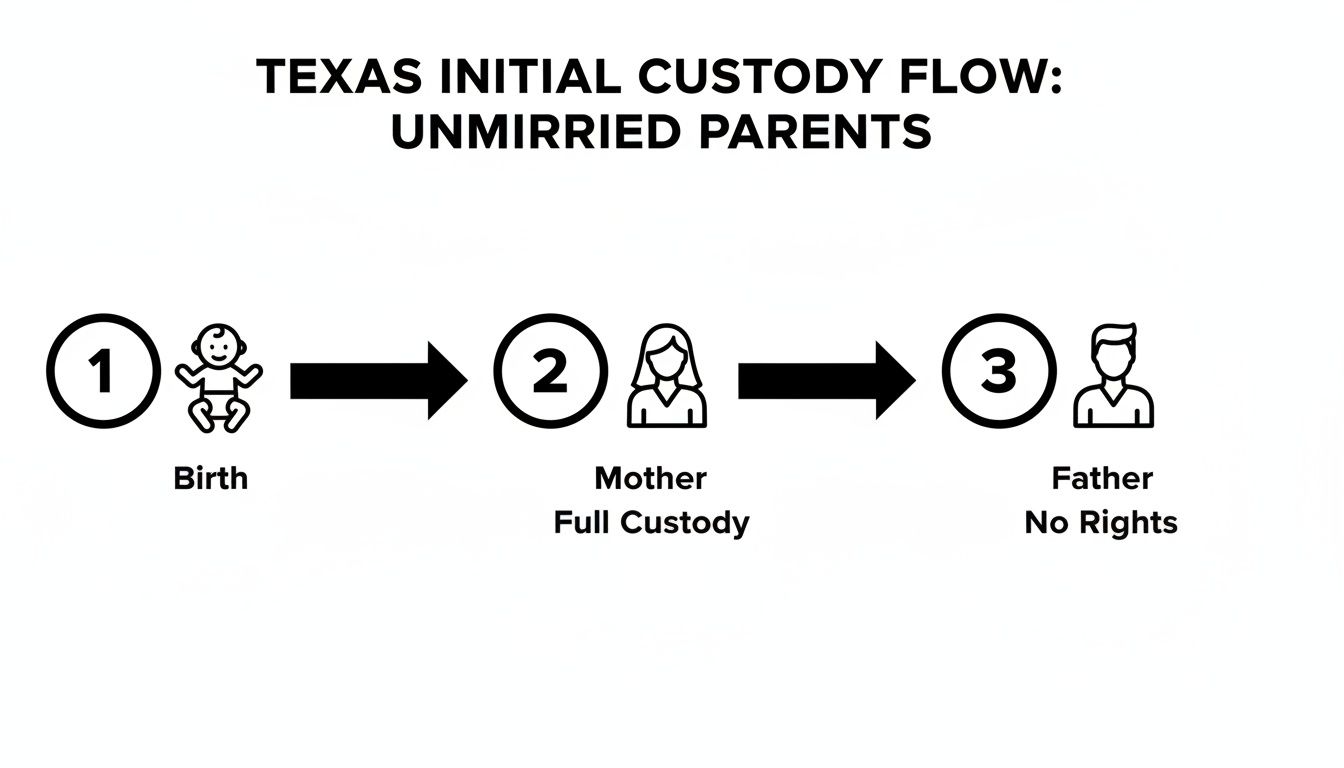
As you can see, the mother automatically gets full custody by default, while the biological father starts with zero legal rights. This is why it is so critical for fathers to take proactive steps. Luckily, Texas law provides two clear paths to legally establish your fatherhood.
The Voluntary Path: Acknowledgment of Paternity (AOP)
The most straightforward way to establish paternity is by signing a voluntary Acknowledgment of Paternity (AOP). This is a simple legal form that both parents sign, typically at the hospital shortly after the child is born.
Signing an AOP is a significant legal act. It serves as a formal declaration that a man is the child's legal father, carrying all the rights and responsibilities that come with it. When both parents are in agreement, it is a quick and effective process. Once the AOP is signed and filed with the Texas Vital Statistics Unit, the father's name can be added to the birth certificate, and more importantly, he gains the legal standing needed to file a custody case and secure specific orders for visitation and decision-making.
Key Takeaway: An Acknowledgment of Paternity is more than just a piece of paper. It's a sworn legal statement that you are the child’s biological father. Once signed and filed, it has the same power as a court order and can be incredibly difficult to reverse.
The Court-Ordered Path: Suit to Adjudicate Parentage
What happens if the parents don't agree, or an AOP was never signed? The second route is through a court case called a Suit to Adjudicate Parentage. This is a formal lawsuit one parent files to ask a judge to legally determine the child’s father.
This court process becomes necessary in a few common situations:
- The mother and the presumed father disagree on paternity.
- The mother refuses to sign an AOP.
- The potential father has doubts and wants confirmation before taking on legal and financial responsibility.
In these cases, a parent files a petition, and the court will almost always order genetic (DNA) testing for a conclusive answer. If the DNA test confirms the man is the biological father, the judge will sign a court order that officially establishes his paternity.
Example Scenario: David is eager to be a father to his new son, Leo, but his relationship with the mother, Sarah, is strained. She refused to sign an AOP at the hospital. To secure his rights, David files a Suit to Adjudicate Parentage. The judge orders a DNA test, which proves David is Leo's dad. The judge then signs an order making it official. That court order is the foundation David needs to then ask for a formal custody and visitation schedule, ensuring he has a legally protected role in his son's life. Understanding these nuances is critical, and you can learn more about what it means if the biological father's name is not on the birth certificate in our detailed article on the topic.
Decoding Custody Terms: Conservatorship and Possession
Once paternity is legally established, the court’s entire focus shifts to one guiding principle: the best interest of the child. Every decision a Texas judge makes from this point forward will be measured against this standard. To navigate this process effectively, you need to understand the two core concepts that will shape your co-parenting life: Conservatorship and Possession.

It helps to think of these as the "what" and the "when" of custody. Conservatorship is about what rights and responsibilities you have as a parent. Possession is about when your child is in your care.
Conservatorship: The Right to Make Decisions
In Texas, Conservatorship is the legal term for who has the authority to make major decisions for your child. This isn't about where your child sleeps each night; it’s about who has the legal right to guide their upbringing.
The Texas Family Code begins with the presumption that Joint Managing Conservatorship (JMC) is in the child's best interest. This means both parents are expected to share the rights and duties of raising their child. In a JMC arrangement, you will need to work together on major issues.
Some of the most common rights and duties you'll share include:
- Making decisions about your child's education.
- Consenting to medical, dental, and surgical treatments.
- Guiding your child's moral and religious upbringing.
- Accessing your child's medical and school records.
Even when parents are named Joint Managing Conservators, the court will typically designate one parent as the "primary" conservator. This parent has the exclusive right to establish the child's residence, although it's usually restricted to a specific geographic area. The other parent is often called the "possessory" conservator.
Possession and Access: The Parenting Time Schedule
While conservatorship covers decision-making, Possession and Access is the part of the court order that outlines the physical parenting schedule. It’s the calendar that details exactly when your child will be with each of you. For many unmarried parents, this is the most emotionally charged part of the process.
To create consistency, Texas law provides a default schedule called the Standard Possession Order (SPO). A judge will almost always order the SPO unless there’s a compelling reason why it wouldn't be in the child's best interest. It is designed to give both parents predictable, reliable time with their child.
The Standard Possession Order is essentially a detailed roadmap for your parenting time. It clearly defines weekends, holidays, and summer vacation, leaving very little room for arguments down the road.
Familiarizing yourself with the SPO is critical because it's the foundation for most court orders. While you and the other parent can agree to customize it, a typical SPO for a non-primary parent living within 100 miles includes:
- Weekend Possession: The first, third, and fifth weekends of every month.
- Holiday Division: Major holidays like Thanksgiving and Christmas are divided and alternated between parents each year.
- Summer Visitation: Generally 30 days of time with the child during the summer, which can often be broken into shorter visits.
For a closer look at how these schedules are structured, you can explore our in-depth guide on possession orders in Texas family law. This framework provides a solid foundation for building a stable routine for your child and protecting your relationship with them.
Calculating Child Support and Medical Obligations
A critical component of any custody case is ensuring your child has the financial support they need to thrive. In Texas, the law removes much of the guesswork by using a clear, formula-based approach to child support. This framework is designed to be predictable and fair, helping both parents understand their financial responsibilities.
As a general rule, the parent who does not have the exclusive right to determine the child's residence—the non-primary conservator—is the parent who pays child support. The Texas Family Code lays out specific guidelines to calculate the amount, which helps maintain consistency across cases.

How Texas Determines the Child Support Amount
The process begins by calculating the paying parent's "net monthly resources." This isn't just their take-home pay. The court considers all sources of income, including wages, overtime, bonuses, commissions, and even rental income.
From that gross income figure, the court subtracts specific deductions to arrive at the net amount. These typically include:
- Social Security taxes
- Federal income tax (calculated for a single person with one exemption)
- Union dues
- The amount paid for the child's health insurance premium
Once the net monthly resources number is determined, the court applies a percentage based on the number of children involved in the case.
| Texas Guideline Child Support Percentages | |
|---|---|
| Number of Children | Percentage of Net Resources |
| 1 | 20% |
| 2 | 25% |
| 3 | 30% |
| 4 | 35% |
| 5 or more | 40% |
These percentages are the cornerstone of financial orders for unmarried parents and are applied to net resources up to a statutory cap, ensuring a fair and standard approach.
A Practical Child Support Calculation Example
Let’s walk through a simple scenario to see how this works in practice. Imagine a dad, Mark, is the non-primary parent for his one child.
- Calculate Gross Monthly Income: Mark earns a salary of $6,000 per month.
- Determine Deductions: After taxes, Social Security, and the cost of the child’s health insurance premium, his total monthly deductions amount to $1,500.
- Find Net Monthly Resources: $6,000 (Gross) – $1,500 (Deductions) = $4,500 in net resources.
- Apply the Guideline Percentage: For one child, the guideline percentage is 20%.
- Calculate the Support Amount: 20% of $4,500 is $900.
In this scenario, Mark’s guideline child support obligation would be $900 per month. While this calculation sets the baseline, a judge can order a different amount if the child’s proven needs justify it. For a deeper dive, review our guide on how to properly calculate child support in Texas.
It is crucial for parents to remember that child support is a right that belongs to the child. It is intended to cover the costs of housing, food, clothing, and other essential daily needs.
Covering Health Insurance and Medical Expenses
Financial support extends beyond a monthly payment. Texas law requires that every custody order specify how the child’s healthcare needs will be met, covering both health insurance and out-of-pocket medical bills.
The court will order one parent to provide health insurance for the child, usually the parent who can obtain quality coverage through their employer at a reasonable cost. The amount that parent pays for the child’s portion of the premium is credited back to them in the child support calculation, as shown in Mark’s example.
For expenses not covered by insurance, such as co-pays, deductibles, or prescriptions, the court will almost always order the parents to split them equally, 50/50. This ensures that both parents contribute fairly to unexpected medical costs, preventing one parent from bearing the entire financial burden.
Modifying or Enforcing Your Custody Order
Receiving a final court order often brings a welcome sense of stability and clarity to your co-parenting relationship. But life is rarely static. What happens when a career opportunity requires a move, a parent’s income changes significantly, or your child’s needs evolve with age?
That “final” order isn’t necessarily the last word for the next 18 years. Texas law understands that circumstances change and provides clear legal paths to adapt your orders to fit new realities. Similarly, a court order is only effective if it is followed. When one parent begins to ignore the possession schedule or fails to pay child support, it can disrupt your child’s life. You are not powerless in this situation; Texas law provides strong legal tools to hold the other parent accountable and protect the consistency your child deserves.
When Can You Change a Custody Order?
To update your custody, visitation, or child support order, you must file a Petition to Modify the Parent-Child Relationship. However, you cannot go back to court simply because you have changed your mind. You must first prove that there has been a material and substantial change in circumstances since the date the judge signed your last order.
This is a high legal standard, but many common life events can meet this requirement:
- Job and Income Changes: A major promotion, a significant pay cut, or a job loss can be grounds for modifying child support.
- Relocation: One parent needing to move for a new job or to be closer to family almost always requires a change to the possession schedule.
- Child’s Changing Needs: As children grow, their needs change. A new medical diagnosis, different schooling requirements, or intense involvement in extracurricular activities might necessitate an updated order.
- A Parent’s Remarriage: The introduction of a new stepparent can sometimes alter the family dynamic enough to justify a modification.
Even if you prove a major change has occurred, the court will only approve the modification if it is also in the child’s best interest. That question remains the single most important factor in any Texas custody case.
Holding a Parent Accountable Through Enforcement
If the other parent is violating a specific, clear provision of your court order, you can take action by filing a Petition for Enforcement. This is a formal request asking a judge to intervene and compel the other parent to comply. Most enforcement actions are filed over two key issues: denied visitation or unpaid child support.
An enforcement action is a serious legal step. You must be able to point to the exact part of the order that was violated, providing specific dates and details for each instance.
A judge who finds that the other parent knowingly violated a court order can impose significant consequences. These may include ordering makeup visitation time, requiring them to pay your attorney’s fees, or even holding them in contempt of court—which can lead to substantial fines or jail time.
The Impact of Family Violence
Nothing alters the landscape of a custody case more profoundly than family violence. A court’s highest priority is protecting a child’s physical and emotional safety. If credible evidence of family violence is presented, it will have a massive impact on any custody decision, whether it’s an initial order or a later modification.
A finding of family violence creates a legal presumption under the Texas Family Code that it is not in the child’s best interest for the abusive parent to be a joint managing conservator. To protect the child, a court will often implement specific safeguards, such as ordering that the abusive parent’s time with the child be supervised by a neutral third party or requiring them to complete courses like anger management or a battering intervention and prevention program.
If you need help navigating divorce, custody, or estate planning in Texas, contact The Law Office of Bryan Fagan today for a free consultation.
Why an Experienced Family Lawyer Is Your Strongest Advocate
When your relationship with your child is on the line, trying to navigate the complexities of Texas family law alone is not just overwhelming—it’s a significant risk. The stakes are simply too high to leave the outcome to chance.
An experienced family lawyer is more than just someone who files paperwork; they are your personal strategist, dedicated negotiator, and powerful advocate in the courtroom. Their role is to understand your goals and translate them into a compelling legal argument that aligns with the court’s primary focus: the “best interest of the child.” They know the local court system, the critical deadlines, and the type of evidence that persuades a judge.
Protecting Your Rights and Your Child’s Future
At The Law Office of Bryan Fagan, PLLC, we understand the incredible emotional and financial weight that custody cases place on parents. Our mission is to lift that legal burden from your shoulders so you can focus on what matters most—your child.
Here’s how our practical guidance helps protect your parental rights:
- Ensuring all deadlines are met so you don’t lose your right to be heard by the court.
- Gathering and presenting compelling evidence to build a strong case for your desired conservatorship and possession schedule.
- Navigating complex negotiations with the other parent’s attorney to work toward a settlement that protects your interests.
- Providing calm, steady counsel during what may be one of the most stressful periods of your life.
We handle the intricate legal details, constantly seeking better ways to build strong cases, which may include using advanced tools like ai for lawyers to enhance our preparation and strategy. This allows you to focus on being the best parent you can be.
A knowledgeable attorney does more than just represent you; they provide the objective, strategic counsel needed to make smart decisions for your family’s long-term stability, free from the emotional turmoil of the moment.
The outcome of your case will define your relationship with your child for years to come. Don’t leave that future to chance.
If you need help navigating divorce, custody, or estate planning in Texas, contact The Law Office of Bryan Fagan today for a free consultation.
Common Questions We Hear from Unmarried Parents
When you’re trying to figure out custody and your rights as an unmarried parent in Texas, the legal jargon can feel overwhelming. It’s completely normal to have a ton of questions. We’ve put together some straightforward answers to the questions that come up most often in our office, hoping to clear up some of the confusion and give you a better sense of the road ahead.
Does Putting the Father’s Name on the Birth Certificate Grant Him Rights?
No, and this is probably the biggest myth we have to bust for unmarried parents. Putting a father’s name on the birth certificate is a meaningful step, and it serves as important evidence that he is the child’s parent. However, in Texas, it does not grant him any enforceable legal rights on its own.
To actually get legal rights to visitation (possession) and a say in major decisions, paternity has to be legally established. This happens one of two ways: both parents sign an Acknowledgment of Paternity (AOP), or one parent files a Suit to Adjudicate Parentage and gets a court order.
Can an Unmarried Mother Move Away with Our Child?
This all boils down to whether or not a court order is in place. If there’s no order, the mother generally has sole custody and can move without the father’s permission. But the game changes the moment a paternity suit is filed. The father can immediately ask the court for a temporary order to stop the child from being moved out of a specific area, like the county and its neighbors.
Nearly every final custody order will include a geographic restriction. This means the primary parent can’t just pack up and move with the child outside of that designated zone without either getting the other parent’s written agreement or going back to court for permission.
If We Agree on Everything, Do We Still Need a Court Order?
Yes, absolutely. We can’t stress this enough. A handshake deal or a simple written agreement between the two of you is not enforceable in court. If things go sour and the other parent suddenly stops following your informal arrangement, you have no legal power to make them comply.
When you get a judge to sign an Agreed Order, you’re turning your mutual understanding into a powerful, legally binding document. It protects everyone’s rights, provides your child with much-needed stability, and gives you both a clear rulebook to follow for years to come.
How Long Does an Unmarried Custody Case Take in Texas?
The timeline really depends on how well you and the other parent are getting along. If you’re in complete agreement on every single issue, your case is “uncontested.” These can move pretty quickly and often wrap up in just a few months.
On the other hand, if you’re at odds over paternity, who makes decisions, the visitation schedule, or child support, the case is “contested.” A contested case can involve mediation, hearings for temporary orders, and maybe even a full trial. This can easily stretch the process out to six months, a year, or sometimes even longer, depending on how complex things are and how backed up the court’s calendar is.
If you need help navigating divorce, custody, or estate planning in Texas, contact The Law Office of Bryan Fagan, PLLC today for a free consultation at https://www.bryanfagan.com.