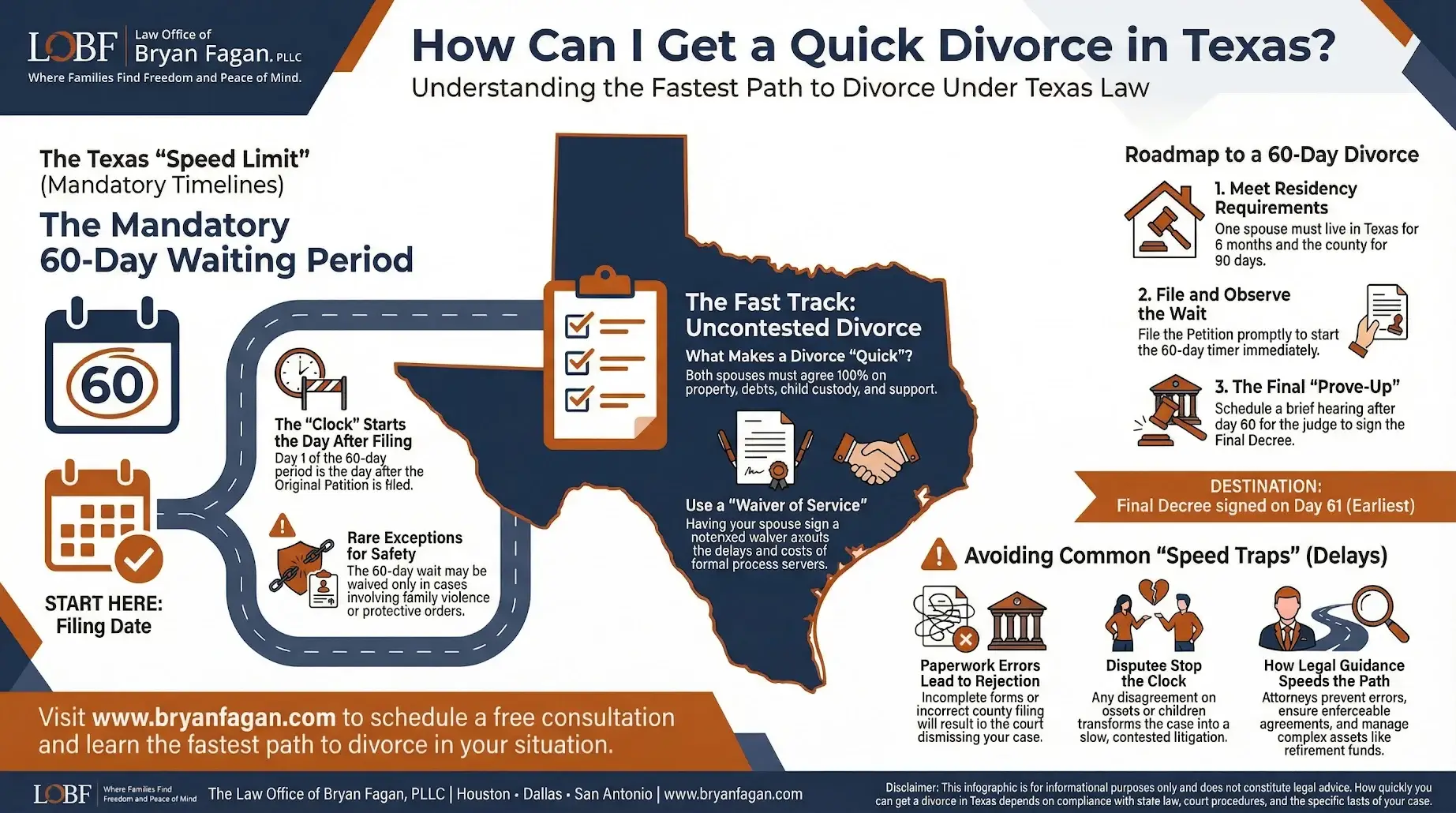

It usually begins with a quiet realization. The conversations have changed. The tension feels constant. You may already be living separate lives under the same roof, wondering what comes next. And somewhere in the middle of that uncertainty, one practical question rises to the surface: How can I get a quick divorce in Texas without making a difficult situation even more overwhelming?
Here is the first thing you need to know. Texas law requires a mandatory 60-day waiting period under Texas Family Code §6.702, and when children are involved, courts must prioritize the “best interest of the child” under §153.002. A quick divorce does not mean skipping legal safeguards. It means moving efficiently within the structure of Texas law, avoiding preventable delays, and making informed decisions from the very beginning.
At The Law Office of Bryan Fagan, PLLC, we have helped families across Houston and throughout Texas navigate this exact crossroads. Founded in 2012 by Bryan Joseph Fagan, a South Texas College of Law graduate and recognized authority on Texas divorce and custody law, our firm was built on a clear purpose: to empower people to reclaim freedom and peace of mind during life’s hardest transitions. That is our Why. We fulfill it through compassionate counsel, practical education, and innovative legal solutions that simplify complex legal systems. That is our How. And what we provide is experienced family law representation designed to protect what matters most—your children, your financial security, and your future.
We understand that divorce is not just a legal filing. It is a deeply personal shift that affects your home, your finances, and your sense of stability. We have seen firsthand how thoughtful planning, accurate filings, and strategic negotiation can shorten timelines and reduce conflict. We have also seen how small mistakes—filing in the wrong county, drafting incomplete decrees, failing to follow statutory requirements—can extend cases unnecessarily and increase stress.
In this article, you will learn what “quick” truly means under Texas law, how uncontested and default divorces work, what happens at a prove-up hearing, and what practical steps you can take to move forward efficiently while protecting your long-term interests. Most importantly, you will gain clarity about how to approach this process with confidence rather than fear.
If you are standing at the beginning of this transition and looking for both guidance and reassurance, you are not alone. Let’s walk through what you need to know so you can move forward with clarity, strength, and peace of mind.
Key Takeaways
- Texas requires a mandatory 60-day waiting period from the date the original petition for divorce is filed before any divorce can be finalized—this timeline cannot be shortened except in rare family violence cases.
- Uncontested divorces are the fastest option because spouses agree on all major issues including property division, child custody, and spousal support before or during the filing process.
- Preparation and cooperation are essential for a quick divorce; agreeing on divorce terms before filing and submitting accurate paperwork prevents delays.
- “Quick” means efficient, not instant—even the fastest Texas divorce takes approximately 60-70 days from filing to final decree under ideal circumstances.
- Legal guidance helps prevent rejected filings and ensures your final decree of divorce is enforceable and protects your long-term interests.

Your Family’s Future Starts Here
Don’t navigate your legal journey alone. Schedule a consultation now and get the clarity and support you deserve.
How Can I Get a Quick Divorce in Texas? The Short Answer
The most efficient path forward for couples asking How can I get a quick divorce in Texas is typically an uncontested divorce in which both spouses reach agreement on all major issues before filing or very early in the case. Under Texas Family Code §6.702, a court may not grant a divorce until at least 60 days have passed from the date the Original Petition for Divorce is filed, with limited exceptions in cases involving family violence. This statutory waiting period remains in effect under current Texas law and applies regardless of how cooperative the parties may be. Even when both spouses are fully aligned, the court must ensure that legal requirements are satisfied before signing a Final Decree of Divorce.
When families raise the question, “How can I get a quick divorce in Texas,” they are usually seeking clarity, structure, and reassurance—not shortcuts that jeopardize their future. A truly efficient Texas divorce means respecting the framework set forth in the Texas Family Code while minimizing unnecessary delay. That includes filing accurate pleadings, properly serving or obtaining a waiver of service from the other spouse, complying with statutory requirements, and preparing a comprehensive Final Decree that addresses property division under Texas community property principles and, when applicable, conservatorship and support provisions under Texas Family Code Chapters 153 and 154.
For couples who can agree on property division, debt allocation, conservatorship, possession schedules, child support, and spousal maintenance where appropriate under Texas Family Code Chapter 8, the timeline often falls within approximately 60 to 70 days from filing to finalization. Courts must also ensure that any orders involving children comply with the “best interest of the child” standard set forth in Texas Family Code §153.002, and that child support calculations reflect current statutory guidelines, including the updated cap on net monthly resources under §154.125(a-1). These safeguards are not obstacles; they are protections designed to ensure stability and fairness for both spouses and children.
Our legal team regularly guides clients through uncontested divorces with careful planning and attention to detail so that the case is ready to finalize as soon as the statutory waiting period expires. We encourage families to review additional guidance in our resource on Quick and Easy Divorce in Texas, which explains whether an uncontested approach may be appropriate for your situation. By combining legal precision with compassionate communication, the attorneys at The Law Office of Bryan Fagan, PLLC help Texans move forward efficiently while protecting what matters most—their children, their financial security, and their peace of mind.

The Mandatory 60-Day Waiting Period in Texas
If you are asking, How can I get a quick divorce in Texas, one of the first legal realities to understand is the mandatory waiting period set by state law. Texas Family Code §6.702 provides that a court may not grant a divorce until at least 60 days have passed from the date the Original Petition for Divorce is filed. This statutory requirement applies in nearly every divorce case filed in Texas and reflects the Legislature’s intent to provide a brief cooling-off period before a marriage is legally dissolved.
The 60-day clock begins the day after your petition is filed with the district court—not when your spouse is served and not when both of you decide to separate. If the 60th day falls on a weekend or court holiday, the divorce cannot be finalized until the next business day. Understanding this timeline from the outset allows families to plan strategically and avoid unnecessary frustration. Rather than delaying progress, this window can be used to finalize agreements, ensure compliance with property division standards under §7.001, and confirm that conservatorship and child support provisions meet the requirements of Chapters 153 and 154, including the updated net resource cap under §154.125(a-1).
There are limited exceptions to the waiting period. Under §6.702(b), a court may waive the 60-day requirement in certain family violence cases if the responding spouse has been convicted of or received deferred adjudication for an offense involving family violence, or if an active protective order or magistrate’s emergency protective order is in place. These exceptions are narrow and require proper documentation, so legal guidance is essential if you believe your situation may qualify.
For most Texas couples, however, the 60-day waiting period is non-negotiable. The key is preparation. When clients understand how the statute operates, they can use the waiting period wisely—drafting a thorough Final Decree of Divorce, confirming financial disclosures, and preparing for the prove-up hearing so the case is ready to conclude as soon as legally permitted.
For a deeper explanation of how this timeline works and how it may affect your case, we encourage you to review our detailed guide on Divorce Waiting Period in Texas. This resource provides practical insight into what the law requires and how families can move forward with clarity and confidence.
Why Uncontested Divorces Are the Fastest Option
When families ask, How can I get a quick divorce in Texas, they are often describing what the law calls an uncontested divorce—one where both spouses agree on every material issue before the case reaches trial. That agreement typically includes property division under Texas Family Code §7.001, allocation of debts, conservatorship and possession under Chapter 153, child support under Chapter 154 (including the updated net monthly resource cap in §154.125(a-1)), and spousal maintenance where applicable under Chapter 8. When these issues are resolved cooperatively, the process becomes significantly more efficient.
Uncontested cases move faster because the court does not need to devote time to contested hearings, discovery disputes, or trial preparation. After filing the Original Petition for Divorce and satisfying residency requirements under §6.301, the parties must still observe the mandatory 60-day waiting period set forth in §6.702. Once that statutory period has expired, the case can typically proceed to a brief prove-up hearing. During that hearing, the judge reviews the Final Decree of Divorce to ensure compliance with Texas law and confirms that any child-related provisions meet the “best interest of the child” standard under §153.002. When the paperwork is accurate and complete, this hearing often lasts only a few minutes.
The streamlined nature of an uncontested divorce reduces both legal complexity and emotional strain. Because both spouses voluntarily disclose financial information and resolve disputes without court intervention, there is usually no need for formal discovery, subpoenas, or extended litigation. However, “uncontested” does not mean informal. Courts still require precise drafting, enforceable language, and full compliance with statutory standards. Even minor inconsistencies between the petition and the final decree can delay entry of judgment.
For those considering electronic filing or preparing documents online, it is important to understand how digital submission fits within Texas procedural rules. We recommend reviewing our guide on Divorce Application Online in Texas: What You Need to Know Before Filing to better understand potential risks and requirements. You may also find helpful information in our broader Texas Divorce Resource Center, which explains both uncontested and contested pathways in detail.
At The Law Office of Bryan Fagan, PLLC, our mission is to educate families and protect futures. By combining careful statutory compliance with practical courtroom experience, our attorneys help families move efficiently through the divorce process while safeguarding what matters most.
Steps to Speed Up the Texas Divorce Process Legally
If you are asking, How can I get a quick divorce in Texas, the answer begins with preparation, cooperation, and strict compliance with the Texas Family Code. Texas law—specifically §6.702—requires a mandatory 60-day waiting period after filing the Original Petition for Divorce. That waiting period cannot be skipped in most cases, but it can be used wisely. A quick divorce is not about rushing the process. It is about positioning your case so that when the statutory clock runs out, you are fully prepared for finalization.
The most effective strategy is reaching agreement before filing. Texas is a community property state, and under Texas Family Code §7.001, courts must divide marital property in a “just and right” manner. By resolving property division, debt allocation, retirement accounts, and real estate issues in advance, couples significantly reduce delays. When children are involved, custody and possession must comply with Chapter 153, and child support must follow Chapter 154, including the updated net resource cap under §154.125(a-1). Addressing these issues early—often through mediation—can prevent your divorce from becoming contested and extending months beyond the 60-day minimum.
Accurate and complete paperwork is equally important. Jurisdictional requirements under §6.301 must be properly alleged, and the Final Decree of Divorce must align precisely with the relief requested in your petition. Texas courts will not sign decrees that contain inconsistencies or missing statutory language. Small errors can lead to rejected filings or additional hearings. That is why careful drafting and review matter so much in uncontested cases.
When appropriate, using a properly executed waiver of service can also reduce procedural delay. Without a waiver, a respondent generally has until 10:00 a.m. on the Monday following 20 days after service to file an answer. Cooperation at this stage can save time and court costs. Filing promptly once agreements are finalized ensures the 60-day waiting period begins without unnecessary delay. During that time, reviewing documents, confirming financial disclosures, and preparing for the prove-up hearing can keep the case on track.
For additional guidance, we encourage readers to review our detailed resource on How to Get a Quick Divorce in Texas: Fast and Easy Steps, which expands on many of these strategies. You may also find helpful insights in our article on Quick and Easy Divorce in Texas, which explains when an uncontested approach may be appropriate.
At The Law Office of Bryan Fagan, PLLC, our mission is to educate families and protect futures. Our attorneys combine practical legal strategy with compassionate client communication, ensuring that efficiency never comes at the expense of protection. When families ask, How can I get a quick divorce in Texas, we guide them toward thoughtful planning, statutory compliance, and informed decision-making—so they can move forward with clarity, confidence, and peace of mind.

What Slows Down a Texas Divorce
When families begin asking, How can I get a quick divorce in Texas, it is just as important to understand what can slow a case down as it is to understand what can speed it up. The Texas Family Code provides a structured framework for divorce, but certain legal and practical obstacles can extend your timeline if they are not addressed proactively.
One of the most common causes of delay is disagreement over property, custody, or support. Texas is a community property state, and under Texas Family Code §7.001, courts must divide marital property in a manner that is “just and right.” If spouses cannot agree on how to divide assets or allocate debts, the divorce shifts from uncontested to contested. Similarly, conservatorship decisions under Chapter 153 and child support determinations under Chapter 154—including compliance with the updated net monthly resource cap in §154.125(a-1)—can become points of dispute. Once a case becomes contested, formal discovery, mediation, and potentially trial may be required. What might have concluded shortly after the mandatory 60-day waiting period in §6.702 can instead stretch into many months.
Service of process issues are another frequent source of delay. After filing the Original Petition for Divorce, proper service must be completed unless a valid waiver of service is executed. If a spouse cannot be located, additional procedural steps such as service by publication may be necessary. Default divorce procedures exist, but they require strict compliance and can add time and complexity to the case.
Incomplete or inaccurate paperwork can also extend your timeline. Residency requirements under §6.301 must be properly established, and pleadings must clearly state the relief requested. Errors in the Final Decree of Divorce—particularly inconsistencies between the petition and the decree—can lead to rejection at the prove-up hearing. Each correction cycle can add days or even weeks to your case.
Court scheduling backlogs may also impact how quickly your final hearing is set after the statutory waiting period expires. While uncontested divorces are generally finalized efficiently, scheduling ultimately depends on each court’s docket.
Emotional conflict is perhaps the most underestimated factor. Divorce is personal, and unresolved tension can quickly escalate minor disagreements into full litigation. Keeping communication respectful and focused on practical solutions helps preserve the efficiency of an uncontested case.
For families concerned about managing costs during this process, we recommend reviewing our guide on How to Get a Free or Nearly Free Divorce in Texas. You may also find helpful guidance in our broader Texas Divorce Resource Center, which outlines both contested and uncontested pathways in detail.
At The Law Office of Bryan Fagan, PLLC, our mission is to educate families and protect futures. By identifying potential delays early and ensuring full compliance with the Texas Family Code, our attorneys help families move forward efficiently while safeguarding their rights and long-term stability.
Can You Get a Divorce Faster in Certain Counties in Texas?
When families begin asking, How can I get a quick divorce in Texas, it is common to wonder whether filing in a different county might speed things up. While court backlogs do vary across Texas and local procedures can affect how quickly a final hearing is scheduled, venue is not simply a matter of convenience. Texas Family Code §6.301 requires that at least one spouse must have lived in Texas for six months and in the county of filing for at least 90 days before the petition is filed. These residency requirements are jurisdictional, meaning the court cannot grant a divorce unless they are satisfied.
Even if one county appears to have a lighter docket, the statutory 60-day waiting period under §6.702 still applies statewide, except in limited family violence circumstances. That means venue selection alone does not eliminate the mandatory timeline. However, when both spouses meet residency requirements in different counties, there may be strategic considerations. Local scheduling practices, courtroom procedures, and familiarity with uncontested prove-up protocols can influence how efficiently a case moves once the waiting period expires.
Our Houston-based legal team regularly advises clients on these practical distinctions while ensuring full compliance with current Texas Family Code provisions. Understanding how venue interacts with the statutory timeline allows families to plan realistically rather than relying on assumptions. For a more detailed explanation of how the waiting period operates and how it affects uncontested cases, we recommend reviewing our article on Understanding the 60-Day Waiting Period for Uncontested Divorces in Texas, which expands on these timing considerations.
At The Law Office of Bryan Fagan, PLLC, our mission is to educate families and protect futures. By combining statutory knowledge with hands-on experience in courts across Texas, we help clients move forward efficiently while remaining grounded in the legal realities that govern every divorce case.

How Children Affect Divorce Timelines in Texas
Divorces that involve children require additional paperwork and judicial scrutiny. Texas courts must ensure that any custody arrangement serves the best interests of the child and that child support calculations meet statutory guidelines.
When minor children are involved, you will need to develop a comprehensive parenting plan addressing conservatorship, possession schedules, and decision-making rights. The court will carefully review these arrangements before approving your final decree of divorce.
Child-related cases sometimes take longer because:
- Child support calculations must comply with Texas Family Code guidelines
- Courts require complete financial information from both parents
- Judges may have additional questions about proposed custody arrangements
- Any concerns about the children’s welfare require resolution before finalization
If you and your spouse can agree on custody, visitation, and support before filing, you eliminate one of the most common sources of delay and conflict.
Online Divorce and Speed: Myth vs. Reality
Many services advertise “quick” or “easy divorce” options online, leading people to believe they can divorce faster by using these tools. Understanding the reality prevents disappointment.
Online filing (e-file) simply means submitting your court forms electronically rather than in person at the clerk’s office. Electronic filing may slightly speed administrative processing, but it does not eliminate the mandatory 60-day waiting period.
Online divorce services are third-party companies that help you prepare divorce documents. While these can be helpful for simple uncontested cases, they carry risks:
- Rushed or incomplete documents may be rejected
- Generic forms may not address your specific situation
- You lose the benefit of legal guidance tailored to Texas law and your circumstances
- Errors discovered after your divorce is finalized can be difficult and expensive to correct
For low income individuals, some Texas courts offer self-help resources, but even these do not change the fundamental timeline requirements.
Can Hiring a Lawyer Help You Get a Quick Divorce in Texas?
When families ask, How can I get a quick divorce in Texas, they are usually hoping to avoid unnecessary delays while still protecting their children, finances, and long-term stability. The most effective way to accomplish that is by working with an experienced Texas family law attorney who understands both the legal framework and the practical realities of local courts. A well-prepared case that complies with the Texas Family Code from the beginning is far less likely to encounter setbacks that extend the timeline.
Many delays occur because of incomplete or incorrect filings. Texas Family Code §6.301 requires that residency be properly established before a court can exercise jurisdiction, and §6.702 mandates the 60-day waiting period in nearly all divorces. If pleadings fail to meet statutory requirements or omit essential details, courts may require amendments or deny finalization. Issues involving property division must comply with §7.001’s “just and right” standard, while conservatorship and possession must align with Chapter 153 and the best interest of the child under §153.002. Child support calculations must reflect Chapter 154, including the updated net monthly resource cap under §154.125(a-1). Careful drafting from the outset helps prevent costly corrections later.
A properly prepared Final Decree of Divorce is equally important. What seems clear during negotiation can become problematic if the language is vague or incomplete. Retirement accounts may require a Qualified Domestic Relations Order, business interests may demand detailed allocation language, and real property transfers must be precisely described. An experienced attorney ensures that the decree is enforceable and consistent with current Texas law, reducing the likelihood of post-divorce litigation.
Court coordination also matters. Local procedures, scheduling practices, and docket congestion vary across counties. Understanding how and when to schedule a prove-up hearing after the statutory waiting period expires can make a measurable difference. For a deeper explanation of how this timeline works and how to use the waiting period productively, we recommend reviewing our guide on the 60-day waiting period for divorce in Texas. This resource provides clarity on statutory requirements and practical planning during the mandatory timeframe. In addition, our comprehensive overview on Texas Divorce Resources offers further insight into navigating the process efficiently.
Beyond paperwork and scheduling, legal representation provides stability during an emotionally difficult transition. Divorce negotiations can quickly shift from cooperative to contested when communication breaks down. A skilled attorney serves as a neutral, steady advocate who keeps the focus on practical outcomes rather than emotional conflict.
When clients ask, How can I get a quick divorce in Texas, the honest answer is not about shortcuts. It is about preparation, statutory compliance, and thoughtful strategy. At The Law Office of Bryan Fagan, PLLC, our mission is to educate families and protect futures. By doing the work correctly the first time, families can move forward with confidence, efficiency, and lasting peace of mind.

Why Choose The Law Office of Bryan Fagan, PLLC
The Law Office of Bryan Fagan, PLLC brings extensive experience handling both uncontested and expedited Texas divorces. Our family law attorneys understand what makes the difference between a divorce that moves efficiently and one that gets bogged down in preventable delays.
We focus on:
- Efficient, detail-oriented drafting that prevents rejected filings and court requests for amendments
- Strategic mediation and negotiation to help spouses reach agreement and keep divorces uncontested
- Clear communication so you always understand where your case stands and what comes next
- Compassionate guidance that acknowledges the emotional difficulty of divorce while keeping you focused on your goals
- Statewide Texas representation for clients across all Texas counties
Our law firm helps Texans move forward with clarity and confidence through efficient legal processes, strategic planning, and compassionate advocacy.
Checklist: How Can I Get a Quick Divorce in Texas
Use this checklist to prepare for the most efficient divorce process possible:
- [ ] Confirm residency requirements: At least one spouse has lived in Texas for at least six months and in the filing county for at least 90 days
- [ ] Determine whether your divorce can remain uncontested: Can you and your spouse agree on property division, debts, custody, support, and all other major issues?
- [ ] Finalize all agreements before filing: Document your agreed divorce terms in writing
- [ ] Prepare accurate, complete paperwork: Include all marital assets, debts, and proposed arrangements
- [ ] File promptly to start the 60-day clock: Do not delay once your paperwork is ready
- [ ] Arrange for waiver of service if appropriate: Have your spouse sign a waiver if you are proceeding cooperatively
- [ ] Consult a Texas divorce attorney: Get legal guidance to avoid delays and protect your interests
Conclusion
Divorce may mark the end of one chapter, but it also opens the door to a new beginning. If you have been asking how to move forward quickly while still protecting your family, your finances, and your peace of mind, the most important takeaway is this: speed and stability can coexist when the process is handled thoughtfully. A well-planned divorce does not just close a case file—it lays the groundwork for a stronger, more secure future.
At The Law Office of Bryan Fagan, PLLC, we believe families deserve clarity, not confusion, during life’s hardest transitions. Our role is not simply to file paperwork. It is to educate you, guide you, and help you make confident decisions that protect what matters most. When you work with an experienced Texas Family Law Attorney, you gain more than legal representation—you gain strategy, structure, and an advocate who understands how Texas courts truly operate.
If you are ready to take the next step, we invite you to schedule a consultation and talk through your situation. Whether your case is straightforward or complex, having a clear plan can make all the difference. Even if you are still gathering information, that first conversation can replace uncertainty with direction.
This season may feel heavy, but it does not define your future. With the right guidance and a steady approach, you can move forward with confidence—and maybe even a sense of relief that you handled it the right way.
Frequently Asked Questions About Divorce in Texas
The quickest way to get a divorce in Texas is typically through an uncontested divorce where both spouses agree on all major issues before filing or early in the process. This includes property division, debt allocation, and—if children are involved—custody and child support arrangements. Texas law requires a mandatory 60-day waiting period in most cases, so the fastest divorces are those that are fully prepared to finalize as soon as that waiting period ends.
The cost of a quick divorce in Texas depends largely on whether the case remains uncontested. Every divorce involves court filing fees, and there may also be service fees, mediation costs, and document preparation expenses. Attorney fees vary based on whether you choose a flat-fee uncontested divorce or hourly representation. The more disagreement and litigation involved, the higher the overall cost tends to be.
In most cases, at least one spouse must attend a brief final hearing, often called a “prove-up,” so the judge can review the paperwork and sign the Final Decree of Divorce. Some counties allow virtual hearings for uncontested divorces. While the court appearance is typically short and straightforward, it is still a required step in most situations.
For most couples, the minimum timeline is 60 days from the date the Original Petition for Divorce is filed. If both parties agree on everything and the paperwork is accurate, the divorce may finalize shortly after the 60-day waiting period ends. Contested divorces, however, can take several months to more than a year depending on complexity and court scheduling.
Texas does not usually allow for an instant or emergency divorce. However, if there is family violence or an urgent safety concern, you can request emergency temporary orders or protective orders from the court. In limited family violence cases, the 60-day waiting period may be waived. Each situation is unique, so legal guidance is important if immediate protection is needed.
Moving out of the marital home without a clear legal strategy can affect custody arrangements, access to property, and the “status quo” a court considers when issuing temporary orders. While leaving may be necessary in some situations—especially for safety reasons—it is wise to speak with a Texas family law attorney before making that decision so your rights and parenting time are protected.
Many Texas counties allow electronic filing (e-filing), which means you can submit divorce documents online rather than in person. However, online filing does not eliminate the mandatory waiting period or the requirement for proper service and court approval. Filing electronically can improve efficiency, but accuracy and compliance with Texas law remain essential.
The least expensive option is usually an uncontested divorce where both spouses agree on all terms and avoid court battles. Reducing conflict, organizing financial information early, and reaching agreements outside of trial can significantly lower costs. While self-help forms may reduce attorney fees, mistakes in paperwork can lead to delays or costly corrections later.
During a divorce, it is important to avoid actions that create legal or financial risk. This includes hiding assets, draining bank accounts, posting inflammatory content on social media, involving children in adult disputes, or ignoring court deadlines. Staying calm, organized, and focused on long-term outcomes can help protect both your case and your peace of mind.