Filing for divorce is often the moment people feel two things at once. Relief that something has finally started, and fear about what comes next. If you're searching for what happens after filing for divorce texas, you probably want more than legal definitions. You want to know what tomorrow looks like, what deadlines matter, and how to keep your home life, finances, and parenting routine from sliding into chaos.
Texas divorce follows a set legal path, but living through it never feels simple. One spouse may still be in the house. Bills still come due. Children still need school pickups, meals, and reassurance. The court process matters, but so does your day-to-day stability. When clients understand the sequence, they make better decisions and avoid the mistakes that cause long delays, bad temporary outcomes, or unnecessary court fights.
Your Guide Through the Texas Divorce Process
A divorce case usually starts long before the paperwork hits the courthouse. By the time someone files, there have often been months of conflict, uncertainty, or silence. Then the petition is filed, and everything suddenly feels official.
That shift can be unsettling. A parent may worry about where the children will sleep next week. A business owner may worry about records, accounts, or payroll. A spouse who didn't file may feel blindsided and immediately fear losing the house, the bank account, or time with the children.
Texas law gives the process structure. There are filing requirements, service rules, response deadlines, a waiting period, temporary arrangements, information exchange, negotiation, and if necessary, a trial. Knowing the order matters because the right move at the right stage can protect your position. The wrong move can make the case harder and more expensive.
If you're still at the very beginning, this overview of how to start the divorce process in Texas is a useful companion. Once the case is filed, the focus shifts from deciding whether to act to managing what happens next with discipline and calm.
The clients who feel most in control are not the ones with simple cases. They're the ones who know the next step before the next problem appears.
The First 20 Days After Filing
Once the Original Petition for Divorce is filed, the next major event is usually service of process. That means the other spouse is formally notified that a divorce case has been opened. In Texas, service is commonly completed by a process server, constable, or sheriff.

For the spouse who filed, proper service matters because the court cannot move forward cleanly without it. For the spouse who was served, the clock starts immediately. After service, the respondent must file an Answer by the Monday following 20 days after service. If that deadline is missed, the court can enter a default judgment under Texas Rule of Civil Procedure 239, and that happens in about 15 to 20% of uncontested cases annually according to Texas judicial statistics, as summarized in this discussion of what happens after divorce papers are served in Texas.
What service means in real life
Being served does not mean you've lost. It means the case is active and you need to respond through the court, not just through text messages or hallway conversations.
A common mistake is assuming, “We're still talking, so I don't need to do anything yet.” That is how defaults happen. Another mistake is reacting emotionally by emptying accounts, changing passwords, or refusing all communication. Those moves can hurt your credibility and create problems that are harder to fix later.
What the respondent should do right away
If you were served, focus on protecting your rights before trying to “win” the whole case in a week.
- Read every page carefully: Look for the case number, the court, and any requests involving children, property, support, or exclusive use of the home.
- Calendar the answer deadline: Don't rely on memory. Put it in your phone, on paper, and anywhere else you'll be sure to see it.
- Preserve records: Keep copies of bank statements, pay stubs, tax returns, mortgage statements, insurance documents, and any messages that relate to the issues in the case.
- Avoid informal side deals: If your spouse says, “Don't worry, I won't do anything,” still file your Answer.
- Get legal advice early: A short consultation at this stage can prevent months of avoidable damage.
What the filing spouse should remember
If you filed, don't assume filing alone creates immediate control. You still need proper service, organized records, and a plan for temporary issues. Filing starts the case. It doesn't finish the practical problems that led you here.
Practical rule: If you've been served, your first job is not to argue. Your first job is to respond on time.
Creating Stability with Temporary Orders
The period after filing is often the most emotionally volatile part of the case. People are still sharing a roof, or trying to stop sharing one. Children are watching. Bills haven't paused. For these reasons, Temporary Orders become important.
Texas law imposes a 60-day waiting period after filing before a divorce can be finalized under Texas Family Code § 6.702. During that time, courts often enter Temporary Orders covering child possession, support, and use of property. The Standard Possession Order is a common benchmark for parenting time, and child support is often set under guideline rules, including 20% of net resources for one child, capped at $9,200 per month as of 2026, according to the Texas State Law Library guide on finalizing a divorce in Texas.

What Temporary Orders actually do
Think of Temporary Orders as the rulebook for the months while the divorce is pending. They can address questions like these:
- Who stays in the house
- Who pays the mortgage, rent, or utilities
- When each parent has the children
- Who carries health insurance
- Whether temporary child support must be paid
- Who can use certain vehicles or accounts
Without those rules, many families end up operating on unstable verbal arrangements. Those usually work only until the first disagreement.
Why this stage shapes the rest of the case
Temporary arrangements often influence the final outcome because they create a new routine. If one parent has been handling most exchanges, school pickups, homework, and medical appointments during the case, that pattern may matter later. If one spouse has been paying certain bills under court order, that paper trail matters too.
That's why preparation matters before the hearing. Don't walk in with broad complaints. Walk in with organized facts.
A useful next step is learning what to expect at a Texas divorce temporary orders hearing.
How to prepare for a temporary orders hearing
Bring order to the facts before asking the court for help.
| Issue | Helpful proof |
|---|---|
| Parenting schedule | School calendars, pickup history, messages about exchanges |
| Household bills | Mortgage, rent, utilities, insurance statements |
| Income | Pay stubs, tax returns, business records if applicable |
| Immediate concerns | Screenshots, emails, account statements, police reports if relevant |
Clients often do better when they focus on stability instead of punishment. Judges generally want workable short-term rules, especially where children are involved.
This overview may also help if you want a visual explanation of the hearing process:
Gathering Information During the Discovery Phase
After the immediate deadlines and temporary issues are handled, the case usually moves into discovery. This is the formal process for gathering information. Clients often dislike this stage because it feels intrusive, but it serves an important purpose. You can't divide property fairly or make informed decisions about support without knowing what exists.
Discovery is how the facts get organized
In many marriages, one spouse handled more of the finances. That doesn't always mean they did anything wrong. It means the other spouse may not have the full picture. Discovery closes that gap.
Common tools include:
- Sworn Inventory and Appraisement: A list of assets, debts, and claims each spouse says exist.
- Interrogatories: Written questions that must be answered.
- Requests for Production: Demands for records such as bank statements, tax returns, loan documents, and business records.
- Financial affidavits and related disclosures: These help frame income, expenses, and cash flow.

If your case includes a closely held business, irregular income, or concerns about hidden funds, outside experts may become necessary. In those situations, resources on specialist divorce forensic accounting services can help you understand how financial tracing and valuation work in practice.
What works and what doesn't
What works is simple, even if it takes effort. Gather complete records. Answer truthfully. Flag gaps early. Keep your documents organized by category instead of dropping everything into one folder.
What doesn't work is selective disclosure, vague estimates, or hoping the other side won't ask follow-up questions. Discovery usually rewards the organized party and exposes the party who cuts corners.
The strongest settlement positions are built with documents, not assumptions.
For a fuller explanation of the process, see this guide to the discovery phase of divorce.
A practical example
If one spouse says, “The business isn't worth much,” and the other spouse says, “It supports our entire lifestyle,” the court won't resolve that by guessing. Discovery gathers tax returns, profit and loss statements, payroll records, balance sheets, and ownership documents. Once the numbers are clear, settlement talks become far more productive.
Reaching an Agreement Through Mediation
By the time a case reaches mediation, many spouses are worn down by the uncertainty. They have answered discovery, exchanged records, and spent weeks or months wondering who will stay in the house, how parenting time will work, or whether they will have enough cash to get through the next year. Mediation is often the first point in the case where the conflict starts to feel manageable again.
Texas divorces cannot be finalized immediately. The law imposes a waiting period, and many cases take longer because the parties use that time to work out property, support, and parenting terms through negotiation rather than asking a judge to decide every disputed issue, as explained in TexasLawHelp's divorce overview.
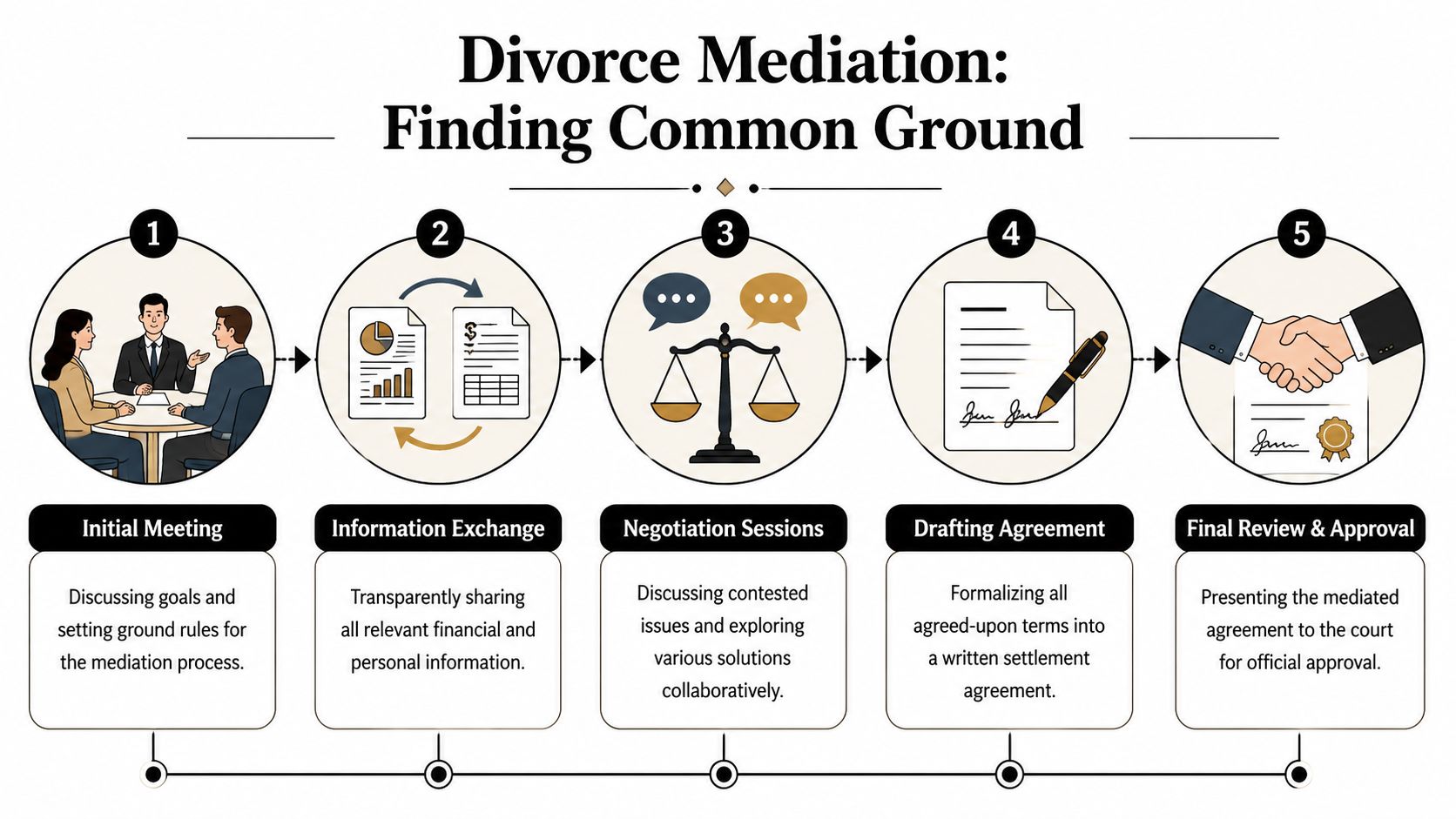
What mediation usually looks like
Mediation is a structured settlement conference led by a neutral mediator. In most Texas divorce cases, each side stays in a separate room with their attorney, and the mediator moves back and forth with proposals, counterproposals, and questions about what each side can realistically accept.
That setting matters more than clients expect.
People are usually more candid in mediation than they are in a courtroom hallway or on the witness stand. They can ask practical questions, test options, and make trade-offs without the pressure of speaking directly to the other spouse every minute. For many families, that lowers the temperature enough to make real decisions.
Some mediations end with a full agreement in one day. Others resolve only the biggest disputes and leave drafting or a few details for later.
Why mediation often gives families better options
A judge can make decisions. A judge cannot tailor daily life as carefully as the parties can.
Mediation works well because it gives both sides room to solve real-world problems, such as:
- Parenting schedules that fit the children's actual routine: school pickup, daycare, extracurricular activities, holidays, and summer plans
- Property divisions built around liquidity and stability: who keeps the house, who takes retirement assets, and how to handle accounts that cannot be divided evenly in a simple way
- Debt assignments tied to reality: which spouse can refinance, which debt needs to be paid off, and how to protect credit while accounts are being closed or transferred
- Timing issues that courts often handle bluntly: move-out dates, home sale deadlines, business transitions, or short-term support while one household becomes two
Those details shape daily peace after the divorce. They also reduce the risk of future enforcement fights.
A fair settlement is not just about who gets what. It is about whether the agreement will actually work on an ordinary Tuesday.
How to use mediation well
Clients sometimes walk into mediation focused on proving a point. That usually costs money and shortens the path to settlement. The better approach is to decide in advance where flexibility exists and where it does not.
Before mediation, identify three categories. First, the terms you need. Second, the terms you want but could trade. Third, the issues that matter emotionally but do not change your long-term stability. That kind of preparation helps clients stay clear-headed when offers start moving.
It also helps to bring a practical lens to the day. If keeping the house means you cannot afford repairs, taxes, and the mortgage, keeping it may not be the win it appears to be. If a proposed parenting plan looks equal on paper but constantly disrupts school and childcare, it may create more conflict than it solves.
When mediation stalls
Mediation does not fix every case. It is harder to reach an agreement when one spouse is hiding information, refusing to negotiate seriously, or using delay as a strategy. It can also fail when the financial picture is still too unclear for either side to measure a fair result.
Even then, mediation is rarely wasted. It often narrows the issues, exposes the actual points of disagreement, and shows both sides what still needs to be proved. In practice, many cases that do not settle at the first mediation resolve later, after more documents are produced or after a court ruling gives the parties a clearer view of the likely outcome.
If negotiation fails, the court decides. That can happen at a contested temporary hearing, a pretrial matter, or a final trial. For clients, the hardest part is usually the loss of control. You may know your family inside and out, but in court, the judge has to make decisions from testimony, documents, and the rules of evidence.
Trials are also expensive. When a Texas divorce proceeds to trial, average costs can reach $15,600 for cases without children and $23,500 for cases with children, and the judge's Final Decree will contain binding rulings on disputed issues, including a just and right division of community property that is not always a 50/50 split, as described in this summary of the Texas divorce process and trial costs.
What the courtroom usually looks like
A trial is not constant drama. Much of it is careful, methodical presentation.
Your attorney presents evidence, questions witnesses, and objects when necessary. The other side does the same. The judge listens, reviews exhibits, and decides what facts have been proven. In custody disputes, property disputes, and support disputes, details matter. Dates matter. Documents matter. Credibility matters.
How clients help their case
Clients often assume their role is to tell the judge everything that happened in the marriage. That's rarely the best approach. The more effective approach is focused testimony.
Helpful habits include:
- Answering the question asked: Don't volunteer three extra arguments.
- Using specific examples: “I paid the mortgage from this account” is more useful than “I always handled everything.”
- Staying composed: Visible anger can distract from strong facts.
- Trusting preparation: The time to organize evidence is before court, not during a break in the hallway.
The trade-off
Some cases need trial. If the other side is hiding assets, refusing reasonable parenting terms, or pushing a plainly unfair position, court may be necessary. But trial is still a blunt instrument. It produces a binding answer, not always a satisfying one.
That reality is why solid preparation and serious settlement efforts matter. Even when a case is headed toward trial, the strongest trial preparation often improves the odds of a reasonable settlement before the judge has to rule.
The Final Decree and Life After Divorce
The last major document in the case is the Final Decree of Divorce. This is the order that ends the marriage and spells out property division, debts, conservatorship, possession, support, and the next steps each person must take.
For many clients, this is the moment they expect to feel immediate relief. Sometimes that happens. Just as often, the first reaction is exhaustion. That is normal. The decree closes the case, but it also starts a new phase. Now the focus shifts from arguing about terms to carrying them out correctly.
If your case settled, one spouse usually appears at a short prove-up hearing so the judge can approve the agreement. If your case went to trial, the decree should match the judge's rulings. In either situation, careful drafting matters. A vague decree creates expensive problems later. A clear decree gives both households a practical set of instructions.
Why details in the decree matter
Good decrees do more than announce the result. They explain how the result will be carried out.
If the house will be sold, the decree should address who selects the realtor, how the listing price will be set, who pays for repairs, and how the net proceeds will be divided. If retirement funds are being split, the decree should make clear whether a separate order is needed and who is responsible for preparing it. If one parent must maintain health insurance, the decree should state when proof must be provided and how unreimbursed medical costs will be shared.
Those details matter because post-divorce conflict usually starts in the gaps. I often see trouble where the decree says what must happen but not when, how, or by whom. The more specific the order, the less room there is for confusion, delay, or finger-pointing.
Standing Orders can still matter here too. If your county has them, they may continue to restrict certain actions until the case is finished. A spouse who changes an account, drops insurance, or transfers property too early can create a separate problem at the end of the case. Read the final paperwork carefully before taking any last-minute financial steps.
Life after the decree
A divorce decree is a court order. Treat it that way from day one.
That means two practical things:
Enforcement may be available if your ex does not comply.
If property is not transferred, support is not paid, or the parenting schedule is ignored, the court may be able to enforce the order.Some terms can be modified later if circumstances change.
Jobs change. Children grow up. Income rises or falls. Parents sometimes need a different schedule. Certain parts of a family court order can be changed, but only through the proper legal process.
One point causes confusion after almost every divorce. The decree itself does not always complete every transfer. A retirement account may still need a separate order. A vehicle title still has to be changed. A deed may need to be signed and filed. If those follow-up tasks are ignored, people are often surprised to learn the case is over but the problem is not.
A good decree does more than end the marriage. It gives you a workable plan for the next chapter.
A practical approach to the first months after divorce
The first few months after divorce are usually about implementation. During this period, calm, organized follow-through protects you.
Start with a written checklist. Update beneficiaries where the order allows it. Change automatic payments. Refinance or close joint accounts if the decree requires it. Save copies of signed orders, deeds, titles, payment confirmations, and any notices sent to the other side. Keep a folder for child-related expenses and reimbursements. If a deadline is coming up, put it on your calendar instead of trusting yourself to remember it.
Ask questions early. If a decree term is unclear, get advice before acting on your own interpretation. That single step prevents a surprising number of post-divorce disputes.
If you need help navigating divorce, custody, or estate planning in Texas, contact Law Office of Bryan Fagan, PLLC today for a free consultation. We help clients understand what happens next, protect their rights at every stage, and build practical solutions that support long-term stability.