
When a grandparent calls after weeks or months of silence from a parent, the question usually isn't legal at first. It's personal. They want to know whether they can still protect a child they've loved, cared for, and often helped raise.
That fear is real. Maybe you picked your grandchild up from school, kept medicine schedules straight, helped with homework, or provided a safe place when life in the parents' home became unstable. Then access changed suddenly. Phone calls stopped. Visits stopped. You were told to stay away.
Texas law can feel cold in that moment, but it isn't impossible to manage. It is strict, and that matters. Courts in Texas don't start from the assumption that a grandparent should automatically get custody or visitation. They start from the presumption that parents have the primary right to make decisions for their children. For grandparents, that means a case has to be built carefully, with facts, documents, and a clear legal path.
If you're searching for answers about grandparents rights in Texas custody, the most useful place to begin is with realism. Love matters. A close bond matters. But in court, those facts alone usually won't be enough. What works is showing the court why your involvement is legally necessary and how the child may be harmed without protection.
Your Grandchild Is Your World We Understand
A grandmother once described the situation this way. “I'm not trying to take anyone's place. I'm trying to make sure my grandbaby is safe.” That captures what many grandparents are feeling when they start looking into court options.
Sometimes the concern begins after a divorce. Sometimes a parent dies, becomes unavailable, struggles with instability, or cuts off contact after a family conflict. In other families, the grandparent has long been the primary caregiver, until one day the arrangement changes and the child is pulled away from the only consistent routine they've known.
If that sounds familiar, you're not overreacting by asking questions. You're responding to a family crisis that may have serious consequences for a child.
Practical rule: Texas courts respond to evidence of child harm, not just evidence of family heartbreak.
That distinction is painful, but it helps you focus on what moves a case forward. A judge may sympathize with the loss of a treasured relationship and still deny relief if the legal standard isn't met. On the other hand, a grandparent with a carefully documented caregiving history and clear proof of danger or instability may have a path into court.
Grandparents rights in Texas custody cases often turn on two practical questions. First, do you have the legal ability to file? Second, if you do, can you prove enough to justify court intervention? Those are separate issues, and both matter.
You don't need to approach this as a family war. The better frame is protection, stability, and careful decision-making. If you're worried about your grandchild's safety, emotional health, or day-to-day care, the legal system may offer options. But those options work best when you understand the barriers before you file.
The First Hurdle Proving You Have the Right to Sue
The first surprise for many grandparents is this. The court doesn't automatically let you argue for custody or visitation just because you're family. You first have to prove standing.
Standing means you have the legal right to bring the case in the first place. Think of it as the key that opens the courthouse door. Without it, the judge never reaches the larger question of what arrangement might help the child.
Texas takes this issue seriously because parents have strong constitutional protection when making decisions about their children. Under the Texas State Law Library's explanation of grandparent visitation law, Texas grandparents don't have an automatic right to custody or visitation, and Texas Family Code Section 153.433 requires a grandparent to overcome the presumption that a parent acts in the child's best interest by proving that denial of access would significantly impair the child's physical health or emotional well-being. The same discussion notes that this narrow structure reflects the parental-rights principles recognized in Troxel v. Granville.
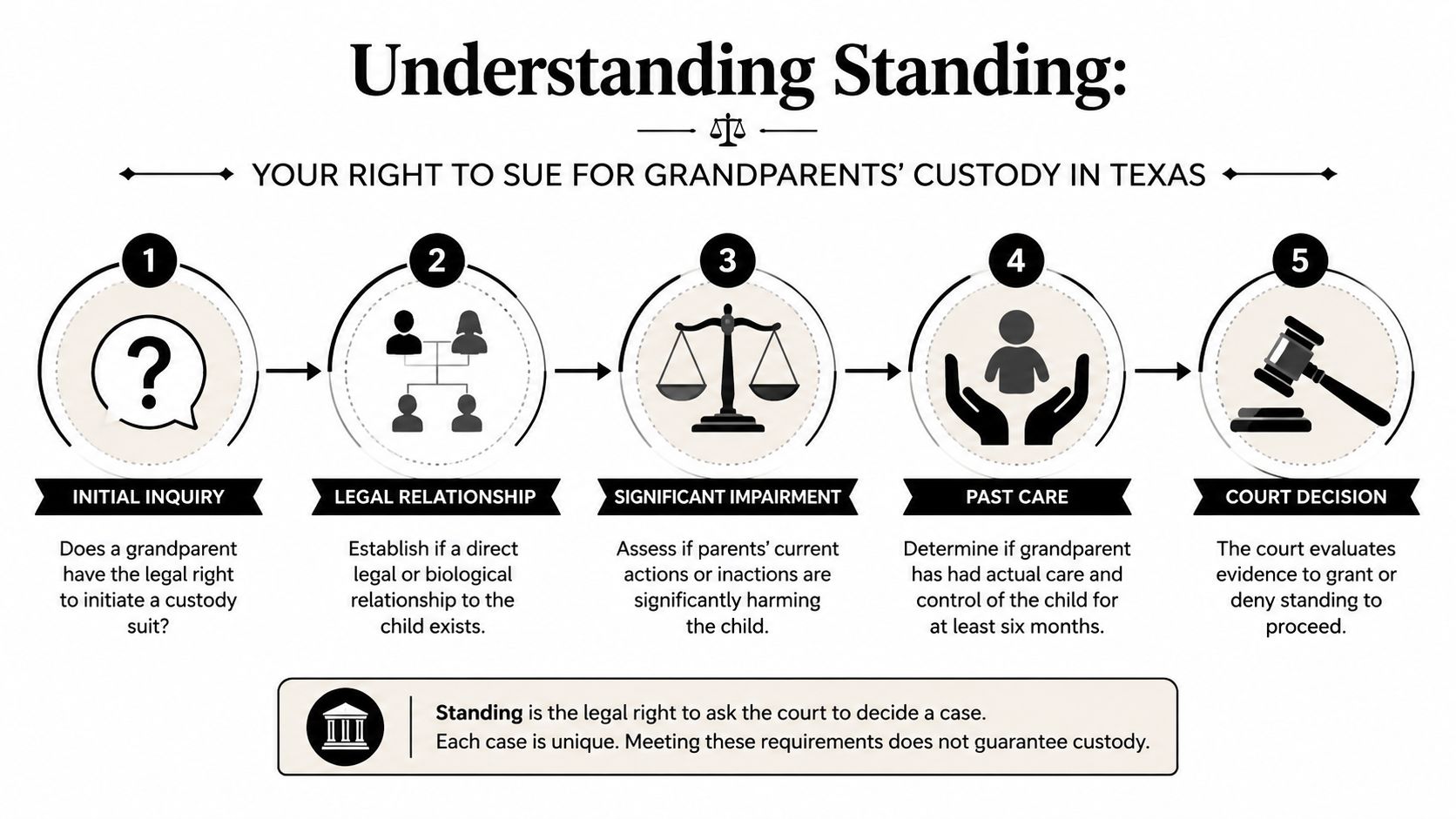
What standing looks like in practice
In plain terms, Texas usually requires more than “I love my grandchild” or “I disagree with the parent.” A grandparent typically needs a recognized legal basis to file.
That may involve facts such as:
- A qualifying family circumstance: A parent may be deceased, incarcerated, legally incompetent, or tied to abuse or neglect issues.
- A prior caregiving role: In some custody situations, a grandparent may establish standing by showing actual care, control, and possession of the child for the required period.
- A live risk to the child: The case must connect the requested court order to the child's physical health or emotional well-being.
The court is looking for a real legal entry point, not a generalized concern.
Standing and harm are not the same thing
Often, cases face complications: A grandparent may have facts that show they should be worried, but not facts that satisfy the threshold to sue. In other cases, a grandparent may have standing but still lose because the proof of harm is too thin.
Here's the practical sequence:
- Show why you belong in court.
- Show why the child needs court action.
A lot of frustration comes from skipping step one.
The strongest filings are focused and fact-specific. Broad claims about being a loving grandparent rarely survive close review.
If you're trying to sort out whether your situation fits one of the recognized pathways, this discussion of top reasons Texas grandparents can file for custody of a grandchild can help frame the issue before you spend time and money on the wrong kind of case.
Why courts set the bar so high
Judges see many family disputes that are emotionally intense but legally weak. Texas law separates those from cases involving genuine danger or serious instability. That's why the standard is built around significant impairment, not ordinary disagreement.
A parent can make choices you dislike and still remain legally protected. A grandparent usually needs to show more than poor communication, tension, inconsistent visitation, or a family falling-out. The proof has to point toward meaningful harm to the child.
That can feel harsh. It also means that when a grandparent does have solid evidence, the case is easier to explain and defend.
Custody vs Possession Understanding the Legal Terms
Many grandparents use the word “custody” to describe any court order involving a child. Texas law is more precise, and that precision matters because the remedy you ask for shapes the evidence you need.
The two terms that cause the most confusion are conservatorship and possession and access. Conservatorship is what many people informally call custody. Possession and access is the legal language often used for visitation or scheduled time.
The basic comparison
A grandparent asking for conservatorship is asking for a larger legal role in the child's life. That can include the power to make important decisions or to serve as the primary caretaker. A grandparent asking for possession or access is asking the court to order time with the child, not to transfer the parent's broader decision-making role.
Under this Texas grandparent rights discussion focused on conservatorship standards, a nonparent grandparent seeking custody or conservatorship must typically show that the child's present circumstances would significantly impair the child's physical health or emotional well-being. That's why the strongest cases tend to rely on objective proof of caregiving continuity, instability in the parental home, or documented abuse or neglect.
| Legal Term | What It Means | Typical Rights Granted |
|---|---|---|
| Managing conservatorship | A court-recognized role involving major responsibility for the child | Possible authority over key decisions involving care, schooling, or medical issues, depending on the order |
| Possessory conservatorship | A more limited conservator role | Scheduled possession and certain rights defined by court order |
| Possession and access | Court-ordered time with the child | A visitation schedule or specific periods of contact |
| Informal family caregiving | Day-to-day help without a court order | No enforceable legal rights if a parent later cuts off access |
What this means for your goal
If you've been the child's daily caregiver, taking them to appointments, handling school, and providing stable housing, conservatorship may be the issue you're really facing.
If the child is living safely with a parent and your concern is preserving contact, the focus may be possession or access instead.
That difference matters for strategy. Asking for more than the facts support can weaken your credibility. Asking for too little can leave a vulnerable child unprotected.
A common example
A grandmother who kept her grandchild for extended periods while a parent struggled with instability might think, “I need visitation.” But if she was effectively parenting the child, the better legal question may be whether conservatorship is the proper request.
By contrast, a grandfather with a strong bond who never served as a primary caregiver may need to think more narrowly and realistically about court-ordered access, assuming he can meet the threshold requirements.
The legal labels aren't just courtroom vocabulary. They define what the judge is being asked to do.
The Step-by-Step Process for Filing a Lawsuit
When grandparents do have a viable path forward, the case usually begins as a Suit Affecting the Parent-Child Relationship, often called a SAPCR. Filing one isn't just a matter of telling the court that you're worried. The paperwork has to line up with the statute from the start.
Step one involves timing and standing
One common basis for standing in a custody case is a prior caregiving role. According to this Texas custody guide for grandparents, a grandparent may establish standing by showing actual care, control, and possession of the child for at least 6 months, and Texas practice guides often note a 90-day filing window after that care period ends. If that may apply to you, timing becomes critical.
Waiting too long can turn a potentially strong filing into a standing problem.
Step two is drafting the petition carefully
The petition tells the court what you're asking for and why the court has authority to hear the case. Many self-filed cases become vulnerable because the petition has to identify the correct legal relationship, the relief requested, and the facts that support standing.
A grandparent who writes, “I raised this child and want custody,” may feel truthful but still leave out the legal detail the court needs. The filing has to connect facts to the specific Texas Family Code pathway that applies.
Step three is the affidavit
For grandparent access cases, the sworn affidavit is one of the most important pieces of the filing. The affidavit needs specific facts showing why denial of access would create the level of harm required by law. If it doesn't adequately plead that kind of impairment, the court can dismiss the suit early.
That means details matter. Dates matter. Specific events matter.
A useful affidavit often addresses questions like these:
- Who handled daily care: Who got the child to school, fed them, monitored homework, or took them to appointments?
- What changed: When did the parent cut off contact or remove the child from a stable routine?
- Why the child is at risk: What specific facts show physical danger, emotional decline, instability, neglect, or severe disruption?
Step four is filing and service
Once the petition and supporting documents are prepared, they must be filed with the proper court. After filing, the parents and any other necessary parties must be formally served.
Service isn't a courtesy notice. It's the legal process that tells the other side a lawsuit has been filed and triggers their obligation to respond. If service is handled incorrectly, the case can stall or become vulnerable to challenge.
Step five is preparing for the response
After service, the parents may deny your allegations, challenge standing, or argue that the case is really a family dispute rather than a child-protection issue.
That's why preparation matters before filing, not after. If your strongest facts are still in text threads, school portals, pharmacy records, or family photos on your phone, they need to be organized immediately. If your situation may be closer to a formal caretaking arrangement, this overview of how to get legal guardianship of a grandchild in Texas may help you compare options.
A rushed filing often creates avoidable problems. A carefully built filing gives the court a clear reason to take your concerns seriously.
Building Your Case Evidence That Wins in Court
A judge deciding a grandparent case in Texas is looking for proof, not just concern. The question is whether the child's physical health or emotional well-being is at real risk without court involvement.
That is a high bar. It also gives you a clear roadmap.

Under this discussion of the evidentiary burden for Texas grandparent access claims, a grandparent must prove by a preponderance of the evidence that denial of possession or access would significantly impair the child's physical health or emotional well-being. In plain English, that means you must show the court that harm is more likely than not, using facts the judge can verify.
The strongest cases usually answer three practical questions. What exactly changed in the child's life? What proof shows that change? Why does that change rise to the level of significant impairment rather than ordinary family conflict?
What evidence tends to help
Judges give more weight to objective records and firsthand testimony than to conclusions. If your involvement in the child's daily life has been extensive, your job is to show that involvement with documents, dates, and witnesses.
Evidence that often matters includes:
- School records: Attendance issues, falling grades, disciplinary reports, teacher emails, or records showing who regularly handled drop-offs, meetings, homework, and school communication.
- Medical records: Missed appointments, delayed treatment, medication problems, mental health concerns, or records showing who consistently took the child to doctors and followed care instructions.
- Caregiving proof: Calendars, sign-in logs, photographs, text messages, receipts, and written routines that show how often the child stayed with you and what day-to-day care you provided.
- Third-party witnesses: Teachers, counselors, coaches, daycare workers, neighbors, and relatives with firsthand knowledge of the child's condition, routine, or living situation.
- Safety evidence: Police reports, protective order records, properly obtained child-protection records, or other documentation tied to neglect, substance abuse, domestic violence, or unsafe supervision.
- Communication records: Messages or voicemails showing repeated requests for emergency childcare, admissions of instability, abrupt removals from a stable routine, or statements that support your timeline.
What usually falls flat
Texas courts do not step in because a grandparent has been more dependable or more available than a parent. They step in when the evidence shows likely harm to the child.
These points are often weak on their own:
- Family tension: Ongoing arguments, hurt feelings, or strained relationships between adults.
- Broad accusations: Claims that a parent is irresponsible, selfish, or unstable without records or credible witnesses to back them up.
- A close bond alone: Love matters, but a strong relationship by itself does not prove significant impairment.
- Lifestyle disagreement: Disapproval of a parent's partner, home rules, job schedule, or personal choices unless those facts connect directly to harm to the child.
Courts focus on impairment to the child, not a comparison of which adult seems more organized, more experienced, or easier to work with.
Build the file like a timeline
The grandparents who present the clearest cases usually organize their evidence around a story the court can follow from start to finish.
Start with a simple care history. List where the child stayed, who handled school and medical needs, and how often you provided meals, transportation, homework help, bedtime care, or emergency coverage.
Next, identify the turning points. Pin down the dates when contact stopped, the child's behavior changed, school problems started, treatment was missed, or the home situation became unstable.
Then connect those events to present risk. If you believe the child is suffering emotionally, show the counseling records, school reports, behavior changes, or witness observations that support it. If the concern is physical safety, gather incident reports, medical records, photographs, or testimony from someone who saw the problem firsthand.
Finally, prepare your witnesses carefully. A teacher who can describe missed school and sudden decline is usually more persuasive than a relative repeating what someone else said. Hearsay is limited. Firsthand knowledge matters.
Before hearing more detail on courtroom preparation, this video gives helpful context on family law strategy:
A practical test before you file
Use this question to pressure-test your case. If the judge removed every sentence that starts with "I think," "I feel," or "I believe," what would still be left in your file?
A case built for court should still stand on records, dates, witness names, and specific incidents. If what remains is thin, gather more before the hearing. If what remains shows a consistent pattern of care by you and a documented pattern of harm or instability affecting the child, you are giving the court something it can act on.
Common Defenses and Complex Scenarios
Grandparents often focus on what they need to prove. That's important, but it's only half the picture. You also need to anticipate how a parent will defend the case.
The most common defense is straightforward. The parent will argue that they are fit, that they have the legal right to make decisions for the child, and that the grandparent is asking the court to override ordinary parental authority without enough proof.
Defenses parents often raise
A parent's attorney may argue that:
- The case is really about conflict, not danger: The parent may say the grandparent disagrees with household rules, new relationships, relocation, or parenting style.
- The grandparent is overstating their role: The parent may acknowledge help from the grandparent but deny that the grandparent had true care, control, and possession.
- There is no significant impairment: The parent may argue that the child is safe, enrolled in school, receiving medical care, and functioning well.
- The grandparent interfered: In some cases, a parent will claim the grandparent undermined boundaries, encouraged the child to resist the parent, or escalated family tension.
Those arguments can be effective if the grandparent's evidence is thin or emotional rather than concrete.
Parents don't have to prove they are perfect. They usually only need to preserve the court's presumption that they are acting in the child's best interest.
The danger of overreaching
Some grandparents hurt their own case by asking for broad relief without matching evidence. For example, if your facts support limited access concerns but not primary custody, asking for full conservatorship may look more like a power struggle than a protective action.
That doesn't mean you should ask for less than a child needs. It means your request should fit your proof.
When adoption or termination is involved
One of the most misunderstood situations involves termination of parental rights connected to adoption. Many families assume that once termination happens, the grandparent has no legal path at all. Often that is effectively the result, but not always.
According to this discussion of narrow Texas exceptions involving adoption and termination scenarios, parental-rights termination for adoption typically cuts off grandparent rights, but grandparents may still have a path to intervene under specific standing rules in Texas Family Code Section 102.004 if the child is in imminent danger or the adoptive placement fails. The same source notes that the evidentiary standard tied to proving significant impairment is even higher in those cases.
That kind of case is highly fact-sensitive. It usually requires a very careful analysis of current danger, procedural posture, and whether the court still has a viable basis to hear the grandparent's request.
Why these cases need precision
Termination and adoption cases can change who has legal authority, which remedies remain available, and whether a prior family relationship has continuing legal significance. A grandparent who files too broadly, too late, or under the wrong theory may lose valuable time.
If your situation involves an adoption, a prior CPS case, or a parent whose rights were terminated, it's important to slow down and evaluate the exact posture of the case before filing anything.
Alternatives to Court and When to Call an Attorney
Not every family problem should start with a lawsuit. In some situations, court is necessary. In others, litigation makes communication worse and doesn't produce a better outcome for the child.
Mediation can be useful when a parent is resistant but not completely unwilling to discuss structure. A mediated agreement may preserve family relationships better than a contested hearing, especially when everyone agrees that the child benefits from stable contact. Negotiation can also help when the issue is scheduling, boundaries, or rebuilding trust rather than immediate danger.
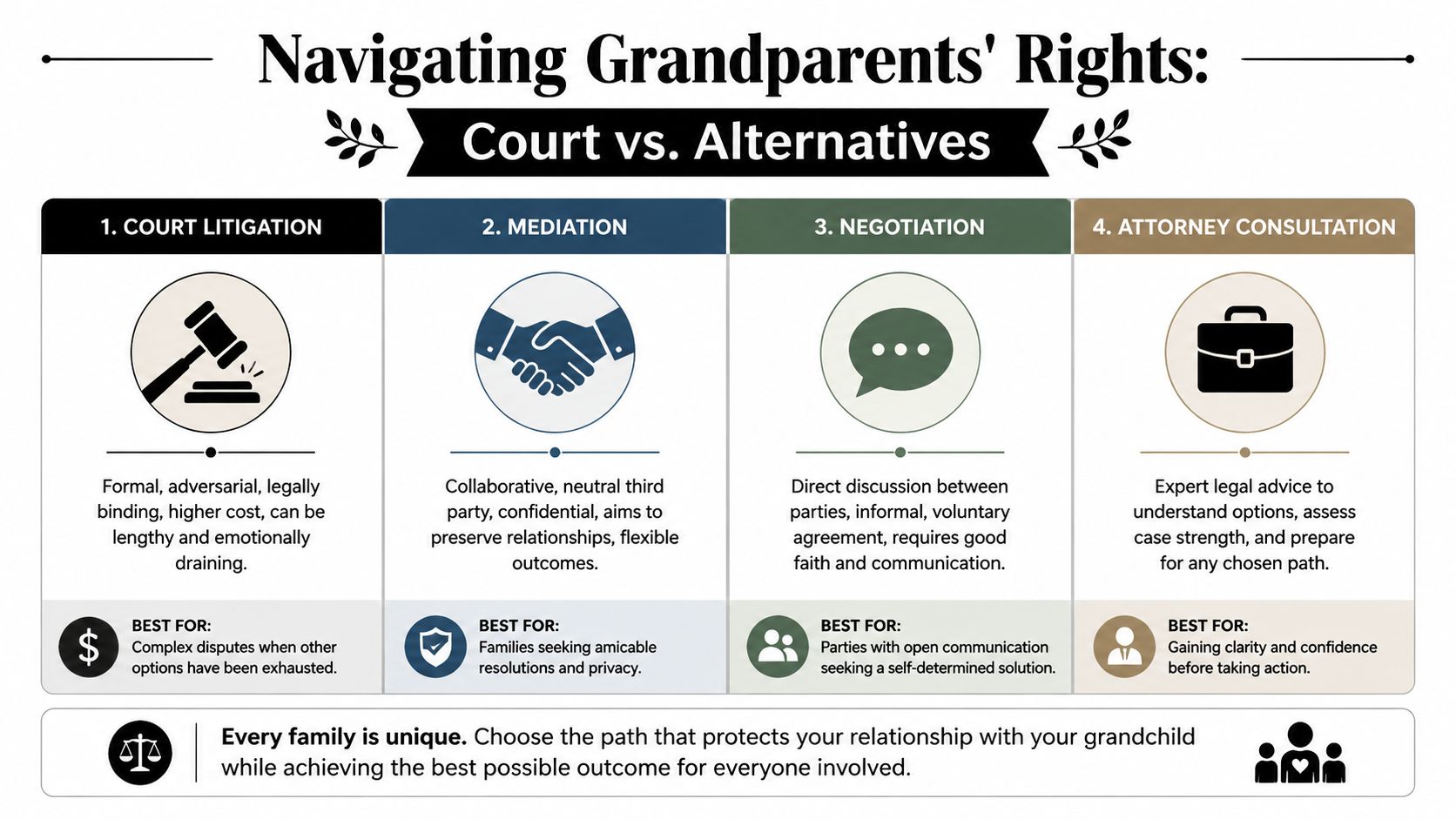
When alternatives make sense
A non-court option may be worth trying if:
- The child is safe: Your concern is contact, conflict, or consistency, not immediate harm.
- The parent still communicates: Even limited communication may allow for a structured agreement.
- The dispute is practical: Transportation, holidays, school schedules, or temporary caretaking can sometimes be resolved outside court.
When legal help should come early
You should speak with a lawyer promptly if the child is living in unstable conditions, if you believe you may qualify through a caregiving history, if a parent is threatening to disappear with the child, or if adoption or termination issues are involved. These cases are sensitive to facts, deadlines, and wording.
Some families also need to consider whether a guardianship or adoption route fits better than a custody fight, depending on who currently has legal rights and what long-term stability the child needs. If that issue is on your radar, this article on adopting your grandchild or relative can help you compare a different legal path.
A consultation doesn't commit you to filing suit. It gives you a realistic assessment of whether your facts support action, what evidence is missing, and whether court is the right tool at all.
If you need help navigating divorce, custody, or estate planning in Texas, contact Law Office of Bryan Fagan, PLLC today for a free consultation. If you're worried about your grandchild, a personalized review of your facts can help you understand whether you have standing, what evidence to gather, and which legal path makes the most sense for your family.