You may be reading this because something has shifted. A parent is aging. You bought a home and now have children. A divorce, remarriage, or illness made the future feel less abstract. Few proactively seek out estate planning for its own sake. They want to know their family won't be left with confusion, court filings, and hard decisions at the worst possible time.
That concern is reasonable. In Texas, many families want a plan that keeps things orderly, private, and manageable if someone dies or becomes unable to handle finances. A living trust can help with that, but only if it's set up and used correctly. That's where readers often get mixed up. They hear that a trust "avoids probate" and assume the document alone solves everything.
It doesn't work that way.
A living trust is often best understood as a set of instructions for property management during your lifetime and after death. It can also fit into a broader estate plan that includes powers of attorney, beneficiary designations, deeds, and even practical tasks like managing your digital assets, which many families now overlook until they need access to accounts, photos, subscriptions, or online financial records.
Planning Your Legacy with Confidence
A Texas family comes in with a common worry. Their home is paid down, they have savings, one spouse handles the bills, and they want to make things easier for the children later. They aren't trying to build a complicated legal structure. They want a plan that says who steps in, who gets what, and how to avoid unnecessary disruption.
That instinct is exactly where estate planning begins. Not with legal jargon. With care for the people who would be left to sort through everything.
For many Texans, a living trust becomes part of that conversation because it can provide structure while you're alive, not just after death. If you become ill, travel for an extended period, or lose capacity, the person you've chosen as successor trustee can step in under the trust's terms. That continuity can matter just as much as what happens after you pass away.
Many families don't want a "fancy" plan. They want a workable one that won't fall apart when someone actually needs to use it.
A good trust plan also reduces the chance that loved ones have to guess what you wanted. Clear instructions help prevent conflict, especially in blended families, second marriages, or situations where one child is more involved in caregiving than the others.
Still, a trust isn't automatic peace of mind. The document has to match your life, your property, and your goals. If it's treated like paperwork to sign and store away, it may not do what you expected. That's why understanding what a living trust is in Texas matters before you decide whether it's right for your family.
What Exactly Is a Living Trust in Texas
A living trust in Texas is a trust created during your lifetime. In legal terms, Texas treats it as an inter vivos trust, meaning it takes effect while you're alive rather than only at death, as explained in the Tarrant County trust research guide.
Think of it as a private rulebook for property.
You create the trust. You decide its terms. You name the people involved. Then property can be held and managed under those rules. In many revocable living trusts, the same person starts out wearing several hats at once. You may be the creator, the current trustee, and the current beneficiary during your lifetime.

The main roles inside the trust
The trust only makes sense once the roles are clear:
- Settlor or grantor. This is the person who creates the trust and puts the plan in motion.
- Trustee. This person manages the trust property according to the written instructions.
- Successor trustee. This is the backup decision-maker who steps in if the original trustee can't serve because of incapacity, resignation, or death.
- Beneficiaries. These are the people or entities who benefit from the trust property.
The trust document should clearly identify those roles. It should also spell out the trustee's powers and the distribution terms. If the language is vague, problems usually show up later, when someone is trying to act during a medical crisis or after a death.
Revocable and irrevocable don't mean the same thing
When people ask what is a living trust in Texas, they often mean a revocable living trust. That's the version most families discuss in ordinary estate planning. A revocable trust can usually be changed or revoked by the creator during life.
An irrevocable trust is different. It usually gives up flexibility in exchange for different legal effects involving control and asset separation. That distinction matters from the beginning because the trust's structure affects how it operates.
Practical rule: Don't focus only on the label "living trust." Focus on who controls the property, who can change the terms, and who takes over if you can't act.
If you're trying to understand what a trustee does after a death, these expert tips for estate management can help you picture the practical responsibilities that follow the legal document.
Living Trust vs Will A Clear Comparison for Texans
Many Texans already know they need a will. The harder question is whether a living trust should replace it as the center of the plan, or whether both documents should work together.
The first big difference is timing. A will only takes effect at death. A living trust can operate during your lifetime. A revocable living trust in Texas is usually effective once it is signed and funded, while a will speaks only after death. Texas probate is often more efficient than probate in some states, but assets passing under a will still go through court supervision. By contrast, a trust is designed to move trust-owned assets outside probate under the trust's terms, as discussed in this overview of living trusts in Texas and how they work.
Living Trust vs. Will in Texas
| Feature | Living Trust | Will |
|---|---|---|
| When it becomes effective | During your lifetime once properly signed and funded | At death |
| Probate | Designed to pass trust-owned assets outside probate | Generally requires probate for assets passing under the will |
| Privacy | Trust administration is generally private | Probate filings are part of the court process |
| Incapacity planning | Successor trustee can manage trust assets under the trust terms | Doesn't manage assets during lifetime incapacity |
| Cost | Often more involved to create and maintain | Usually simpler and less costly upfront |
| Asset transfer process | Requires retitling assets into the trust | Doesn't require lifetime retitling to exist |
Which one fits which situation
If you're a parent of minor children, a will still matters because it often handles issues a trust does not, including naming guardians in a standard estate plan. If your concern is management of property during incapacity, a trust often offers more continuity.
Here is a simple way to think about it:
- Use a will when your estate plan is straightforward and your main goal is to direct who receives your property after death.
- Use a living trust when you want management during incapacity, privacy, and a smoother transition for assets that are placed into the trust.
- Use both together when you want a fuller plan that covers both trust assets and anything left outside the trust.
A lot of families compare these tools as if one must defeat the other. That usually isn't the right frame. They're different instruments. In many Texas plans, they complement one another. If you're sorting through the distinction in more detail, this discussion of testamentary trust vs living trust is a helpful next step.
Key Benefits and Limitations of a Texas Living Trust
A Texas living trust often sounds simple on paper. You sign the document, name beneficiaries, and assume your family is protected. In real life, the benefit usually depends on one practical step that many families miss. The assets must be placed into the trust.
That point changes how you should evaluate the pros and cons.
Survey data discussed in this explanation of living trusts versus wills in Texas suggests living trusts are less common than wills. That makes sense. A trust can be very useful, but it asks more of you after the signing appointment. You have to follow through on deeds, account titles, and beneficiary coordination if you want the plan to work the way you expect.
Benefits that matter in daily life
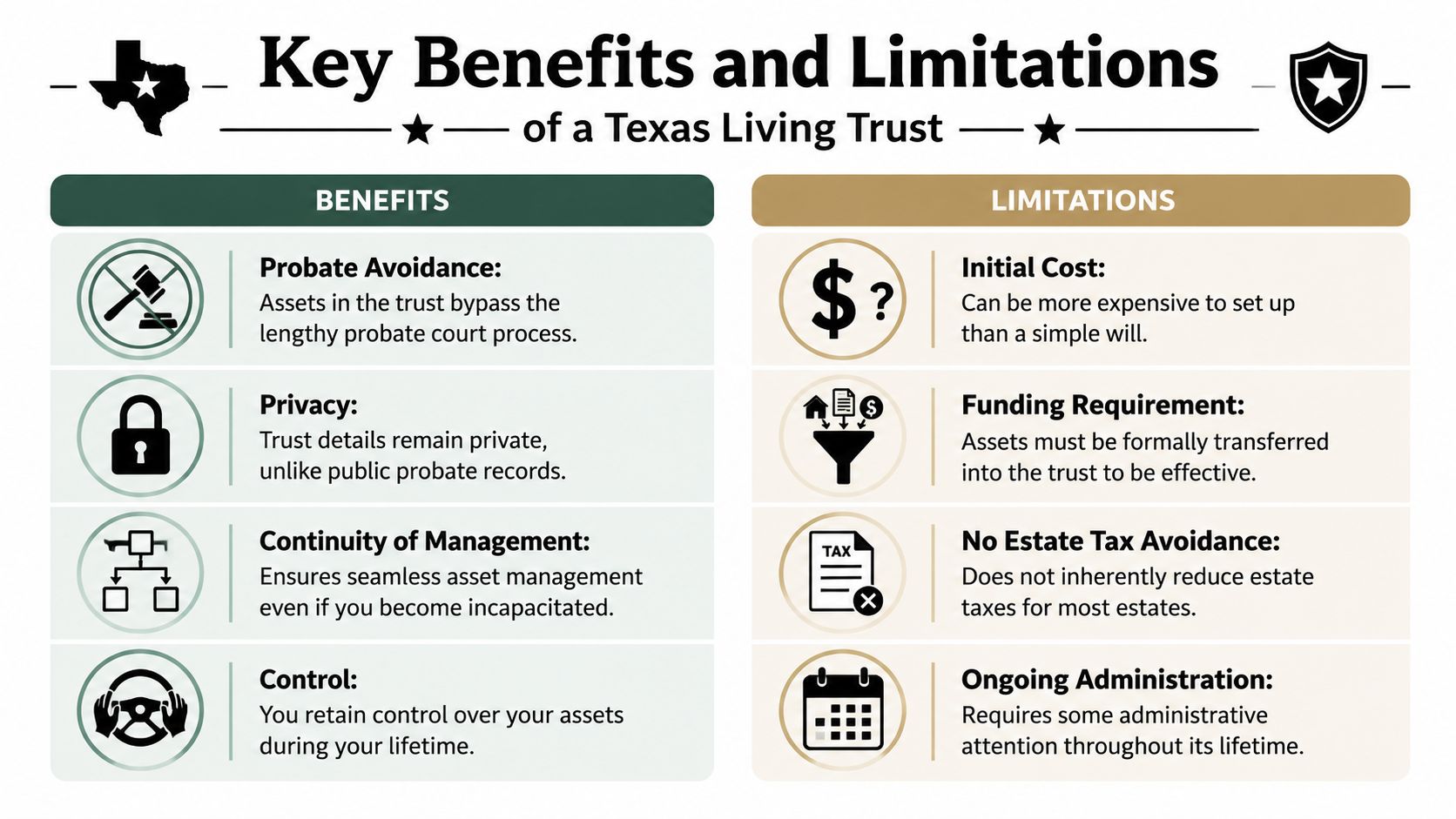
A revocable living trust can create continuity if you become incapacitated. If you can no longer manage your finances, the successor trustee you selected can manage trust property under the instructions you already put in place. For a family trying to keep bills paid, rental property maintained, or investments monitored, that continuity can remove a great deal of stress.
Privacy also matters to many Texas families. A trust administration is usually more private than a probate proceeding, which means financial details and distribution terms are less likely to become part of a public court file.
A trust also gives you room for clearer management rules. You can direct when property is distributed, whether funds should be held for a younger beneficiary, and who will oversee that process.
Used properly, a living trust works like a container. Property inside the container follows the trust's rules. Property left outside may not.
Limitations that deserve equal attention
A revocable living trust does not solve every estate planning problem. It usually does not provide the kind of asset protection people sometimes associate with irrevocable trusts or business entities. It also does not replace every other document. Texas families still often need a will, powers of attorney, and beneficiary review on retirement accounts and insurance.
The larger weakness is usually not the legal document itself. It is incomplete funding.
Here is the concern I raise with clients all the time. If you sign a trust but leave your home, non-retirement accounts, or other major assets in your individual name, your family may still face the very court process you were trying to reduce. That is why a trust should never be judged by the binder alone. It should be judged by whether the assets were transferred.
A simple example helps. If a couple creates a trust and signs a deed transferring the house into the trust, that house is positioned to follow the trust terms. If they sign the trust but never change the deed, the trust may offer far less help than they expected for that asset.
That is also why maintenance matters. New accounts, a refinanced home, or property bought years later can all create gaps if ownership is never updated.
If you want a fuller explanation of those tradeoffs, this guide on how a Texas revocable living trust works and when to use it lays out the decision in practical terms.
How to Create and Fund Your Texas Living Trust
A family signs their trust, puts the binder on a shelf, and feels done. Then a parent dies, and the house is still titled in that parent's individual name. The trust was real, but one of the most important assets never made it into it.
That is the mistake I want you to watch for.
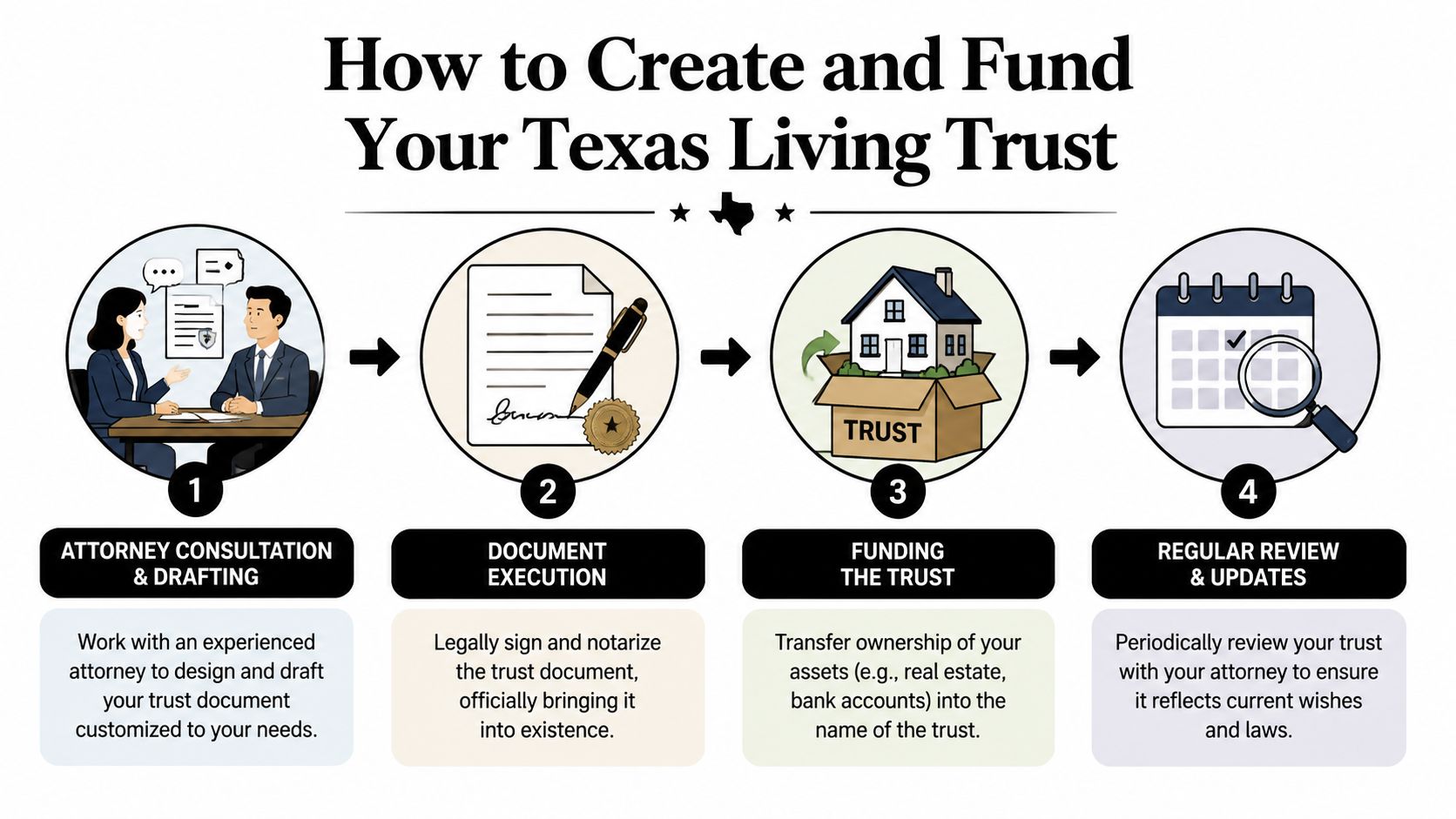
A Texas living trust has two parts. First, you create the legal instructions. Second, you transfer assets so the trust owns what it is supposed to control. If the second part never happens, the trust may do far less than your family expected. Texas probate guidance often stresses this point because incomplete funding is one of the most common reasons a trust plan falls short.
Step one and step two
Start with the design of the trust itself. You choose who will serve as trustee now, who will step in later as successor trustee, who receives the property, and what instructions should guide distributions and management. In many Texas families, this part also needs to fit with a will, powers of attorney, and beneficiary designations already in place.
Then you sign the trust correctly.
Many people stop there because signing feels like completion. Legally, it is only the beginning. The signed document is the rulebook. Funding is what places the assets under those rules.
If you want a practical checklist for the transfer process, review this guide on how to fund a living trust alongside your trust papers.
A short video can also help make the process more concrete:
Step three is the part people miss
Funding the trust means changing title or ownership so the trustee holds the asset for the trust. Different assets require different steps, which is why this stage often takes more time than families expect.
A house, for example, usually requires a new deed. A bank or brokerage account may require the institution's own forms. Personal property may pass by assignment. Business interests can involve company agreements or transfer restrictions that need review first.
The trust works like a container. Signing creates the container. Funding puts the property inside it.
That is why I tell clients to make a written funding list instead of relying on memory. Go asset by asset. House. Non-retirement accounts. Business interests. Valuable personal property. If an item is supposed to be controlled by the trust, confirm that ownership changed.
Takeaway: The trust controls the assets titled in its name. Assets left outside the trust may still need probate or separate planning.
Step four means review, not neglect
Funding is not a one-time event. It is an ongoing habit.
People buy a new home, open a new investment account, refinance real estate, or forget to retitle property after a major life change. Each of those moments can create a gap between the plan on paper and the assets your family owns. Years later, that gap is where confusion begins.
A simple review after major life events helps keep the trust working as intended. Marriage, divorce, a move, the birth of a child or grandchild, the death or incapacity of a trustee, and major asset purchases all justify another look.
This is also where professional help can be practical. Law Office of Bryan Fagan, PLLC can assist with trust drafting, related estate planning documents, and probate questions so the trust language and the asset transfer work fit together under Texas law.
Understanding the Costs of a Living Trust
A Texas family may spend good money on a trust, sign every page, store the binder safely, and still leave their loved ones with probate problems if the trust is never fully funded. That is the cost issue many articles miss. The drafting fee matters, but the larger question is whether you are paying for a document alone or for a plan that is carried out.
In plain terms, a living trust usually costs more than a simple will because there is more work involved. The attorney is not only preparing the trust itself. The job often includes reviewing how your home is titled, checking account ownership, coordinating beneficiary designations, and making sure the trust matches the rest of your estate plan.

What you are really paying for
The price can vary widely because families and assets vary widely.
A person with one home, a few bank accounts, and straightforward beneficiaries usually needs less work than someone with rental property, a family business, a blended family, or concerns about a child handling money wisely. Texas community property issues can also add planning time, because ownership needs to be clear before assets are transferred into the trust.
You are also paying for different levels of help:
- Document preparation. Drafting the trust and related estate planning papers.
- Advice about fit. Deciding whether a trust makes sense for your goals, not just whether one can be created.
- Funding work. Preparing deeds, assignment documents, and instructions to transfer assets into the trust.
- Future updates. Revising the plan after major life changes, asset changes, or changes in Texas law.
That third item is often the hidden separator between a lower fee and a higher one.
A low-cost form may give you trust language. It may not give you clear instructions for retitling the house, moving a brokerage account, or handling a business interest with transfer restrictions. If those steps are left unfinished, your family can end up paying later in delays, confusion, and probate costs that the trust was supposed to reduce.
A practical way to evaluate cost
Ask a simple question before you hire anyone or choose any service: Does this price include funding guidance, or only drafting?
That question gets to the heart of whether the trust is likely to work. A trust without assets in it works like an empty safe. The container exists, but the valuables were never placed inside.
For many Texas families, the better value is not the cheapest option on day one. It is the option that includes enough guidance to transfer the right assets, review the plan after major changes, and reduce the risk that your family is left sorting out an incomplete plan later.
Common Questions About Texas Living Trusts
Readers usually have the same practical concerns after they understand the basics. They want to know what happens when real life doesn't follow the checklist perfectly.
What if I forget to put something into the trust
This is one of the most important questions. A common backup document is a pour-over will, which directs property left outside the trust to be transferred into it at death. But there is an important limitation. Those assets still have to go through probate before they can be poured into the trust, as explained in this guidance on creating a living trust and handling unfunded assets.
That means a pour-over will is a safety net, not a substitute for funding.
Does a living trust replace every other estate planning document
Usually, no. Many people still need a will, powers of attorney, medical directives, and updated beneficiary designations. A trust often works best as part of a coordinated plan rather than as a standalone fix.
For example, if you have retirement accounts or life insurance, those assets may pass by beneficiary designation rather than through your trust unless your planning specifically addresses them. If you own a homestead, the deed and title questions should be reviewed carefully so the trust plan matches your larger estate goals.
How does a living trust fit with Texas community property issues
Texas is a community property state, so married couples should be careful about what property is separate, what property is community, and how title reflects ownership. That matters even more if there has been a prior marriage, inherited property, or a pending divorce.
If you're divorcing or recently divorced, trust planning should not be done in isolation. Changes to property rights, beneficiary designations, and fiduciary roles can all affect whether the plan still makes sense. A trust that worked during marriage may need revision afterward.
If your life has changed, your trust should be reviewed before you assume it still says what you think it says.
Can a living trust help with incapacity
Yes, that is often one of its strongest practical uses. If the trust is written clearly and funded properly, the successor trustee can step in to manage trust assets if you become incapacitated. That can reduce disruption in paying expenses and managing property.
Will a living trust eliminate every court process
No. It can reduce the need for probate as to assets properly held in the trust, but it doesn't guarantee that every legal issue disappears. Property outside the trust, disputes among beneficiaries, or title problems can still create complications.
The calm, useful way to think about a living trust is this: it is a strong tool, but only when the document is well drafted, the assets are transferred correctly, and the rest of the estate plan supports it.
If you need help navigating divorce, custody, or estate planning in Texas, contact Law Office of Bryan Fagan, PLLC today for a free consultation. A customized review can help you decide whether a living trust fits your goals, how it should be funded, and how it should work with your will, property rights, and broader family plan.