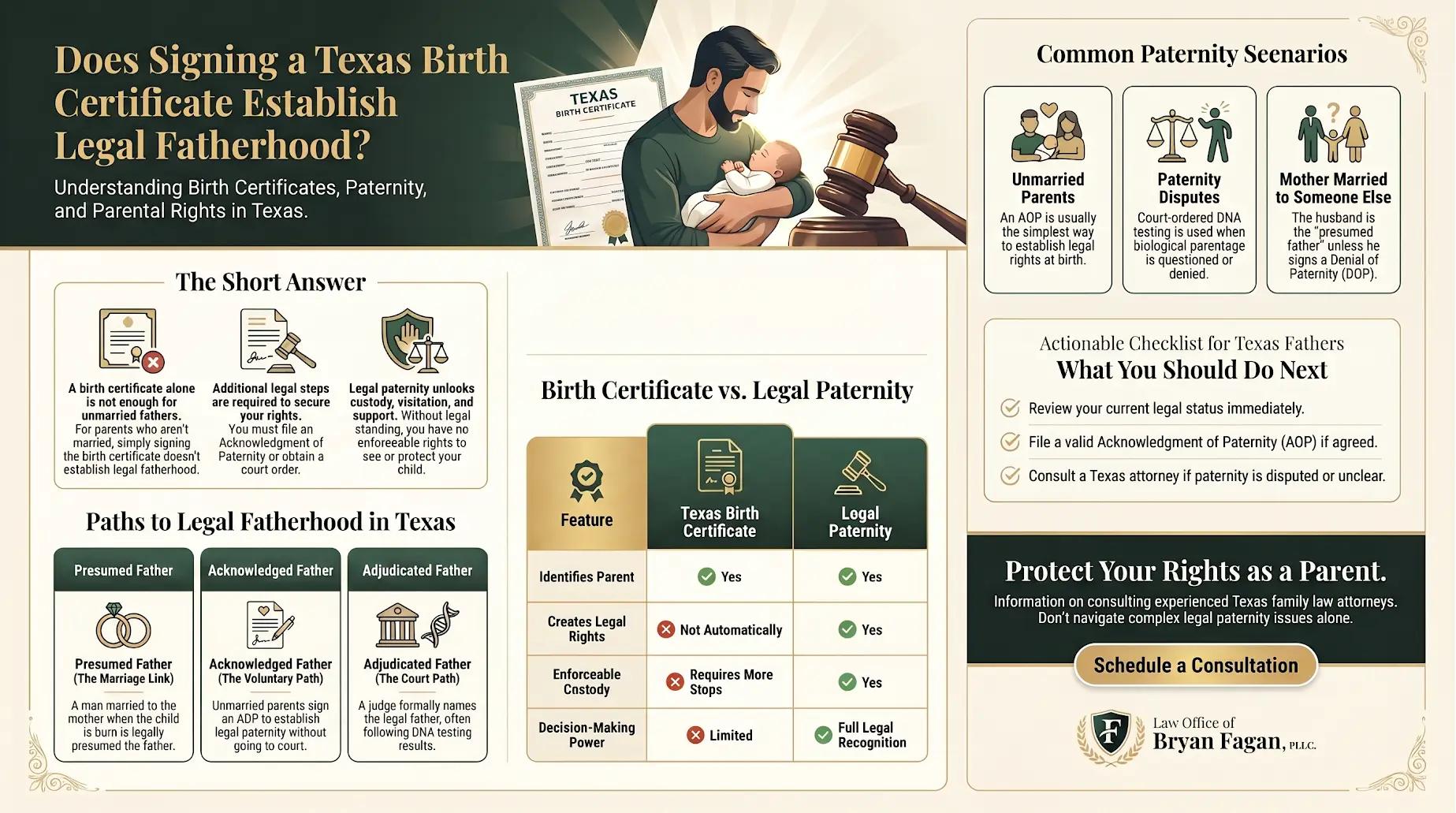
A father sat across from me recently looking frustrated and more than a little confused. He had been involved in his daughter’s life since the day she was born. He changed diapers, attended doctor’s appointments, and helped support her financially. Then a disagreement with the child’s mother turned into a legal dispute. During the process, someone told him he might not actually be the child’s legal father, even though his name was on the birth certificate. So he asked the question that brings many parents to our office: Does Signing a Texas Birth Certificate Establish Legal Fatherhood?
The answer catches a lot of people off guard. In Texas, having your name on a birth certificate does not automatically establish legal fatherhood. In many cases, the document that creates the legal parent-child relationship is an Acknowledgment of Paternity (AOP), a separate form that is often signed at the hospital alongside the birth certificate paperwork. Because these documents are frequently completed at the same time, many parents understandably assume they are one and the same. Under Texas law, however, they serve very different purposes.
That distinction can have enormous consequences. Legal fatherhood affects everything from custody and visitation rights to child support obligations, inheritance rights, medical decision-making authority, and access to important information about your child. Discovering years later that there is a problem with your legal status as a parent can create stress, uncertainty, and costly litigation that could have been avoided with the right information from the beginning.
At the Law Office of Bryan Fagan, PLLC, we believe families deserve clarity during life’s most challenging transitions. Our mission is to empower parents with the knowledge they need to protect their relationships with their children and make informed decisions about their future. Founded by Bryan Joseph Fagan, a South Texas College of Law graduate and recognized authority on Texas family law, our firm has helped thousands of Texas families navigate complex issues involving paternity, custody, child support, and parental rights.
In this guide, I will explain what actually establishes legal fatherhood under Texas law, why a birth certificate alone may not be enough, how the Acknowledgment of Paternity process works, what happens when paternity is disputed, and the practical steps you can take to protect your rights. For some parents, confirming their status is surprisingly simple. For others, identifying a problem early can prevent years of legal headaches later. Either way, understanding the difference between a birth certificate and legal fatherhood is one of the most important things an unmarried parent can do to protect what matters most.
The Short Answer
No — in Texas, signing the birth certificate alone does not establish legal fatherhood. Legal fatherhood comes from a valid Acknowledgment of Paternity (Texas Family Code §160.301–.305), a court order, or the marital presumption. Most unmarried fathers sign the AOP at the hospital alongside the birth certificate, and it is the AOP — not the certificate — that makes them the legal father.
Key Takeaways
- The birth certificate is a record, not a legal status. Your name on it documents a claim; it does not by itself confer the rights and duties of a parent under Texas law.
- The Acknowledgment of Paternity (AOP) is what establishes fatherhood. When validly signed and filed, an AOP carries the same legal weight as a court adjudication of paternity (§160.305).
- Most hospital signings include both documents. Many fathers sign an AOP at the hospital without realizing it is separate from the birth certificate — which is good news for them.
- A presumed father is different from an acknowledged father. If the mother was married to someone else, that husband may be the presumed father (§160.204), and your AOP may not be valid without a denial of paternity from him.
- You have 60 days to rescind, then limited grounds to challenge. After the rescission window closes, an AOP can be undone only for fraud, duress, or material mistake of fact (§160.307–.308).
- Legal fatherhood and custody are separate steps. Establishing paternity gives you standing; you still need a court order to fix custody, possession, and child support.

Your Family’s Future Starts Here
Don’t navigate your legal journey alone. Schedule a consultation now and get the clarity and support you deserve.
What Texas Law Actually Says About the Birth Certificate

Many parents are surprised to learn that the answer to Does Signing a Texas Birth Certificate Establish Legal Fatherhood is generally no. A birth certificate is an important government record, but it is not the legal document that creates a father-child relationship under Texas law. Instead, legal fatherhood is typically established through the marital presumption found in Texas Family Code §160.204, a properly executed Acknowledgment of Paternity (AOP), or a court order determining parentage. The birth certificate may reflect one of those legal events, but it is not the source of the legal relationship itself.
For unmarried parents, a father’s name is usually added to the birth certificate because an Acknowledgment of Paternity has been signed and filed. This distinction matters because many fathers assume that appearing on the birth certificate automatically secures all parental rights. In reality, the certificate often serves as evidence that another legal step occurred behind the scenes. The true legal significance comes from the underlying acknowledgment or court order, not from the birth certificate entry itself.
Texas law makes this point clear. Under Texas Family Code §160.305, a validly executed and filed Acknowledgment of Paternity has the same legal effect as a court order establishing paternity. This means the AOP—not the birth certificate—is what legally establishes fatherhood. If you are unsure whether an acknowledgment was properly completed, reviewing the documentation before a dispute arises can save significant time, expense, and frustration later.
In straightforward situations where both parents agree about parentage, confirming the existence of a valid AOP may be relatively simple. In more complex cases involving custody disputes, child support issues, relocation concerns, or competing claims of parentage, determining legal fatherhood can become far more complicated. When disagreements develop, courts focus on legal documentation rather than assumptions about what a birth certificate alone proves.
Understanding the difference between a birth certificate and legal fatherhood is critical for protecting your rights and your relationship with your child. Whether you are seeking visitation, pursuing conservatorship, or simply trying to understand your legal status, knowing the answer to Does Signing a Texas Birth Certificate Establish Legal Fatherhood can help you avoid costly mistakes. For a deeper explanation of the process, review our guide on the Acknowledgment of Paternity in Texas and learn how Texas law formally establishes parental rights.
Why this is usually good news
If your name is on the birth certificate as an unmarried father in Texas, an Acknowledgment of Paternity was almost certainly signed to put it there. That means you likely already have legal standing — you just need to confirm the AOP was filed with Vital Statistics and that no competing presumed father existed at the time.
Acknowledgment of Paternity vs. the Birth Certificate
The Acknowledgment of Paternity is the form that establishes legal fatherhood; the birth certificate is the public record that reflects it. Under §160.301, the AOP is a sworn statement signed by both the mother and the man seeking to establish paternity, executed under penalty of perjury. It is a free form (§160.306 waives the filing fee) and is usually offered at the hospital at the time of birth, which is why the two documents get conflated.
Here is the practical breakdown of how Texas law treats each document and what it means for you.
| Category | What Texas Law Says | Practical Impact |
|---|---|---|
| Birth certificate | An administrative record maintained by Vital Statistics; not the legal source of parentage. | Your name on it is evidence, not the right itself. Not enough alone to assert custody. |
| Acknowledgment of Paternity | A sworn form under §160.301–.305; once filed, equivalent to a court adjudication of paternity. | This is what makes you the legal father. Confirm it was signed and filed. |
| Marital presumption | Under §160.204, a man married to the mother is presumed the father. | If you were married to the mother, you are already the presumed legal father — no AOP needed. |
| Court adjudication | A paternity suit resulting in a court order establishing the father. | The route when there is a dispute, a competing presumed father, or no AOP. |
The takeaway: do not rely on the certificate. Pull a copy of the AOP, confirm it was filed with the Texas Vital Statistics Unit, and verify both parties signed it correctly. If you cannot locate a signed AOP and you were not married to the mother, you may not yet be the legal father — and that gap is fixable, but only if you act on it.
The Presumed-Father Trap for Unmarried Couples
One of the most misunderstood issues in Texas paternity law arises when a child has a presumed father under Texas Family Code §160.204. If a mother was married when the child was born—or within 300 days before the birth—the law generally presumes her husband is the child’s legal father, regardless of biological parentage. This often surprises unmarried fathers who believe they have fully established their rights because they signed paperwork at the hospital. It also highlights why the question Does Signing a Texas Birth Certificate Establish Legal Fatherhood can have significant legal consequences. In many situations, the answer is more complicated than parents expect.
When a presumed father exists, an Acknowledgment of Paternity (AOP) alone is typically not enough. Texas Family Code §§160.302–160.303 require a valid Denial of Paternity from the presumed father before the acknowledgment can effectively establish legal fatherhood. Many parents are unaware of this requirement. They sign documents, see the father’s name added to the birth certificate, and move forward believing the issue has been permanently resolved. Years later, however, a custody dispute, child support proceeding, or other family law case may reveal that a critical legal step was never completed. For a detailed explanation of how the process works, see our guide on Acknowledgment of Paternity in Texas.
This issue often surfaces at the worst possible time. A parent may file for custody or seek orders affecting a child, only to discover that legal fatherhood is being challenged. In straightforward situations, the defect may be corrected through additional filings and court action. In more complex cases involving contested parentage, significant periods of parental involvement, or disputes over conservatorship and possession, the issue can dramatically affect case progression. Judges expect parties to address standing and parentage questions early rather than allowing them to become obstacles later in the litigation process.
The problem can become even more significant when a case faces dismissal deadlines or procedural hurdles. A party focused on preserving a lawsuit through a Texas Motion to Retain may suddenly find that unresolved parentage questions are affecting the court’s ability to move the case forward. Courts routinely evaluate diligence, credibility, and whether the parties are actively advancing the case toward resolution. If legal fatherhood remains uncertain, delays can multiply, increasing costs and creating uncertainty for everyone involved—especially the child.
Experienced family law practitioners routinely screen for presumed-father issues before pursuing custody litigation or other significant court proceedings. In cases involving straightforward filings, identifying the issue early can prevent unnecessary delays. Where disputes are contested, emotions run high, or long-term parental rights are at stake, a more strategic approach may be necessary. Understanding whether a presumed father exists—and whether all required documents were properly filed—can help protect your rights, avoid dismissal risks, and keep your family law case moving forward. Parents seeking orders related to child custody in Texas should make sure these foundational issues are resolved before larger disputes reach the courtroom.
Warning
If the mother was married to anyone else at any point within 300 days before the birth, your AOP may be invalid without a Denial of Paternity from her husband. Do not assume the hospital caught this. A single unaddressed presumption can unravel your standing years later in a custody dispute.
“The birth certificate tells the world who you say the father is. The Acknowledgment of Paternity tells the court who the father legally is. Only one of those wins a custody case.”
What Establishing Fatherhood Actually Gives You

Establishing legal fatherhood gives you standing — the legal right to ask a Texas court for custody, possession, and a say in your child’s life. Without it, you are, in the eyes of the law, a Establishing legal fatherhood is often the first critical step in protecting a father’s rights under Texas law. Once paternity is legally established, a father gains standing—the legal ability to ask a Texas court for orders regarding conservatorship, possession, access, and other parental rights. Without legal fatherhood, a man may have no enforceable right to participate in decisions affecting the child, regardless of how active he has been in the child’s life. This is one reason why questions such as Does Signing a Texas Birth Certificate Establish Legal Fatherhood are so important. Many parents assume the birth certificate alone creates legal rights when, in reality, Texas law requires additional legal steps to establish parentage.
After legal fatherhood is established, a father can file a Suit Affecting the Parent-Child Relationship (SAPCR) and ask the court to determine issues involving custody, visitation, and parental responsibilities. However, establishing paternity does not automatically create a possession schedule or grant decision-making authority. Those rights are determined through separate court orders based on the child’s best interests under Texas Family Code §153.002. For many parents, understanding this distinction can prevent frustration and costly delays later in the process.
In straightforward situations where parents agree on custody and parenting arrangements, obtaining the necessary orders may be relatively simple. In more complex cases involving contested custody disputes, relocation issues, CPS concerns, or disagreements regarding parental decision-making, establishing paternity is only the beginning of a broader legal strategy. Courts evaluate not only legal parentage but also factors such as stability, credibility, parental involvement, and each party’s willingness to support the child’s well-being. Judges expect parties to actively move their cases forward and demonstrate diligence throughout the process.
These issues can become particularly important when a case faces procedural delays or potential dismissal. A parent who has established paternity but failed to pursue custody or conservatorship orders may find that critical questions remain unresolved. In matters involving a Texas Motion to Retain, courts often examine whether meaningful progress is being made and whether unresolved parentage or custody issues are preventing the case from advancing. Delay can increase uncertainty, create additional litigation costs, and affect the overall direction of the case.
For parents seeking clarity about their rights, establishing fatherhood should be viewed as a foundation rather than a finish line. In straightforward matters, basic legal guidance may be enough to complete the process efficiently. Where disputes are contested or long-term parental rights are at stake, a more strategic approach may be necessary. Understanding how to legally establish paternity and secure enforceable court orders can help protect your relationship with your child, avoid procedural setbacks, and keep your case moving toward a resolution. To learn more about the process, review our guide on how to establish paternity in Texas and explore additional information about child custody in Texas.stranger to the child, regardless of how involved you have been. With it, you can file a Suit Affecting the Parent-Child Relationship (SAPCR) and seek the rights and duties a parent is entitled to under Texas law.
3
ways Texas law establishes legal fatherhood
60
days to rescind an AOP without a court fight
300
days before birth that can trigger a presumed father
Strategy
Establish paternity and file your SAPCR together, not in sequence. Confirming your AOP and immediately asking the court for a possession schedule and decision-making rights in one coordinated move closes the gap that lets the other parent control access while you wait.
The Mistakes and Deadlines That Cost Fathers Their Rights
When it comes to establishing legal fatherhood in Texas, timing matters. Many fathers do not realize that the law places strict deadlines on challenging or withdrawing an Acknowledgment of Paternity (AOP). Under Texas Family Code §160.307, a person who signs an AOP generally has only 60 days to rescind it, or until a court proceeding involving the child begins—whichever occurs first. After that deadline passes, Texas Family Code §160.308 significantly limits the ability to challenge the acknowledgment, usually requiring proof of fraud, duress, or a material mistake of fact. Waiting too long can dramatically reduce your legal options and make an already difficult situation even more complicated.
One reason these deadlines create confusion is that many parents mistakenly believe that signing paperwork at the hospital permanently resolves all questions about parentage. Similar misunderstandings arise when people ask, Does Signing a Texas Birth Certificate Establish Legal Fatherhood? While a birth certificate may reflect a legal determination of parentage, the underlying legal documents and statutory requirements ultimately control. Missing a filing deadline, failing to review documents carefully, or assuming everything was handled correctly can create problems that surface years later during a custody dispute, child support proceeding, or other family law case.
In straightforward situations, correcting an administrative error may require only limited legal guidance. In more complex cases involving contested paternity, competing claims of parentage, custody disputes, or ongoing litigation, mistakes can affect the entire direction of a case. Courts often evaluate whether parties acted diligently once they became aware of a problem. Judges also consider credibility and whether a party took reasonable steps to protect the child’s stability and best interests. Delays that could have been avoided may complicate future requests involving conservatorship, possession, or decision-making authority under Texas law.
These issues can become especially significant when a case is already facing procedural challenges. If a lawsuit risks dismissal and a party must pursue a Texas Motion to Retain, unresolved parentage issues may create additional obstacles to keeping the case on track. Courts generally expect meaningful case progression and proactive efforts to resolve foundational legal questions. Waiting until litigation is underway to address paternity concerns can increase costs, prolong uncertainty, and place additional stress on families seeking clarity and stability.
The good news is that many of these mistakes are preventable. Understanding deadlines, reviewing legal documents carefully, and addressing concerns early can help preserve important rights and avoid unnecessary litigation. For parents who need guidance on correcting records after paternity has been established, our article on changing a child’s last name and adding a father’s name in Texas provides additional information. Parents dealing with broader parenting issues may also benefit from learning more about child custody in Texas. Whether your situation is relatively straightforward or involves contested issues requiring a strategic approach, early action is often the best way to protect your rights and your child’s future.
| Your Status | Eligibility Test | What It Means |
|---|---|---|
| Married to the mother at birth | Marital presumption under §160.204 | You are already the presumed legal father; no AOP required. |
| Unmarried, signed AOP, no other presumed father | Valid AOP filed under §160.305 | You are the legal father. Confirm filing, then pursue custody. |
| Unmarried, mother married to someone else | Competing presumption; needs Denial of Paternity | Your AOP may be invalid. Legal action likely needed to establish status. |
| On certificate but no AOP found | No valid establishing instrument | You likely are not the legal father yet. File a paternity suit. |
Check Where Your Fatherhood Status Stands
Use the quick check below to see which of the four situations above you are likely in. It walks through the same questions I ask in an initial call — your marital status at the birth, whether an AOP was signed, and whether another man may be the presumed father. It takes under a minute and points you to your likely next step.
Was an Acknowledgment of Paternity (AOP) signed?
This is the sworn form usually signed at the hospital, separate from the birth certificate.
Yes, we signed an AOP Not sure / need to check No, nothing was signed ← Start overIs your name on the child’s birth certificate?
Yes, I’m on the certificate No / not yet Not sure ← BackWas the mother married to anyone else within 300 days before the birth?
This can create a “presumed father” who must sign a denial for your AOP to be valid.
Yes, she was married to someone else No, she was not married to anyone else Not sure ← BackYou are probably already the legal father
With a signed AOP and no competing presumed father, you likely hold legal fatherhood under Texas Family Code §160.305. The next step is confirming the AOP was filed and, if you want a possession schedule, filing for custody.
Your standing needs to be confirmed
You may be the legal father, but an unconfirmed AOP filing or an unclear marital history leaves a gap worth closing before any dispute. A quick review can verify your status and flag anything that needs fixing now.
A competing presumed father may affect your standing
Because the mother was married to someone else near the birth, that husband may be the presumed father under §160.204. Your AOP may not be valid without his denial of paternity. This is fixable, but it usually needs legal action — the sooner the better.
You may not be the legal father yet
If no AOP was signed and you were not married to the mother, the birth certificate alone does not establish fatherhood. The path forward is usually a paternity suit asking the court to adjudicate you as the father — and you can pursue custody in the same case.
Were you married to the child’s mother at the time of birth?
Yes, we were married No, we were not marriedWant a definitive answer on your standing before a custody issue starts?
Schedule a Legal Strategy SessionHow This Plays Out in Harris County and Nearby Counties

Paternity and custody cases in Harris County are typically handled by the family district courts, and the Texas Office of the Attorney General is often involved when child support issues are part of the dispute. While the legal standards governing parentage are the same statewide under the Texas Family Code, the practical experience of moving a case through the court system can vary significantly from county to county. Questions such as Does Signing a Texas Birth Certificate Establish Legal Fatherhood are governed by state law, but filing procedures, scheduling practices, docket congestion, and local court expectations often differ depending on where the case is filed. In a high-volume jurisdiction like Harris County, mistakes in paperwork or delays in addressing legal issues can add weeks—or even months—to a case.
The distinction between statewide law and local court practice becomes especially important when parentage issues intersect with custody disputes. Texas courts apply the same legal principles regarding paternity, conservatorship, and the best interests of the child under Texas Family Code §153.002. However, judges also expect parties to move cases forward diligently and resolve threshold issues early. For example, a dispute involving a presumed father under Texas Family Code §160.204 may require additional filings and legal analysis before a court can address custody or visitation requests. Understanding these procedural requirements can help families avoid unnecessary delays and keep their cases progressing efficiently. Readers can learn more about these issues in our guide to the presumed father doctrine in Texas.
Surrounding counties such as Fort Bend, Montgomery, Galveston, and Brazoria each operate under the same Texas statutes but often have different administrative procedures, associate judge systems, and scheduling timelines. Venue can also become a significant issue when parents live in different counties or when a child has recently relocated. In straightforward situations, venue questions may be resolved quickly through routine filings. In more complex cases involving contested custody, interstate issues, CPS involvement, or competing parentage claims, venue disputes can affect both strategy and case progression.
These procedural differences become particularly important when a case is facing inactivity concerns or potential dismissal. A party seeking relief through a Texas Motion to Retain must often demonstrate that meaningful progress is being made and that the case remains active. Courts frequently evaluate diligence, credibility, and the reasons for any delays. Unresolved paternity issues, venue disputes, or incomplete filings can create obstacles that make it more difficult to keep a case moving forward. Addressing these concerns early often reduces the risk of costly setbacks later.
Whether you live in Houston, Katy, Cypress, Spring, Pearland, Sugar Land, Conroe, or The Woodlands, the legal standard for establishing fatherhood remains the same. The challenge is often navigating the procedural path unique to your local court. In straightforward matters, basic legal guidance may be enough to move the process forward. Where disputes are contested, family dynamics are complicated, or long-term parental rights are at stake, a more structured legal strategy may be necessary. Families facing these issues should also understand how parentage can affect future proceedings involving child custody in Texas, making it important to build a strong legal foundation from the beginning.
What to Do If You’re Dealing With Fatherhood Status in Texas
Bring this checklist to a session and we’ll work through it together.
Schedule a Legal Strategy SessionWhat I Tell Every Client Who Calls About Fatherhood Status
Here is what I told that father from last week, and what I tell everyone: the birth certificate is not the finish line, and it is not the proof you think it is. The legal question is whether a valid Acknowledgment of Paternity was signed and filed — or whether the marital presumption or a court order covers you. Find that document, confirm its status, and you will know exactly where you stand.
The reason I push fathers to handle this now, before any dispute, is that the deadlines are real and the presumed-father trap is invisible until someone goes looking for it. A signature you made in a hospital room three years ago can be the thing that wins or loses your standing today. You do not want to discover a gap in the middle of a custody fight, when fixing it is slower, more expensive, and more contested.
If you are an unmarried father in the Houston area and you are not certain your fatherhood is legally locked in, that uncertainty is the problem to solve first. Bring me what you have — the certificate, anything you signed, the dates — and we will confirm your status and map the next step in one session. The sooner we look, the more options you have.
Confirm your fatherhood status before someone else questions it.
Schedule a Legal Strategy SessionConclusion:
At the end of the day, the question is not simply Does Signing a Texas Birth Certificate Establish Legal Fatherhood—it is whether your legal rights and responsibilities as a parent are fully protected under Texas law. A misunderstanding about paternity can remain hidden for years and only surface when custody, visitation, child support, inheritance, or other important issues are suddenly on the line. Taking the time to understand your legal status now can provide clarity, stability, and peace of mind for both you and your child in the future.
In straightforward situations, confirming that a properly executed Acknowledgment of Paternity was signed and filed may be all that is needed. In more complex cases, additional legal steps may be necessary. If your case involves a disputed paternity claim, a presumed father, missing paperwork, genetic testing, interstate issues, or an existing custody dispute, the path forward may require a more detailed legal strategy. Every family is different, which is why understanding the specific facts of your situation matters.
At the Law Office of Bryan Fagan, PLLC, we believe families make better decisions when they have accurate information and trusted guidance. Our goal is to help parents understand their options, protect their relationships with their children, and move forward with confidence. Whether you are looking to confirm your legal fatherhood status or address a more complicated parentage issue, gaining clarity today can help protect what matters most tomorrow.
Questions My Clients Ask About Establishing Fatherhood in Texas
Not by itself. The birth certificate is an administrative record. What establishes legal fatherhood is a valid Acknowledgment of Paternity, the marital presumption, or a court order. In most cases where an unmarried father is on the certificate, an AOP was signed to put him there — so confirm that the AOP exists and was filed.
There is no single hard deadline to be added, but the easiest moment is at the hospital when the child is born, when the AOP and certificate paperwork are offered together. After that, you can sign an AOP later through Vital Statistics or a certified entity, or establish paternity by court order. The practical advice is simple: do not wait, because delay invites disputes and complicates custody.
It is a sworn legal form, signed by both the mother and the father under penalty of perjury, that establishes the man as the child’s legal father under Texas Family Code §160.301–.305. It is free to file. Once validly executed and filed, it carries the same weight as a court order adjudicating paternity. It is usually offered at the hospital at birth.
Being on the certificate is evidence of fatherhood, but the rights flow from the legal establishment of paternity behind it, not the listing itself. Even once you are the legal father, custody and possession rights require a separate court order. So the certificate alone does not give you an enforceable right to time with your child.
Possibly, but it is not automatic. If you signed an AOP, you can rescind within 60 days under §160.307, or after that challenge it only for fraud, duress, or material mistake of fact under §160.308, generally within four years. Genetic testing may support a challenge, but the AOP’s status as the equivalent of a judgment means courts treat these challenges seriously. Get advice before signing anything.
Her husband is the presumed father under §160.204, even if he is not biologically related. For your acknowledgment to be valid, the presumed father generally must sign a Denial of Paternity that is filed with your AOP. If that did not happen, your standing is vulnerable, and you may need a court to adjudicate paternity. This is a common and fixable problem, but it requires action.
You file a paternity suit, often a Suit Affecting the Parent-Child Relationship, and ask the court to adjudicate you as the father. Genetic testing is commonly ordered. Once the court enters an order, you are the legal father and can pursue custody and possession in the same case. This is the route when there is no AOP or when an AOP is being contested.
No. Establishing paternity gives you standing to ask for custody, possession, and decision-making, but those are decided in a separate court order based on the child’s best interest. Many fathers stop at paternity and are frustrated to learn they still have no enforceable schedule. The efficient approach is to establish paternity and request a possession order in the same proceeding.
Yes, but only on limited grounds after the 60-day rescission window closes. Under §160.308, a challenge requires fraud, duress, or material mistake of fact, generally within four years. Because a valid AOP is treated as the equivalent of a court judgment, the bar is high. That cuts both ways — it protects your status as a father and makes it harder to undo if you signed in error.
Very limited ones. Until paternity is legally established, an unmarried father generally has no enforceable right to custody or possession, and the mother is treated as the sole managing conservator by default. This is why establishing paternity quickly matters so much — your rights as a father in Texas largely begin once your legal status is confirmed.
Have a question above that applies to you? Get it answered directly.
Schedule a Legal Strategy Session