When exploring estate planning vs Will in Texas, you're probably trying to solve a real family problem, not win a legal debate. You may have children, a home, retirement accounts, aging parents, or a spouse who depends on you. You may also have that uneasy feeling that a simple will might not be enough, but you're not sure what “enough” looks like.
That concern is justified. According to Caring.com's 2025 wills survey, only 24% of survey respondents said they have a will, down from 33% in 2022, and more than 50% reported having no will at all. Many families are still deciding between doing the bare minimum and putting a broader plan in place. In practice, that usually means choosing between a basic will and a more complete estate plan that can include trusts, powers of attorney, medical directives, and beneficiary coordination.
Planning Your Legacy A Will or a Full Estate Plan
A common Texas family scenario goes like this. A couple buys a home, names each other on bank accounts, starts retirement savings through work, and has children. They assume that if one of them dies, everything will “just go” to the survivor. Then a parent gets sick, a child is born, a remarriage happens, or a house is purchased, and the family realizes they haven't planned for what happens if someone can't make decisions while still alive.
That's where the difference between a will and a full estate plan becomes practical.
A standalone will is mainly about what happens after death. It can name an executor, leave property to chosen beneficiaries, and nominate guardians for minor children. For many people, that's an important first step.
An extensive estate plan is broader. It usually includes a will or trust, but it also addresses who can manage finances during incapacity, who can make medical decisions, how assets pass outside probate, and how to reduce confusion for the people left to carry out your wishes.
Here's the question that matters most in real life:
Are you only planning for death, or are you also planning for illness, incapacity, second marriages, beneficiary mistakes, and the day-to-day realities your family may face?
That's why estate planning vs will Texas isn't really an abstract comparison. It's a decision about where the gaps are in your current protection. Some families need a properly drafted will and updated beneficiary forms. Others need a trust-based plan because privacy, probate avoidance, incapacity planning, or blended family concerns make a basic will too narrow.
A good plan should fit your life as it is now, not the life you had five years ago.
Understanding a Texas Last Will and Testament
A husband dies unexpectedly. His wife finds a signed will in a desk drawer, but the mortgage is still due, one account has no beneficiary listed, and no one has authority to manage anything until the probate court recognizes the executor. That is often the moment a family learns what a will can do, and what it cannot.
A Texas Last Will and Testament is a legal document that gives instructions for property you own in your individual name at death. It can name the person who will handle the estate, state who should receive probate assets, and nominate guardians for minor children. For many parents, that last function carries the most weight because it gives the court clear guidance about who should raise their children if both parents die.
What a will does in Texas
In practical terms, a will usually does three jobs well.
- Names an executor who can ask the probate court for authority to act on behalf of the estate
- Directs distribution of probate property so those assets pass under your instructions instead of under Texas intestacy rules
- Nominates guardians for minor children, which the court takes seriously when making guardianship decisions
If you want a closer look at execution requirements and validity rules, this guide on a Will in Texas is a useful starting point.
When a will takes effect
A Texas will does not help during your lifetime. It becomes operative only after death, and the executor usually must go through probate before gaining authority to collect assets, deal with creditors, and distribute property.
That timing matters.
Clients often assume a signed will lets a spouse or adult child step in during a medical crisis or after a sudden decline in capacity. It does not. If the problem is incapacity, the will sits in the drawer while the family looks for powers of attorney, healthcare directives, or, in some cases, a court guardianship.
What a will does not do
A will is an important document, but it leaves several common Texas planning problems unresolved.
- It does not avoid probate for assets that pass under the will
- It does not control assets with beneficiary designations such as many retirement accounts and life insurance policies
- It does not govern jointly held property that passes by survivorship terms
- It does not give anyone authority to manage your finances while you are alive
- It does not authorize medical decision-making or access to health information
Those gaps are why a family can have a valid will and still face confusion, delay, or court involvement.
Texas families also need to remember that some estates are affected less by the will than they expect. A house with survivorship features, payable-on-death accounts, transfer-on-death designations, retirement plans, and life insurance may pass outside the will altogether. Tax issues can also require separate planning, and broader perspectives such as these San Diego estate tax planning insights show why inheritance planning is rarely just about one document.
For a person with simple assets, no blended family concerns, and updated beneficiary forms, a well-drafted will may be a sound starting point. For anyone worried about incapacity, probate delays, uneven asset titles, or children from prior relationships, a will alone usually leaves too much to chance.
Exploring the Scope of Comprehensive Estate Planning
A well-structured estate plan is less about one form and more about a coordinated system. Each document solves a different problem. When those pieces work together, your family has guidance during life, at death, and during the administration that follows.
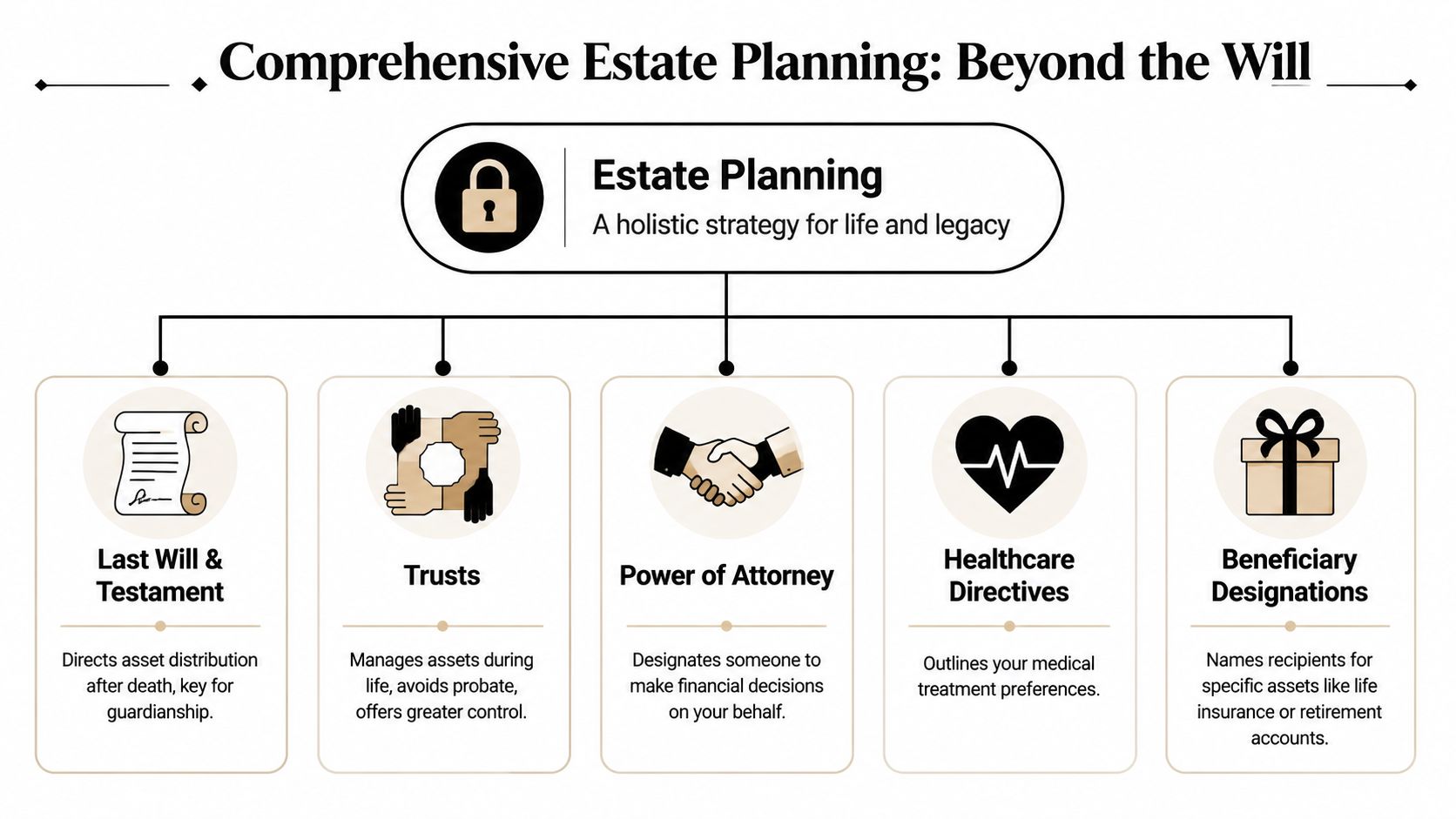
The core pieces of a broader plan
A full Texas estate plan often includes several of the following:
- Revocable living trust. This can hold assets during your lifetime and provide instructions for management and distribution without routing those trust assets through probate.
- Pour-over will. If a trust is part of the plan, a will often serves as a backup to direct certain assets into the trust at death.
- Durable power of attorney. This authorizes someone to handle financial matters if you can't.
- Medical power of attorney. This names the person who can make healthcare decisions if you are unable to communicate informed consent.
- Advance directive to physicians. Often called a living will, this states preferences about certain end-of-life medical treatment decisions.
- HIPAA authorization and related releases. These can help loved ones get medical information when needed.
- Beneficiary review. Retirement accounts, life insurance, and some financial accounts need their own coordination.
Why families choose estate planning over just a will
The biggest difference is functional coverage. A broader plan can address events that happen before death, especially incapacity. It can also improve privacy and streamline asset management if the plan is funded correctly.
Texas families often need that broader coverage for practical reasons:
- A parent develops memory issues and bills still need to be paid.
- A spouse becomes hospitalized and someone needs authority to act.
- A remarriage changes inheritance goals and beneficiary forms need review.
- A business owner needs continuity if illness interrupts operations.
A trust isn't right for everyone. But when someone owns real estate, wants to reduce probate exposure, or wants more control over how and when beneficiaries receive property, it becomes a serious option. For readers comparing structures, this article on setting up a trust in Texas explains the setup considerations in more detail.
Some readers also want to understand how broader transfer planning connects to larger tax concepts. For that, these San Diego estate tax planning insights can help clarify terminology, especially if your family owns property or has connections in multiple states.
Practical point: A comprehensive estate plan doesn't replace common sense asset review. It organizes legal authority, ownership, and beneficiary instructions so your family isn't left guessing.
Key Differences Probate Privacy and Control
A Texas family can feel fully prepared because they signed a will years ago. Then a parent dies owning a home, a few bank accounts, and an investment account in that parent's name alone. The family still has to deal with probate, public filings, and delays before anyone has clear authority to act. That surprise is often what separates a basic will from a plan built for how property is handled in Texas.
The comparison below highlights the points that usually matter most in practice.
| Issue | Will-based plan | Trust-based estate plan |
|---|---|---|
| When it works | After death | During life, at death, and after death |
| Probate | Usually goes through probate | Properly titled trust assets can usually avoid probate |
| Privacy | Probate filings are generally public | Trust administration is generally private |
| Incapacity planning | Will offers no help during lifetime incapacity | Can work with powers of attorney and trust management |
| Control after death | Distributes through estate administration | Can allow staged distributions and ongoing management |
| Best use case | Simpler estates, guardianship nominations, basic planning | Families needing broader control, privacy, or incapacity protection |
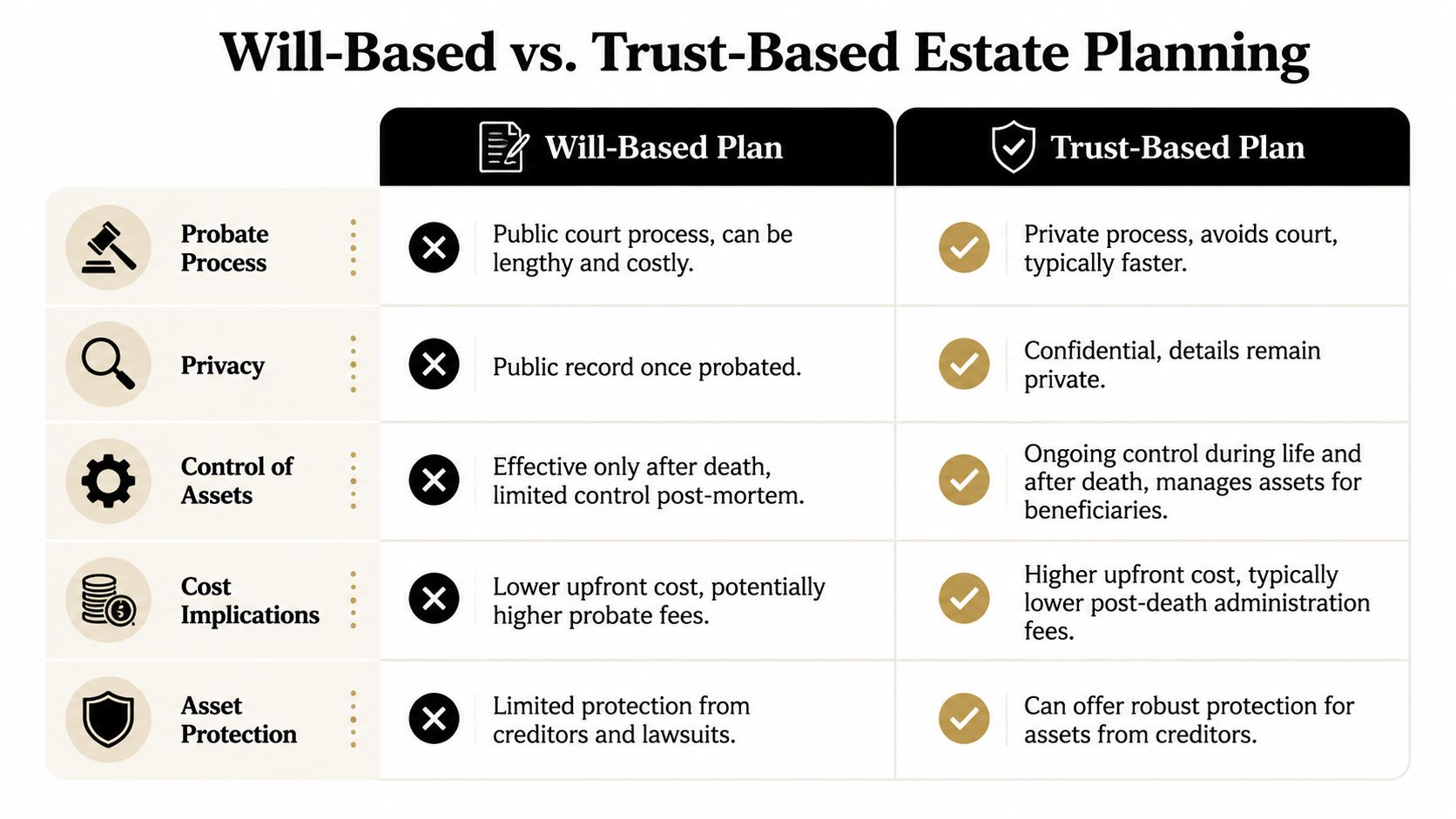
Probate changes the family's experience
A will does not avoid probate for assets that must pass through the estate. In Texas, that means the family may need a court process before an executor can collect property, pay debts, and distribute what remains. A trust can reduce that court involvement for assets properly transferred to the trust during life.
That difference affects timing, stress, and cost. It also affects who can see the file. If you want a simple outside comparison of how court-supervised administration can work in another state, Florida probate explained gives a useful general picture, even though Texas procedures are different.
Privacy is often a family issue, not a vanity issue
Probate records are generally public. For some families, that is acceptable. For others, it creates unnecessary exposure.
I pay close attention to this point in cases involving business ownership, rental property, blended families, or a child who is already in conflict with siblings. A trust administration usually keeps more of the details out of the courthouse, which can lower friction at a time when emotions are already high. Privacy does not remove a trustee's duties, but it does keep more of the process in private hands.
Control depends on what you want to happen after you are gone
A simple will usually points assets to beneficiaries outright after administration. Sometimes that is enough. Sometimes it is exactly the wrong fit.
A trust can hold money for a beneficiary who is too young to manage it well, is receiving disability benefits, is in a troubled marriage, or needs distributions over time instead of one lump sum. That level of control matters in second-marriage planning as well. A spouse may want to provide for a surviving husband or wife while preserving the remainder for children from an earlier relationship.
Incapacity is where the gap becomes obvious
A will has no job during your lifetime. If the primary family risk is stroke, dementia, accident, or serious illness, a will alone leaves the hardest problem unsolved.
Broader planning can include financial powers of attorney, medical directives, and in some cases a trust that allows a successor trustee to step in without waiting for a court proceeding. Families should also review assets that pass by contract, because account structure and beneficiary forms can undercut the rest of the plan. This Texas beneficiary designation checklist is a useful place to start that review.
Cost should be measured at two different times
A will usually costs less to prepare. A trust-based plan often costs more upfront because the documents are more involved and the trust must be funded correctly. If no one retitles assets, the trust may not deliver the result the family expected.
The practical question is where you want the burden to fall. You can do more work now, while you are healthy and making clear decisions, or leave more work for your family after death or incapacity. In many Texas estates, that is the trade-off that matters most.
The Overlooked Impact of Beneficiary Designations
Some of the most important assets in a family estate may never pass under the will at all. Retirement accounts, life insurance policies, and certain payable-on-death or transfer-on-death accounts often move according to beneficiary designation forms. Those forms are contractual, and they can override the instructions in a will.
That's why a person can have a carefully drafted will and still create a significantly unfair outcome.
The mistake that causes avoidable conflict
Tarleton Firm's discussion of wills and trusts in Texas points out a common and devastating planning failure: outdated beneficiary designations on retirement accounts or life insurance policies can override the will entirely. That risk is especially serious when life changes such as divorce and remarriage have occurred.
A simple example shows how this happens. Someone divorces, remarries, updates the will, and believes the current spouse is protected. But the old 401(k) form still names the former spouse. At death, the retirement plan may pay according to that beneficiary form, not the newer will.
Watch for this trap: Your will may reflect your current wishes perfectly, while your beneficiary forms still reflect a life you no longer live.
What to review now
This is one of the easiest planning problems to miss because the documents are often scattered across employers, plan administrators, banks, and insurance carriers.
Review these items together:
- Employer retirement plans such as 401(k) or similar workplace accounts
- IRAs and other investment accounts with transfer-on-death designations
- Life insurance policies issued years ago and rarely revisited
- Bank and brokerage accounts with payable-on-death instructions
- Recent divorce decrees or remarriage changes that should trigger a full review
If you're sorting through who should be named on a policy or account, this explanation of the differences between beneficiary and dependent can help clear up a common point of confusion.
Families in Texas should also review these forms alongside their estate documents, not separately. This practical guide on Texas beneficiary designation tips is a good next read if you suspect your account designations are outdated.
Choosing the Right Path for Your Texas Family
A Texas family often comes into my office focused on one question. "Do we need a will?" After a short conversation, the better question usually becomes, "What would happen if one of us could not act next month, or if our biggest assets never pass under the will at all?"
That is the essential choice. A will solves an important but limited problem. Many families need a plan that also covers incapacity, beneficiary-driven accounts, and the practical handoff of control during a crisis.
Young couple with minor children
Parents of minor children usually need a will because a will is the document that lets them nominate guardians. If both parents die, that written nomination gives the court clear guidance about who should raise the children.
Young parents also tend to need more than that. If one parent is hospitalized, deployed, or loses capacity after an accident, the family still has bills to pay, medical decisions to make, and children to care for. A will does not hand someone authority during life. Powers of attorney and medical directives often matter just as much in this stage of life.
Blended family with prior children
Blended families rarely fit well inside a simple "leave everything to my spouse" plan. That approach can unintentionally disinherit children from an earlier relationship, or leave their inheritance dependent on what the surviving spouse decides years later.
A trust may make more sense here because it can set rules that balance both concerns. It can provide for a surviving spouse while preserving what should pass to children from a prior marriage. Families in this situation usually benefit from clear instructions instead of assumptions.
Business owner or family with significant assets
A business interest, rental property, mineral rights, or several investment accounts change the analysis. The issue is not only who inherits. The issue is who can act, who has access, and whether the family will be forced into delays or public court proceedings at the worst possible time.
These cases often require coordination across several documents. A trust may be part of the answer. So may powers of attorney, buy-sell terms, company records, and updated beneficiary designations. The goal is continuity and clear authority, not paperwork for its own sake.
Aging parent or single adult
For an aging parent, the immediate risk is often incapacity, not death. A will does nothing if a stroke, dementia diagnosis, or sudden hospitalization leaves someone unable to manage accounts or make medical choices.
For a single adult, planning can preserve independence. For an older parent, it can spare the family from a guardianship fight by putting decision-making authority in place before a crisis begins.
A practical way to decide
Start with the gap you are trying to close.
- Need to name guardians for children. A will belongs on the list.
- Need someone to act during incapacity. Add financial and medical decision-making documents.
- Want more privacy or less court involvement. A trust may deserve serious consideration.
- Have a blended family or unequal distribution goals. Use planning that gives clearer control over who receives what, and when.
- Own retirement accounts, life insurance, or payable-on-death accounts. Review those designations alongside the rest of the plan because the will may never control them.
The right path depends on your whole life picture, not just what happens after death. A simple will may be enough for some households. For many Texas families, the better answer is a plan that also covers incapacity, non-probate assets, and the people who will need legal authority before anything ever reaches probate.
Your Decision Checklist and Next Steps
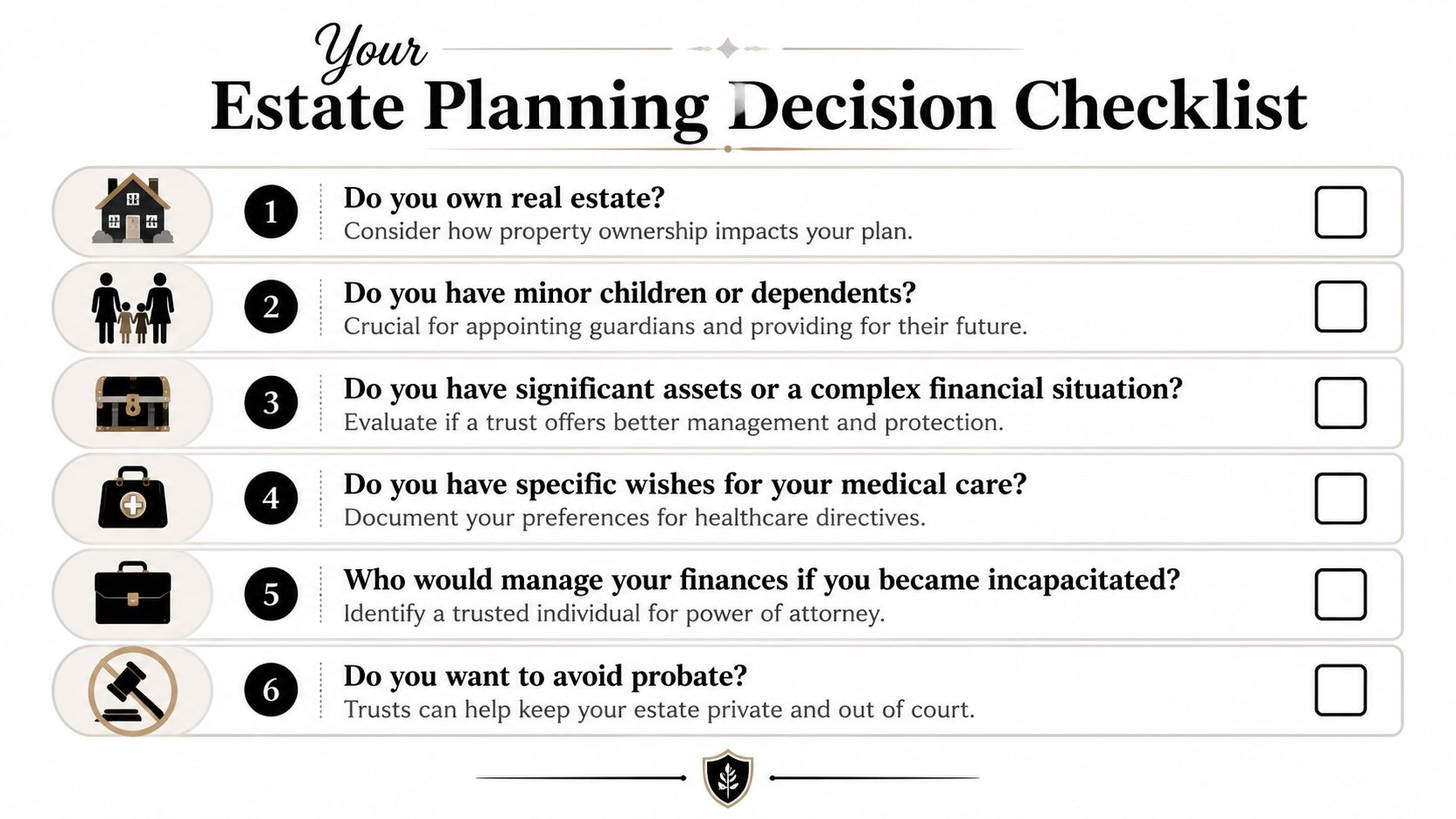
If you're still weighing estate planning vs will Texas options, start with these questions:
- Do you own real estate? Property ownership often changes how probate and title issues affect your family.
- Do you have minor children or dependents? A will may be essential for guardian nominations, but that may only solve part of the problem.
- Would your family need help if you became incapacitated? If the answer is yes, you likely need more than a will.
- Do you have retirement accounts, life insurance, or transfer-on-death accounts? Those designations need to match your estate plan.
- Are privacy and court involvement concerns for you? If you want more administration outside public probate, a trust may deserve serious consideration.
- Has your life changed recently? Marriage, divorce, births, deaths, illness, home purchases, or inheritance often mean your old documents no longer fit.
Your next step doesn't have to be complicated. Gather your current will, trust documents if any, powers of attorney, insurance policies, retirement account statements, and beneficiary forms. Then look for gaps. If no one has authority to act during incapacity, if beneficiary forms don't match your wishes, or if your family would likely face probate issues you want to avoid, it's time to update the plan.
If you need help navigating divorce, custody, or estate planning in Texas, contact Law Office of Bryan Fagan, PLLC today for a free consultation. A review of your situation can help you decide whether a will is enough, whether a trust-based plan makes more sense, and which documents your family needs for peace of mind.