
A quiet evening in Houston Heights can turn heavy fast. Maybe you're sitting at the kitchen table after the children are asleep, staring at bank statements and wondering whether your marriage can be repaired. Maybe your former spouse just mentioned moving, and your first thought wasn't about logistics. It was fear about losing time with your child. Maybe you're in a military family, and a deployment or PCS move has suddenly made an already tense parenting arrangement feel unworkable.
When that happens, they don't need legal jargon first. They need clarity. They need to know what Texas law states, what Harris County courts usually require, and how to choose a lawyer who can guide them without adding more confusion.
A Houston Heights family law attorney should do more than file paperwork. That lawyer should help you understand your choices, protect your rights, and give you a plan you can follow. Family law problems often touch every part of daily life, including your children, your home, your finances, and your sense of stability. The right legal help won't remove the stress overnight, but it can make the road ahead feel manageable.
A lot of people begin this search later than they wish they had. They wait until the argument about the children gets worse, until one spouse moves money, or until they're served with papers and feel like they're already behind. That's understandable. Family change rarely arrives at a convenient time.
Consider a common Houston Heights situation. A parent has lived in the same neighborhood for years. The child goes to school nearby, sees grandparents on weekends, and follows a familiar routine. Then the other parent starts talking about changing schools, changing schedules, or relocating. The issue isn't just legal. It's personal because it affects the child's daily life and your role in it.
You don't need to have every answer before you speak with a lawyer. You do need to understand what problem needs immediate attention.
That first step is often identifying the category of your issue. Is this a divorce? A custody dispute between unmarried parents? A request to modify an existing order? A question about protecting property before filing? The legal path changes depending on the answer.
Start with the problem that can't wait
Some matters need attention quickly:
- Child-related instability: If there's a dispute over possession, school decisions, or safety concerns, temporary court orders may matter early.
- Financial uncertainty: If bills, access to accounts, or use of marital property has become contested, legal guidance can help protect the status quo.
- Military relocation concerns: Orders that worked before deployment or transfer may no longer fit real life.
Gather the basics before your first meeting
You don't need a polished binder. A simple folder helps. Include:
- Court papers: Any petition, order, or notice you've received
- Family details: Children's school schedules, medical needs, and current routines
- Financial records: Recent statements for accounts, debts, income, and major assets
- Key timeline notes: Important dates involving separation, moves, incidents, or prior agreements
A family law case feels less overwhelming when it moves from fear to facts. That's where progress usually begins.
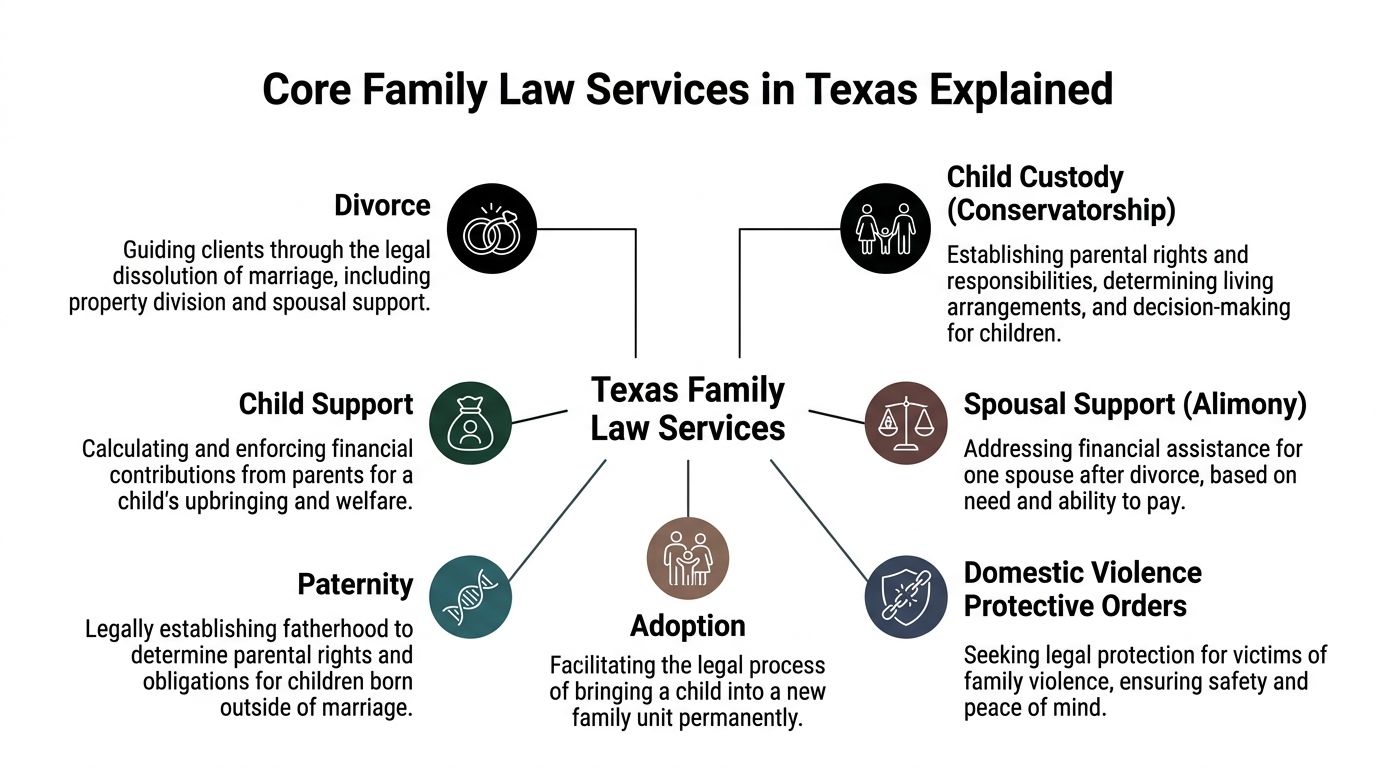
Core Family Law Services in Texas Explained
A family law case usually starts with one pressing question. Who will the children stay with. How will the bills get paid. What happens to the house. Texas law puts each of those questions into a legal category, and once you know the category, the process becomes easier to follow.
Divorce and property division
A divorce case does two jobs at once. It legally ends the marriage, and it sorts out the financial partnership that existed during the marriage.
Under Texas Family Code Section 7.001, a court divides community property in a way that is “just and right.” Clients often hear that phrase and assume it means a strict fifty-fifty split. Texas courts do not have to divide every asset down the middle. The judge looks at the full picture, including the nature of the property, the parties' financial circumstances, and facts that may have affected the marriage.
A practical way to understand this is to picture the marital estate as one large household ledger rather than a stack of separate items. The court may let one spouse keep the house, assign certain debts to the other spouse, and adjust retirement or cash assets to reach an overall result the law considers fair.
That distinction matters in Houston Heights cases, where families may have a home with substantial equity, a closely held business, stock compensation from the Energy Corridor or Medical Center, or retirement benefits that require separate court orders to divide properly. Separate property questions can also become a serious point of dispute. Property owned before marriage, some gifts, and some inheritances may remain separate, but only if they can be clearly traced.
Child custody and support
Texas uses the word conservatorship where many parents would say custody. It covers decision-making authority, the child's primary residence, and the schedule for time with each parent. Under Texas Family Code Chapter 153, the court focuses on the best interest of the child.
That standard sounds broad because it is broad. Judges look at the child's day-to-day life. Who gets the child to school on time. Who handles medical care. How well can each parent provide stability. Is there a history of family violence, substance abuse, or serious conflict. A possession schedule is not supposed to reward one parent or punish the other. It is supposed to support the child's welfare.
Child support is a separate piece of the case. Texas usually starts with guideline support based on the paying parent's resources, although the court can depart from the guideline amount in some circumstances under the Family Code. In Harris County, the details matter. Work schedules in healthcare, energy, law enforcement, and shift-based jobs often do not fit neatly into a standard calendar, so parents sometimes need orders written with more precision than a generic form provides.
If you already have orders and need to revisit them, Custody & Support Modifications addresses modifying existing custody, visitation, and support orders.
Practical rule: General complaints rarely carry much weight in court. Specific facts tied to the child's needs do.
Other family law matters people often overlook
Many families need help outside the divorce context. That is common, especially for unmarried parents, blended families, and households dealing with safety concerns.
A family lawyer may also handle:
- Paternity: Establishing legal fatherhood so custody, visitation, and support can be addressed
- Adoption: Completing the legal process that creates a parent-child relationship
- Protective orders: Asking the court for protection in cases involving family violence
- Mediation: Working toward settlement with a neutral third party before asking a judge to decide disputed issues
Each of these matters has its own rules and deadlines. A paternity case, for example, is often the legal doorway to custody and support rights for unmarried parents. A protective order case can move much faster and may affect later custody decisions.
Complex Houston cases
Houston-area family cases often involve facts that change how a lawyer prepares the case. Military families are a good example. A parent stationed near Houston may face deployment, temporary duty assignments, relocation orders, or questions about military benefits. Orders that look workable on paper can break down quickly if they do not address notice requirements, long-distance parenting time, or who makes decisions during an absence.
Business ownership creates another layer. So do professional practices, rental properties, deferred compensation plans, and disputes over whether an asset is community or separate property. In neighborhoods like Houston Heights, where home values and redevelopment pressures can be high, even the decision about whether to sell or keep a residence can shape the entire case.
The right lawyer does more than recite Texas statutes. The lawyer should be able to apply those rules to Harris County realities, including local court expectations, detailed temporary-order practice, and the practical problems Houston families face.
What to Expect in the Harris County Family Courts
A Harris County family case usually feels most stressful at the beginning, when everything is unfamiliar and the stakes are personal. A parent in Houston Heights may be trying to keep a child's routine stable, protect access to the family home, or figure out how a deployment schedule fits into a custody order. Court becomes easier to handle once you know what each stage is designed to do.

The usual path from filing to final order
Family courts in Harris County follow Texas law, but the day-to-day rhythm is local. Judges expect deadlines to be met, paperwork to be organized, and temporary disputes to be narrowed quickly. For many Houston Heights families, the process works like building a frame before finishing the house. The court often deals with immediate needs first, then works toward a final order.
A typical case often moves through these steps:
Original petition is filed
One party opens the case and tells the court what relief is being requested.The other side is served or appears
Formal notice starts the legal timetable for an answer or other response.Temporary orders may be requested
These hearings can address conservatorship, possession, child support, spousal support, use of property, and who remains in the home while the case is pending.Information is exchanged
This may include bank records, pay stubs, tax returns, school records, medical records, calendars, texts, and other evidence tied to the disputed issues.Mediation is often required before trial
Many Harris County courts expect parties to make a real effort to settle before asking the judge to decide everything.Final documents are signed, or trial is held
If agreements are reached, the paperwork is drafted and entered. If not, the judge hears the evidence and signs final orders.
That sequence matters because each stage builds on the one before it. A weak temporary-orders presentation can shape the rest of the case. A missed document deadline can limit what evidence the court sees later.
What a court appearance often looks like
Clients often expect every court date to feel like a full trial. In Harris County family courts, many settings are much narrower than that.
A temporary-orders hearing may focus on only a few questions. Where will the children sleep on school nights? Who pays the mortgage this month? Does one parent need temporary child support? The judge is usually looking for clear facts, organized exhibits, and practical proposals that protect stability while the case continues.
Preparation matters more than performance. Bring the documents your attorney requested. Arrive early. Dress conservatively. Know the purpose of that hearing and what decision the court is being asked to make.
In family court, the clearer your proof and the narrower your request, the easier it is for the judge to act.
A Harris County issue military families should address early
Houston Heights includes a meaningful military and veteran population, so military family law issues are not rare here. A 2025 projection from Houston Landing's legal aid resource page showed that 68% of Houston-area military parents reported confusion over custody enforcement during deployment, while only 12% of local family law firms offered specialized military family law resources. The same source also noted that, as of 2025, over 15% of Houston Heights residents were active-duty military or veterans.
Those numbers help explain why boilerplate parenting plans can fail in real life. Texas courts can address military service, but the order needs to be written with that reality in mind. Deployment, temporary duty assignments, training, and PCS moves can all affect possession schedules, notice requirements, virtual parenting time, and decision-making authority during an absence.
If your family has military ties, raise that issue at the start of the case, not after a conflict develops. Ask how the proposed order will work if one parent leaves on short notice, returns early, or must exercise visitation from another state or country.
Why local court knowledge makes a difference
Texas family law sets the legal rules. Harris County practice shapes how those rules play out week to week.
That local piece can affect scheduling, mediation timing, temporary-order expectations, document presentation, and how quickly a case gains or loses momentum. A lawyer who regularly appears in Harris County is often better positioned to explain what your judge is likely to want first, what paperwork should be gathered now, and which disputes are worth presenting immediately.
Cost is part of that planning too. Families who understand the likely path of the case are usually in a better position to control expense and avoid unnecessary hearings. For a practical overview of how those costs are commonly structured, review this guide to divorce attorney fees in Texas.
Understanding Legal Fees and Budgeting for Your Case
Legal fees are one of the first worries people raise, and for good reason. Family law cases affect your future, but they also arrive at a time when money may already feel tight. The better approach is to treat cost as something to understand and plan for, not something mysterious.
The main fee structures
A retainer is usually an advance payment held in a client trust account. It functions as a reserve that your lawyer bills against as work is performed. It isn't the same as a flat total for the entire case unless the fee agreement clearly says so.
Hourly billing means you pay for the time spent on tasks such as reviewing documents, preparing motions, attending hearings, negotiating, and communicating with you or the other side. This structure is common in contested family law matters because the amount of work can change as the case develops.
A flat fee is sometimes used for limited and more predictable work. Whether that applies depends on the type of matter and the scope of representation.
What usually drives the overall cost
Some cases stay focused and resolve efficiently. Others become expensive because of conflict, complexity, or both.
A few common cost drivers include:
- Contested issues: Disputes over custody, property, or support usually require more attorney time
- Complex assets: Businesses, large estates, and tracing separate property often require more analysis
- Emergency requests: Temporary orders or urgent filings can accelerate work early in the case
- Poor communication between parties: Repeated conflict often means more drafting, negotiation, and hearings
Questions you should ask about billing
Don't leave a consultation with a vague idea of the financial arrangement. Ask for specifics about how fees are charged, when invoices are issued, and what work may increase cost over time.
This is also where a detailed fee agreement matters. It should explain how billing works, what the lawyer's scope of work includes, and how unused trust funds are handled if the representation ends.
For a plain-language discussion of this topic, this article on divorce attorney fees can help you frame the right budgeting questions before hiring counsel.
| Fee topic | What to clarify |
|---|---|
| Retainer | Whether it is refundable in part if unused |
| Billing rate | Who bills time, including attorneys and staff |
| Extra expenses | Filing fees, service fees, mediation costs, expert costs |
| Invoices | How often you'll receive statements and what details they include |
A clear budget conversation early often prevents frustration later.
Key Questions for Your Attorney Consultation
You sit down for a consultation with a folder of bank statements, school records, and text messages, and one question is running through your mind. Can this lawyer help me protect my family and make sense of what happens next in Houston Heights and Harris County?
That meeting should do more than collect facts. It should help you understand your position, the pressure points in your case, and how a Harris County judge may view the issues in front of you. If your family has a military connection, a pending relocation, or an existing order from another Texas county, those local details matter early.
Ask about Harris County experience that matches your problem
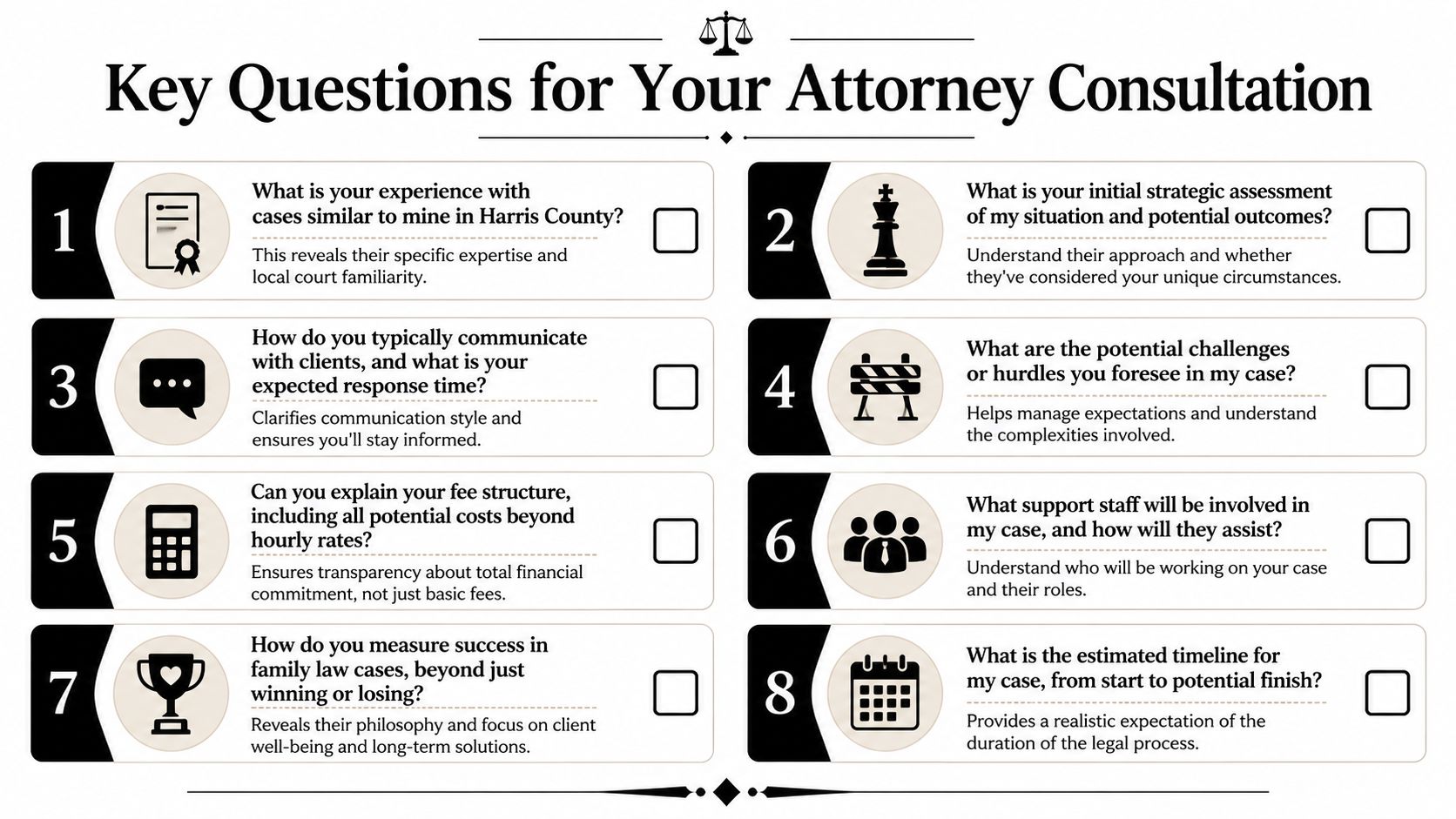
Start with a direct question. How often do you handle this type of case in Harris County family courts?
That question gets past general marketing language. A lawyer who regularly handles custody modifications, enforcement actions, military family issues, or high-conflict divorces in Harris County will usually spot procedural problems sooner. Local practice can affect timing, expectations for temporary orders, and how carefully you need to prepare for mediation or a hearing.
You should also ask how the attorney sees your legal issues under Texas law. For example, property division in a Texas divorce must be "just and right" under Texas Family Code Section 7.001. In plain terms, the court is not using a simple calculator. It is making a fairness decision based on the facts. A useful consultation explains what facts may push that decision one way or another in your case.
Ask for a working plan
A strong attorney will give you an early strategy based on the facts you have today, while also explaining what could change that strategy later. Family law works a lot like putting together a map before a storm. You may not know every road closure yet, but you should still know the likely route, the hazards, and the next turn.
Questions that often produce useful answers include:
- What is the biggest legal risk in my case right now?
- What should I avoid doing this week that could hurt me in court?
- Do you expect this case to resolve in mediation, or should I prepare for hearings?
- What documents or facts do you need before you can advise me with more confidence?
- If my spouse is in the military, deployed, or subject to transfer, how does that change the case timeline or custody analysis?
Listen for specifics. A careful lawyer may say, "Based on these facts, here is the likely first step," instead of making broad promises. That is usually a good sign.
A dependable family lawyer explains uncertainty clearly and does not promise a guaranteed result from any Harris County judge.
Ask how communication works in real life
Good legal advice is hard to use if you cannot get updates when your case starts moving fast.
Ask who will handle day-to-day communication. In many family law cases, the attorney leads strategy while a paralegal helps gather records, prepare forms, and schedule deadlines. That structure can work well, but you should know it in advance so you are not surprised later.
A few practical questions can clear this up:
- Who is my main contact if I have a question about my case status?
- Who prepares filings and who appears in court with me?
- How do I reach the office if an emergency involving the children comes up after hours?
- How will I be told about mediation dates, hearings, or signed orders?
If you want help preparing before that first meeting, this family law attorney consultation guide can help you organize your questions and papers.
Bring a short, useful case file
You do not need to walk in with a perfect binder. You do need enough information for the attorney to see the outline of the problem.
Bring these items if you have them:
- Current court orders
- Recent pay stubs, tax returns, or other financial records
- A one-page timeline of major events
- A list of immediate concerns about children, property, or safety
- Names, dates, and contact information that may matter
That preparation helps the lawyer give advice tied to facts, not guesswork. It also makes the consultation more productive, which is especially helpful when local issues, such as prior Harris County filings or military service, may affect the first decisions in your case.
Identifying a Top Houston Heights Attorney Differentiators and Red Flags
Once you've asked good questions, the next task is judging the answers. At this stage, many people second-guess themselves. They assume every family lawyer offers roughly the same value. In practice, the differences can be significant.
Differentiators that usually matter
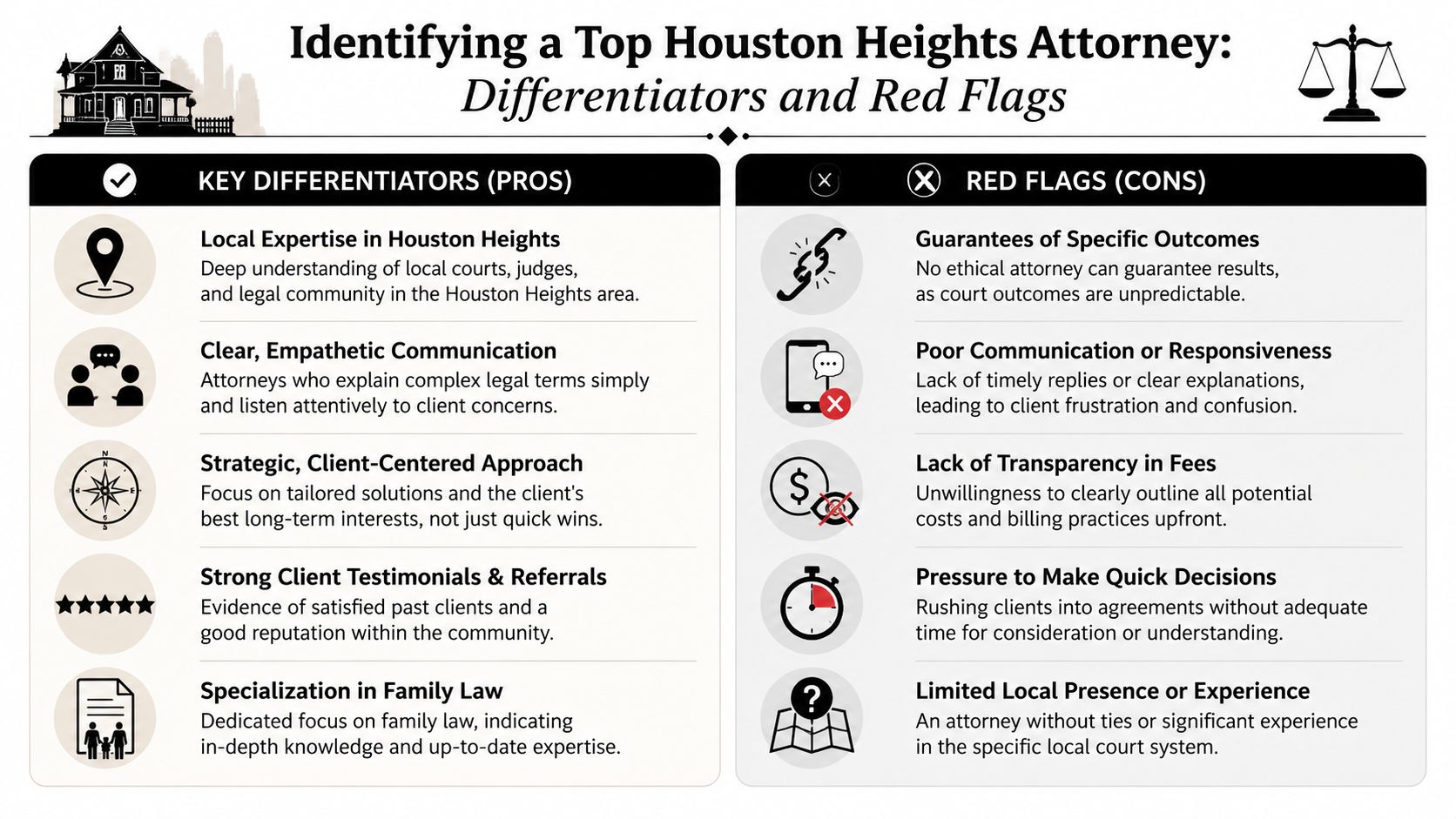
One of the clearest markers of advanced expertise in Texas family law is Board Certification in Family Law. According to Cornell's Texas family lawyer listing page, only 1% of family lawyers in Texas hold this distinction, and the certification requires substantial experience, specialized continuing education, and passage of a rigorous examination.
That matters because family law isn't a single skill. It combines courtroom judgment, negotiation, statutory knowledge, and practical problem-solving under stress.
Other strong differentiators include:
- Local Harris County experience: Familiarity with court routines and expectations
- Clear communication: The ability to explain hard issues in plain English
- Focused family law practice: A lawyer who regularly handles divorce, custody, support, and enforcement issues
- Thoughtful staffing: Knowing who is doing the work and how your matter is managed
The Houston Heights divorce attorney page is one example of a local resource people review when comparing how firms discuss these issues and what kinds of cases they handle.
Red flags you shouldn't dismiss
Some warning signs appear early. Pay attention to them.
| Red flag | Why it matters |
|---|---|
| Guarantees of a result | No ethical attorney can promise how a judge will rule |
| Pressure to sign immediately | Good legal advice allows room for informed decisions |
| Vague billing explanations | Confusion about fees often becomes conflict later |
| Slow or careless communication | Early responsiveness often reflects future responsiveness |
A lawyer can be confident without being reckless. In a consultation, confidence sounds like informed judgment. Recklessness sounds like certainty where certainty doesn't exist.
A practical framework for comparison
When you compare attorneys, ask yourself three questions. Did this person understand my facts? Did this person explain the law clearly? Did I leave with a realistic sense of what happens next?
In some cases, clients also consider whether a firm has the capacity to handle more complicated matters. The Law Office of Bryan Fagan, PLLC states that its attorneys have over 100 years of combined legal experience and handle complex family matters involving high-net-worth estates, business ownership disputes, and military family issues, as reflected in the publisher information provided for this article. That kind of team structure may matter when your case is more involved than a straightforward filing.
Take the Next Step Toward Peace of Mind
Hiring a Houston Heights family law attorney isn't just about finding someone with a license and an office. It's about finding a guide who can help you make sound decisions when your personal life feels uncertain.
By this point, you know what many people don't know when they start. You know how Texas family law issues are grouped. You know what a Harris County case often looks like from filing through final order. You know how to think about fees, what to ask in a consultation, and what warning signs to watch for before you commit.
That knowledge matters. It helps you move from reacting emotionally to acting deliberately. It also helps you protect your children, your finances, and your peace of mind with fewer surprises.
If you're facing divorce, a custody dispute, a support issue, or a military family law question in Houston Heights, don't wait until confusion turns into a larger problem. A focused conversation early can often clarify what needs immediate action and what can be handled step by step.
If you need help navigating divorce, custody, or estate planning in Texas, contact Law Office of Bryan Fagan, PLLC today for a free consultation. A confidential conversation can help you understand your options, identify the next right step, and move forward with more confidence.