
You check your bank account, and the child support payment still isn't there. Rent is due. Groceries don't wait. Your child's needs haven't changed just because the other parent stopped paying.
If that's where you are right now, you're not powerless. Texas gives parents real tools to enforce child support, but the path that works best depends on one thing many people underestimate: whether you can prove the missed payments clearly and put the right enforcement method in front of the right decision-maker.
A lot of parents searching for how to enforce child support in Texas are deciding between two routes. One is working through the Texas Office of the Attorney General. The other is filing a private court enforcement action. Both can work. The difference is speed, control, and how well each option fits the facts of your case.
What Texas Parents Can Do When Child Support Goes Unpaid
A missed payment can look temporary at first. Then another due date passes, and now you are deciding whether to keep waiting, open a case with the Attorney General, or hire a lawyer to ask the court to act.
That choice matters. In Texas, child support is enforceable because of a court order. A text message promising to pay later is not a substitute for one. If there is no signed order setting support, the issue is usually not enforcement yet. The issue is getting an enforceable order in place.
Start with the question that controls everything
Do you already have a signed child support order?
If you do, Texas law gives the court and the state several ways to enforce it, including income withholding, contempt remedies, liens, and license consequences. If you do not, informal arrangements often leave parents stuck. I see that problem often in cases where parents adjusted payments after a job loss or agreed to "handle it privately" after divorce. Those side agreements may feel practical in the moment, but they are hard to enforce later because the court looks first to the written order.
Practical rule: Enforce the order you have, not the arrangement you hoped would hold.
The next decision is strategic. Some parents are well served by opening or pursuing a case through the Texas Office of the Attorney General. Others need a private enforcement action in court, especially when time matters, the arrears are growing, or the facts are not straightforward.
What actually makes an enforcement case stronger
The best enforcement cases are rarely the loudest ones. They are the ones that are easiest to prove.
A strong case usually has these features:
- A clear order: The amount due, due dates, and any medical or dental support terms are stated plainly in the signed order.
- A reliable payment history: The missed amounts are tied to dates and records, not memory.
- A collection method that fits the parent's income: Wage withholding can work well for a salaried employee. It is less effective when the paying parent changes jobs often, works for cash, is self-employed, or receives irregular income.
- Early action: Delay gives the other parent more time to switch employers, hide income, or create confusion about what was paid.
That last point gets overlooked in many guides. Evidence drives results, especially in difficult cases. If the paying parent has irregular income, gets paid in cash, works contract jobs, or owns a business, the difference between using the OAG and filing a private court action often comes down to how much proof you can gather and how quickly you can present it.
Parents often hope there is one form that fixes everything. In practice, enforcement is a pressure process. The right route depends on the order, the payment record, the other parent's income pattern, and how much control you need over the case.
Your First Steps When Child Support Payments Stop
The first useful move isn't anger. It's organization.
Before you call the Attorney General, before you hire a lawyer, and before you file anything in court, gather the proof that shows exactly what's happened. In many cases, the quality of this early file determines how much pressure you can bring later.

Start your enforcement file
Create one folder, digital or paper, and keep everything in it.
That file should include:
- Your signed order: Find the most recent child support order, divorce decree, or SAPCR order that sets support.
- A payment log: List each due date, what should have been paid, what was paid, and what remains unpaid.
- Proof of payments received: Bank deposits, payment portal records, checks, money transfer screenshots, or anything else that shows what came in.
- Missed-payment notes: If a payment was short, late, or skipped, note it immediately.
- Communication records: Save texts, emails, voicemails, and direct messages where the other parent discusses payment.
A simple spreadsheet is often enough. Judges and enforcement staff don't need drama. They need dates, amounts, and documents that line up.
Confirm what the order actually says
Parents are often surprised by what their own order requires. Some orders include base child support plus medical or dental support. Some require payment through a state disbursement unit. Others contain income withholding provisions that were never activated.
Review these points carefully:
- Where payments must be sent
- When each payment is due
- Whether uninsured medical or dental obligations are included
- Whether an income withholding order already exists
- Whether the arrears involve support only, or support plus medical and dental obligations
Save the actual order and read the payment language word for word. A lot of enforcement problems start because parents rely on memory instead of the signed terms.
Don't rely on promises to fix arrears
The most common mistake I see is waiting because the other parent says they'll “make it up next month.” Maybe they mean it. Maybe they don't. Either way, delay usually weakens your position.
What helps instead:
| Situation | Better response |
|---|---|
| The other parent says they lost a job | Keep documenting missed payments and get updated employment information if you can |
| The other parent offers a side deal | Don't treat it as replacing the court order |
| The other parent pays in cash | Document the date and amount immediately and keep a receipt trail |
| The other parent becomes hard to reach | Preserve every communication attempt and any address or employer details you have |
If you're also dealing with parenting-time problems, it helps to keep those records separate. For broader custody issues, our Texas child custody resources can help you understand how possession and support are treated differently under Texas law.
Using the Texas Attorney General for Enforcement
A parent calls after three missed payments. The other parent has a regular job, there is already a support order, and the main question is simple: how do we start collecting without spending more time and money than the case requires?
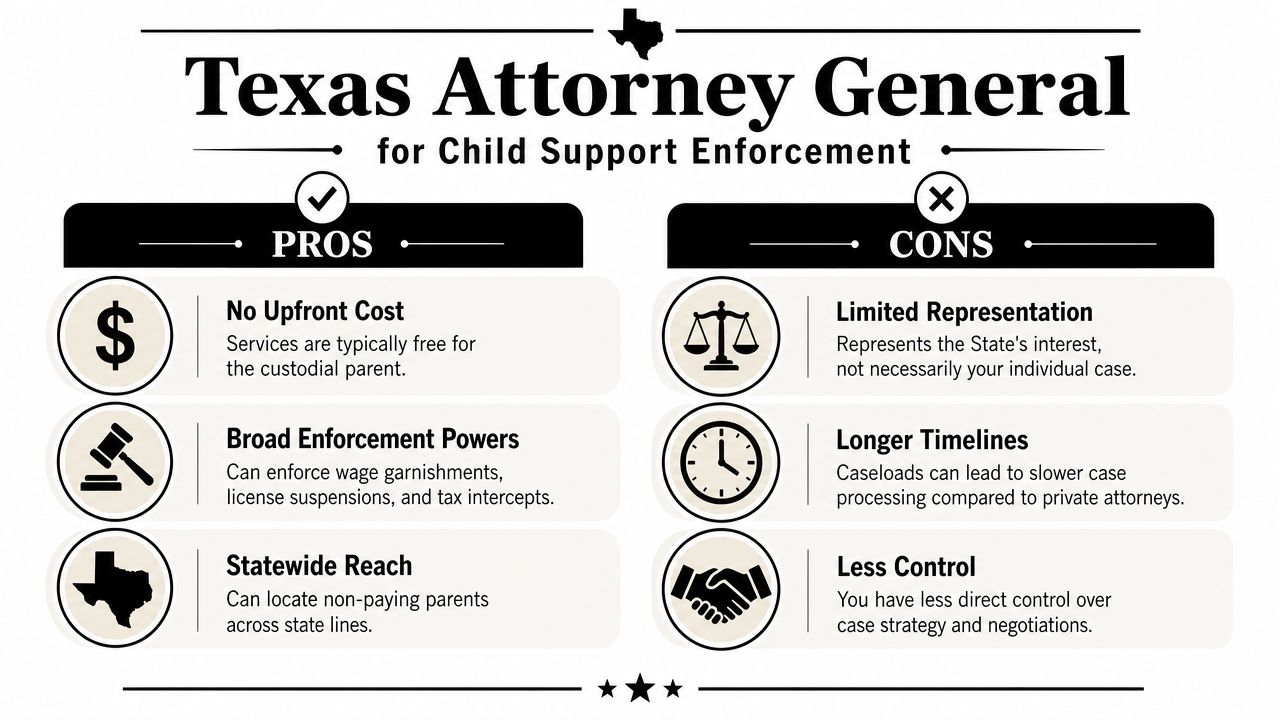
In that situation, the Texas Office of the Attorney General Child Support Division is often the right first move. The OAG is built to handle enforcement at scale, and it tends to work best in cases where the order is clear, the employer is known, and the problem is getting money collected rather than proving where the money went.
The practical advantage is reach. The agency handles a large volume of child support matters across Texas, and withholding from wages remains one of the most effective collection tools in routine cases, as discussed in this Texas child support statistics summary.
Why the OAG works well in many cases
The OAG is usually a good fit when the facts are already clean.
If the other parent is a regular employee and the arrears are easy to calculate, the agency can often use the standard enforcement tools that get results:
- Income withholding: Usually the fastest and most reliable tool when wages can be traced to an employer.
- Liens and administrative collection efforts: Useful when arrears have built up and other assets or accounts can be reached.
- License suspension requests: A pressure tool that can matter when ordinary collection efforts are being ignored.
That combination is why many parents should at least consider the OAG before paying for private litigation. For a straightforward enforcement file, the state system may do exactly what is needed.
Here's a helpful overview if you want a plain-language walkthrough before deciding how to proceed.
Where the OAG has limits
The trade-off is individual attention. The OAG handles many cases. It does not prepare your matter the way a private attorney prepares a contested court file.
That difference becomes important in the cases parents struggle with most. If the other parent is self-employed, paid in cash, working irregular jobs, disputing the amount owed, or shifting money between accounts, enforcement is no longer just a collection problem. It becomes an evidence problem.
Here is the practical split:
| If your case looks like this | The OAG may be a strong fit |
|---|---|
| Regular employee with known employer | Yes |
| Clear payment record and straightforward arrears | Yes |
| Need statewide enforcement tools | Yes |
| Self-employed parent with changing income | Often not enough by itself |
| Parent hiding income or moving assets | Usually better with focused court action |
| Need a custom hearing strategy and evidence plan | Private counsel is often the better option |
That last point gets missed in a lot of guides. In hard cases, the crucial step is not filing a complaint. Instead, it involves gathering bank records, payment histories, employer information, business documents, text messages, and other proof that lets a judge see nonpayment clearly.
A private family-law practice such as Law Office of Bryan Fagan, PLLC can handle enforcement litigation in addition to administrative options. That can matter when you need subpoenas, hearing preparation, and a case strategy built around irregular income or disputed arrears.
Taking Your Child Support Case to Court
A parent can ignore letters for months. A hearing date usually gets attention.
When administrative enforcement has stalled, or the facts suggest the other parent is avoiding payment in more deliberate ways, filing for court enforcement may be the better move. That is often true when the arrears are disputed, income is irregular, or the parent works for cash or through a closely held business. In those cases, the question is not only whether support went unpaid. The question is whether you can present proof clearly enough for a judge to act.
Texas Family Code Chapter 157 sets the rules for enforcement. In practice, court gives you a way to ask for enforceable relief, set the case for hearing, and put the missed payments in front of a judge with a record that is organized and specific.

What court enforcement adds
Court enforcement can do more than send another notice. Depending on the facts and the proof, the court may order wage withholding, confirm arrears, grant a money judgment, place liens on certain property, suspend licenses, place the parent on community supervision, or hold the parent in contempt.
That last remedy gets a lot of attention, and for good reason. Contempt puts real pressure on a parent who had the ability to follow the order and chose not to. Judges take that issue seriously, but they also expect precision. If the payment records are incomplete, the order language is unclear, or the requested relief is not framed correctly, even a frustrated judge may have limited room to act.
OAG enforcement versus private court enforcement
Both paths can work. The right choice depends on the kind of problem you have.
| Issue | OAG route | Private court action |
|---|---|---|
| Cost to start | Often lower for the parent seeking enforcement | Usually involves attorney fees and filing costs |
| Control over strategy | Limited | Much more direct |
| Specific evidence presentation | Limited | Stronger |
| Contempt presentation in court | More constrained by agency process | More fully developed through private litigation |
| Best for | Standard collection cases | Complex, disputed, or evasive cases |
In straightforward cases, the OAG may be enough. In harder cases, private litigation often gives you more control over timing, pleadings, subpoenas, witness preparation, and how the payment history is presented at the hearing.
That control matters most where many parents get stuck. A parent with a regular paycheck is one kind of case. A parent who is self-employed, runs expenses through a business, gets paid informally, or keeps changing jobs is a different case entirely. Court can still help, but only if the file is built carefully.
Cases where court action is often the better call
Court enforcement usually deserves serious consideration when:
- The parent is self-employed or paid informally
- You suspect income or assets are being hidden
- The arrears include medical or dental support
- The payment history is disputed
- The other parent has ignored prior enforcement efforts
- You need a hearing built around documents, testimony, and a clear arrears calculation
Texas law also allows money judgments for certain unpaid support obligations, including qualifying medical or dental support claims and interest on arrears where the statute permits it. Whether that relief is available in your case depends on the dates, the order language, and the proof you can bring to court.
If your support issue is tied to a broader post-divorce dispute, our Texas divorce blog may help you identify whether enforcement, modification, or another filing is the better legal step.
Gathering Evidence to Strengthen Your Enforcement Case
If I had to pick the one thing that most often separates a strong enforcement case from a weak one, it would be this: documentation quality.
That is especially true when the paying parent has irregular income, changes jobs constantly, works for cash, is self-employed, or claims poverty while still maintaining a lifestyle that suggests otherwise. In those cases, proving nonpayment is only part of the job. You also need evidence that points to ability to pay, access to assets, or inconsistencies in the other parent's story.

Why evidence matters more in difficult cases
Texas law allows tools beyond wage withholding, including liens and license suspension, but those remedies are harder to use effectively when the parent has no obvious wages to garnish. Guidance discussing hard-to-enforce cases notes that successful enforcement often depends more on documentation quality than on proving nonpayment alone, especially when the payer has irregular income or works off the books, as explained in this discussion of Texas child support enforcement challenges involving unstable income.
That tracks with what happens in real hearings. The cleaner your record, the less room the other side has to blur the facts.
Evidence that often makes a difference
Some evidence is obvious. Some is overlooked.
- Certified payment histories: If support was supposed to pass through an official channel, this can anchor your arrears calculation.
- Bank statements: These help confirm what you received and what you didn't.
- Texts and emails: Admissions such as “I'll send it when I can” can matter because they acknowledge the obligation.
- Employer information: Old employers, current employers, job titles, side businesses, and work locations all help.
- Social media posts: Photos of travel, business activity, vehicles, purchases, or work can become useful when someone claims they have no income at all.
- Property and asset clues: Vehicles, equipment, business pages, rental properties, and public-facing business activity can point toward resources.
- Medical and dental bills: If those obligations are part of the order, keep receipts, invoices, and proof of what remains unpaid.
Build the case like you're preparing for cross-examination
A judge will usually trust organized proof over broad accusations. That means your file should answer these questions quickly:
| Question a judge may ask | Evidence that helps answer it |
|---|---|
| What exactly was ordered? | Signed order and relevant pages highlighted |
| What was missed? | Payment log and supporting records |
| How do you know the amount owed? | Arrears summary tied to due dates |
| Can the parent be located? | Address history, phone numbers, employer details |
| Is there evidence of ability to pay? | Work records, business activity, bank records, public posts |
Keep records as if someone else will need to understand the case in ten minutes. That “someone else” may be a judge.
What doesn't help much
Anger is understandable, but it's not evidence.
These points usually carry less weight unless supported by records:
- “He always lies about money.”
- “She's obviously hiding income.”
- “Everyone knows he gets paid in cash.”
- “He told a friend he bought a new truck.”
Good enforcement work turns suspicion into documents, timelines, and testimony that can stand up in court.
Answering Your Top Enforcement Questions
A lot of parents reach this point after trying to be patient for too long. The questions are usually practical: who should handle the case, what can be enforced, and when does it make sense to push for court action instead of waiting.
Should I start with the OAG or go straight to court
It depends on the kind of problem you have.
The OAG is often a sensible starting point when the order is clear, the missed payments are easy to calculate, and the other parent has a regular employer who can be found. In that type of case, administrative enforcement tools can work well.
A private enforcement case in court usually makes more sense when the facts are disputed, the other parent is self-employed, works for cash, changes jobs often, or appears to be hiding income. Those are the cases where evidence preparation matters most. If ability to pay will be contested, the better question is not just who can file first. It is who is in the best position to build and present the proof.
Can Texas enforce more than just the monthly support amount
Yes. A support order may include medical support and dental support, and those obligations can be enforced too.
That issue gets missed more often than it should. I regularly see cases where a parent focuses only on the monthly child support number and overlooks unpaid reimbursements, insurance obligations, or other ordered support terms that also belong in the enforcement calculation.
When does nonpayment start leading to stronger consequences
The short answer is sooner than many parents expect.
As noted earlier, Texas enforcement tools can escalate once support falls behind for a meaningful period, including license-related consequences in some cases. Delay usually makes the case harder to clean up. Records get lost, payment disputes grow, and a parent who was easy to find six months ago may be much harder to track down now.
Can I stop visitation if child support is not paid
No.
Child support and possession are separate parts of the order. If you deny court-ordered visitation because support is unpaid, you can create a new problem for yourself while the original arrearage still remains unpaid. The better course is to enforce support through the proper process and keep your side of the order clean.
What if the other parent lives in another state
Texas can often enforce support across state lines, but interstate cases need careful handling. The details matter. Which state issued the order, where the other parent lives now, and whether anyone is also trying to modify the order can change the procedure.
If the case involves another state and irregular income, I would treat evidence gathering as an early priority, not an afterthought. In practice, those files are won with documents, location information, payment history, and proof of income sources, not with assumptions about what the other parent should be earning.
Your Next Steps and When to Seek Legal Help
If you're deciding what to do today, use a simple framework.
Start here
- You have a court order and regular missed payments: Gather your records and consider starting with the OAG.
- You suspect hidden income or cash work: Focus on evidence before assuming wage withholding will solve it.
- You're owed support plus medical or dental obligations: Review the order carefully and calculate each category separately.
- The other parent ignores notices or keeps changing jobs: Court enforcement may be the more effective path.
Seek legal help sooner when these signs are present
Some facts usually justify a faster conversation with counsel:
- The arrears have grown beyond a minor shortfall
- The parent is self-employed or paid off the books
- You believe assets are being concealed
- The payment history is disputed
- You need a contempt case prepared correctly under Chapter 157
- There are interstate issues, prior modifications, or multiple overlapping orders
A good enforcement strategy is rarely about using every available remedy. It's about using the right remedy, backed by the right proof, at the right time.
If you need help navigating divorce, custody, or estate planning in Texas, contact Law Office of Bryan Fagan, PLLC today for a free consultation. If child support has gone unpaid, a consultation can help you identify whether to begin with the Attorney General, file a court enforcement action, or take additional steps to document arrears before you move forward.