
Texas Gestational Surrogacy vs Traditional Surrogacy usually stops being an academic question the moment someone tells intended parents, “You know the surrogate’s genetic connection could change who Texas considers the legal parent, right?” That is often when the phone rings. A couple has already spent months working with a fertility clinic, selected a surrogate, signed paperwork, and started planning for a child they have dreamed about for years. Then someone mentions that not all surrogacy arrangements receive the same treatment under Texas law. Suddenly, what felt like a medical journey becomes a legal one.
Most intended parents assume that if everyone agrees to the arrangement, the law will simply honor those wishes. Unfortunately, that is not always how it works. Texas has a detailed statutory framework that protects certain surrogacy arrangements and provides a path to establish parentage before a child is born. Other arrangements operate on much shakier legal ground. The distinction often comes down to a single fact that many people overlook at the beginning of the process.
At the Law Office of Bryan Fagan, PLLC, we regularly meet families who are surprised to learn how much turns on that one detail. Founded by Bryan Joseph Fagan, a South Texas College of Law graduate and recognized authority in Texas family law, our firm believes families deserve clear answers before making decisions that affect their future. Building a family through surrogacy involves tremendous hope, trust, and financial investment. It should not involve preventable legal surprises.
One consultation in particular illustrates the stakes. Intended parents came to our office after moving forward with a surrogacy arrangement they believed was fully protected. They had relied on informal advice, online research, and documents they assumed would be enough. What they did not realize was that the structure of their arrangement placed them outside many of the protections Texas law provides. By the time they sought legal guidance, the risks were no longer hypothetical. They were immediate.
In this article, I will walk you through how Texas treats gestational and traditional surrogacy differently, why the surrogate’s genetic connection matters so much under Texas law, what protections a validated gestational agreement actually provides, and where intended parents most commonly make mistakes. We will examine the Texas Family Code provisions that govern these cases, the requirements many families overlook, and the practical realities that can determine whether your path to parenthood proceeds smoothly or becomes far more complicated than expected.
The Bottom Line
In Texas, gestational surrogacy — where the surrogate has no genetic link to the child — is backed by statute and can be validated in court before birth under Texas Family Code Chapter 160. Traditional surrogacy, where the surrogate is also the egg donor, is not covered by that statute and is treated closer to an adoption, leaving intended parents far more exposed.
Key Takeaways
- The genetic link is the whole game. Gestational surrogacy means the surrogate is not genetically related to the child. Traditional surrogacy means she is — and that biological tie gives her parental standing Texas courts must reckon with.
- Only gestational agreements have a Texas statute. Texas Family Code §160.754 authorizes and §160.756 lets a court validate a gestational agreement. Traditional surrogacy falls outside Subchapter I entirely.
- Texas requires the intended parents to be married. Under §160.754(b), a validated gestational agreement requires the intended parents to be married to each other — a requirement that surprises many couples.
- The surrogate’s own eggs cannot be used. §160.754(c) requires the eggs come from an intended parent or a donor — which is precisely what makes traditional surrogacy fall outside the protected statute.
- Residency matters. §160.755 requires the surrogate or the intended parents to have lived in Texas for the 90 days before filing to validate the agreement.
- Validate before birth, not after. A pre-birth validated agreement is what puts the intended parents’ names on the birth certificate without an adoption fight. Skipping it is the most expensive mistake I see.

Your Family’s Future Starts Here
Don’t navigate your legal journey alone. Schedule a consultation now and get the clarity and support you deserve.
What Gestational and Traditional Surrogacy Actually Mean in Texas

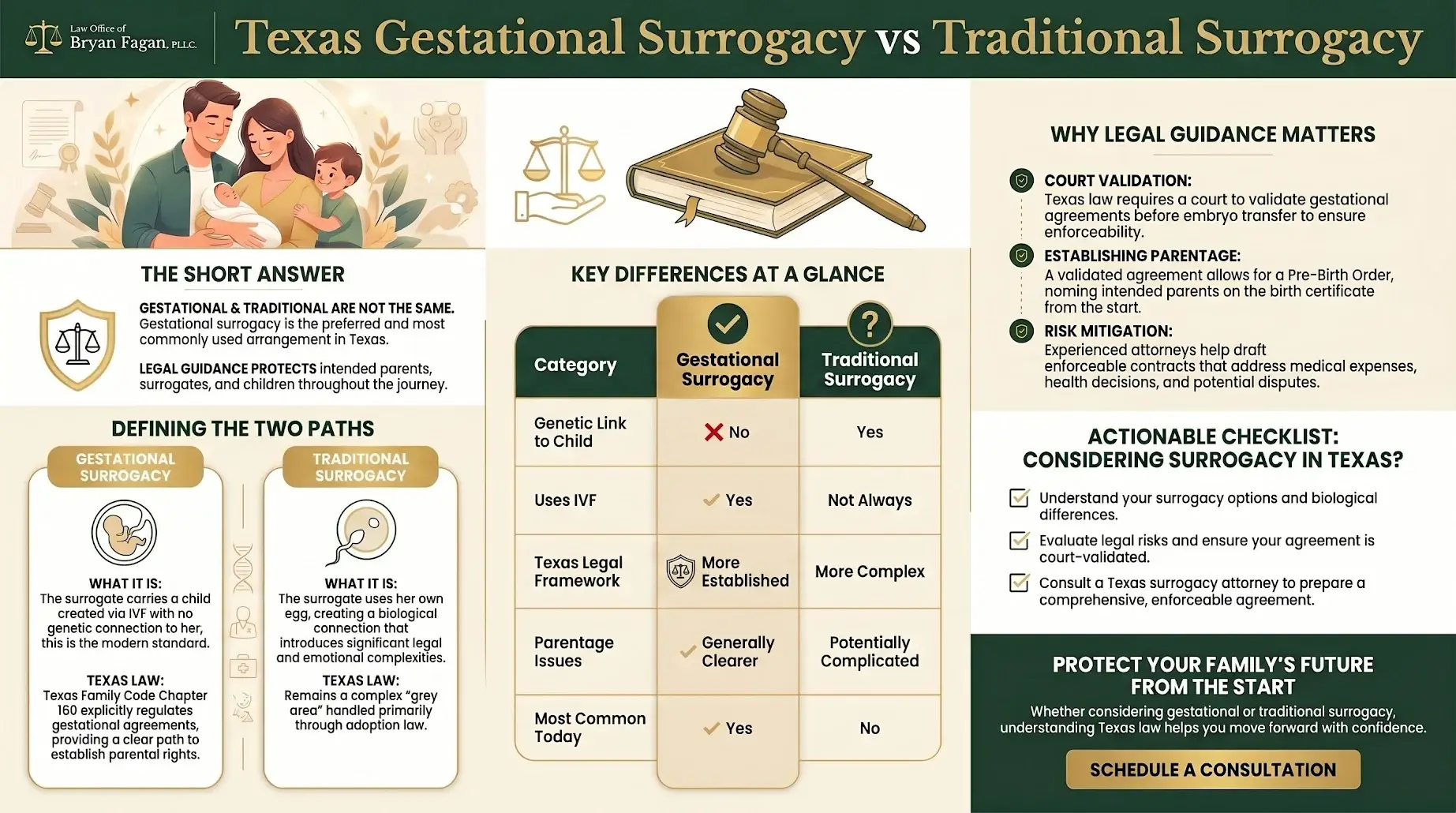
The central issue in Texas Gestational Surrogacy vs Traditional Surrogacy is whether the surrogate is genetically related to the child. In a gestational surrogacy arrangement, the surrogate carries an embryo created from the intended parents’ or a donor’s egg and sperm, meaning she has no biological connection to the baby. In a traditional surrogacy arrangement, the surrogate’s own egg is used, making her both the birth mother and genetic mother.
That distinction is also the legal dividing line. Texas Family Code Chapter 160, Subchapter I provides a statutory framework for validated gestational agreements, allowing intended parents to establish parentage before birth. Traditional surrogacy falls outside those protections because the surrogate has a genetic relationship to the child.
Why Traditional Surrogacy Is Rare in Texas
Most fertility clinics prefer gestational surrogacy because it offers greater legal certainty. When the surrogate is genetically related to the child, parentage issues can resemble an adoption or contested parentage case rather than enforcement of a validated agreement. In straightforward gestational surrogacy arrangements, intended parents often have a clear legal path forward. In more complex cases involving traditional surrogacy, donor issues, or disputed parentage, strategic legal planning becomes even more important.
Learn more about protecting your parental rights through a Texas gestational agreement.
Strategic insight
If anyone is proposing a traditional surrogacy arrangement in Texas, treat that as a signal to get legal counsel before — not after — the medical process begins. The structure you choose at the clinic stage determines which body of law governs the outcome, and that is not something you can retrofit later.
Why Texas Law Treats the Two So Differently
The legal distinction at the center of Texas Gestational Surrogacy vs Traditional Surrogacy is not accidental—it was intentionally built into Texas law. Texas Family Code Chapter 160, Subchapter I creates a statutory framework for gestational surrogacy, allowing courts to validate a gestational agreement and establish parentage before a child is born. Traditional surrogacy, however, falls outside that framework because the surrogate is genetically related to the child.
Under Texas Family Code §160.754, a valid gestational agreement requires that the egg come from an intended parent or donor, not the surrogate herself. That requirement creates a bright legal line. When the surrogate has no genetic connection to the child, Texas courts can more easily recognize the intended parents through a court-approved process. If the surrogate is genetically related to the child, parentage rights become far more complicated, and contract enforceability may be challenged.
Many intended parents are surprised to learn that Texas law imposes additional requirements before a court will validate a gestational agreement. For example, §160.754 generally requires the intended parents to be married, while §160.756 requires the court to review medical necessity findings, voluntary consent, and other statutory factors before approving the arrangement. In straightforward gestational surrogacy arrangements, these requirements create a predictable path to parentage. In more complex cases involving unmarried intended parents, donor arrangements, residency issues, or contested parentage, strategic legal planning becomes increasingly important.
Because mistakes made before embryo transfer can create significant legal risk later, understanding how Texas surrogacy laws apply to your specific circumstances is critical. Learn more about protecting your parental rights through a Texas gestational agreement attorney in Katy and how proper court validation can help avoid future disputes.
What this protects
When you follow the statute, a Texas court issues an order before the child is born declaring the intended parents to be the legal parents. The hospital puts your names on the birth certificate. There is no post-birth adoption, no waiting period, no surrogate “consent” window after delivery. That certainty is the entire point of the gestational path.
| Category | What Texas Law Says | Practical Impact |
|---|---|---|
| Genetic link of surrogate | Gestational: none. Traditional: surrogate is the genetic mother. | Determines whether the protected statute applies at all. |
| Governing statute | Gestational agreements: Tex. Fam. Code Ch. 160, Subchapter I (§§160.754–160.763, 2025). Traditional: not covered. | Gestational has a court-validation path; traditional does not. |
| Egg source requirement | §160.754(c): eggs from intended parent or donor; surrogate’s eggs may not be used. | Traditional surrogacy is structurally outside the statute. |
| Marriage requirement | §160.754(b): intended parents must be married to each other. | Unmarried intended parents need a different legal strategy. |
| Residency | §160.755: 90 days in Texas before filing to validate. | Out-of-state parents must plan timing carefully. |
The Validated Gestational Agreement Is Your Real Protection

When comparing Texas Gestational Surrogacy vs Traditional Surrogacy, one of the most important differences is the availability of court-approved parentage protection before the child is born. A signed agreement is important, but a validated gestational agreement under Texas Family Code §160.756 provides something far more powerful: a court order establishing the intended parents’ legal rights in advance.
Under Texas Family Code Chapter 160, Subchapter I, the intended parents and surrogate may petition the court to validate their agreement before birth. To approve the arrangement, the court must evaluate several factors, including whether the parties entered the agreement voluntarily, whether statutory requirements have been satisfied, whether medical evidence supports the arrangement, and whether responsibility for pregnancy-related expenses has been properly addressed. Once validated, the agreement creates a clearer path for parentage recognition and helps reduce the risk of future disputes.
The Residency Requirement Many Families Overlook
One of the most common planning mistakes involves Texas’s residency requirements. Under Texas Family Code §160.755, either the surrogate or the intended parents must have lived in Texas for at least 90 days before filing for validation. Intended parents traveling to Texas for fertility treatment often assume that medical treatment alone creates jurisdiction, but that is not always the case.
In straightforward gestational surrogacy arrangements, residency and court validation issues can often be addressed early in the process. In more complex cases involving out-of-state intended parents, international families, donor arrangements, or unusual parentage circumstances, strategic legal planning before embryo transfer becomes increasingly important. When court validation has not occurred, or when eligibility requirements are overlooked, intended parents may lose access to some of the legal protections that make gestational surrogacy attractive in the first place.
For additional information about parentage protection and assisted reproduction issues, visit our guide on legal issues in Texas surrogacy and assisted reproduction.
“A surrogacy contract that has not been validated by a court is a promise. A validated gestational agreement is an order. In a contested case, only one of those two things wins.”
Surrogacy Arrangement Strength Checker
6 quick questions · No contact info required
1. Is the surrogate genetically unrelated to the child (gestational), rather than using her own eggs (traditional)?
2. Are the intended parents married to each other?
2. Has the child already been born under this traditional arrangement?
3. Will the surrogate or intended parents have lived in Texas for at least 90 days before filing?
4. Is there a written agreement in place (or planned) before the embryo transfer?
5. Has a court validated the agreement (or do you plan to seek validation before birth)?
6. Has medical documentation been prepared showing why the intended mother cannot safely carry the pregnancy?
Strong Position
Your arrangement lines up with the protected Texas path
A gestational arrangement, married intended parents, Texas residency, a written agreement, and a plan to validate before birth with medical documentation — this is exactly the structure Chapter 160 was built to protect. The next step is making sure the agreement is drafted to satisfy §160.756 and the validation petition is filed correctly.
Most clients hear back within 5 minutes during business hours (8 AM–10 PM CT, 7 days a week).
Workable — With Gaps to Close
You are on the gestational path, but key pieces are missing
A gestational arrangement gives you access to the statute, but missing pieces — no written agreement yet, no validation plan, or no medical documentation — are exactly what a court examines under §160.756. These are fixable before birth, and fixing them is far cheaper than litigating parentage after delivery.
Most clients hear back within 5 minutes during business hours (8 AM–10 PM CT, 7 days a week).
High Exposure
A traditional arrangement falls outside the protected statute
Because the surrogate is the genetic mother, your situation sits outside Chapter 160’s validation path and looks far more like an adoption — with the surrogate retaining parental standing Texas courts must address. This is the highest-risk structure, especially after birth. You need a tailored legal strategy now, not a template contract.
Most clients hear back within 5 minutes during business hours (8 AM–10 PM CT, 7 days a week).
Get a read on your specific arrangement
The checker shows the pattern. A Legal Strategy Session shows what to do about your exact facts — before a clinic timeline forces your hand.
Schedule a Strategy SessionWhere Traditional Surrogacy Goes Wrong in Real Cases
One of the most significant risks highlighted by Texas Gestational Surrogacy vs Traditional Surrogacy appears when everyone assumes parentage has already been settled—only to discover after the child's birth that it has not. In traditional surrogacy, the surrogate is both the birth mother and the genetic mother. Because Texas Family Code Chapter 160, Subchapter I does not provide a court-validation process for traditional surrogacy arrangements, intended parents often have fewer legal protections than they realize.
A common misconception is that a signed surrogacy agreement automatically resolves future parentage issues. In straightforward gestational surrogacy arrangements, a court-validated agreement under Texas Family Code §160.756 can establish parentage before birth and significantly reduce uncertainty. When court validation has not occurred, however, or when the surrogate is genetically related to the child, the legal analysis changes. If the surrogate later challenges the arrangement, Texas courts must consider the rights associated with her biological connection to the child, and the dispute can begin to resemble a parentage or adoption proceeding rather than simple contract enforcement.
Where parentage is disputed, outcomes become less predictable, more expensive, and more emotionally taxing for everyone involved. In more complex cases involving traditional surrogacy, unmarried intended parents, donor arrangements, or contested parentage claims, strategic legal planning before embryo transfer becomes critical. What appears to be a minor procedural decision at the beginning of the process can ultimately determine whether intended parents receive the protections available under Texas law or find themselves facing avoidable litigation later.
For additional information about parentage protection and assisted reproduction planning, visit our guide on Texas surrogacy agreements and assisted reproduction issues.
The costly mistake I see most
Intended parents proceed with a traditional arrangement on a handshake or a template contract, skip court involvement entirely, and assume the birth certificate will sort itself out. When the surrogate's circumstances change, they discover that the cheapest part of the process — getting the legal structure right up front — was the part that would have protected them. Reconstructing parental rights after birth costs many times more than building them correctly before conception.
How Texas Compares to Other States

Texas sits in the middle of the national spectrum: more protective than states that ban compensated surrogacy outright, less permissive than states that recognize agreements with almost no court involvement. California, for example, enforces both gestational and traditional surrogacy agreements broadly and is widely considered the most surrogacy-friendly state, with streamlined pre-birth parentage orders.
New York, after long prohibiting compensated surrogacy, now permits gestational surrogacy under a detailed statutory framework with strong surrogate protections. Florida likewise has a dedicated gestational surrogacy statute requiring married intended parents, similar in spirit to Texas. The throughline across the more cautious states, Texas included, is that the protected, predictable path is almost always the gestational one — the genetic-link distinction is not a Texas quirk, it is the national fault line.
County-by-County Procedural Realities
The statute is statewide, but where you file shapes the experience. In Harris County, gestational agreement validations move through the family courts, and judges here see these petitions regularly, which generally makes for a smoother validation hearing when the paperwork meets §160.756.
In Fort Bend and Montgomery County, the same statute applies, but the courts handle fewer of these matters, so the procedural rhythm and scheduling can differ — getting the petition and medical evidence right the first time matters even more where the docket is less accustomed to them. In Galveston and Brazoria County, intended parents should expect to coordinate timing carefully around the 90-day residency anchor under §160.755. Across all of these, the substance is identical; the difference is local procedure, and that is exactly where having counsel who files in these courts earns its keep.
Texas Family Code subchapter governing gestational agreements
Texas residency required before filing to validate (§160.755)
When a validated order should issue to avoid an adoption fight
Checklist: What to Do If You're Choosing Between Gestational and Traditional Surrogacy
Confirm the arrangement is gestational, not traditional. Verify with your clinic that the surrogate's own eggs will not be used. This single fact determines whether the protected Texas statute applies.
Get legal counsel before the embryo transfer. The agreement must be in place before transfer, so legal work belongs at the front of the timeline, not after a positive pregnancy test.
Confirm the marriage requirement applies to you. If the intended parents are not married, raise it immediately so counsel can build an alternative strategy.
Map the 90-day residency early. Determine whether the surrogate or intended parents satisfy §160.755 and plan filing timing around it.
Secure the medical documentation. Gather evidence that the intended mother cannot safely carry a pregnancy, which the court must find under §160.756(b).
Retain independent counsel for the intended parents. Do not rely solely on the agency's or surrogate's lawyer; your parentage is what's at stake.
Plan to validate before birth. Calendar the validation petition so the order issues ahead of delivery and the birth certificate is correct from day one.
Confirm the filing county's procedure. Harris, Fort Bend, Montgomery, Galveston, and Brazoria handle these at different volumes; align expectations with where you'll file.
Keep every signed document and clinic record. The validation hearing relies on a clean paper trail tied to the statutory requirements.
Want this checklist turned into a plan?
We'll convert these steps into a sequenced legal timeline built around your clinic's schedule.
Schedule a Strategy SessionWhat I Tell Every Client Who Calls About Gestational vs. Traditional Surrogacy

After explaining the legal differences discussed throughout this article, most clients realize that Texas Gestational Surrogacy vs Traditional Surrogacy is not simply a medical or personal preference—it is a decision that can dramatically affect parentage rights and legal certainty. In straightforward gestational surrogacy arrangements, Texas Family Code Chapter 160, Subchapter I provides a statutory pathway for court validation, parentage recognition, and protection before a child is born. Traditional surrogacy does not offer the same framework because the surrogate has a genetic connection to the child. That single distinction often determines whether intended parents are relying on a court order or hoping a private agreement will be enough.
One of the most common mistakes intended parents make is waiting too long to address the legal side of the process. Issues involving eligibility requirements under Texas Family Code §160.754, residency requirements under §160.755, or court validation under §160.756 are far easier to address before embryo transfer than after a dispute arises. When court validation has not occurred, or if the surrogate is genetically related to the child, the risk of future parentage conflicts increases significantly. In more complex cases involving donor arrangements, unmarried intended parents, same-sex couples, international families, or contested parentage questions, strategic legal planning becomes even more important.
The most effective time to protect your family is before any medical procedures begin. Understanding which legal framework applies to your situation can help prevent costly mistakes, reduce uncertainty, and provide a clearer path toward parentage. For additional guidance, explore our resource on how divorce can impact surrogacy agreements in Texas and learn how proactive planning can help safeguard your family's future.
Lock down your parental rights before the clinic timeline starts
Book a Legal Strategy Session with The Law Office of Bryan Fagan and get your surrogacy structure right the first time.
Schedule a Strategy SessionConclusion:
Understanding Texas Gestational Surrogacy vs Traditional Surrogacy ultimately comes down to understanding risk, certainty, and the legal foundation you are building for your family. In straightforward situations, a properly structured gestational surrogacy arrangement may provide a clear path to establishing parentage before birth. In more complex cases, particularly those involving traditional surrogacy, donor issues, residency concerns, unmarried intended parents, or unique family circumstances, the legal questions become significantly more nuanced. If your case involves any factor that falls outside the standard framework, obtaining guidance early can make a meaningful difference in protecting your rights and avoiding costly surprises later.
At the Law Office of Bryan Fagan, PLLC, we believe families deserve more than legal documents—they deserve clarity, confidence, and a strategy built around their specific goals. Our role is to help you understand your options, identify potential risks before they become problems, and create a legal structure that protects what matters most. Whether you are just beginning to explore surrogacy or are already moving forward with a planned arrangement, the right legal guidance can help you move ahead with greater peace of mind and a clearer path toward building the family you envision.
Questions My Clients Ask About Texas Gestational Surrogacy vs. Traditional Surrogacy
A "surrogate" in the traditional sense uses her own egg, so she is the genetic mother of the child. A gestational surrogate (or gestational carrier) carries an embryo created from someone else's egg and sperm and has no genetic connection to the child. In Texas, that genetic distinction is what determines whether the protected statute under Chapter 160 applies.
Gestational surrogacy is an arrangement where a woman carries and delivers a baby conceived through IVF using an egg and sperm from the intended parents or donors — not her own egg. Because she has no genetic link to the child, Texas allows the intended parents to validate a gestational agreement in court and be recognized as the legal parents before birth.
In gestational surrogacy, the biological (genetic) mother is whoever provided the egg — typically the intended mother or an egg donor — not the surrogate who carries the pregnancy. This is the core distinction from traditional surrogacy, where the surrogate is the biological mother because her own egg is used.
Traditional surrogacy is not prohibited outright, but it falls outside Texas Family Code Chapter 160, Subchapter I, which only covers gestational agreements. That means there is no statutory court-validation path, and because the surrogate is the genetic mother, the arrangement is treated much more like an adoption — with significantly more legal exposure for intended parents.
For a validated gestational agreement under Texas Family Code §160.754(b), yes — the intended parents must be married to each other. Unmarried intended parents are not automatically shut out of surrogacy, but they fall outside the validated-agreement path and need a different legal strategy, which is something to address before the medical process begins.
Total costs vary widely depending on the agency, clinic, surrogate compensation, and legal work, and the medical and agency portions are set outside our office. On the legal side, our role is drafting and validating the gestational agreement so your parentage is secured before birth. We will give you a clear scope in a Legal Strategy Session rather than a vague range.
Before birth. Under §160.756, a Texas court validates the agreement and declares the intended parents to be the legal parents in advance, so the hospital can place their names on the birth certificate without a post-birth adoption. Waiting until after birth is the mistake that turns a clean process into a contested one.
They can, but the 90-day residency requirement in §160.755 means either the surrogate or the intended parents must have lived in Texas for the 90 days before filing to validate. In practice, the surrogate's Texas residency often anchors jurisdiction. This is a timing question to solve before the embryo transfer, not after.
With a validated gestational agreement, the court has already declared parentage, so a gestational carrier with no genetic link has no standing to claim the child. In a traditional arrangement with no validated agreement, a genetic surrogate who changes her mind has real parental standing — which is exactly why the structure you choose matters so much.
Yes. An agency contract is not a court order, and only a court order validating the agreement under Chapter 160 secures your parentage at birth. Independent legal counsel for the intended parents — separate from the agency and the surrogate — is how you make sure the agreement actually satisfies §160.756 and gets validated.
Have a question the FAQ didn't answer?
Surrogacy law turns on facts. Bring yours to a Legal Strategy Session and get a direct answer about your arrangement.
Schedule a Strategy Session