 Skip to content
Divorce can leave you stuck between two hard questions, who should speak for me, and how do I keep this from getting worse. For many Texas spouses, the answer isn't obvious at first. One path puts a lawyer in your corner to protect your rights. The other uses a neutral mediator to help both sides work toward an agreement.
The right choice depends on your family, your finances, and how much conflict is already in the room. If you're worried about children, property, business records, or a spouse who controls the money, you need a clear framework before you sign anything. If you and your spouse can still communicate respectfully, mediation may give you more control and less courtroom stress.
Here's the quickest way to see the difference.
| Aspect | Divorce Lawyer | Divorce Mediator |
|---|---|---|
| Primary role | Advocates for one spouse | Neutral third party for both spouses |
| Legal advice | Yes, for their client | No |
| Control over outcome | More indirect, because positions are negotiated through counsel | More direct, because spouses decide the terms |
| Best fit | Contested, complex, or high-risk cases | Cooperative cases with room for agreement |
| Typical end product | Final decree through negotiation or court | Written settlement, often a Memorandum of Understanding |
| Texas family law value | Protects legal rights and procedure | Helps reduce conflict and reach agreement |
The Crossroads of Divorce Choosing Your Path Forward
A wife sits at her kitchen table after work, looking at tax returns, school calendars, and a divorce petition she barely understands. Her husband says they can “work it out,” but he also handles the bank accounts and knows the business records are in his office. She doesn't know whether to call a lawyer, schedule mediation, or try to save money by doing both later.
That moment is the crossroads many Texans face. A divorce lawyer and a mediator are not competing labels for the same job. They serve different purposes, and Texas families often need to understand the difference before they can make a smart decision.
In Texas, divorce also touches property division, custody, and sometimes probate and estate planning concerns if a family has wills, beneficiary designations, or powers of attorney that need updating. A spouse who picks the wrong path too early can lose time, advantage, or access to important information. The safest first move is usually to identify the level of conflict and the level of trust that still exists.
Practical rule: If you can still gather full financial information and speak calmly about the children, mediation may be workable. If you can't, legal representation should come first.
For readers who want a deeper look at the mediation process itself, How Does Mediation Work gives a useful starting point. And if you're comparing options in a straightforward, non-court setting, Divorce Mediation is the term you'll hear most often for a mediated resolution of divorce issues outside of court.
Defining the Roles Lawyer as Advocate vs Mediator as Neutral
A divorce lawyer is your advocate. A mediator is the facilitator who helps both spouses talk through the issues. That distinction sounds simple, but it changes everything about how the case moves and who is protecting your legal position. As Nolo explains, the mediator is neutral and doesn't take sides or give legal advice, while the lawyer's primary job is to represent one client's interests.
Think of it like a coach and a referee
A lawyer is like a coach on your sideline. The lawyer studies the rules, prepares your strategy, and pushes for the outcome that best protects you under Texas law. The lawyer can file pleadings, request discovery, negotiate with the other side, and advise you before you sign anything.
A mediator is more like a referee who keeps the discussion moving. The mediator doesn't pick winners and doesn't tell either spouse what legal advice they should follow. The goal is to help both sides reach common ground without turning the divorce into a full-blown fight.
That difference matters in Texas because family law decisions can affect property division, conservatorship, possession schedules, and later estate-planning changes. If you need someone to evaluate whether a proposed settlement is fair, enforceable, and complete, that's attorney work. If you need a structured conversation with ground rules and a neutral guide, that's mediation work.
Where Texas law fits in
Texas Family Code issues don't disappear just because the process feels cooperative. A settlement still needs to hold up on paper, especially when it deals with children, debt, retirement benefits, or real estate. That's why lawyers and mediators are often complementary in the same divorce, especially when one spouse wants advice and the other wants a calmer process.
For couples also thinking about how property should be structured before marriage or after a major life change, Prenuptial & Postnuptial Agreements covers drafting and review of marital property agreements. That's a different tool, but it reflects the same core principle, legal rights only stay protected when the documents match the family's actual situation.
A mediator helps you reach an agreement. A lawyer helps make sure the agreement protects you.
Comparing the Divorce Process Lawyer Led vs Mediation

A Texas divorce can follow very different paths depending on who is guiding the process. In mediation, the spouses stay at the center of the discussion and work toward their own agreement. In a lawyer-led divorce, each side has counsel shaping the case, and unresolved issues can move toward a judge for decision if the parties cannot settle.
Bottom line: Mediation is built around agreement. Litigation is built around resolution through the court process if agreement does not happen.
That difference changes more than the tone of the case. It changes how much control each spouse keeps, how private the process stays, and how much formal pressure enters the room. Under the Texas Family Code, those differences matter most when the divorce involves children, debt, retirement benefits, real estate, or other property that needs careful handling on paper.
Privacy is one of the clearest divides. Mediation usually stays private, which matters when a family wants to address parenting plans, finances, or business information without putting every detail into a public court record. Litigation is more formal, and more of the dispute can become part of the court file.
Communication also follows a different path. Mediation keeps the conversation direct, with the mediator helping both spouses stay focused and avoid getting pulled into side arguments. A lawyer-led divorce usually routes communication through attorneys, which can help when emotions are high, but it also adds distance and more formal positioning.
The end result looks different too. A mediated case often ends in a written settlement, sometimes called a Memorandum of Understanding, while a litigated or negotiated case ends in a Final Decree of Divorce. A Final Decree of Divorce still has to match Texas law, especially if the agreement touches conservatorship, possession, child support, or a division of marital property.
| Aspect | Divorce Lawyer | Divorce Mediator |
|---|---|---|
| Control | Less direct control for the spouses, because the process is adversarial | More direct control, because the spouses decide the terms |
| Privacy | More public, because court filings and hearings may become part of the record | More private, because discussions happen outside the courtroom |
| Communication | Usually through counsel, especially in contested cases | Direct, with the mediator guiding the discussion |
| Formality | Highly formal, with pleadings, hearings, and court deadlines | Less formal, focused on settlement discussions |
| End result | Final Decree of Divorce after negotiation or trial | Settlement document, often a Memorandum of Understanding |
For readers dealing with fights over custody, support, or property, the firm's resources on contested divorce can help frame what a more formal case tends to involve. Texas families with that kind of conflict often need a lawyer to evaluate evidence, protect deadlines, and make sure any proposed outcome fits the case as a whole.
For a broader look at the cost side of a case, Texas divorce cost factors can also help explain why the process choice affects the overall financial burden.
The Financial Equation Cost and Timelines
Money and time are usually the first things people ask about, and for good reason. A divorce that drags on can affect housing decisions, parenting routines, and the emotional bandwidth you have left for work and family. A faster, simpler process often costs less because there are fewer moving parts to pay for.
Mediation is generally faster than litigated divorce because it avoids court scheduling and repeated motion practice. One source says a lawyer-driven divorce can take 18 months to 3 years, while mediation can often be completed in 3 to 6 months and may require only 2 to 5 sessions (Equitable Mediation). That doesn't mean every mediation is quick, but it does show why many families see mediation as a way to narrow both stress and delay.
Why the price tag changes
A lawyer-led case usually becomes more expensive when the conflict level rises. More discovery, more hearings, more document review, and more trial preparation all increase the work needed. Mediation can still involve attorney review, especially before anyone signs a final agreement, but the process is usually narrower and more targeted.
Texas families sometimes ask whether cheaper always means better. It doesn't. A lower-cost process can be the wrong process if one spouse lacks information or bargaining power. The key issue is whether the path gives you a legally sound result without forcing you into avoidable conflict.
For a Texas-specific look at budgeting and fee drivers, How Much Does a Divorce Cost in Texas is a practical next stop. That context matters because cost is never just about the filing, it's about the work your case requires.
When to Choose a Divorce Lawyer in Texas
Some divorces can be mediated safely. Others should start with legal representation, and not as a backup plan. If there's a history of abuse, threats, or coercion, a lawyer is not optional. If one spouse controls the accounts, the books, or the business records, mediation can become structurally unfair.

A lawyer matters most when you need someone to force disclosure, challenge incomplete information, and preserve your safety. The research brief's link to the lawyer-mediator relationship in family finance disputes is clear on the practical point, a neutral mediator can't give specific legal advice or ensure the settlement is based on complete information in the way a lawyer can (University of Bristol paper). That warning is especially important in cases involving a family business, inaccessible financial records, or a major income gap.
Situations where a lawyer should come first
- Domestic violence or intimidation: A lawyer can help protect your rights, request temporary orders, and keep the process from becoming another place where control continues.
- Hidden assets or poor transparency: If you suspect money, retirement funds, or business income isn't being fully disclosed, lawyer-driven discovery can matter more than a “cooperative” conversation.
- Complex property: Real estate, a closely held business, retirement benefits, and debt allocation usually need detailed legal review.
- High-conflict custody disputes: When the children are being pulled into the conflict, counsel can help focus the case on legally relevant facts instead of emotions.
- Power imbalance: If one spouse has the documents and the other doesn't, mediation alone may leave the weaker spouse negotiating blind.
A Texas-centered decision point
Texas Family Code issues around children and property don't disappear because a spouse wants to keep things friendly. The law still governs what can be ordered, what can be agreed to, and whether the result is fair enough to sign. If you're unsure whether your case belongs in mediation or litigation, Choosing the Right Divorce Lawyer in Texas is worth reviewing before you make a move.
When Mediation Is the Right Path for Your Divorce
Mediation works best when both spouses can still speak openly and keep the conversation focused on solutions. That usually means there's enough trust left to exchange financial information, discuss parenting time without constant escalation, and make compromises that both sides can live with. It's also a strong fit when the couple wants to protect the co-parenting relationship after the divorce is over.
That doesn't mean mediation is soft or informal in the wrong way. It means the spouses are choosing a process that lets them shape the result together instead of waiting for a court to impose one. In the right case, that can create room for flexible possession schedules, creative parenting solutions, and property terms that fit the family's real life better than a one-size-fits-all order.
The Canadian review of divorce and family mediation across three cities found that mediation produced a full settlement in about 50% of cases and a partial settlement in another 15%, with mediators estimating an overall settlement rate of about 54% (Government of Canada PDF). That's not a promise for every Texas family, but it does show why mediation has remained such an important settlement tool.
If both spouses want control, privacy, and a calmer tone, mediation can be the better first step.
Texas parents often value mediation because it gives them more room to preserve working relationships after the divorce. If the finances are relatively clear and the main issue is how to divide responsibilities fairly, mediation can be a practical path. If the conversation keeps turning into threats or concealment, it usually stops being the right fit.
Making Your Decision Checklist and Hybrid Options
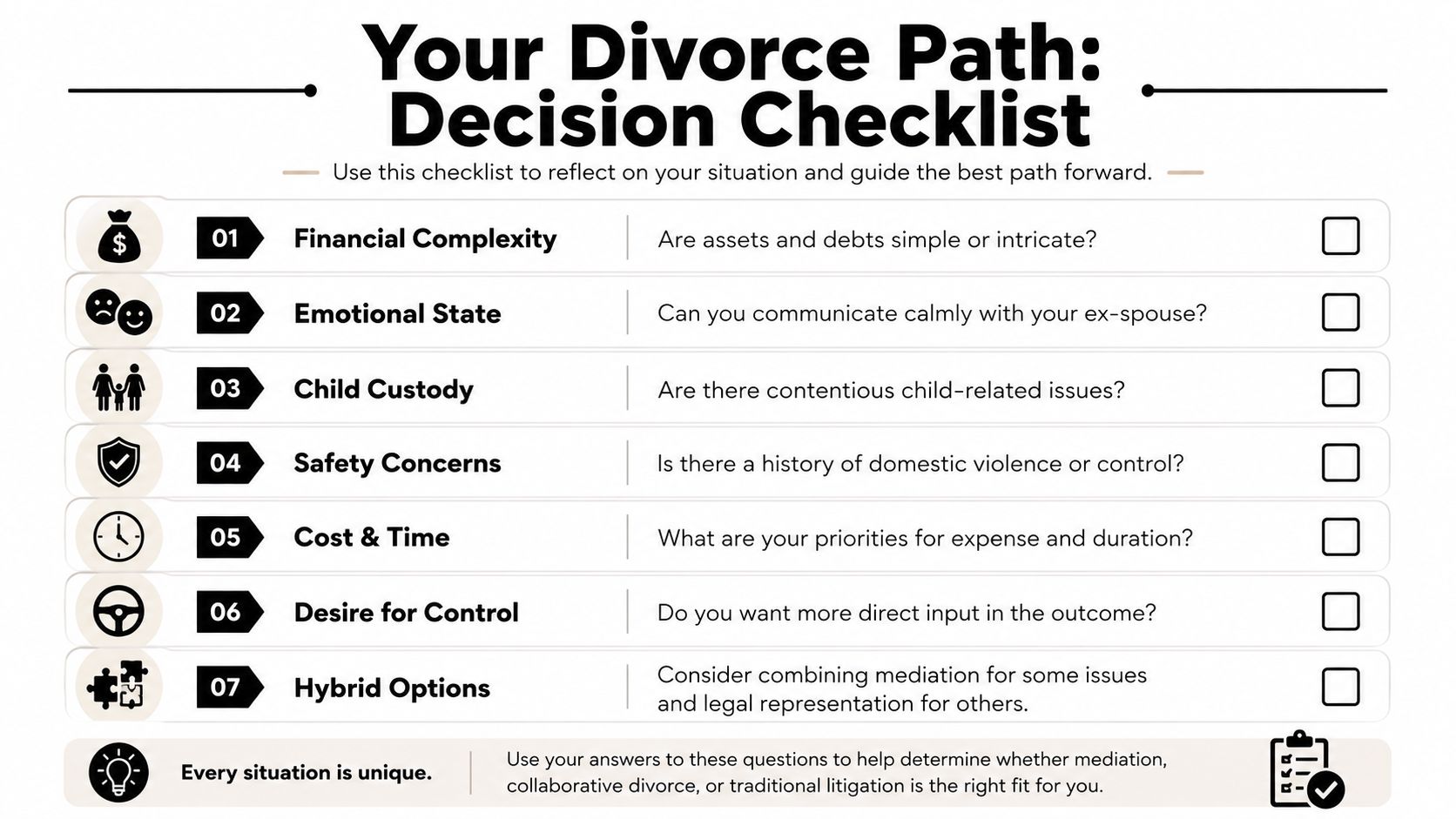
A Texas divorce often turns on a few practical questions. The answers usually point you toward a lawyer, a mediator, or a mix of both.
- Financial Complexity: Are your assets and debts simple, or do you have business interests, retirement accounts, or property that is hard to value?
- Emotional State: Can you and your spouse talk without every conversation turning hostile?
- Child Custody: Are there serious disputes about parenting time, decision-making, or safety?
- Safety Concerns: Is there any history of control, threats, or abuse?
- Cost and Time: Is your priority a faster resolution, a more protective process, or both?
- Desire for Control: Do you want direct input on the outcome, or do you need a lawyer to press your position?
- Hybrid Options: Could mediation handle some issues while lawyers handle the most sensitive ones?
These questions matter because Texas family law does not treat every divorce the same way. A case with children may call for a detailed conservatorship plan. A case with a business may require a closer look at valuation, tax consequences, and the division of community and separate property. A case with safety concerns may call for a more protective process from the start.
Hybrid paths are common in real Texas divorces. Some spouses use collaborative divorce, which keeps the focus on settlement instead of trial. Others let a mediator help them reach agreement, then have a lawyer review the Mediated Settlement Agreement before anyone signs. That approach can add a layer of legal protection without turning the entire case into courtroom combat.
If you are comparing your next step, start with the facts on the ground, not the label. If the main concern is a fair parenting arrangement and open communication still exists, mediation may fit. If there is a business to divide, complicated property to sort out, or pressure in the relationship, a lawyer may need to take the lead. Many Texas families need both, just at different points in the process.
For a more personal view of your options, the Law Office of Bryan Fagan, PLLC helps Texas families with divorce, custody, property division, mediation, and related estate planning concerns. A free consultation can help you decide whether a lawyer, a mediator, or a hybrid approach fits your family situation.


