 Skip to content
You're staring at a divorce decision that can change your money, your kids' routine, and where you live next month. One spouse wants to “keep it simple” with mediation. The other says they need a lawyer before they sign anything. That split is normal, and in Texas it often means the answer isn't mediator or divorce attorney, it's knowing when to use one, the other, or both.
| Factor | Mediation | Divorce Attorney |
|---|---|---|
| Decision model | Neutral facilitator helps spouses reach their own agreement | One lawyer advocates for one spouse's interests |
| Advice | No legal advice from the mediator | Legal advice, strategy, and client-only advocacy |
| Cost profile | Usually lower | Usually higher, especially in contested cases |
| Time | Often faster | Often slower when court is involved |
| Control | Spouses keep control of the outcome | A judge may end up deciding disputed issues |
| Best fit | Cooperative, informed spouses | Conflict, complexity, or protection needs |
When Divorce Feels Overwhelming in Texas
A lot of people make this decision at the kitchen table, after the kids are asleep, with a phone in one hand and a stack of bills in the other. They know they need help, but they don't know whether to call a mediator first or sit down with a divorce attorney first. That confusion is not a weakness. It's what divorce feels like when your life is still moving and the paperwork hasn't caught up.
What matters right now is not picking the “right” label. It's figuring out which path fits your facts, what it will cost, how long it will take, and whether the final paperwork will hold up when somebody tries to enforce it later.
In Texas, that choice gets sharper because the law rewards clarity. Property division, child custody, support, and settlement language all need to be handled carefully if you want the agreement to stick. A free triage call with a Texas family law team can save you from starting in the wrong place and paying for it twice.
If you're in that spot, take a breath. You do not need to solve the whole case tonight. You just need to identify whether your matter is simple enough for mediation, serious enough for a lawyer, or messy enough to use both.
What Mediation and Divorce Representation Actually Mean
The structural difference that changes everything
Mediation is a 1-neutral-facilitator model. A mediator helps spouses talk through property, support, and parenting issues, but the mediator does not represent either side and cannot give legal advice. A divorce attorney is a 2-advocate model, one lawyer for one spouse, with a duty to protect that client's interests and no one else's.
That structural difference matters more than many realize. In mediation, you and your spouse make the deal. In attorney-led divorce, your lawyer advises you on advantages, risk, and legal rights, then negotiates or litigates on your behalf.
Texas law treats mediated settlement agreements seriously. Under Tex. Fam. Code § 6.602, a properly executed mediated agreement can become binding, which is why the language matters so much before anyone signs. If you want a deeper look at the process itself, how mediation works is a useful starting point.
Practical rule: If you need legal advice before you sign, you need counsel. A mediator can help you reach agreement, but a mediator cannot tell you whether the agreement is smart for you.
What each professional can and cannot do
A mediator can organize the conversation, keep the process moving, and help both sides narrow disputes. A mediator cannot pick a side, force a result, or step into the role of advocate. That makes mediation useful when both spouses are basically operating in good faith and understand the issues well enough to negotiate.
A divorce attorney can do the opposite. Your lawyer can advise you on Texas property division, child-related issues, and settlement risk, then push for terms that protect you. That is especially important when the other side has more information, more money, or more experience negotiating.
For readers also thinking about property planning before or after marriage, Prenuptial & Postnuptial Agreements can matter because drafting and review of marital property agreements often shape what's on the table in a divorce.
Cost, Time, and Control Side by Side
If you want the blunt answer, mediation is usually the cheaper and faster path, while attorney-driven divorce usually costs more and takes longer because court becomes part of the process. Independent legal guidance estimates mediated divorces at 3–6 months and 2–5 sessions, compared with 18 months to 3 years for lawyer-driven divorce, with mediation commonly around $3,000–$10,000 total or $150–$800/hour, and attorney-driven cases often starting at $10,000+ per spouse and rising to $15,000–$50,000+ per spouse in complex matters. Those figures come from neutral legal resources, and they line up with how most Texas families experience the process in real life. See the cost and timing overview in Nolo's divorce lawyer or mediator guide.
The part families miss
Cost is not just the invoice. It is also the cost of repeated drafts, extra expert help, and the emotional drain that comes from letting a dispute linger.
Mediation's strength is control. You and your spouse decide the terms, which means you can trade issues creatively. Attorney-led litigation shifts control toward the judge, which can be the right move when the other side will not be fair, but it removes a lot of flexibility.
Bottom line: mediation gives spouses control of the outcome, while litigation hands that control to a judge.
| Factor | Mediation | Divorce Attorney |
|---|---|---|
| Cost | Often lower, sometimes much lower | Usually higher |
| Time to finish | Often faster | Usually slower when contested |
| Control | Spouses control the deal | Judge may decide unresolved issues |
| Privacy | More private than court | More exposure once litigation escalates |
| Enforceability | Strong when the agreement is drafted correctly | Strong, but often arrives through court orders and contested process |
What Texas spouses should focus on
A cheap agreement that later collapses is not a bargain. A slower case that protects you from a lopsided property division may be worth every extra hour.
The main question is not whether mediation is “better.” It is whether the facts of your case make it efficient enough, safe enough, and informed enough to use without giving away bargaining power you needed to keep.
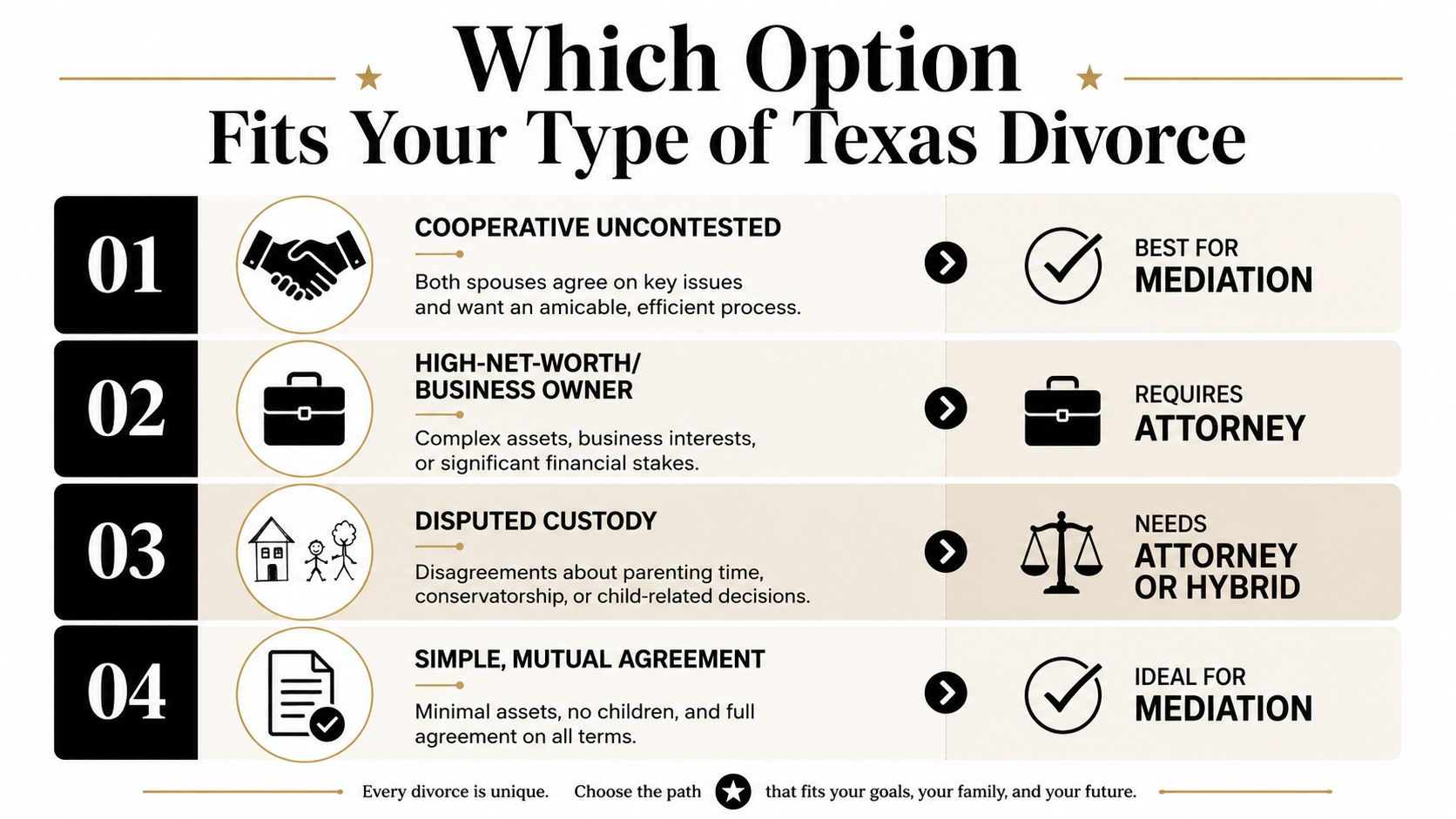
Which Option Fits Your Type of Texas Divorce
A cooperative divorce is usually a mediation case. If the marriage is short, the property is straightforward, and both spouses can talk without drama, mediation often gets you to a clean settlement with less expense and less heat. That is where mediation does its best work, because the spouses already agree on the outcome in broad strokes and just need help turning that into paper.
A high-asset or business-owner divorce is different. When a family business, retirement assets, real estate, or other complex property is involved, the danger is not just conflict, it's an uneven settlement caused by incomplete valuation or poor drafting. That is attorney territory, and in many cases the smarter move is attorney guidance first, mediation second.
Custody disputes and military family issues
Custody cases can go either way depending on safety and cooperation. If both parents can build a parenting plan in good faith, mediation can work well. If there is a dispute over possession schedules, relocation, or anything that touches safety, attorney advocacy becomes the safer path because children's schedules and legal rights cannot be treated casually.
Military families face another layer of complexity. Deployment, benefits, and the Servicemembers Civil Relief Act can change timing and strategy, so those cases usually benefit from attorney guidance rather than a pure mediation-only approach.
A video overview can help you think through the decision in a structured way.
| Texas divorce type | Better fit | Why |
|---|---|---|
| Cooperative uncontested | Mediation | Lower conflict, faster settlement, fewer moving parts |
| High-net-worth or business-owner | Attorney first, then possibly mediation | Valuation and drafting need protection |
| Disputed custody | Attorney or hybrid | Parenting risk needs legal advocacy |
| Simple mutual agreement | Mediation | Efficient if both sides are informed and honest |
When people ask me which path fits, I usually start with this question. Are you trying to preserve an agreement, or are you trying to defend yourself against one that might already be unfair? That answer points you in the right direction faster than any label does.
You can also compare this with collaborative divorce versus mediation if you're deciding between private settlement tools.
When Mediation Plus a Consulting Attorney Beats Either Alone
A lot of Texas families don't need a courtroom battle, but they also don't need to walk into mediation blind. That middle path is often the smartest one. Mediation can keep the cost down, while a consulting attorney makes sure the spouse with less information does not get pushed into a bad deal.

The cases where mediation should slow down
Mediation is not recommended when there is domestic violence, coercion, or a significant power imbalance. That includes a spouse who controls the money, a spouse who is intimidated easily, or a spouse who does not understand the legal and financial issues well enough to negotiate on equal footing. In those cases, a consulting lawyer can restore balance without turning the entire case into a war.
A mediated draft also is not the finish line by itself. Under Tex. Fam. Code § 6.602, the agreement still needs to be handled correctly, and independent legal review is often the difference between a clean settlement and a future fight over what the document means.
A plain example
Say a wife doesn't control the accounts and has never handled the family finances. Her husband is calm, but he has all the numbers and all the terminology. She may still use mediation to avoid courtroom expense, but she should have her own attorney review the proposed deal before she signs.
That hybrid approach is often the safest answer. Mediation does the heavy lifting on compromise, and the attorney keeps the settlement from becoming one-sided.
If you're still sorting out whom to hire, a practical guide on how to find a specialist lawyer can help you decide what kind of support you need before you sit down at the table.
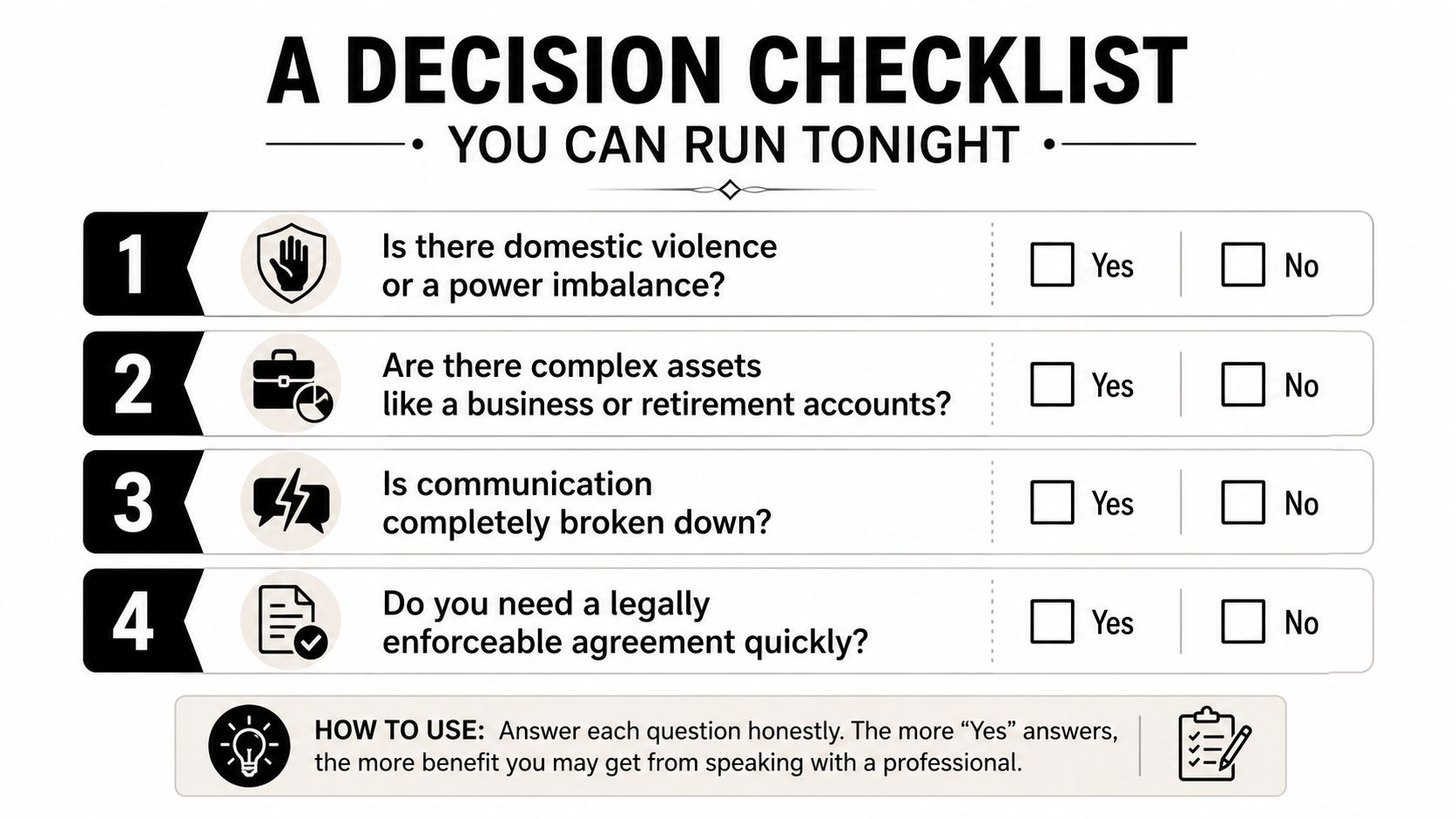
A Decision Checklist You Can Run Tonight
Start with the safety question. If there's domestic violence, intimidation, or a clear power imbalance, mediation alone is the wrong starting point. Get a divorce attorney involved first.
Then ask whether both spouses have full financial disclosure. If one side controls the books, hides information, or keeps changing the story, attorney representation is the better move. Mediation works best when the facts are on the table.
Next, look at the assets.
- Complex property or business ownership: If you're dividing a business, retirement accounts, or real estate, lean toward attorney guidance, even if mediation comes later.
- Children and a contested parenting plan: If you can't agree on possession, school decisions, or relocation, a lawyer should help shape the strategy.
- Communication breakdown: If every conversation turns into a fight, mediation may still work later, but not before legal advice resets the ground rules.
- Need for a fast, enforceable result: If timing matters and you want the agreement locked down correctly, use a lawyer or a hybrid approach so the paperwork is drafted with enforcement in mind.
A good next step is simple. If the case is straightforward, schedule a mediation intake with a Texas-credentialed mediator. If any of the red flags are present, request a free consultation with a Texas divorce attorney before you sit down at the table.
Texas Questions Families Ask Before They Choose
A mediated agreement can be legally binding in Texas when it's handled correctly under Tex. Fam. Code § 6.602. That's why the drafting matters so much. If the language is sloppy, the agreement can create the next fight instead of ending the current one.
If domestic violence is part of the relationship history, do not treat mediation as the default. Safety comes first, and a Texas divorce attorney should evaluate whether mediation is appropriate at all.
Military families need special attention because deployment, benefits, and federal protections can affect timing and strategy. A lawyer who understands those issues can help you avoid a settlement that ignores service-related realities.
Texas courts can modify a divorce decree or parenting order later if circumstances materially change, but modification is not a casual fix. It usually takes more than regret or second thoughts. If you think your parenting plan or support order will need future changes, plan the first agreement carefully so you are not back in court unnecessarily.
Talk Through Your Options With a Texas Family Law Attorney
The right choice depends on the marriage, the assets, and the children, not on slogans about mediation being cheaper or lawyers being tougher. If you're still uncertain, that's the moment to get real legal guidance and stop guessing. A Texas family law attorney can tell you whether mediation, representation, or a hybrid path fits your situation.
If you want a deeper look at what to ask before hiring counsel, how to choose a family law attorney is a good place to start. The Law Office of Bryan Fagan, PLLC serves families across Texas with divorce, custody, mediation, and estate planning guidance, and a free consultation can help you triage the next step before you sign anything.
If you need help deciding between mediation and a divorce attorney, the Law Office of Bryan Fagan, PLLC can review your facts, explain the risks, and help you choose the path that fits your case. Visit Law Office of Bryan Fagan, PLLC to schedule a free consultation and get clear next steps for your divorce, custody, or property concerns.


