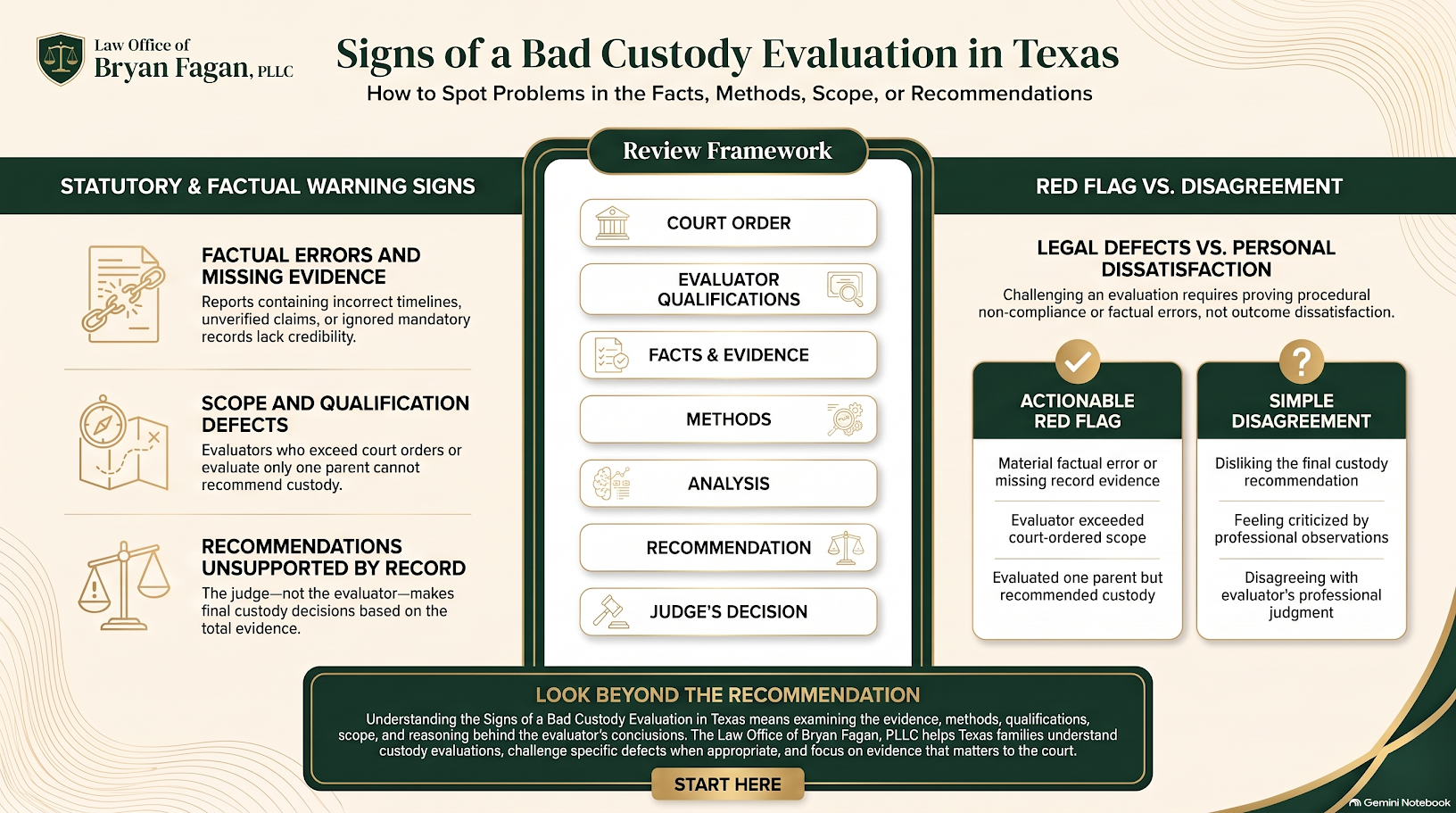

A custody evaluation report can feel final the moment it arrives, especially when the recommendation touches the parts of your child’s life you worry about most: where they sleep, how they get to school, whether homework gets done, and whether the stress of divorce is starting to show up in their grades or behavior. It is not final; the court decides. But some evaluations do have real problems, and Texas law gives parents specific things to check. This guide explains the Signs of a Bad Custody Evaluation in Texas and how those warning signs may connect to a child’s academic stability, emotional health, and daily routine.
At The Law Office of Bryan Fagan, PLLC, our mission is educating families and protecting futures. Led by Bryan Joseph Fagan, a South Texas College of Law graduate and recognized authority on Texas divorce and custody law, our Houston-based family law firm helps parents make sense of complex custody issues with compassion, clarity, and practical legal guidance. Under Texas Family Code §153.002, the child’s best interest is the court’s primary concern, and that includes the child’s real life: school attendance, routines, records, counseling needs, and the stability each parent can provide.
This article will help you understand which custody-evaluation concerns may be statutory compliance problems, which concerns may go to the weight of the evidence, and why a disappointing recommendation, by itself, is not enough. If you are worried that an evaluation missed something important about your child’s school life or emotional well-being, the goal here is to help you slow the moment down, identify what can actually be checked, and move forward with greater peace of mind.
Key Takeaways
- Ten signs, each checkable. Every sign on this page points to something in the court’s order, the evaluator’s disclosures or the report.
- Two kinds of problem. Eight signs concern specific Chapter 107 requirements; two concern accuracy and support, which go to weight.
- Disagreement alone is not a sign. A recommendation can be unwelcome and still follow every statutory requirement.
- The court decides. Whether an evaluator is qualified, and how much weight an evaluation receives, are questions for the court.
- Bring paper, not impressions. The order, the report and any disclosures are what your attorney needs to assess a concern.
Quick Answer
A custody evaluation has a real problem when it misses a specific Texas requirement you can check, or when its facts or reasoning do not hold up. The checkable problems involve the evaluator’s qualifications, required disclosures, required elements, testing and what the report must state. A recommendation you disagree with is not, by itself, one of them. The court decides what follows.
The 10 Signs at a Glance
Each row is one sign. The last row is not a sign; it is listed so the difference is clear.
| # | Sign | What to check | Authority | Where it goes next |
|---|---|---|---|---|
| 1 | The evaluator’s qualifications do not match the statute | The report’s name, license number and qualification statement | §§107.103(d), 107.105, 107.108(h) | Evaluator-qualifications page |
| 2 | A conflict or prior knowledge was not disclosed | Disclosures before and after appointment; any earlier professional work with your family | §107.107 | Challenge page |
| 3 | The evaluator discussed the case with one side’s lawyer and did not disclose it | Disclosures of substantive communications to each attorney of record | §107.108(d) | Challenge page |
| 4 | A required element is missing and the report does not explain why | The order’s element list against the report | §§107.103(c), 107.109 | Challenge page; process guide |
| 5 | An evaluator who evaluated only one side recommends custody or visitation | Whether both parties were evaluated | §107.108(f) | Challenge page |
| 6 | Testing was done by someone not qualified for those tests | Who administered and interpreted any psychometric tests | §107.110 | Psychological-evaluation page |
| 7 | The report does not state its basis or its limits | A statement of the basis for the conclusions and how the information limits them | §107.108(f) | Report page |
| 8 | The report gets facts about your family wrong | Factual statements against your records and documents | Weight; Tex. R. Evid. 104(e) | Challenge page |
| 9 | The conclusions go further than the information described | Findings next to the recommendation | Weight; Tex. R. Evid. 104(e) | Challenge page |
| 10 | The report does not show where its facts came from | Notes on the sources of verification and information | §107.108(e) | Report page |
| — | A disappointing recommendation, by itself | Whether anything above also applies | Not a sign | Your attorney; weight is for the court |
What Are the Signs of a Bad Custody Evaluation in Texas?

Signs of a Bad Custody Evaluation in Texas usually begin with something specific you can check: the court’s order, the evaluator’s disclosures, the report’s required statements, or the facts used to support the recommendation. Texas Family Code Chapter 107 governs court-ordered child custody evaluations, including who may conduct them, what must be disclosed, which elements must be completed, and what the report must state.
1. The evaluator’s qualifications do not match the statute
One important warning sign is that the evaluator’s qualifications do not match the statute. Texas Family Code §107.108(h) requires the report to identify each evaluator who conducted any part of the evaluation, provide the evaluator’s license number, and state that the evaluator has read and meets the requirements of §107.104 or was appointed under §107.106. If that information is missing, incomplete, or does not fit the evaluator’s stated role, it is worth reviewing carefully.
Texas Family Code §107.103(d) generally requires each person who conducts a custody evaluation to be qualified under §107.104, unless a limited exception applies. Section 107.105 also makes clear that the court decides whether the evaluator’s qualifications satisfy Chapter 107. For a deeper breakdown of the statutory paths, see our guide to Child Custody Evaluator Qualifications Texas.
2. A conflict or prior knowledge was not disclosed
Look at what the evaluator disclosed, and when. Before accepting an appointment, Section 107.107(a) requires the evaluator to disclose to the court, each attorney for a party, any attorney for the child and any unrepresented party any conflict of interest with a party or the child, any previous knowledge of a party or the child (other than from a court-ordered evaluation), and any pecuniary relationship or relationship of confidence or trust with an attorney in the suit.
After appointment, Section 107.107(c) requires immediate disclosure of a newly discovered conflict or previous knowledge. Section 107.107(f) separately bars appointing an individual who has worked in a professional capacity with a party, the child or an involved family member, with narrow exceptions for a group parenting-skills teacher and a previous evaluator, who must notify the court and each represented party’s attorney, or the party if unrepresented. If you learn of a covered relationship that was never disclosed, note how and when you learned it.
Parents may describe unequal treatment as evaluator bias, but the more reliable starting point is the specific relationships, prior knowledge, conflicts and disclosures addressed by Section 107.107.
3. The evaluator discussed the case with one side’s lawyer and did not disclose it
Ask whether any substantive conversation with a party’s lawyer was disclosed. Section 107.108(d) requires the evaluator to disclose to each attorney of record any communication regarding a substantive issue between the evaluator and an attorney of record representing a party in a contested suit. The rule does not apply to communications with an attorney ad litem or amicus attorney.
4. A required element is missing and the report does not explain why

A custody evaluation may have a serious problem if the court ordered specific evaluation elements and the report does not show that those elements were completed or explain why they were not. This is one of the practical Signs of a Bad Custody Evaluation in Texas because Texas Family Code §107.103(c) generally requires the appointment order to list the basic elements of the evaluation and any additional elements the court requires.
Under Texas Family Code §107.109, basic elements can include personal interviews of the parties, interviews and observations of the child, collateral records, and an assessment of each parent-child relationship. The court may also order additional steps, such as an evaluation of each party’s residence. In plain English, the evaluator should not skip a required part of the evaluation and then offer a custody opinion as if nothing is missing.
The key is whether the report identifies the missing element and explains the effect of that missing information. Section 107.109(b) requires the report to state which element was not completed, why it was not completed, and how that affects the evaluator’s confidence in the opinion. A missing element that is clearly explained is different from one that simply disappears from the report.
Parents should also compare the report to the specific questions listed in the appointment order. Section 107.103(c) requires the order to state the issues or questions the evaluation must address, and §107.113(a) requires the report to answer the court’s specific questions. For more background on how custody evaluations work and what parents should prepare for, see our guide on mastering custody evaluations for preferred outcomes.
5. An evaluator who evaluated only one side recommends custody or visitation
Check whether both sides were evaluated. Under Section 107.108(f), an evaluator who has evaluated only one side of a contested suit must refrain from recommending conservatorship, possession or access. That evaluator may still state whether information about a party indicates concerns for the child’s safety, the party’s parenting skills or capability, the party’s relationship with the child, or the party’s mental health.
6. Testing was done by someone not qualified for those tests
If the report describes psychometric testing, check who administered and interpreted it. Section 107.110(a) permits testing only if the court ordered it or the evaluator determined it necessary, and only by an evaluator appropriately licensed and trained to administer and interpret the specific tests selected and trained in their specialized forensic application. Under Section 107.110(d), an evaluator without that training may designate a licensed psychologist to conduct the testing. Separately ordered psychological examinations are covered on our page about psychological evaluations in custody cases.
7. The report does not state its basis or its limits
Look for a statement of the basis and the limits. Section 107.108(f) requires the report to state the basis for the evaluator’s conclusions or recommendations and the extent to which the information obtained limits the reliability and validity of the opinion, conclusions and recommendations.
8. The report gets facts about your family wrong
Compare the report’s factual statements with your own records. Dates, events, school and medical history, and who said what can be checked against documents you already have. A factual error is an accuracy problem rather than a missing statutory step; whether it matters, and how much, is for the court.
9. The conclusions go further than the information described
Read the findings next to the recommendation. If a recommendation depends on facts the report never describes, or the described information points somewhere else, note the gap and the page where it appears. Like a factual error, an unsupported conclusion is a question about how much weight the evaluation deserves.
10. The report does not show where its facts came from
Check whether the report notes its sources. Section 107.108(e) requires the evaluator, to the extent possible, to verify each statement of fact pertinent to the evaluation and to note the sources of verification and information in the report. A report that states facts without any indication of where they came from is harder to test and worth flagging for your attorney.
Compliance Problems Versus Weight Problems

Not every concern with a custody evaluation creates the same legal issue. Some Signs of a Bad Custody Evaluation in Texas involve specific Chapter 107 requirements, such as qualifications, disclosures, required elements, testing, or report contents. Other concerns involve accuracy, support, or credibility, such as whether the evaluator got the facts right or relied too heavily on one parent’s version of events.
A compliance problem asks whether the evaluator did what Texas law required. A weight problem asks how much the court should rely on the evaluation after hearing the evidence. For example, a missing statutory statement may raise a different issue than a report that includes the statement but reaches a conclusion one parent believes is weak, incomplete, or unsupported.
Texas Rule of Evidence 104(e) recognizes that evidence may still be challenged for weight or credibility, even when it is admitted. In plain English, that means a parent may still question the strength of the evaluator’s opinion through records, testimony, cross-examination, or competing evidence. The court decides how those issues affect the case, and the result depends on the law, the report, and the specific record before the judge.
In re Marriage of Lynch shows why this distinction matters. The Texarkana court reviewed complaints involving child interviews, school records, health records, criminal-history information, and collateral contacts, and found no abuse of discretion in admitting the evaluator’s testimony on that record. The court treated the claimed lack of follow-up with character-reference sources as an issue for cross-examination and evidentiary weight, not automatic exclusion. That does not mean missing elements never matter; Chapter 107 and the facts of the evaluation still control. For parents preparing for the process, our guide on getting yourself ready for a home study may also help you understand why preparation, records, and daily parenting details matter.
What Is Not a Sign: Disagreement Alone
A recommendation you disagree with is not, by itself, a sign of a bad evaluation. An evaluator can follow every requirement on this page and still reach a conclusion one parent finds painful. If none of the ten signs applies, the disagreement is about the conclusion itself, and the court weighs the evaluation alongside the rest of the evidence.
What Should a Parent Do After Spotting a Sign?
Write it down and take it to your attorney. Gather the order appointing the evaluator, the report and any disclosures you received, and list each concern with the page or paragraph where it appears. Raising a concern in the case is covered on our separate page about challenging a custody evaluation, and how the evaluation works from start to finish is explained in our guide to how a Texas child custody evaluation works.
Legal Resources
Legal research note: This page was checked against Texas Family Code Sections 107.103, 107.104 through 107.110 and 107.113, and against Texas Rule of Evidence 104(e) in the official compilation effective July 2, 2026, and In re Marriage of Lynch (Tex. App.—Texarkana 2023, mem. op.). The authorities were last checked on October 1, 2026.
- Texas Family Code Chapter 107 — the official compilation published by the Texas Legislature, including Subchapter D on child custody evaluations and every Chapter 107 section cited on this page. Official text.
- In re Marriage of Lynch, No. 06-23-00001-CV (Tex. App.—Texarkana Dec. 20, 2023) (memorandum opinion) — A record-specific abuse-of-discretion decision examining asserted Section 107.109 deficiencies individually. The court distinguished complaints about investigative thoroughness affecting weight from grounds for inadmissibility, and its disposition concerned the evaluator’s testimony. Chapter 107 remains the primary authority.
- Texas Rules of Evidence (effective July 2, 2026) — the official compilation published by the Texas Judicial Branch, including Rule 104(e) on evidence relevant to weight and credibility. Official text.
Meet Kimberly P. Washington
Attorney Routing
Kimberly P. Washington
Senior Managing Attorney
Kimberly Washington has been with the Law Office of Bryan Fagan, PLLC since 2015 and provides senior legal leadership in Texas family-law matters, including divorce, child custody, and mediation. When a report raises one of these questions, sorting a compliance problem from a disagreement is where that conversation starts.
Licensed by the State Bar of Texas since 2008 · Juris Doctor, Thurgood Marshall School of Law
Conclusion:
When you are looking for the Signs of a Bad Custody Evaluation in Texas, the most important question is not simply whether the report feels unfair. The better question is whether the evaluation missed something the court needed to see, such as school stability, required Chapter 107 elements, evaluator disclosures, the source of key facts, or the limits of the evaluator’s conclusions. Once you can identify the concern clearly, you can respond with records, legal analysis, and a plan instead of reacting only to the stress of the recommendation.
In straightforward situations, a parent may need help reviewing the child custody evaluation report, gathering school records, and deciding whether the concern is a compliance issue, a factual error, or a question of evidentiary weight. In more complex custody disputes, especially those involving safety concerns, psychological testing, special education needs, substance abuse allegations, or one-sided recommendations, the strategy may need to be more detailed and trial-focused. For more background on how an evaluation may affect your custody case, see our guide on the effect of a child custody evaluation.
The Law Office of Bryan Fagan, PLLC helps Texas families understand their options, protect what matters most, and move forward with greater peace of mind. If you are unsure whether your custody evaluation has a real legal problem, a focused consultation can help you sort the legal issues from the emotional noise and decide what steps make sense for your family.
About the Author
Bryan Fagan
Founder, Law Office of Bryan Fagan, PLLC
Texas Divorce & Family Law Attorney · Licensed in Texas Since 2012
Bryan Fagan founded the Law Office of Bryan Fagan, PLLC in 2012. His work includes Texas family-law strategy, firmwide leadership, team-based case planning, and client education designed to help families understand their legal options and make informed decisions.
Juris Doctor, South Texas College of Law, 2011 · Licensed by the State Bar of Texas May 4, 2012 · Bar No. 24080889
About the Law Office of Bryan Fagan, PLLC
The Law Office of Bryan Fagan, PLLC helps Texas families understand and navigate family-law issues involving divorce, child custody, possession and access, and related matters. Founded by Bryan Fagan in 2012, the firm combines legal representation with education designed to give families clearer information about their options and the decisions ahead.
This page provides general information about warning signs parents can check in a Texas child custody evaluation. It is not legal advice, and reading it does not create an attorney-client relationship. Whether a particular evaluation has a problem, and what follows from it, is determined by the court under the governing statutes, the rules of evidence, the orders in the case and the individual facts.
Frequently Asked Questions
In Texas, ten checkable signs are: qualifications that do not match the statute, an undisclosed conflict, an undisclosed substantive conversation with one side’s lawyer, a missing and unexplained required element, a recommendation after evaluating only one side, testing by someone not qualified for those tests, no stated basis or limits, factual errors, unsupported conclusions, and no record of where facts came from.
Not by itself. A recommendation can be unwelcome and still follow every Chapter 107 requirement. The signs on this page are things you can check in the order, the disclosures and the report. If none of them applies, the disagreement is about the conclusion, and the court decides what weight the evaluation receives.
Section 107.109(b) requires the report to identify any basic or ordered element that was not completed, explain why, and explain the likely effect on the evaluator’s confidence in the opinion. An element that is missing without that explanation is sign 4; an element that is missing with it is something your attorney can weigh.
Under Section 107.108(f), an evaluator who evaluated only one side must refrain from recommending conservatorship, possession or access. The evaluator may still state whether information about that party indicates concerns for the child’s safety, parenting skills or capability, the party’s relationship with the child, or mental health.
No—not by itself. Different interview lengths may justify asking what work was completed, but time alone does not establish a statutory violation. Compare the court’s order, the required elements, the evaluator’s disclosures, and the report’s stated basis and limitations. Qualification details are covered separately in our guide to child custody evaluator qualifications in Texas.
Bring the court’s order appointing the evaluator, the report, any disclosures you received, and a short list of each concern with the page or paragraph where it appears. Your attorney can then sort compliance questions from accuracy questions and decide what, if anything, to raise in the case.