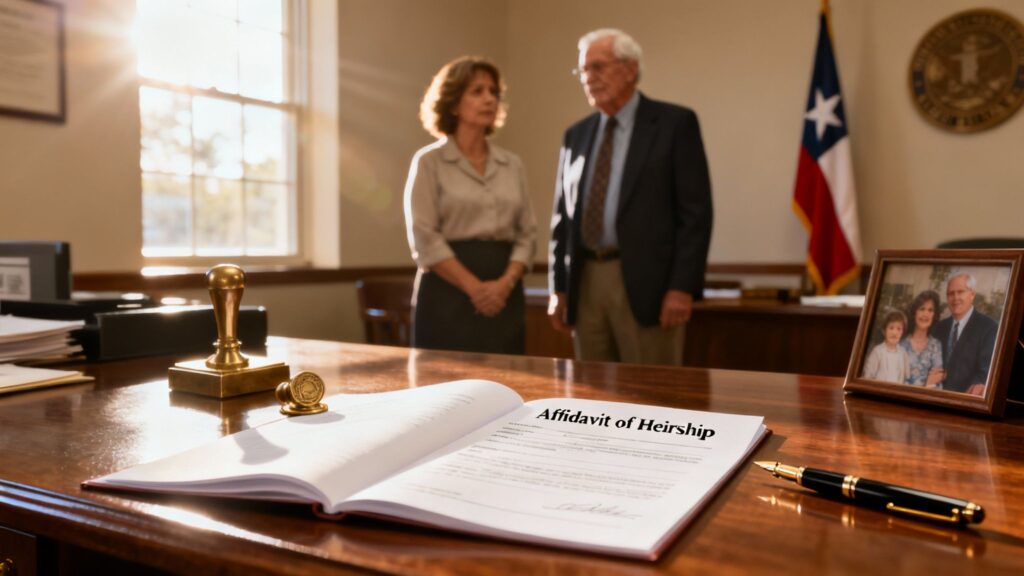
Losing a loved one is one of life’s most difficult transitions, and the last thing you want to face is a mountain of confusing legal paperwork. For many Texas families, the Affidavit of Heirship Texas form can be a lifeline, offering a way to transfer property—like the family home—when someone passes away without a will. It is a legal tool designed to sidestep the often lengthy and expensive probate court process, giving your family a clearer path forward during a deeply challenging time.
A Simpler Way to Handle Property After a Loss
When a family member dies without leaving a will, it’s legally known as dying “intestate.” This immediately raises the stressful question of what happens to their property. For many families in Texas, the biggest asset is the home they lived in. The thought of getting tangled up in a complicated court battle just to transfer the title is the last thing anyone wants to face while grieving.
Thankfully, Texas law provides a practical alternative to a full-blown probate in these exact situations.
This is where the Affidavit of Heirship comes in. It’s a sworn statement that officially identifies the deceased person’s legal heirs according to Texas’s intestacy laws (Texas Estates Code § 201.001-003). Instead of going through the courts, this document is simply filed in the real property records of the county where the home is located.
It’s an especially supportive solution when:
- The person who passed away didn’t have a will.
- The main asset they left behind is real estate.
- All the legal heirs are on the same page about what should happen to the property.
How It Works Legally
While this tool is meant to simplify things, it still operates within a specific legal framework. The Texas Estates Code provisions state that a properly completed and recorded Affidavit of Heirship becomes prima facie evidence—meaning it’s accepted as fact unless proven otherwise—after it has been on file for five years.
The process is also much less expensive than probate. Filing fees are usually just $50 to $75 per county. But it’s important to know its limitations. Some banks or title companies might be hesitant to accept it on its own, sometimes requiring more legal steps before they’ll fully recognize the title transfer.
Think of this affidavit as a roadmap for your family. It tells the world who the rightful heirs are according to the law. It’s a way to settle your loved one’s affairs with clarity and dignity, helping you avoid unnecessary legal fights when your family is already hurting.
By creating a clean, public record of who the heirs are, the affidavit helps families manage a loved one’s final business with less friction. It brings a sense of order to a chaotic time, letting you focus on what truly matters: supporting each other.
Determining If an Affidavit of Heirship Is Right for Your Family
Before you start tracking down documents and calling potential witnesses, it’s absolutely critical to figure out if an Affidavit of Heirship is the right legal path for your family. It’s a powerful tool in the right circumstances, but it is definitely not a one-size-fits-all solution.
Making the right choice at this stage can save you a world of time, money, and heartache down the road. This affidavit was designed for very specific situations, and the first—and most important—step is confirming that yours qualifies.
At its core, the affidavit’s purpose is to create a clear, public record of who the heirs are when there’s no will. It essentially announces to the county, and the world, who stands to inherit according to Texas law. This is what allows for the transfer of real property, like a house or land, without having to go through a formal probate court process.
When Is an Affidavit of Heirship the Best Option?
This legal document really shines under a specific set of circumstances. If your family’s situation lines up with the following points, there’s a good chance an Affidavit of Heirship is a strong contender for settling your loved one’s estate.
It is typically the right choice when:
- The Decedent Died Without a Will: This is the absolute deal-breaker. The affidavit exists to establish heirs in the absence of a will. If a will exists, it must be probated in court. No exceptions.
- The Estate Primarily Consists of Real Property: The affidavit is most effective for transferring the title to real estate. While it can sometimes be used for simple assets like a car, its main job is to clear the title on a home or piece of land.
- All Heirs Are in Agreement: Every single legal heir must be on the same page about what to do with the property. Any disagreement can completely derail the process and might force the whole matter into probate court for a judge to sort out.
- The Estate Has No Unsecured Debts: This process doesn’t deal with creditors. If the estate owes money to credit card companies or has other unsecured debts, those bills need to be settled. An affidavit isn’t the right tool if there are financial obligations that need to be managed by an administrator.
For example, imagine a mother passes away without a will, and her only major asset is the family home. She leaves behind three adult children who all agree they want to sell the house and split the proceeds. There are no outstanding debts to worry about. In a case like this, using an affidavit of heirship texas form is a perfect fit. It’s efficient, saves on court costs, and helps them reach their goal directly.
Situations Where an Affidavit of Heirship Is Unsuitable
Just as important as knowing when to use this affidavit is knowing when not to. Trying to force it in the wrong context can lead to serious legal headaches and rejections from banks or title companies.
An Affidavit of Heirship is not the right tool if there is any ambiguity or conflict. Its strength lies in its simplicity for clear-cut situations. If your family’s circumstances are complex, forcing this solution can create more problems than it solves.
This tool is generally unsuitable if:
- An Heir Is a Minor: Minors can’t legally sign contracts or affidavits. If one of the heirs is under 18, a formal guardianship proceeding may be required to protect their interests, which means going to court.
- The Heirs Cannot Be Located: The affidavit demands a complete list of all heirs. If someone can’t be found, you can’t proceed, because their legal rights must be accounted for.
- The Decedent Had Significant Debts: As mentioned, this process doesn’t address creditors. An estate with complex debts needs a formal administration to make sure all creditors are properly notified and paid according to the law.
- The Estate Contains Complex Assets: If the estate includes things like stocks, bonds, or large bank accounts, those institutions will almost certainly require Letters Testamentary from a probate court before they transfer anything. An affidavit simply won’t be sufficient.
Understanding these distinctions is crucial. At The Law Office of Bryan Fagan, PLLC, we help families evaluate their unique circumstances to choose the most compassionate and effective legal path forward.
Gathering The Essential Information And Documents
The strength of an Affidavit of Heirship lies entirely in its accuracy and completeness. Think of it like building the foundation for a house—if one piece of information is wrong or missing, the whole structure can become unstable later.
Before you even touch a template or start drafting, your most important job is to meticulously gather all the necessary facts. We’ve seen families have to start this process all over again because they rushed this stage. A single overlooked heir or an incorrect property description can invalidate the entire affidavit. Taking your time now will save you an incredible amount of stress and potential legal headaches down the road.
The Decedent’s Personal And Marital History
First things first, you need to collect the key details about the person who passed away (the “decedent”). This isn’t just a formality; it establishes the core identity and legal standing of the person whose estate is in question.
You’ll need to confirm their full legal name as it appears on official documents, plus any other names or aliases they used. You also need the exact date and place of death—a certified copy of the death certificate is your best source for this.
Finally, you must assemble a complete marital history. This means listing every single marriage the decedent had. For each one, you need the spouse’s name, the date of the marriage, and exactly how it ended (divorce, annulment, or death of the spouse). This is absolutely critical because former spouses might have inheritance rights depending on the situation.
Building A Comprehensive Family Tree
This next part is often the most challenging, but it’s the heart of the affidavit. You must identify all legal heirs, which requires building a detailed family tree that leaves no stone unturned. An incomplete list is a fatal flaw.
You’ll need to identify:
- All Children: List every child, whether born inside or outside of a marriage, or legally adopted. For each, you need their full name, birth date, and current address. If a child has passed away, you must note their date of death and then identify their children (the decedent’s grandchildren), as they may be next in the line of inheritance.
- Parents: If the decedent had no children, the line of heirship moves up to their parents. You’ll need to identify the decedent’s mother and father.
- Siblings: If the decedent’s parents are also deceased, you must list all of the decedent’s siblings (full and half-siblings). Just as with children, if any sibling has passed away, you must then track down their children (the decedent’s nieces and nephews).
Before you fill out a single line on the form, you need a complete picture of the family and property details. To make sure you don’t miss anything, we’ve put together a checklist of the essential information you’ll need to collect.
Essential Information For Your Affidavit Of Heirship
| Information Category | Specific Details Required | Where to Find It |
|---|---|---|
| Decedent’s Information | Full legal name & aliases, date/place of death, Social Security number. | Death certificate, driver’s license, Social Security records. |
| Marital History | List of all marriages, spouse names, marriage/divorce dates, how each marriage ended. | Marriage certificates, divorce decrees, death certificates of former spouses. |
| Family – Children | Full names, birth dates, and current addresses of all children (living or deceased). | Birth certificates, family Bibles, personal records. |
| Family – Grandchildren | If a child is deceased, list all of their children (the decedent’s grandchildren). | Birth certificates of grandchildren, information from the deceased child’s family. |
| Family – Parents/Siblings | If no children, list parents and/or siblings (and their children if they are deceased). | Decedent’s birth certificate, public records, family interviews. |
| Witness Information | Names and contact information for two disinterested witnesses with personal knowledge. | Family friends, long-time neighbors, colleagues (not heirs). |
| Property Details | Full legal description of the real estate, not just the street address. | Property deed, county appraisal district website, property tax records. |
| Decedent’s Debts | A list of all known debts and liabilities of the estate. | Bank statements, credit card bills, mortgage documents. |
Having all of this information organized and verified ahead of time will make the process of actually completing the affidavit much smoother and more reliable.
Securing Accurate Property Details
Finally, let’s talk about the property itself. A simple street address won’t cut it for a legal document like this.
You absolutely must have the full legal description of the property. This is the official description used in deeds and other legal filings to uniquely identify a specific parcel of land.
You can usually find this information on:
- The original deed to the property
- The county appraisal district’s website
- The most recent property tax records
Using the exact legal description is non-negotiable. It eliminates any possible confusion about which piece of real estate the affidavit is meant to transfer. While this guide focuses on the affidavit, getting familiar with general legal document templates can also help you understand how legal details like this are structured to protect the integrity of the title transfer for years to come.
Finding and Working with Disinterested Witnesses
One of the absolute must-haves for a valid affidavit of heirship Texas form is getting two disinterested witnesses to sign. This isn’t just a friendly suggestion—it’s a strict legal requirement in the Texas Estates Code, and it’s what gives the document its authority. Without two qualified witnesses, an affidavit is essentially just a piece of paper with no legal power.
So, what exactly is a “disinterested witness”? It’s someone who knew the deceased person and their family history but will not inherit anything from the estate. They cannot have any financial stake in the outcome.
This rule is there for a good reason: it prevents people from making self-serving claims and ensures the information in the affidavit is a true, unbiased account of who the heirs really are.
Who Qualifies as a Disinterested Witness
Finding the right people can feel like a tall order, especially when you’re already juggling so much after a loss. The key is to think about people who were a part of your loved one’s life but aren’t in the direct line of inheritance.
Good candidates are often right under your nose:
- Long-time family friends who were at holiday dinners and birthday parties.
- Neighbors who lived next door for years and saw the family grow.
- Close coworkers who knew the deceased well over a long period.
- Fellow church members or friends from a community group who were familiar with the family situation.
The single most important thing is that the witness has personal knowledge of the family history they’re swearing to. They need to be able to confidently confirm, under oath, details about the deceased’s marriages, children, and other family members.
The infographic below breaks down the simple process of getting these crucial witnesses on board for your affidavit.
As you can see, it’s a straightforward path: find someone suitable who won’t inherit, make sure they know the family history and are willing to help, and then complete the notarized signing where they officially affirm the facts.
Preparing Your Witnesses for the Notary
Once you have two people who have agreed to help, you need to prepare them for what’s next. This isn’t about coaching them on what to say, but making sure they understand their role and are comfortable with the process. A little preparation goes a long way toward making the signing experience smooth for everyone.
Before you all meet with the notary, take some time to sit down with each witness and go over the affidavit. Explain that they will be swearing, under penalty of perjury, that the family details in the document are true to the best of their knowledge.
A common mistake is just assuming a witness knows every last detail. It’s much better to walk them through the family tree you’ve laid out, including birth dates, marriages, divorces, and deaths. This gives them a chance to confirm everything or flag any potential errors before you’re all standing in front of the notary.
Make it clear that their signature is only to verify the family relationships—the “heirship roadmap.” They aren’t signing off on financial details or how property is divided. This simple clarification can really put a witness at ease, especially if they’re nervous about being involved in a legal document.
Finally, coordinate a time for you, all the other heirs, and both witnesses to meet a notary public together. Everyone has to sign the affidavit in the notary’s presence. Don’t forget to remind the witnesses to bring a valid photo ID, because the notary is required to verify their identity. By guiding your witnesses through these steps, you’re not only satisfying the legal requirements but also showing respect for the time and effort they’re giving to help your family.
You’ve done the hard work of tracking down all the necessary information and lining up your two disinterested witnesses. Now it’s time for the final, and most critical, stage: actually executing the affidavit. This is where all your research becomes a legally recognized document.
Getting this part right isn’t just a suggestion; it’s absolutely essential. One slip-up, and you could face frustrating delays or find the whole affidavit rejected, sending you back to square one.
This final push involves three key steps: filling out the form with precision, getting it properly notarized, and filing it with the correct county clerk. Let’s walk through each one so you can get it done right the first time.
Breaking Down the Sections of the Form
At first glance, an affidavit of heirship Texas form can look pretty intimidating. It’s filled with formal language and specific sections, but each part is there for a reason—to build a clear, legal picture of why the listed heirs are the rightful property owners.
You’ll see that the form asks for the exact information you’ve already gathered:
- Decedent’s Information: Full name, date of death, and last known address. This part officially identifies the person whose estate is in question.
- Marital and Family History: This is the heart of the affidavit. You’ll detail the decedent’s marriages, divorces, children, and any other relatives needed to satisfy Texas intestacy law. Think of it as creating the official family tree that establishes heirship.
- Identification of Heirs: Here, you’ll explicitly list every heir, their relationship to the person who passed away, and their specific share of the property according to Texas law.
- Description of Property: You need the full legal description of the real estate. There is no room for ambiguity here—it has to be exact.
- Statements from Witnesses: The form provides space for your two witnesses to swear, under oath, that the family history you’ve provided is true to the best of their personal knowledge.
It is vital that every single blank is filled out accurately. A simple mistake, like a misspelled name or a wrong date, can be enough for a title company to reject the affidavit when you try to sell the property later.
The Notarization: A Critical Moment
Signing the affidavit isn’t like signing a birthday card. It’s a formal event that absolutely must happen in the presence of a notary public. This is a non-negotiable step.
Here’s the key: All heirs and both disinterested witnesses must sign the document at the same time, together, in front of the notary. People cannot sign it on different days or in different locations.
The notary’s job is to verify the identity of every single person signing and to witness them doing it. They will not give you legal advice or double-check your facts. Their official stamp and signature simply confirm that the right people signed the document willingly.
Practical Tip: Before you all head to the notary, send a reminder to everyone—heirs and witnesses—to bring a valid, government-issued photo ID. A driver’s license or passport works perfectly. A notary cannot and will not proceed without this, and a forgotten ID will bring everything to a grinding halt.
This coordinated signing process protects the legal integrity of the document. For anyone dealing with multiple legal forms, looking into document workflow automation can provide some great insights on how to manage these multi-signature requirements more efficiently.
Filing the Affidavit With the County Clerk
With the completed and notarized affidavit in hand, you’re ready for the final step: filing it in the public record. This is what officially makes it a legal instrument that proves ownership.
You have to file the affidavit in the real property records for the county where the property is physically located. If the decedent owned land in more than one county, you will need to file a separate, original affidavit in each of those counties.
Here’s a quick rundown of what to expect:
- Find the County Clerk’s Office: Locate the correct office for the county where the property is. Most counties have websites with filing procedures, hours, and fee information.
- Pay the Filing Fee: There’s a fee to record the document. It usually runs between $25 and $75, but this can vary depending on the county and how many pages are in your affidavit.
- Get Certified Copies: Don’t leave without these. Once the affidavit is officially filed and recorded, ask the clerk for several certified copies. These are official copies with the clerk’s stamp, and you’ll need them for your records and for dealing with tax offices, utility companies, or a future buyer.
Filing the affidavit creates a clear, public chain of title. It’s the final action that solidifies the transfer of ownership from the decedent to the heirs, giving your family the legal standing to manage or sell the property.
Common Questions About the Texas Affidavit of Heirship
Even when dealing with what seems like a straightforward legal tool, it’s only natural for questions to pop up. After guiding countless Texas families through the Affidavit of Heirship process, we’ve noticed the same concerns and uncertainties tend to surface again and again. Let’s address some of those common questions to bring you some peace of mind.
Getting these things sorted out is a normal, and necessary, part of handling a loved one’s estate. Our goal here is to give you the clarity you need to move forward with confidence.
What Happens if a Bank or Title Company Rejects the Affidavit?
This is a significant concern, and it’s a scenario that can cause a lot of stress. While a properly filed Affidavit of Heirship is recognized as evidence of title under the Texas Estates Code, that doesn’t mean private institutions are required to accept it. Banks and title companies are notoriously cautious. Their biggest fear? Liability from an unknown heir who might surface down the road.
If a title company refuses to accept the affidavit before you can sell a property, they will almost certainly demand a more formal court action. This usually means a judicial determination of heirship, where a judge officially declares who the heirs are. For a title company, a court order is a guarantee they won’t get sued later.
What about a bank? If they refuse to release funds from a small account, you might need to provide more proof or look into a Small Estate Affidavit if the estate’s value (not counting the house) is under $75,000, as set by Texas Estates Code § 205.001.
Practical Tip: We strongly encourage you to call the bank or title company before you start this process. Ask them directly if they accept an Affidavit of Heirship and what, specifically, they need to see. A five-minute phone call upfront can save you weeks of frustration.
Can This Affidavit Transfer More Than Just Real Estate?
The short answer is: sometimes, but it’s not its primary purpose. The Affidavit of Heirship was designed for one main job: transferring title to real property like a house or land. For that, it’s the perfect tool when there’s no will.
For other types of assets, its effectiveness is less certain and depends on the policies of the institution holding the asset. For example:
- Vehicles: You might be able to use it to transfer a car title. However, the Texas Department of Motor Vehicles has its own forms for heirship that are usually much easier to use.
- Bank Accounts: A bank might accept it for a very small account, but there are no guarantees. For anything more than a few thousand dollars, most financial institutions will require official “letters testamentary” or “letters of administration” issued by a probate court.
This affidavit is generally not the right tool for transferring things like stocks, bonds, or significant investment accounts. If your loved one’s estate has a mix of different assets, it’s really important to talk to an attorney. They can help you understand if the affidavit is enough or if another approach makes more sense for your family.
What if We Find a Will After Filing the Affidavit?
Discovering a will after you’ve already filed an Affidavit of Heirship definitely complicates things, but it’s a fixable problem. In Texas, a valid will always takes priority over the laws of intestacy.
If you find a will within four years of the person’s death, the next step is usually to submit it to the court for probate. Once the will is probated, that legal process completely overrides the Affidavit of Heirship you filed.
This means the property will be distributed to the beneficiaries named in the will, who may or may not be the same people identified as heirs in the affidavit. The court’s orders from the probate case become the new, official record of who owns what.
If you find yourself in this situation, stop relying on the affidavit immediately and contact an experienced estate planning attorney. They’ll guide you through the steps to probate the will and correct the public record. Acting quickly is the key to preventing a simple complication from turning into a major legal headache.
If you need help navigating divorce, custody, or estate planning in Texas, contact The Law Office of Bryan Fagan today for a free consultation. Our compassionate attorneys are here to provide the clear guidance and support your family deserves. Contact us today for a free consultation to discuss your specific situation.