Skip to content
Planning for your family's future is one of the most significant and caring steps you can take. While legal documents can feel intimidating, creating a living trust is a straightforward process designed to protect your assets and provide for your loved ones with privacy and efficiency. It involves three key steps: drafting the trust document, signing it correctly, and then transferring your assets into the trust’s name—a process known as "funding." This final step is what gives the trust its power to help your family avoid the public and often lengthy probate process.
Your Guide to Securing Your Family's Future in Texas
Thinking about the future can feel overwhelming, but taking action to protect your family and your hard-earned assets is a profound act of love. This guide is designed to walk you through how to set up a living trust in Texas, breaking down complex legal concepts into clear, actionable steps so you can feel confident and prepared.

Why Consider a Living Trust
A living trust is a legal tool that holds your property for your benefit while you are alive. It allows you to maintain complete control over your assets now, while ensuring your wishes are carried out smoothly and privately after you're gone.
Unlike a will, a properly funded living trust can help your loved ones avoid the probate court process, which can be time-consuming, expensive, and public. This relieves them of a significant burden during an already difficult time. Think of it as creating a clear, private roadmap for your legacy, ensuring your family is supported exactly as you intend.
The use of trusts in wealth planning has grown significantly, and for good reason. The Trusts & Estates industry in the United States is projected to hit a market size of $290.1 billion by 2025. This isn't just a number; it shows a real shift as more people recognize the powerful benefits trusts offer, especially when it comes to privacy and control over how assets are transferred. You can explore more insights about these economic trends and their impact on estate planning.
Key advantages of a Texas living trust include:
- Avoiding Probate: Your assets can be passed to your beneficiaries without court supervision, saving everyone time and money.
- Maintaining Privacy: A will becomes a public record once it goes through probate. A trust keeps your family's financial matters private.
- Incapacity Planning: If you become unable to manage your own finances, your chosen successor trustee can step in immediately without needing court intervention, as outlined in the Texas Estates Code.
Understanding the Key People in Your Living Trust
Before diving into the process, it's important to understand the key players involved in a living trust. While the terms might sound formal, the roles are designed to work together to protect your legacy and carry out your wishes. Think of it as choosing the trusted individuals who will execute your plan.

The Core Roles in Your Trust
Let's break down the four essential roles you'll find in every Texas living trust. Understanding these positions is the first step toward creating a plan that truly reflects your goals.
The Grantor (or Settlor): This is you—the person creating the trust and placing your assets into it. With a revocable living trust, you retain 100% control over your assets during your lifetime. You can manage, buy, or sell property just as you always have.
The Trustee: This is the manager of the trust. While you are alive and well, you will almost always serve as your own Trustee. You continue to handle your finances and property without any outside interference.
The Beneficiaries: These are the people or organizations you want to receive your assets. Beneficiaries can be your children, grandchildren, a favorite charity, or anyone else you choose. You can also set specific conditions for how and when they receive their inheritance.
The Successor Trustee: This person is your trusted backup. You name a Successor Trustee to step in and manage the trust if you become incapacitated or when you pass away. They are legally bound by a fiduciary duty to follow your instructions, ensuring your assets go to the right people at the right time.
Key Takeaway: The Successor Trustee holds a position of immense responsibility. This person acts as your agent, tasked with carrying out your final wishes with integrity and care. It is essential to choose someone who is organized, trustworthy, and capable of handling financial matters.
For example, imagine you place your Houston home and a savings account into a trust. You are the Grantor and the Trustee, so you continue living in your home and using your money as usual. You name your adult son as the Successor Trustee and your two children as the Beneficiaries. If you pass away, your son seamlessly steps into the Trustee role to distribute the assets as you directed—all without the stress and expense of probate court.
To help you visualize these roles, here’s a simple breakdown:
Key Roles in a Texas Living Trust Explained
| Role | Who This Is | Primary Responsibility |
|---|---|---|
| Grantor (Settlor) | You—the person creating the trust. | Creates the trust and funds it with assets. |
| Trustee | Initially, this is also you. | Manages the trust assets during your lifetime. |
| Beneficiary | The people or charities you choose. | Receives the assets from the trust. |
| Successor Trustee | A trusted person or institution you name. | Takes over as Trustee upon your incapacity or death. |
The responsibilities of a Successor Trustee are very similar to those of an executor of a will. To better understand the legal duties involved, you might find our guide on the duties of an executor of a will in Texas helpful. It provides a clear picture of the fiduciary responsibility this person undertakes.
Bringing Your Texas Living Trust to Life
Once you understand the key roles, the next step is to create the legal document that formally establishes your living trust. This is where your intentions are put into writing, turning your plan to protect your family into a legally binding reality. This process begins with making foundational decisions that will define how your trust operates.
Making the Foundational Decisions
Before any legal language is written, it's vital to be clear on your wishes. This means taking time to think through who will carry out your instructions and who will benefit from your planning.
First, you'll need to finalize your choice for the Successor Trustee. This is the person or institution you entrust to manage everything when you no longer can. This is arguably the most critical decision in the process, as this individual or entity is taking on a serious fiduciary responsibility.
Next, you must clearly identify your beneficiaries. For many, this is as simple as naming their children. However, a trust allows for more detailed planning. For example, you might want to leave a specific heirloom to a close friend or designate a portion of your estate for a charity that is important to you.
Defining How and When Assets Are Distributed
It’s not enough to just name your beneficiaries; you also have to decide on the terms of the trust itself. This means specifying how and when your assets should be distributed. This is your opportunity to provide for your loved ones in a way that aligns with their needs and your values.
For instance, do you want your children to receive their inheritance all at once? Or would you prefer the assets be distributed in stages—for example, at certain ages—to help them manage their inheritance responsibly?
A Practical Example: Let's say you want to help your grandchild pay for college. You can include a provision in your trust that their inheritance is specifically for tuition and educational expenses. Or you could state that they will receive the funds when they turn 25 years old, an age when they might be more financially mature.
These tailored instructions are one of the most significant advantages of a trust, giving you a level of control that a simple will cannot offer.
Drafting the Official Trust Agreement
Once you've made these core decisions, it’s time to draft the official trust agreement. This is a detailed legal document that outlines every aspect of your trust, from who is in charge to the precise instructions for distributing your assets.
While DIY legal websites and templates may seem like a convenient option, they often fail to address the specific nuances of Texas law. The Texas Estates Code has clear requirements that a trust must meet to be legally valid. A small error or ambiguous phrase in a generic document can create significant legal problems, potentially invalidating your plan and forcing your family into the very probate court you sought to avoid.
This is why working with an experienced Texas estate planning attorney is so important. A knowledgeable attorney does more than just fill in a form; they draft an agreement with precise language that:
- Complies with the Texas Estates Code, ensuring all legal requirements are met.
- Accounts for "what-if" scenarios, such as what happens if a beneficiary passes away unexpectedly.
- Eliminates ambiguity by using clear, specific terms that help prevent family disputes.
- Builds a solid legal foundation that will stand up to scrutiny and ensure your wishes are carried out exactly as you planned.
An attorney provides professional counsel, helping you consider possibilities you might not have anticipated. This guidance is invaluable for creating a living trust that delivers true security and peace of mind.
Making Your Trust Do Its Job: The Critical Step of Funding
You’ve signed the papers for your new living trust. That’s a crucial step, but it’s only half the journey. The trust document itself is like an empty container. It’s well-built and ready to hold assets, but until you actually put your assets into it, it cannot protect them or help your family avoid probate.
To make your trust work as intended, you must complete the next step: funding the trust. This is the legal term for transferring the ownership of your assets from your name into the name of your trust. This action gives your trust its power. It allows your successor trustee to manage your affairs if you become incapacitated and to distribute your property to your loved ones without court intervention after you’re gone.
If this step is skipped, your assets remain legally in your name and will almost certainly have to go through probate court, defeating one of the primary purposes of setting up a trust.
Funding looks different depending on the asset:
- Real Estate: For your home or other property, this involves signing a new deed that transfers the title from "John Doe" to "The John Doe Living Trust."
- Bank Accounts: You'll work with your bank to retitle your checking and savings accounts so the trust is the new owner.
- Investment Accounts: Your non-retirement brokerage accounts are handled similarly. You will need to complete paperwork to retitle them in the trust's name.
This process is what brings your estate plan to life.
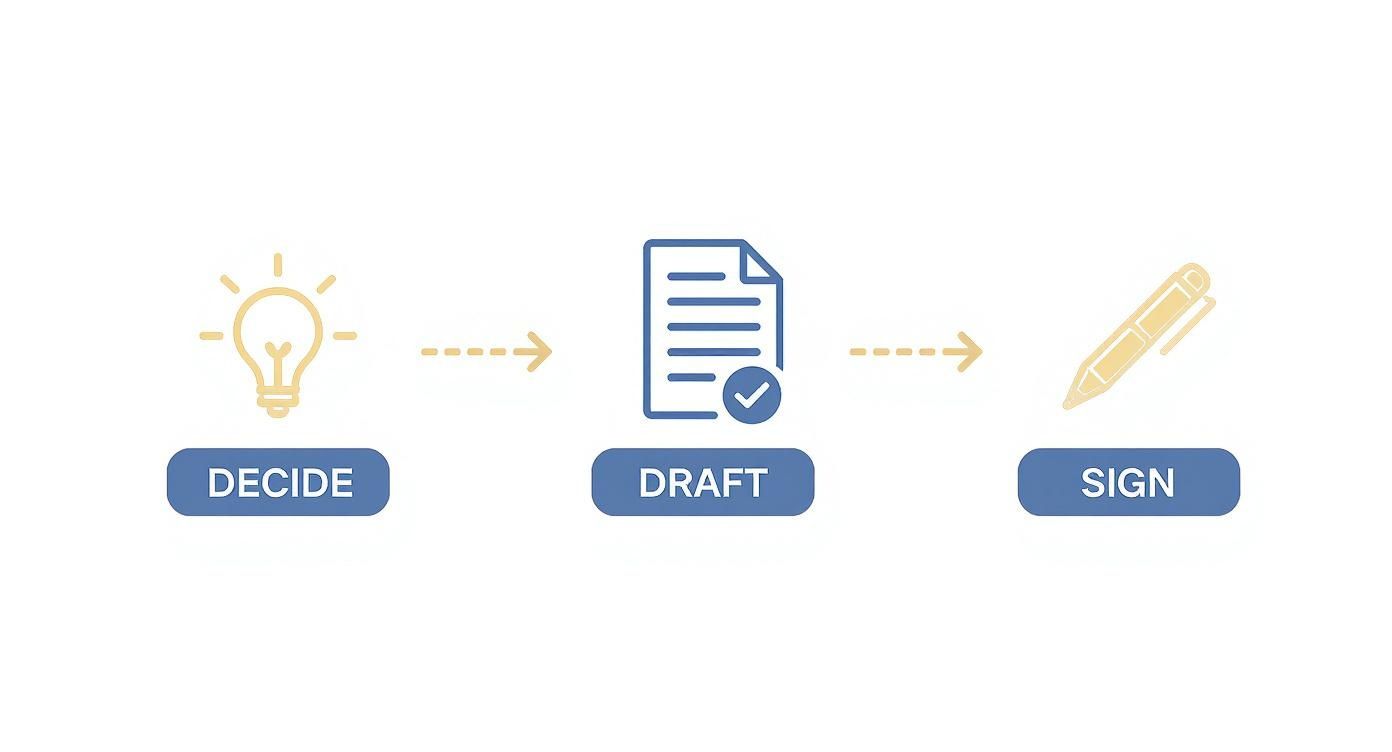
As the infographic shows, creating the trust is a clear, manageable process. But funding is the final, hands-on step that makes it all worthwhile.
Putting Funding into Practice
Let's imagine a retired couple in Fort Worth who just established "The Miller Family Trust." Their first step is to sign a new deed for their home, moving it into the trust. Then, they go to their bank to retitle their joint savings account. Finally, they contact their financial advisor to begin the process of moving their brokerage account into the name of the trust. Now, those assets are officially protected and managed by the trust.
Key Takeaway: Be very careful—not everything should go directly into your living trust. Retirement accounts like a 401(k) or IRA have special tax-deferred status and their own beneficiary rules. Attempting to retitle one of these accounts in your trust's name can be a costly mistake, potentially triggering significant tax penalties. Instead, you will typically name the trust as a primary or secondary beneficiary on the account itself.
It's surprising how many people put off estate planning. A 2025 survey found that only 13% of people have a living trust, and just 24% have a basic will. The number one reason? Procrastination. A staggering 43% of people said they "just haven't gotten around to it." If you want to dig into the numbers, you can review the full estate planning report.
Funding your trust requires focused effort and attention to detail, but it is absolutely essential. Taking the time now to properly transfer your assets is what gives your trust its legal authority and ensures your family will be taken care of exactly as you planned. It’s the ultimate peace of mind.
Keeping Your Living Trust Current Through Life's Changes
Creating your living trust is a monumental step in protecting your family, but it is a living document, not something to be set and forgotten. A trust is designed to be flexible and adapt to the inevitable changes in life. It is not a one-and-done task to be filed away.
Major life events are a signal to review your trust documents and ensure they still reflect your wishes. These moments are more common than you might think and serve as critical checkpoints for your estate plan.
When to Review and Update Your Trust
Life rarely stays the same, and your trust needs to keep up. Certain milestones should always prompt a review with your estate planning attorney to discuss whether your trust needs to be amended.
Consider these common scenarios:
- Family Changes: Marriage, divorce, or the birth of a child or grandchild are all significant reasons to update your trust. Your beneficiaries and how you plan to distribute assets will almost certainly need a fresh look.
- Asset Changes: If you sell a home and buy a new one, you must ensure the new property is correctly titled in the name of the trust. This also applies when you refinance a mortgage or open a new, substantial investment account.
- Financial Shifts: Receiving a large inheritance or experiencing any other major change in your financial situation may require adjustments to your plan.
A living trust is only as powerful as it is current. An outdated trust can create the very confusion and family disputes you were trying to prevent. A periodic review every three to five years—or immediately after any major life event—is a vital part of responsible trust ownership.
The Power of Maintenance in a Crisis
One of the most profound benefits of a well-maintained trust becomes clear during a crisis. If you become incapacitated and unable to manage your own affairs, your Successor Trustee can step in immediately. No court intervention is needed for them to pay your bills, manage your investments, or handle your financial life.
This feature allows your family to avoid a stressful, public, and often expensive guardianship proceeding—the court process required to appoint someone to manage your affairs when you haven't planned ahead. Regular maintenance ensures this safety net is always strong and ready.
More and more people are recognizing these benefits. Globally, the estate planning services market is expected to hit around US$4.74 billion in 2025 and is projected to climb to US$8.37 billion by 2031. This trend shows a growing understanding of how vital these planning tools are for families everywhere.
Finally, as you make these important updates, remember to safeguard the physical documents. Keeping your trust agreement, deeds, and other related papers in a secure yet accessible place is critical. Our team has put together practical advice on storing your estate planning documents to help you protect these vital records.
Common Questions About Texas Living Trusts
Even with a clear plan, it's natural for questions to arise as you navigate how to set up a living trust. This process is about securing your family’s future, and you deserve to feel confident in every decision. We've gathered some of the most common questions we hear from clients to provide you with the clear, direct answers you need.
Does a Living Trust Help Me Avoid Estate Taxes?
Many people are curious about the tax implications of a living trust. It's helpful to first understand the difference between a death tax vs. estate tax.
The good news? Texas does not have a state-level estate or inheritance tax. This is a significant relief for many families.
While a living trust can be structured to help minimize federal estate taxes for exceptionally large estates, that’s not its primary purpose for most Texans. The main benefit for the average family is avoiding the probate process. This is often far more valuable, saving your loved ones a significant amount of time, money, and the stress of a public court proceeding.
What If I Forget to Put an Asset Into My Living Trust?
This is an excellent question and a common concern. Life gets busy, and it's easy to overlook an asset. Any property that isn't formally titled in the name of your trust will likely have to go through probate—the very process you're trying to avoid.
To safeguard against this, an experienced attorney will draft a "pour-over will" to accompany your trust. Think of this will as a legal safety net. Its sole purpose is to "catch" any forgotten assets and "pour" them into your trust after your passing.
While the pour-over will itself must be probated, it ensures your assets ultimately end up where you intended, all managed under the single umbrella of your trust. You can learn more about what in a will goes to probate in Texas.
A living trust is a powerful tool, but its effectiveness depends on being properly funded. A pour-over will is the essential backup plan that ensures your entire estate plan works together seamlessly, even if an asset is initially overlooked.
Is a Living Trust More Expensive Than a Will?
Initially, a living trust typically has a higher upfront cost than a simple will. However, it's important to view this as an investment that can save your family a much larger sum down the road.
The costs associated with probate—including court fees, attorney fees, and administrative expenses—can add up quickly. In many cases, these costs far exceed the initial investment in creating a trust. By avoiding the probate process entirely, a trust often proves to be the more cost-effective choice for your heirs in the long run.
If you need help navigating divorce, custody, or estate planning in Texas, contact The Law Office of Bryan Fagan, PLLC today for a free consultation.