
Going through a divorce can be one of life’s most difficult transitions—but understanding your rights under Texas law can make it less overwhelming. When you’ve poured your heart and soul into building a business, and that business becomes a central piece of the divorce puzzle, the stakes can feel impossibly high.
So, what exactly is a business valuation in divorce? At its core, it’s the process of figuring out what a business is worth in the real world—its fair market value—so the marital portion can be divided fairly under Texas law. Think of it like a financial appraisal for your company, much like you'd get for your house, but with a lot more moving parts.
Your Guide to Business Valuation in a Texas Divorce
Divorce is a major life disruption, but knowing your rights and what to expect under Texas law can make a world of difference. For business owners, the process adds another layer of complexity that demands careful planning and expert advice.
This guide is here to demystify one of the most contentious parts of any divorce involving a business: the valuation. We'll walk you through the entire process, step by step. You'll understand how Texas courts view your business, the methods used to determine its value, and exactly what you can do to prepare.
Our goal is simple: to replace uncertainty with knowledge. By understanding this process, you can protect the business you've worked so hard to build and secure your financial footing for the future. This is your roadmap to navigating the intersection of your business and your divorce with confidence.
Why This Process Matters So Much
For most families, a business isn't just another number on a balance sheet. It’s the direct result of years of sacrifice, late nights, and unwavering dedication. It’s your livelihood and, in many cases, the most significant asset in your marital estate.
Getting the valuation right is absolutely critical for a fair property division. An inaccurate number—whether it’s too high or too low—can completely derail a settlement. It could cost one spouse their rightful share or saddle the other with a buyout payment they can't possibly afford.
A thorough, well-supported business valuation gives the court a clear and accurate financial picture. This not only reduces conflict but also paves the way for a more reasonable and fair resolution. It is the bedrock upon which a "just and right" division of property is truly built.
We cover more on the unique challenges you'll face in our guide to a business owner divorce. With the right legal team and a solid grasp of the steps ahead, you can tackle this process proactively, safeguarding both your personal and professional future.
How Texas Community Property Law Views Your Business
Before a single calculator comes out, we have to talk about the law. Here in Texas, everything in a divorce hinges on one core concept: the difference between “community property” and “separate property.” Getting this right from the very beginning is the most critical step in figuring out how much of your business is actually on the table for division.
The Texas Family Code starts with a powerful assumption: any property, including your business, acquired by either spouse during the marriage is presumed to belong to the marital community. What does that mean in plain English? A court will automatically consider your business community property unless you can prove otherwise with clear and convincing evidence.
This is why understanding the interplay between your business, the law, and the valuation process is so essential.
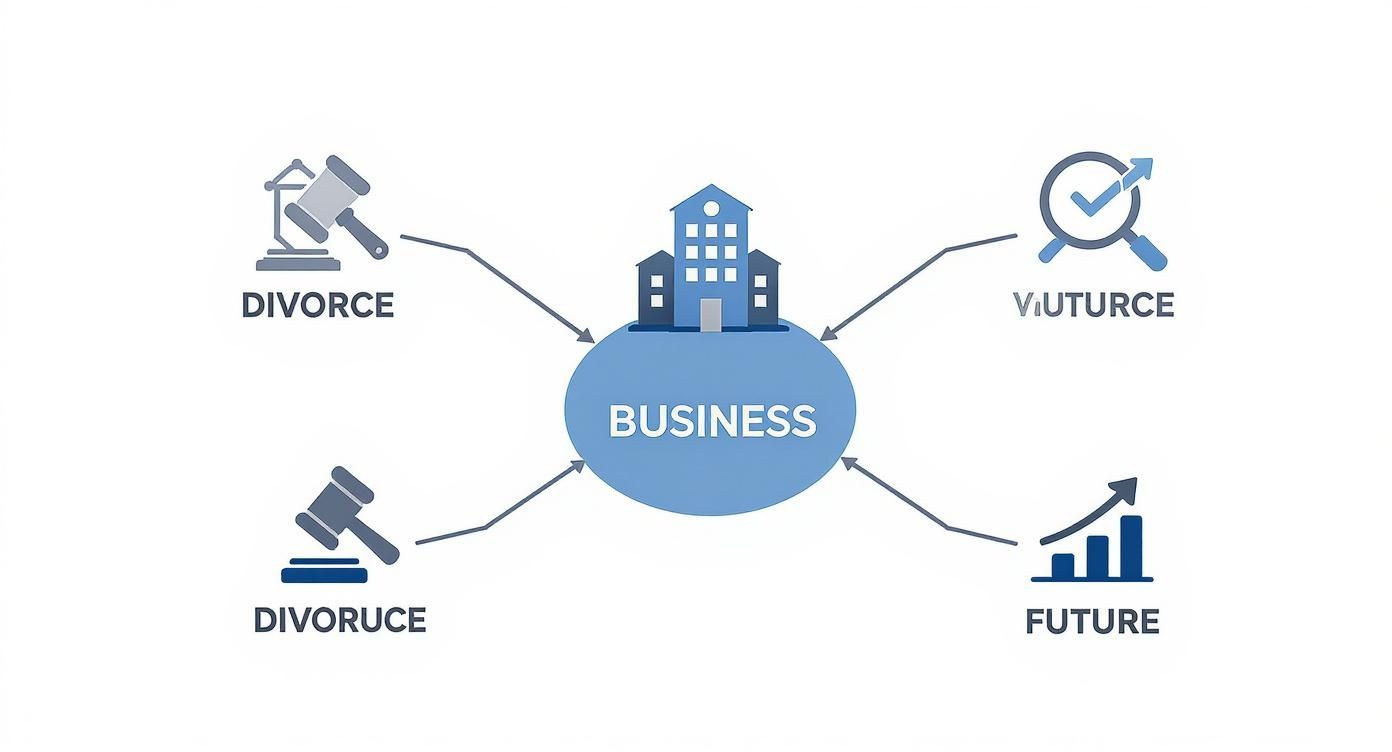
As you can see, your business sits right at the intersection of complex financial and legal crossroads that will shape its future during a divorce.
The Inception of Title Rule
So, how do Texas courts decide if a business is separate or community property? They use a principle called the inception of title rule. Found in the Texas Family Code § 3.001, this rule states that an asset’s character is locked in the moment it is first acquired. The "when" is everything.
Let's walk through a common scenario to see how this plays out.
Imagine you launched a small consulting firm five years before you even met your spouse. On your wedding day, that business was unquestionably your separate property because its "inception of title" predated the marriage. But fast forward through a ten-year marriage where both of you poured your energy into growing the company. Its revenue has tripled, and its value has skyrocketed.
Here's the tricky part: while the original business entity itself remains your separate property, the growth in value that happened during the marriage—thanks to the time, toil, and talent of you or your spouse—is likely community property. This is where the lines get blurry, and a professional valuation becomes non-negotiable. You can learn more about these critical differences in our guide on the essentials of community property in Texas divorces.
Tracing Assets and Reimbursement Claims
When a business is a mix of separate and community property, we have to untangle the finances. This is done through a meticulous process called tracing. A forensic accountant will literally follow the money, creating a clear trail to identify and prove which portion of the business is truly separate property.
This deep dive often uncovers another important concept: reimbursement claims. A reimbursement claim can be filed when one marital estate (like your community funds) has been used to benefit another estate (like your separate property business) without getting anything in return.
For example, if you used money from a joint savings account to buy new equipment for the business you owned before marriage, the community estate might have a claim to be paid back for that contribution.
Why Outside Economic Events Matter
A business's value isn't a fixed number; it's constantly shifting with the tides of the economy. The 2008 recession and the COVID-19 pandemic are perfect examples of how external forces can dramatically alter a company's worth. Years ago, valuations might have leaned heavily on past performance.
Today, a good expert has to account for market volatility and its impact on future profits. They must carefully distinguish between growth that happened because of the owner's hard work (active appreciation) and growth that was simply due to market trends (passive appreciation). This ensures the final valuation is fair and reflects reality.
Grasping these legal principles is the foundation for a fair business valuation in divorce. It sets the rules of the game, defining exactly what is being valued and divided so the final outcome is just and equitable under Texas law.
The Three Core Methods for Valuing a Business

Figuring out what a business is worth during a divorce isn't just guesswork. It’s a methodical process, grounded in solid financial principles. Think of it like a detective building a case—each valuation method offers a different piece of evidence to help prove the business's true value.
In Texas courts, valuation experts almost always use one or a combination of three main approaches to land on a number that's both fair and defensible. Getting a handle on these methods will help you make sense of the conversations with your attorney and expert, and you'll be able to follow along as they build their analysis.
The Asset-Based Approach
The most direct and easiest to grasp is the Asset-Based Approach. It’s pretty much what it sounds like. Imagine you're taking a full inventory of everything the company owns. You’d tally up all the tangible assets—real estate, equipment, company cars, cash in the bank—and then subtract all its liabilities, like business loans and outstanding debts.
What’s left is the business's net asset value. This method is a great fit for businesses whose value is primarily tied up in physical things, like a real estate holding company or a manufacturing plant loaded with heavy machinery.
The biggest drawback, though, is that this approach often fails to capture the value of intangible assets. Things like a stellar brand reputation, a loyal customer base, or proprietary software don’t show up on a balance sheet but can be incredibly valuable.
The Market-Based Approach
Next up is the Market-Based Approach, which works on a principle we can all relate to: a business is worth what someone else has recently paid for a similar one. It’s the exact same logic a real estate agent uses when they pull "comps" to price your house by looking at what similar homes in your neighborhood have sold for.
With this method, a valuation expert digs into recent sales of businesses in the same industry, of a similar size, and in a comparable geographic area. They analyze these deals to find a relevant pricing multiple—like a multiple of revenue or earnings—and then apply it to your business.
This approach is rock-solid when there's good, clean data on comparable sales. The real challenge pops up for unique or highly specialized businesses where finding a true "apples-to-apples" comparison is next to impossible.
The Income-Based Approach
Finally, we have the Income-Based Approach. This method looks at the business as an investment. Its value isn't just about what it owns or what similar companies have sold for, but its power to generate profits in the future. The fundamental question it answers is: What is the present-day value of all the income this business is likely to produce down the road?
Experts use sophisticated techniques like the Discounted Cash Flow (DCF) method to project future earnings and then discount them back to today's value, which accounts for the risks involved. This approach is often the go-to for service businesses—think law firms, medical practices, or consulting agencies—where the primary driver of value is consistent, predictable cash flow.
To make these concepts a bit clearer, let's break them down in a simple table.
Comparing Business Valuation Methods
This table provides a simple comparison of the three primary business valuation methods used in Texas divorce cases, helping you understand what each one focuses on and when it is most commonly used.
| Valuation Method | What It Measures | Best For |
|---|---|---|
| Asset-Based Approach | The net value of a company's assets minus its liabilities (Assets – Liabilities = Value). | Businesses rich in tangible assets, like real estate holding companies or manufacturing. |
| Market-Based Approach | The value of similar businesses that have recently been sold ("comps"). | Industries with frequent, well-documented sales, providing reliable comparison data. |
| Income-Based Approach | The business's ability to generate future income and cash flow. | Service-based businesses or those with strong, predictable earnings, like professional practices. |
Each method provides a different lens through which to view the business's value, and a skilled expert knows how to choose the right one for the job.
The complexity of these methods underscores why a professional, objective valuation is so critical. In divorce proceedings, where emotions run high, having a trustworthy, data-driven assessment helps reduce disputes and provides the court with a solid foundation for an equitable settlement.
The process of a business valuation in divorce can become a major point of contention, because getting the number right is essential for a fair split of the marital estate. With so many couples having business interests, precision is everything. Experts often use the asset, market, and income methods in combination to cross-check their conclusions and build a more bulletproof valuation. This multi-pronged strategy is a powerful way to counter any attempts to lowball or inflate the business's value, pushing for a more just outcome. For a deeper dive, you can explore the importance of a strong business valuation in divorce proceedings.
At the end of the day, a true valuation professional won't just pick one method and call it a day. They will carefully consider the specific nature of your business, the industry it's in, and the state of its financial records. More often than not, they’ll use a blend of these approaches to triangulate a final, well-supported opinion of value that can hold up under the intense scrutiny of a Texas courtroom.
How Experts Uncover the True Value of Your Business

A business’s tax return or profit and loss statement rarely tells the whole story, especially when you’re in the middle of a divorce. This is where a valuation expert, often a forensic accountant, becomes an essential part of your team. Their job is to be a financial detective, digging deeper than the numbers on the page to find out what the company is really worth.
This isn’t about pointing fingers or accusing anyone of hiding money. It’s simply a necessary step to make sure the final property division is fair. By painting an accurate and objective financial picture, we can work toward a settlement that is truly "just and right," just as Texas law requires.
Normalizing Earnings: What It Really Means
One of the first things an expert will do is a process called "normalizing" earnings. Think of it like a mechanic tuning up an engine to see its true performance potential. The goal here is to adjust the company’s stated profits to reflect what it can actually, sustainably earn.
Many small business owners, for perfectly legitimate tax reasons, run personal expenses through the company. While that's fine for the IRS, it can make the business look less profitable than it is. Normalization is the process of adding those personal expenses back into the income statement.
Some of the most common "add-backs" we see include:
- Personal Vehicle Payments: The business pays for a car that’s used for both personal errands and company business.
- Family Salaries: Payments are made to a spouse or a child who isn’t actually doing substantial work for the company.
- Personal Travel and Entertainment: That "business trip" was really a family vacation, or those "client dinners" were personal meals.
- Discretionary Spending: Things like personal country club memberships or life insurance policies paid for by the business.
By adding these items back, the expert gets to the real cash flow the business generates. This number is the bedrock for an accurate business valuation in divorce.
Goodwill: The Difference Between Personal and Enterprise
Another concept that can get tricky is goodwill. This is the intangible value a business has beyond its desks, computers, and inventory. It’s the reason the phone keeps ringing—things like a stellar brand reputation, a loyal customer base, and your own professional standing in the community.
In a Texas divorce, the courts are very specific about separating two distinct types of goodwill:
- Personal Goodwill: This is the value that is tied directly to you. It comes from your unique skills, your personal reputation, and the relationships you’ve built. If you left the business, this value would probably walk right out the door with you. In Texas, personal goodwill is not a marital asset and cannot be divided in a divorce.
- Enterprise Goodwill: This value belongs to the business itself, no matter who is running it. It’s created by things like a well-known brand name, a fantastic location, or unique company processes. Because it’s an asset of the business, enterprise goodwill is a marital asset and is subject to division.
A skilled valuation expert will spend a lot of time carefully separating these two types of goodwill. This is often one of the most hotly contested parts of a business valuation, and getting it right is absolutely critical to protecting your separate property while still ensuring a fair division of the community asset.
The process is a deep financial investigation, and it’s especially crucial when the business is a major part of the marital estate. Valuation experts typically look at after-tax income over a 3- to 5-year historical period to figure out the normalized earnings and sustainable cash flow. When personal expenses run through the business aren't added back, they can inflate costs and make the company appear less valuable, which is why a thorough forensic review is so important. You can discover more insights on how divorce impacts business valuations.
Preparing for the Discovery Process
To do their job right, a valuation expert needs a mountain of financial documents. This happens during the formal "discovery" phase of your divorce, and being prepared can make the entire process smoother and less expensive.
You can get a head start by beginning to gather these key documents now:
- Business Tax Returns: Federal income tax returns for the last five years.
- Financial Statements: Profit and loss statements, balance sheets, and cash flow statements, also for the last five years.
- Bank and Credit Card Statements: Pull statements for all business and personal accounts for at least the past three years.
- General Ledgers: This gives the expert a detailed, line-by-line breakdown of every transaction.
- Loan Documents: Any paperwork related to outstanding business debts or lines of credit.
- Key Agreements: Things like partnership agreements, buy-sell agreements, and contracts with major customers.
Having these documents organized and ready to go will save time and money. It also shows transparency, which can help lower the temperature and build a foundation for a more reasonable negotiation. Taking these proactive steps empowers you and your legal team to build a strong, evidence-based case for a fair outcome.
Common Valuation Disputes and How to Prepare
Let's be realistic: even with the best experts and intentions, valuing a business during a divorce is rarely a smooth, conflict-free process. Disagreements aren't just common; they're practically expected. Knowing where the friction points are likely to be can save you an incredible amount of time, money, and heartache.
Being prepared for these arguments allows you and our team to build a proactive strategy. It’s about seeing the challenges coming and having the evidence ready to back up your position, ensuring the final number is as fair and accurate as possible.
The Battle Over the Valuation Date
One of the most frequent fights is over the valuation date—the specific "snapshot" day on which the business's value is calculated. This single date is a huge deal because a company's worth can swing wildly in a short amount of time due to market shifts, a big new contract, or even a sudden economic downturn.
Under the Texas Family Code, the default is to value property as of the date of the divorce trial. However, spouses can agree to a different date, like the day you separated. You can bet one spouse might push for a date when the business was in a slump to argue for a lower value, while the other will point to a date reflecting peak performance. Your attorney's job is to argue for a valuation date that truly reflects the business's real, ongoing value.
Disagreements on Goodwill
As we've touched on, untangling personal goodwill from enterprise goodwill is a critical—and often heated—step. The spouse who runs the business will likely argue that most of the company's success is tied directly to their personal skills, reputation, and client relationships (personal goodwill), which is their separate property and shouldn't be divided.
On the other side, the other spouse will argue that the business has built up significant brand value, solid operational systems, and a loyal customer base that would stick around even if the owner-spouse left. This is enterprise goodwill, a community asset that absolutely needs to be part of the marital estate. This is where a forensic expert becomes essential; they provide an objective analysis of what truly drives the business's success.
Suspicions of Devaluation
Unfortunately, it’s not unheard of for a business-owning spouse to actively try to make the business look less valuable on paper during a divorce. A sharp legal and financial team knows exactly what red flags to hunt for.
Some of the common tactics we see include:
- Delaying new contracts or holding off on closing major client deals until after the divorce is final.
- Inflating expenses by pre-paying for a year's worth of services or making big, unnecessary purchases.
- Taking on sudden, large debts that sink the company's net worth.
- Paying unusually large bonuses or salaries to family members or friends on the payroll.
An experienced forensic accountant can spot these games a mile away. They do it by comparing financial records from the years before the divorce to the period during the divorce. A sudden nosedive in revenue or a sharp spike in expenses without a legitimate business reason is a massive warning sign that demands immediate investigation.
Before we move on, it's crucial to gather the right documents. A thorough valuation is built on a foundation of solid financial evidence. Below is a checklist of the typical documents your attorney and valuation expert will need to get started. Having these ready will make the process much smoother and more efficient.
Preparing for Your Business Valuation: A Document Checklist
| Document Category | Specific Examples | Why It's Important |
|---|---|---|
| Corporate & Legal Docs | Articles of Incorporation, Bylaws, Partnership Agreements, Shareholder Agreements, Meeting Minutes | Establishes ownership structure, control, and any restrictions on transferring business interests. |
| Tax Returns | Business tax returns (Federal & State) for the past 5 years (Forms 1120, 1120S, 1065) | Provides a detailed history of revenue, expenses, and profitability as reported to the IRS. |
| Financial Statements | Income Statements (P&L), Balance Sheets, Cash Flow Statements for the past 5 years (audited if available) | Gives a comprehensive picture of the company's financial health, assets, liabilities, and performance over time. |
| Key Operational Records | General Ledger, Bank Statements, Accounts Receivable/Payable Aging Reports, Payroll Records, Major Contracts | Offers a real-time look at the day-to-day financial activities and obligations of the business. |
| Asset & Debt Info | Lists of equipment, real estate, and inventory; Loan agreements, lines of credit, and other debt instruments | Helps determine the tangible value of the business (Asset Approach) and its overall financial obligations. |
| Sales & Marketing Info | Customer lists, sales forecasts, marketing plans, industry and competitor analysis | Provides context for the company's market position and future earning potential (Income Approach). |
Having these documents organized and ready to go is one of the most powerful steps you can take. It shows you're prepared and serious, and it gives your team the ammunition they need to build a strong case from day one.
How to Proactively Prepare for Disputes
The best defense against these valuation fights is a strong offense built on meticulous preparation. In court, vague claims and fuzzy numbers fall apart quickly. A case built on clear, verifiable evidence is the one that stands strong.
Here are the practical steps you can take:
- Maintain Meticulous Records: Keep your financial documents complete and organized. The more transparent and clean your records are, the harder it is for anyone to poke holes in the numbers.
- Work with a Credible Expert: The reputation of your valuation expert is everything. A well-respected professional with deep experience in Texas divorce cases provides an opinion that carries significant weight with a judge.
- Be Transparent in Discovery: When the other side requests information, respond promptly and thoroughly. Hiding documents or being evasive only creates suspicion and can seriously damage your credibility and your case.
- Trust Your Legal Team: Your attorney has been down this road countless times. Lean on their experience to anticipate the arguments, sidestep the traps, and build a powerful, evidence-based strategy that protects your financial future.
Protecting Your Business and Your Future
Figuring out the value of a business in a divorce can feel like navigating a minefield. It’s complicated, no doubt about it, but it’s absolutely a process you can manage when you have the right team of professionals in your corner. Now that you have a clearer picture of the valuation methods and the common disputes that can pop up, you can start focusing on the path forward, armed with the knowledge to protect what you’ve worked so hard to build.
This process calls for you to be proactive, not reactive. Start gathering those key financial documents we talked about earlier. Just as important, avoid making any sudden, major financial decisions within the business—things that could easily be misinterpreted by your spouse’s side. In these situations, transparency and preparation are your best friends.
Taking Control of Your Next Steps
One of the most powerful ways to protect your business is through smart legal planning, sometimes long before a divorce is even a possibility. For instance, knowing how a buy-sell agreement can affect a valuation provides a lot of clarity and can prevent future headaches. To get ahead of potential divorce proceedings, it’s also a good idea to start understanding prenuptial agreements and how they can be used as a protective shield. These legal documents can spell out exactly how business assets will be handled, which can save you an incredible amount of time and stress down the road. You can learn more by reading about how a buy-sell agreement will impact the valuation of a business in a Texas divorce.
Protecting your business is about more than just the bottom line; it's about securing your livelihood and your future. The single most important first step you can take is to seek out expert legal counsel early on. This ensures your rights are defended every single step of the way.
The stakes are high, but you don't have to face this challenge on your own. Our team has the experience and the compassion to guide you through every stage, working to ensure the final outcome is both fair and just.
If you need help navigating divorce, custody, or estate planning in Texas, contact The Law Office of Bryan Fagan today for a free consultation.
Frequently Asked Questions About Business Valuation
Going through a business valuation in a divorce kicks up a lot of very specific, real-world questions. We’ve put together some straightforward answers to the most common concerns we hear from our clients. While this should help clear up some of the fog, remember that every single case has its own unique twists and turns.
What Happens If My Spouse and I Disagree on the Business Value?
It's not just common to disagree on the value—it's almost expected. When this happens, the typical path forward involves each of you hiring your own valuation expert. Each expert will then prepare their own independent report, and you'll likely end up with two different numbers.
If those numbers are miles apart, the first step is for your attorneys to try and negotiate a resolution. Maybe you meet in the middle, or perhaps there's another creative way to bridge the gap. If you just can't find common ground, both experts will probably have to testify in court. A judge will then listen to both sides, dig into the evidence and the methods they used, and make the final call on the business's value for dividing the marital estate.
Does My Spouse Get Half of the Business I Started Before Marriage?
Not necessarily. Under the Texas Family Code, a business you owned before you said "I do" is considered your separate property. The core of that business, as it existed on your wedding day, remains yours alone.
Here's the catch, though: any growth in the business's value that happened during the marriage is often considered community property, especially if that growth was due to the time, effort, or money from either spouse. This is where a forensic expert becomes indispensable. Their job is to trace the assets and pinpoint exactly what portion of that increase is community property and subject to a "just and right" division.
Will I Be Forced to Sell the Business in the Divorce?
Selling the business is almost always a last-ditch effort in the eyes of a Texas court. Judges really prefer not to break up a successful, operating company if they can help it. The much more common solution is for one spouse to buy out the other's share of the community property interest in the business.
This buyout can happen in a few different ways:
- A Lump-Sum Payment: You might use other community assets, like savings or investment accounts, to pay for your spouse's share.
- A Structured Payout: Payments can be made over a set period, which can be easier on cash flow.
- An Asset Offset: You could trade the business interest for another major asset. For instance, you keep the business, and your spouse gets the family home or a larger portion of the retirement accounts.
How Much Does a Business Valuation for a Divorce Cost?
The cost of a business valuation in divorce can swing pretty wildly. The final price tag really depends on the business's size, how tangled its finances are, and frankly, how organized the financial records are. For a small, straightforward local business, a valuation might run a few thousand dollars.
On the other hand, if we're talking about a larger company with multiple locations, complicated revenue streams, or sloppy bookkeeping, the cost could easily climb into the tens of thousands. While it's a serious expense, think of it as a critical investment. Getting an accurate number is the only way to ensure a fair and equitable division of what is often the most valuable asset in the marriage.
If you need help navigating divorce, custody, or estate planning in Texas, contact The Law Office of Bryan Fagan today for a free consultation.